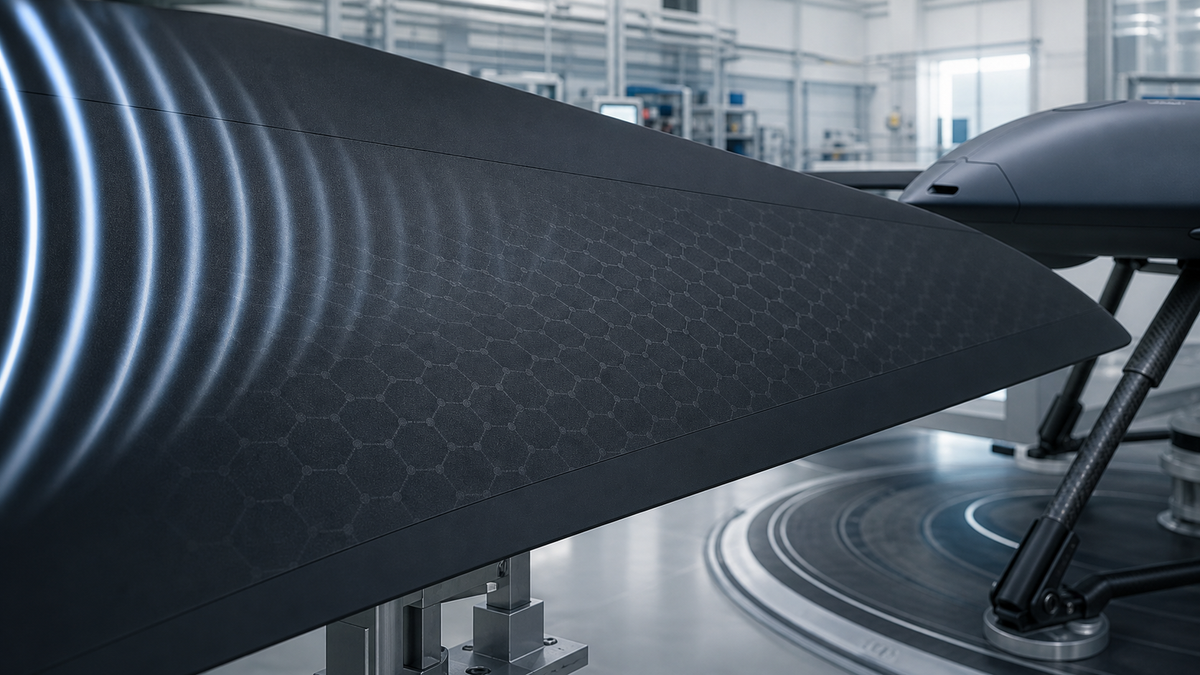
Graphene radar absorbing materials are attracting attention in aerospace because they offer a rare combination of low weight, high electrical conductivity, thermal stability, and compatibility with coatings and composites. For aircraft and drones, where every gram and every millimeter matters, those properties make graphene an interesting ingredient in next-generation radar absorbing coatings.
The goal is not to make a platform "invisible." Radar absorption is more practical than that. A radar absorbing material, or RAM, is designed to reduce the amount of electromagnetic energy that reflects back toward a radar receiver. In aircraft and unmanned aerial systems, that can support lower detectability, reduced electromagnetic interference, and better control over how a surface interacts with radio-frequency energy.
Graphene is not a magic stealth paint. It must be engineered into the right coating stack, polymer matrix, surface geometry, or composite structure. But when it is used correctly, graphene can help create thinner, lighter, and more durable radar absorbing systems than many conventional filler-heavy approaches.
Why Radar Absorbing Materials Matter
Radar works by transmitting electromagnetic waves and measuring the energy that returns from an object. A surface with high reflection sends more energy back. A surface with better absorption, scattering control, or impedance matching sends less useful energy back.
Traditional radar absorbing materials often use carbon black, ferrites, magnetic particles, conductive polymers, carbon nanotubes, or layered composite structures. These materials can work well, but they often come with tradeoffs:
- added weight
- thicker coating layers
- narrow-band absorption
- reduced mechanical durability
- processing complexity
- heat and environmental aging concerns
Those tradeoffs matter in aerospace. A fighter aircraft, high-altitude platform, or drone has limited tolerance for extra mass. A small drone has even less margin. A coating that performs well in the lab but adds too much weight, cracks during vibration, or fails under temperature cycling is not useful in the field.
That is where graphene becomes interesting. Because graphene-based materials can provide strong electromagnetic interaction at low loading levels, they may help reduce the amount of filler needed in a coating or composite.
What Makes Graphene Useful for Radar Absorption
Graphene is a two-dimensional carbon material with excellent electrical conductivity and a very high surface area. In radar absorbing systems, those properties can contribute to several useful mechanisms.
First, graphene can create conductive networks inside a polymer or coating. When electromagnetic waves interact with those networks, part of the energy can be dissipated as heat through dielectric loss and conductive loss.
Second, graphene sheets can form layered pathways that increase the distance electromagnetic waves travel inside the material. Instead of reflecting cleanly off the surface, the incoming wave can experience multiple internal reflections and scattering events.
Third, graphene can help with impedance matching. A good radar absorber does not simply block the wave at the surface. If the surface is too conductive, it may behave more like a mirror. The absorber must allow energy to enter the material and then dissipate it internally. Graphene's conductivity can be tuned through loading level, flake structure, oxidation state, hybridization, and coating design.
Fourth, graphene is lightweight. This is one of its most important aerospace advantages. Small amounts of graphene nanoplatelets, graphene oxide, reduced graphene oxide, or graphene hybrid fillers can influence electrical and electromagnetic behavior without turning the coating into a heavy layer.
Graphene Coatings for Aircraft Surfaces
For aircraft, graphene radar absorbing coatings are usually discussed as part of a multilayer surface system. A practical aerospace coating must do more than absorb radar energy. It also has to survive ultraviolet exposure, rain erosion, temperature swings, fuel and oil contact, vibration, and maintenance handling.
Graphene can contribute to these coating systems in several ways:
- as a conductive nanofiller in epoxy, polyurethane, or other aerospace coatings
- as part of a hybrid absorber with magnetic particles or ceramic fillers
- as a thin electromagnetic loss layer in a multilayer stack
- as a reinforcement additive that improves mechanical toughness
- as a thermal spreading component that helps manage localized heating
The most promising designs are usually hybrid systems. Graphene provides dielectric and conductive loss, while magnetic particles or other fillers can add magnetic loss. When these mechanisms are balanced, the material can absorb across a broader range of radar frequencies than a single-component material.
For aircraft, thickness is a serious constraint. A thick absorber may be effective, but it can interfere with aerodynamics, weight targets, and maintenance. Graphene's value is strongest when it helps reduce thickness or weight while maintaining useful electromagnetic performance.
Why Drones Are a Strong Use Case
Drones are an especially interesting platform for graphene radar absorbing materials because they are weight-sensitive, often made from polymer composites, and may have more flexible manufacturing pathways than traditional aircraft.
Small unmanned aerial vehicles do not have much room for heavy ferrite-based materials or thick multilayer absorbers. Their frames, skins, propeller systems, and sensor housings are usually designed around low mass and manufacturability. A sprayable or printable graphene-enhanced coating could be attractive because it may be applied to composite surfaces without completely redesigning the airframe.
Potential drone-related uses include:
- radar absorbing exterior coatings
- electromagnetic shielding around onboard electronics
- conductive composite skins
- lightweight radomes and sensor housings
- coatings that combine radar absorption with corrosion or weather protection
The commercial path for drones may also move faster than for crewed aircraft. Testing requirements are still serious, especially for defense and aerospace systems, but smaller platforms can sometimes accept faster iteration in materials, coatings, and component-level validation.
Graphene Alone Is Usually Not Enough
One of the most important points about graphene in radar absorbing materials is that graphene alone is rarely the complete answer.
A highly conductive surface can reflect electromagnetic waves instead of absorbing them. Too little graphene may not create enough loss. Too much graphene can cause agglomeration, poor dispersion, brittle coatings, processing problems, or unwanted surface reflectivity.
The performance depends on:
- graphene type and quality
- flake size and number of layers
- oxidation or reduction level
- dispersion in the polymer matrix
- coating thickness
- filler loading
- surface roughness and internal structure
- combination with magnetic or dielectric additives
- target frequency range
This is why responsible claims matter. A graphene coating may show strong radar absorption under specific laboratory conditions, but that does not automatically mean it will perform the same way on a full aircraft or drone. Real platforms involve curved surfaces, seams, fasteners, temperature gradients, weathering, and manufacturing variation.
Hybrid Graphene Radar Absorbing Materials
The most practical graphene RAM systems are often composites. Researchers and manufacturers combine graphene with other materials to create multiple loss pathways and better impedance matching.
Common hybrid approaches include:
- graphene with ferrite or iron-based magnetic particles
- graphene with carbon nanotubes or carbon fibers
- graphene oxide or reduced graphene oxide in polymer coatings
- graphene aerogels or foams for lightweight porous absorbers
- graphene with ceramic particles for thermal and environmental stability
- multilayer coatings with controlled conductivity gradients
These designs can be tuned so the incoming electromagnetic wave enters the surface instead of bouncing off it. Once inside, the material converts a portion of the energy into heat through dielectric loss, conductive loss, magnetic loss, interfacial polarization, and internal scattering.
For aerospace, the challenge is not just achieving a strong absorption number in one test. The challenge is building a coating that is repeatable, repairable, durable, and compatible with existing manufacturing.
Manufacturing Considerations
Graphene radar absorbing coatings can be made through several routes, depending on the application and performance target.
Spray coatings are attractive because they fit existing aircraft and drone coating processes. Graphene can be dispersed into a resin or coating formulation and applied to complex shapes. The challenge is maintaining uniform dispersion and thickness across the surface.
Composite layups are another route. Graphene can be introduced into fiber-reinforced polymers, interlayers, or resin systems. This approach may be useful when the radar absorbing function needs to be built directly into the structure instead of applied as a separate paint layer.
Printing and patterning methods are also interesting for smaller platforms and specialized components. These methods may allow local control of conductivity and absorption behavior across a surface.
For any of these routes, quality control is critical. Graphene materials vary widely by supplier and production method. Few-layer graphene, graphene nanoplatelets, graphene oxide, and reduced graphene oxide can behave very differently. A coating recipe that works with one material may not work with another.
Benefits Beyond Radar Absorption
Graphene coatings can offer secondary benefits that matter in aerospace.
Depending on the formulation, graphene may improve:
- electrical conductivity
- electrostatic discharge protection
- electromagnetic interference shielding
- corrosion resistance
- thermal spreading
- mechanical toughness
- barrier performance against moisture and gases
This multifunctionality is commercially important. A coating that only provides radar absorption may be hard to justify unless the performance is exceptional. A coating that also improves durability, EMI control, and environmental resistance has a stronger value proposition.
For drones, multifunctionality is especially valuable because the platform has limited room for separate layers and separate systems. A single coating that helps with electromagnetic behavior and environmental protection can simplify design.
Limits and Challenges
Graphene radar absorbing materials still face real barriers before broad aerospace adoption.
The first challenge is consistency. Graphene materials are not all the same, and coating performance depends heavily on the structure of the graphene filler.
The second challenge is dispersion. Graphene sheets tend to stack or agglomerate. Poor dispersion creates weak spots, inconsistent conductivity, and reduced electromagnetic performance.
The third challenge is durability. Aircraft and drones experience rain, sand, vibration, ultraviolet light, thermal cycling, and mechanical abrasion. A radar absorbing coating must survive these conditions without losing adhesion or changing its electrical behavior too much.
The fourth challenge is verification. Radar absorption is frequency-dependent, angle-dependent, and geometry-dependent. A material may perform well in a flat-panel laboratory test but differently on a real airframe.
The fifth challenge is cost. Graphene can be cost-effective at low loading levels, but high-quality materials and controlled processing still need to compete with established carbon and magnetic fillers.
Future Outlook
The future of graphene in radar absorbing materials will likely be hybrid, structural, and multifunctional. Instead of simple "graphene paint," the most valuable systems may be engineered coating stacks, composite skins, patterned surfaces, and materials that combine radar absorption with shielding, thermal control, and environmental protection.
For aircraft, the path will be careful and certification-heavy. New materials must prove that they can survive aerospace service conditions and deliver repeatable performance.
For drones, the path may be more flexible. Smaller platforms, faster development cycles, and stronger pressure for lightweight electromagnetic control make drones a natural early market for graphene-enhanced RAM coatings.
The key takeaway is simple: graphene will not make aircraft or drones disappear, but it can help engineers design lighter, thinner, and more capable radar absorbing materials. Used responsibly, it is a serious candidate for the next generation of aerospace coatings and electromagnetic materials.
Further Reading
- Carbon-based radar absorbing materials toward stealth technologies: https://pmc.ncbi.nlm.nih.gov/articles/PMC10646258/
- Multifunctional radar absorbing structures review: https://www.sciopen.com/article/10.26599/NR.2025.94907643
- Graphene in aviation materials research: https://arxiv.org/abs/2209.08977