
Unlocking Quasicrystal Physics in 30-Degree Twisted Bilayer Graphene
Research on 30° quasi-periodic twisted bilayer graphene reveals a unique, fractal-like energy structure under magnetic fields, paving the way for novel...
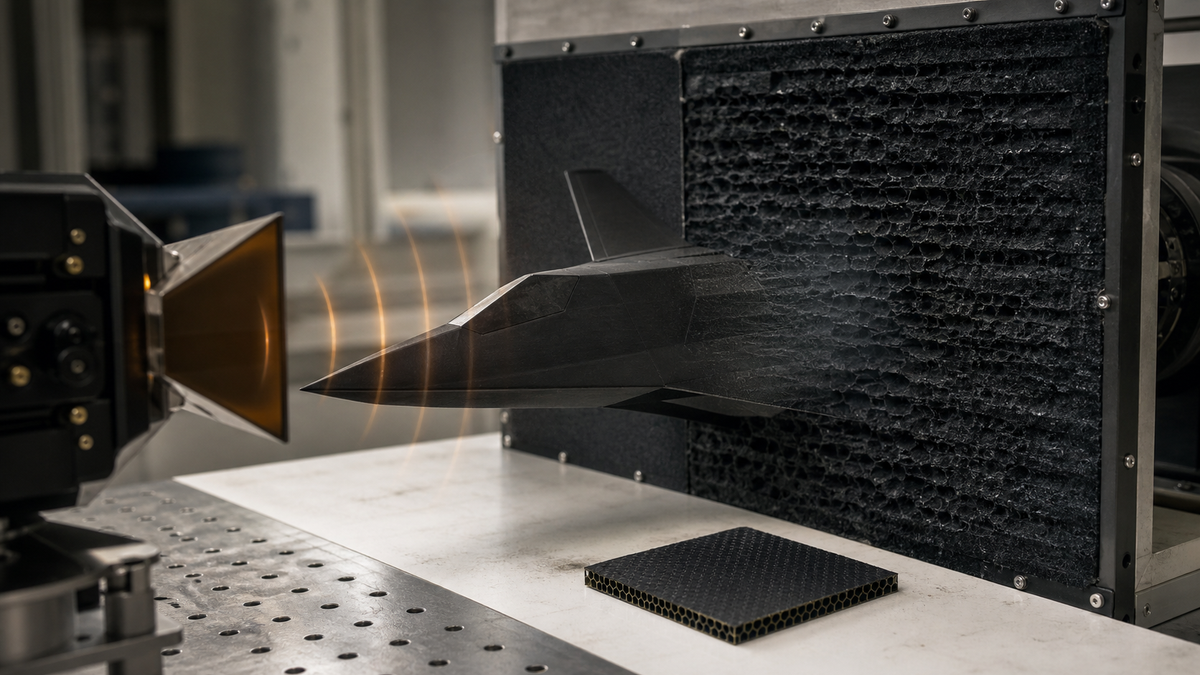
A radar wave does not bounce off every surface in the same way. Some shapes send energy back toward the receiver. Some surfaces scatter it away. Some materials convert part of that electromagnetic energy into heat before it can return. Graphene is interesting because it sits right at the intersection of those three ideas: it is extremely thin, electrically unusual, easy to combine with polymers and carbons, and capable of forming networks that interact with microwave and radio-frequency energy.
That does not mean a sheet of graphene can make an airplane disappear. It means graphene belongs in a serious conversation about radar absorbing materials, electromagnetic interference shielding, lightweight composites, and the long engineering road between a promising lab sample and a flight-qualified aerospace system.
Radar works by sending electromagnetic waves into the environment and listening for the energy that comes back. A strong return can happen when a wave meets a conductive or reflective object with geometry that sends energy back toward the radar. Radar absorbing materials attempt to reduce that returned energy by changing what happens at the surface and inside the material.
At a high level, an absorber needs two things. First, the incoming wave has to enter the material instead of simply reflecting at the surface. Second, once inside, the wave energy has to be dissipated. That loss can come from electrical conduction, polarization effects, magnetic loss, multiple internal reflections, or interfacial effects between different phases of a composite.
This is why the field is not just about one miracle ingredient. Effective absorbers are usually engineered systems. They balance conductivity, impedance, thickness, density, thermal stability, mechanical strength, manufacturability, corrosion behavior, and cost. If one property is pushed too far, another can get worse. A material that is too conductive may behave more like a mirror. A material that absorbs well in one laboratory test may be too fragile, too heavy, too narrowband, or too hard to manufacture at useful scale.
Graphene and related materials such as graphene oxide, reduced graphene oxide, graphene nanoplatelets, and laser-induced graphene attract radar absorption interest because they give engineers several knobs to turn. Carbon networks can conduct electricity. Defects and functional groups can create polarization sites. Layered flakes can create many interfaces inside a polymer or ceramic matrix. Porous graphene structures can trap waves through repeated scattering paths. Hybrid materials can combine graphene with magnetic particles, foams, elastomers, or fibers.
A useful way to think about graphene is not as a magic stealth coating, but as a tunable loss component. In a composite, graphene can help create pathways where induced currents form and dissipate energy. It can also increase the number of internal boundaries where charges accumulate and relax under an alternating electromagnetic field. The same large surface area that makes graphene interesting for sensors, batteries, and membranes also matters here because more interface means more places for electromagnetic energy to interact with matter.
The catch is that graphene's advantages are very sensitive to structure. Flake size, oxidation level, defects, dispersion quality, orientation, porosity, and matrix chemistry all change the result. Poorly dispersed graphene can clump and create inconsistent behavior. Overloading a polymer can damage mechanical properties or create excessive reflection. The best research treats graphene as part of a designed microstructure, not as a powder sprinkled into a resin with guaranteed results.
Many graphene headlines blur two different ideas: electromagnetic shielding and radar absorption. Shielding can mean blocking electromagnetic interference from reaching a device or escaping from it. A conductive enclosure, film, gasket, coating, or composite can shield by reflecting or absorbing energy. That is useful for electronics, vehicles, cables, sensors, aircraft systems, and data center equipment.
Radar absorption is more specific. The goal is not merely to block radiation, but to reduce the energy that returns in a detectable way. A shiny metal plate may be an excellent shield and still be a poor absorber because it reflects strongly. A good radar absorbing material tries to avoid behaving like a simple mirror.
This distinction matters for graphene suppliers and product developers. A customer asking for EMI shielding tape, enclosure coating, battery pack shielding, or sensor protection may need conductivity and coverage. A customer asking about radar absorbing composites is asking for a much harder system-level problem, especially if the environment includes weather, heat, vibration, fuel exposure, impact, maintenance cycles, and certification.
The phrase hidden airplanes in the air sounds dramatic, but real stealth is not a coating trick. Aircraft observability is affected by shape, edges, cavities, inlets, fasteners, surface finish, emissions, heat, mission profile, maintenance condition, radar frequency, viewing angle, sensor fusion, and operating context. Materials can help, but they are one part of a much larger design discipline.
Graphene-based absorbers may be relevant to aerospace research because weight matters. Traditional absorbers can add mass, and aircraft structures already fight every gram. Carbon-based materials offer a tempting route toward lighter multifunctional surfaces: a composite that provides mechanical strength, lightning-strike management, EMI shielding, thermal spreading, and some electromagnetic loss would be far more valuable than a coating that only works in a narrow test condition.
But there is a large gap between a laboratory coupon and an aircraft surface. A flight article must survive rain erosion, ultraviolet exposure, temperature cycling, repairs, cleaning chemicals, lightning events, structural loading, and manufacturing variability. It must also keep performing after years of service. For graphene, the hard questions are not only electromagnetic. They are industrial: Can it be dispersed repeatably? Can the coating be applied over large curved surfaces? Can repairs be made consistently? Can quality control detect hidden defects? Can the supply chain deliver the same material batch after batch?
The near-term commercial opportunities are likely broader than stealth aircraft. Graphene-enhanced electromagnetic materials can be useful in electronics housings, antenna-adjacent components, automotive radar management, drone materials, satellite electronics, test chambers, wearable devices, medical equipment shielding, and industrial sensors. These markets often need lighter, thinner, corrosion-resistant, or more flexible materials that manage electromagnetic noise.
For example, an electric vehicle contains high-power electronics, sensors, battery modules, communications systems, and radar. Managing electromagnetic interference is a practical engineering problem, not a science fiction one. A graphene composite that helps control stray electromagnetic energy while also supporting thermal or mechanical requirements could have value even if it has nothing to do with making anything invisible.
Industrial test equipment is another good fit. Radar and microwave labs use absorbing materials to line chambers, reduce reflections, and isolate measurements. In that setting, engineers can evaluate performance under controlled conditions and compare graphene-based absorbers against established foams, ferrites, carbon blacks, and hybrid composites. That kind of environment is where material claims can become measurable product data.
Recent reviews of carbon-based radar absorbing materials describe a broad design space that includes graphene, carbon nanotubes, carbon fibers, foams, aerogels, and hybrid composites. The common theme is that carbon materials can offer low density, corrosion resistance, processability, and tunable electrical behavior. Reviews of graphene-based electromagnetic interference shielding also emphasize the importance of combining conductivity with architecture, because real performance depends on how sheets, pores, fillers, and interfaces are arranged.
Recent work on laser-induced graphene and other engineered carbon surfaces is especially interesting because it points toward patterning and scalable processing. Instead of relying only on mixing powders into a polymer, researchers can create porous conductive carbon directly on a substrate surface. That could matter for coatings, sensors, flexible electronics, and specialized absorber surfaces. Still, these are research directions, not proof that any single graphene process is ready for aircraft stealth deployment.
The most important lesson is that electromagnetic absorption is a structure-property problem. The chemistry matters, but so does geometry. The filler matters, but so does the host material. The lab result matters, but so does environmental durability. A serious buyer should ask for test method, sample geometry, frequency range, thickness, density, mechanical data, aging data, and repeatability before treating any graphene absorber claim as commercially meaningful.
Graphene can be part of the answer when the question is electromagnetic wave management. It may help build lighter absorbing composites, better EMI shielding systems, multifunctional aerospace materials, and more compact test-lab components. The practical path is not to ask whether graphene hides airplanes. The better question is: what electromagnetic problem needs solving, under what operating conditions, and what other mechanical or manufacturing requirements must the material satisfy at the same time?
If the target is a grounded industrial product, the first step is usually a sample-level study. Compare graphene loading, dispersion quality, resin compatibility, surface finish, mechanical strength, and electromagnetic behavior against a known baseline. If the target is aerospace, the bar is much higher. The material must be judged as part of a certified system, not as an isolated powder property.
Graphene's promise is real, but it is not magic. It gives materials engineers more control over conductivity, interfaces, and lightweight carbon architecture. In radar absorption and electromagnetic shielding, that control can be valuable. The companies that win will be the ones that turn it into repeatable products, measured data, and durable manufacturing processes.
Carbon-based radar absorbing materials review: https://pmc.ncbi.nlm.nih.gov/articles/PMC10646258/
Graphene-based electromagnetic interference shielding review: https://academic.oup.com/ooms/article/3/1/itac012/6865040
Laser-induced graphene stealth materials study: https://www.mdpi.com/2079-4991/15/8/623
Metasurface composite electromagnetic materials example: https://www.nature.com/articles/s41467-025-66317-3
Serious about B2B integration? Test our premium Pulsed Electrical Resistive Carbon Heating turbostratic graphene in your lab. 100g sample packs available now.
Explore More
Research on 30° quasi-periodic twisted bilayer graphene reveals a unique, fractal-like energy structure under magnetic fields, paving the way for novel...

Researchers discover naturally formed graphene sheets and carbon ovals in stingless bee hives, creating a novel emergent material with powerful blue light...

Discover how rippled graphene pores act as fluidic memristors, enabling advanced synaptic functionalities for the next generation of neuromorphic computing.