
Rippled Graphene Pores for Neuromorphic Fluidic Memristive Devices
Discover how rippled graphene pores act as fluidic memristors, enabling advanced synaptic functionalities for the next generation of neuromorphic computing.
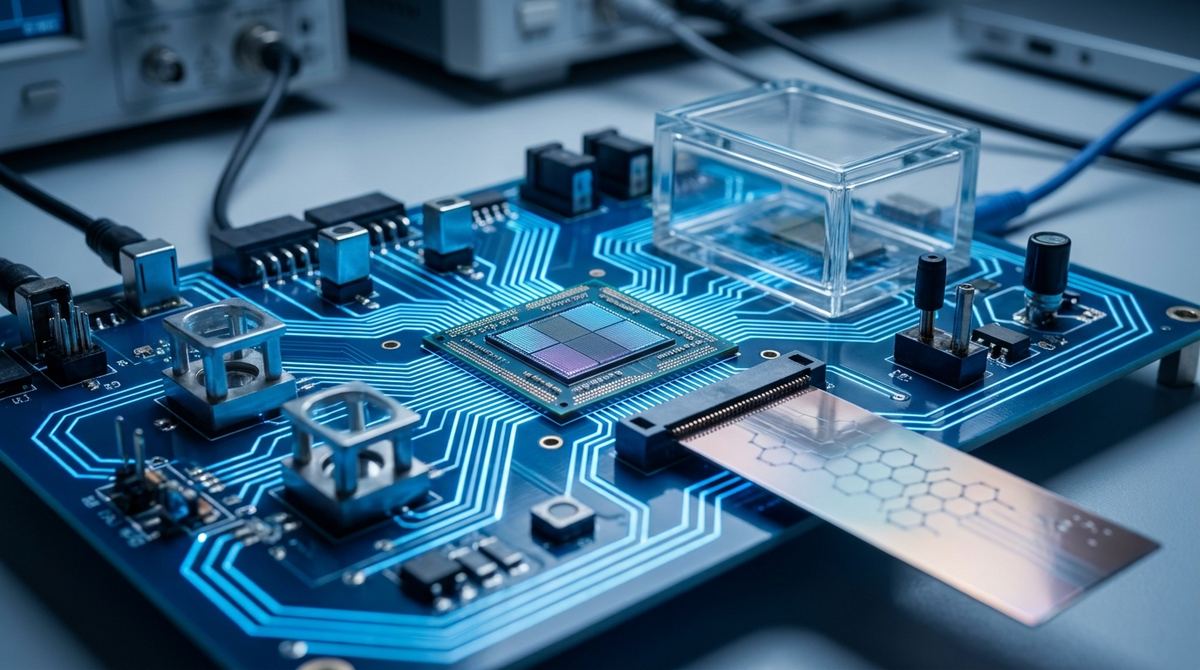
As DRAM technology scales down to smaller process nodes, the physical proximity of memory cells creates a significant security vulnerability known as Rowhammer. This phenomenon occurs when repeated, rapid activations of a specific row (the aggressor) cause electromagnetic interference that leaks charge from adjacent rows (the victims). If enough charge leaks before the next refresh cycle, a bit flip occurs, potentially leading to privilege escalation or system crashes.
To combat this, researchers and manufacturers have developed various mitigation techniques. One of the most prominent, referred to in recent literature as Graphene, relies on a simple activation-count tracking mechanism. The logic is straightforward: the memory controller tracks how many times each row is activated. Once a row reaches a predefined threshold, the controller issues a refresh to the neighboring rows to prevent bit flips.
While Graphene provides a baseline level of security, it is fundamentally a blunt instrument. Because it relies on simple activation counts, it often triggers unnecessary refreshes on rows that are being accessed frequently but are not actually at risk of a bit flip. This leads to increased memory latency and wasted energy, which is a critical concern for high-performance computing and mobile devices.
The core engineering problem with Graphene-style mitigations is the lack of context. A row might be accessed millions of times in a standard workload without any actual vulnerability to bit flips. However, because Graphene only looks at the number of activations, it cannot distinguish between a high-frequency legitimate access pattern and a malicious Rowhammer attack pattern.
This results in a high rate of mitigation-induced refreshes. Every time the controller issues an extra refresh to prevent a potential flip, it blocks the memory bus, increasing the average Last Level Cache (LLC) latency and consuming extra power. For engineers designing low-power embedded systems or high-throughput data center hardware, this inefficiency is unacceptable.
The Rowhammer Vulnerability Counter (RVC) framework, as proposed by Jain and Tavva, shifts the focus from the aggressor to the victim. Instead of asking how many times a row has been accessed, RVC asks how vulnerable a specific row is to a bit flip based on its current state and the surrounding activity.
By evaluating the actual vulnerability of a row rather than just counting activations, RVC can selectively issue refreshes only when a row is on the verge of experiencing a bit flip. This precision allows for a massive reduction in unnecessary refresh operations. According to the research, RVC can achieve a 95% to 99.99% improvement in mitigation-induced refreshes compared to Graphene, while simultaneously reducing LLC latency by up to 76.91%.
For hardware engineers, security researchers, or startup teams working on custom SoC (System on Chip) designs, implementing an RVC-style logic in a memory controller is a high-value project. This guide outlines how to build a prototype testbed to implement and validate RVC logic.
To build this prototype, you will need a platform that allows for low-level control over memory command timing and interception.
1. FPGA Development Board: A Xilinx Artix-7 or Zynq UltraScale+ MPSoC is ideal. The FPGA allows you to implement custom logic between the processor and the DRAM.
2. DRAM Module: A standard DDR4 or DDR5 SODIMM. Note that newer generations are more susceptible to Rowhammer, making them better test subjects.
3. Logic Analyzer or High-Bandwidth Oscilloscope: To verify the timing of the refresh commands and ensure they are being issued correctly.
4. Development Environment: Xilinx Vivado for Verilog/VHDL implementation and a Linux-based host machine for running Rowhammer attack patterns.
5. Memory Controller IP: A baseline DDR4 controller IP core that you can modify to include your custom RVC logic.
The implementation involves modifying the standard memory controller state machine to include a vulnerability tracking table.
Step 1: Implement the Graphene Baseline.
Before implementing RVC, you must implement the standard Graphene logic. Create a small SRAM-based table within your FPGA that stores the activation count for a subset of active rows. When a count reaches a predefined threshold (e.g., 10,000 activations), trigger a refresh command to the adjacent rows.
Step 2: Implement the RVC Vulnerability Table.
Instead of a simple counter, implement a table that tracks the vulnerability state of victim rows. This table requires more complex logic. You will need to track not just the count, but the frequency of activations of the neighbors.
Step 3: Integrate the RVC Decision Engine.
The decision engine is the heart of RVC. Instead of a simple threshold check, the engine must evaluate if the current activation pattern of the aggressor rows is likely to cause a charge leak in the victim rows. This requires a more sophisticated mathematical model of charge leakage, which is an engineering assumption based on the specific DRAM density and temperature.
Step 4: Command Interception and Refresh Injection.
Modify the command scheduler. When the RVC engine determines a row is at risk, it must inject a REFRESH command into the command queue with high priority, ensuring it occurs before the next potential bit flip.
To prove the effectiveness of your RVC implementation, you must perform a comparative analysis against the Graphene baseline.
1. Baseline Performance Test: Run a standard memory-intensive workload (like SPECrate) and measure the average LLC latency and power consumption using the Graphene mitigation active.
2. Rowhammer Stress Test: Use a tool like Google's Rowhammer test or a custom FPGA-based pattern generator to target specific rows. This should be done at varying temperatures, as temperature significantly affects charge leakage.
3. Mitigation Efficiency Test: Measure the total number of extra refresh commands issued by the controller during the stress test. The goal is to see the 95%+ reduction in refreshes described in the RVC research.
4. Latency and Power Measurement: Use the FPGA's internal performance counters to measure the impact on memory access latency and the power consumption of the DRAM interface.
When implementing this, keep the following risks and assumptions in mind:
1. Hardware Complexity: The RVC logic is significantly more complex than Graphene. Implementing the vulnerability tracking table in high-speed logic can consume significant FPGA resources (LUTs and BRAM).
2. Timing Constraints: Injecting refresh commands into a high-speed DDR4/DDR5 stream requires extremely precise timing. Incorrectly timed refreshes can lead to data corruption or system instability.
3. Threshold Assumptions: The research assumes that the vulnerability of a row can be accurately modeled. In a real-world lab setting, the exact threshold for a bit flip is highly dependent on the specific DRAM manufacturer, the temperature, and the voltage. We recommend starting with a cautious, conservative threshold and gradually lowering it as you observe the bit-flip behavior in your specific hardware.
4. Space Overhead: While the research suggests RVC has no additional space overhead compared to Graphene, this assumes an optimized hardware implementation. In a prototype FPGA environment, expect a noticeable increase in logic utilization.
By moving from simple activation counting to victim-centric vulnerability tracking, engineers can create memory systems that are both significantly more secure and much more efficient.
Serious about B2B integration? Test our premium Pulsed Electrical Resistive Carbon Heating turbostratic graphene in your lab. 100g sample packs available now.
Explore More
Discover how rippled graphene pores act as fluidic memristors, enabling advanced synaptic functionalities for the next generation of neuromorphic computing.

Learn how to use electromechanical responses in gapped graphene to measure electronic temperature and band gaps using traveling flexural waves.

Explore how researchers have discovered viscous electron fluid behavior in cadmium, a breakthrough that could revolutionize the future of nanoelectronics.