
Dielectric Control: Tuning Graphene's Ultrafast Electronics
Researchers show how dielectric substrates can control ultrafast carrier dynamics in graphene, offering a new method for designing next-gen terahertz and...
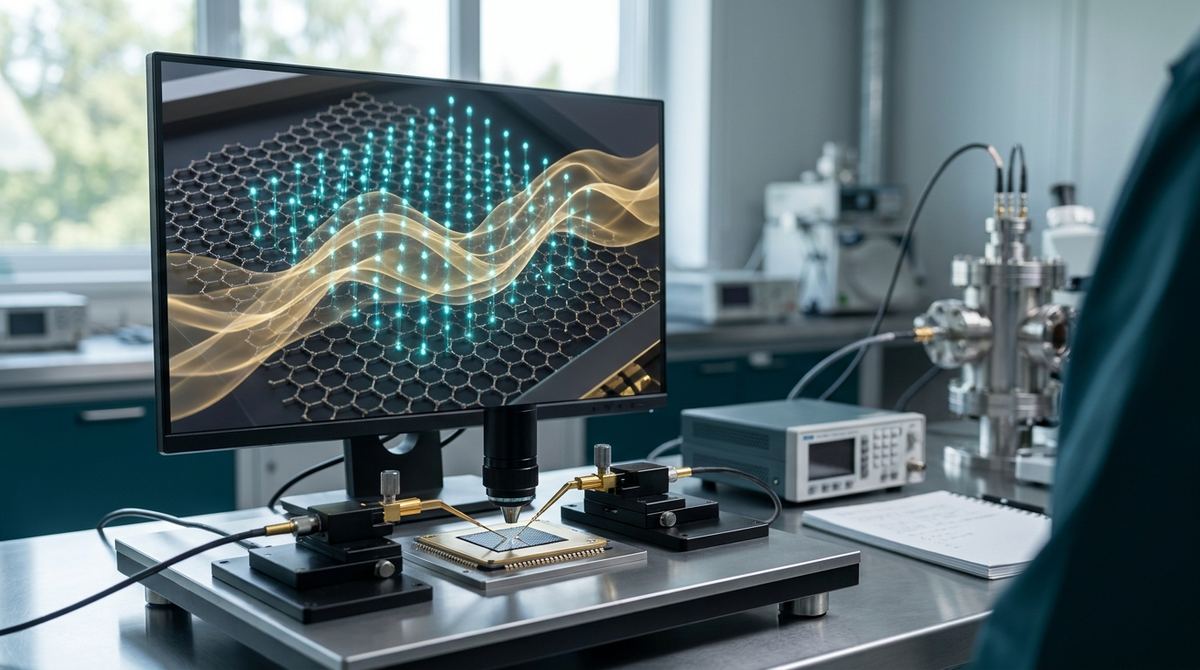
Imagine a perfectly silent, crowded ballroom. To avoid bumping into each other, every dancer has found a spot and frozen in place, forming a perfectly ordered, crystalline pattern. In this state, no one can move, and the dance floor is effectively an insulator. Now, imagine a second group of dancers, able to glide effortlessly through the gaps between their frozen colleagues. The floor is simultaneously static and flowing, a bizarre state of organized yet mobile humanity. This strange scenario is a remarkably close analogy for a newly predicted state of matter in graphene, a discovery that challenges the very definitions of metals and insulators.
In the world of materials science, the distinction between a metal and an insulator has long been a foundational concept. In a metal, electrons flow freely like a liquid, carrying electrical current. In an insulator, electrons are tightly bound to atoms, unable to move, and the material cannot conduct electricity. For nearly a century, physicists have known about a special kind of insulator called a Wigner crystal. Proposed by Eugene Wigner in 1934, this exotic state forms when the repulsive force between electrons overwhelms their kinetic energy. At very low densities and temperatures, electrons will spontaneously arrange themselves into a regular, crystalline lattice to minimize their mutual repulsion, effectively freezing in place. This crystal of pure electrons is the ultimate insulator. The problem is that this simple binary—either electrons flow freely (metal) or they are locked in place (insulator)—might not be the whole story. What if a material could be both at the same time? In a recent theoretical paper, researchers Junkai Dong, Tomohiro Soejima, Daniel E. Parker, and Ashvin Vishwanath have explored this very question, predicting the existence of a paradoxical phase: a metallic Wigner crystal. Their work seeks to solve the puzzle of what happens in highly interacting electronic systems, pushing beyond the traditional boundaries of solid-state physics.
The central idea behind this research is the creation of a system where two distinct populations of electrons coexist, with each behaving differently. The platform for this phenomenon is a special form of graphene known as rhombohedral graphene. Unlike common graphene, this variant has a unique electronic structure that dramatically enhances the effects of electron-electron repulsion. The researchers' theory shows that by carefully tuning the number of electrons in this material—a process called doping—it is possible to push one "flavor" of electrons into a Wigner crystal state. These electrons freeze into a rigid, ordered lattice. However, the system can simultaneously host another flavor of electrons that are not part of this crystal. These other electrons remain mobile and are free to travel through the empty channels within the electron crystal lattice. The result is a material that is simultaneously a crystal of localized electrons and a conductor of mobile electrons. It is an insulator and a metal at the same time. This hybrid state, the metallic Wigner crystal, represents a fundamentally new phase of electronic matter that was previously only a theoretical curiosity.
The choice of material is absolutely critical to observing this effect. Standard graphene, known as Bernal or AB-stacked graphene, consists of two hexagonal carbon layers where atoms in the top layer are offset to sit above the center of the hexagons in the bottom layer. While a wonder material, its electronic properties are not ideal for fostering strong electron interactions. The breakthrough comes from using rhombohedral, or ABC-stacked, trilayer graphene. In this configuration, each successive layer is shifted in the same direction, creating a unique crystal symmetry. This specific stacking gives rise to an unusual feature in its electronic band structure known as a "flat band." In a material with a flat band, electrons behave as if they have an extremely large mass. They move very sluggishly, and their kinetic energy becomes almost negligible. When kinetic energy is suppressed, the potential energy from electrostatic repulsion between electrons becomes the dominant force governing their behavior. This creates the perfect breeding ground for a Wigner crystal to form at much more accessible electron densities and temperatures than would be required in a vacuum or other materials. The rhombohedral graphene acts as a stage, amplifying the interactions between electrons until they are forced to crystallize. This unique platform is what allows for the formation of such a delicate and exotic state, a feat not easily achieved in other graphene electronics systems.
Through sophisticated theoretical modeling, the research team mapped out the different electronic phases that could exist in rhombohedral trilayer graphene under various conditions of electron density and magnetic fields. Their calculations confirmed that at certain "doping" levels, the system would indeed settle into a metallic Wigner crystal state. They found that electrons in condensed matter systems possess quantum properties beyond just charge, often referred to as spin and valley "flavors." The key finding was that it is possible to create a Wigner crystal composed of electrons from only one or a few of these flavors. For instance, the "spin-up valley-K" electrons might crystallize, while the "spin-down valley-K prime" electrons remain delocalized and free to move. This phenomenon is called a flavor-polarized Wigner crystal. The mobile electrons are not blocked by the crystallized electrons because of quantum mechanical principles that allow them to pass through the lattice. The result is a system with a rigid electronic charge order that still exhibits metallic conductivity. The researchers' models provide a concrete, testable prediction of the exact conditions under which this novel state should appear, offering a clear roadmap for experimental physicists to follow.
This theoretical discovery is significant for several reasons. First, it adds a new member to the family of quantum phases of matter. It demonstrates that the textbook definitions of metals and insulators are incomplete and that more complex, hybrid states are possible. This deepens our fundamental understanding of how billions of interacting electrons organize themselves into the materials that build our world. Second, it showcases the incredible potential of engineered quantum materials like rhombohedral graphene. By controlling the atomic stacking of carbon atoms, we can create electronic environments that give rise to entirely new physics. This opens a new frontier in materials design, where we can create materials with properties not found in nature. For engineers and innovators, the ability to create a material that is simultaneously insulating in one respect and conducting in another offers a new tool. Such a system, with its highly tunable electronic properties, could become the foundation for revolutionary graphene applications that leverage collective quantum phenomena rather than just simple current flow.
It is crucial to emphasize that this research is, at present, a theoretical prediction. The calculations and models are robust, but they have not yet been confirmed by a physical experiment. The primary limitation is the immense challenge of fabricating and measuring the required devices. Creating large, pristine samples of rhombohedral trilayer graphene is technically difficult. Furthermore, the experiments would need to be conducted at extremely low temperatures and would require incredibly sensitive electrical transport measurements to unambiguously identify the metallic Wigner crystal state and distinguish it from other possible competing electronic phases. Experimentalists will need to "catch these crystals doping" in the lab, a task that will push the boundaries of modern condensed matter physics techniques. The theoretical models also rely on certain idealizations, and real-world effects like disorder and impurities in the graphene lattice could potentially disrupt or alter the formation of this delicate state.
While direct commercial products based on metallic Wigner crystals are on a distant horizon, the long-term potential is tantalizing. The ability to switch a material between insulating, metallic, and this hybrid metallic Wigner crystal state by simply applying a voltage could lead to novel electronic components. One could envision new types of memory or logic gates where information is encoded in the collective phase of the electrons rather than a simple on or off current state. This could be far more energy-efficient than current semiconductor technology. Furthermore, the intricate quantum nature of this state could have applications in quantum computing, where the collective states of matter can be used to store or process quantum information. The insights gained from studying these systems will also feed into the broader field of quantum materials, accelerating the discovery of other exotic phenomena. Understanding these fundamental building blocks is a necessary precursor to any future technological revolution, a factor closely watched in graphene market research. For now, the most immediate application is as a new platform for scientists to explore the rich and often bizarre world of strongly correlated quantum physics.
If you take away just one concept from this research, let it be this: in a specially stacked form of graphene, scientists have predicted that electrons can do two contradictory things at once. They can freeze into a solid crystal due to their mutual repulsion while simultaneously allowing other electrons to flow through them like a metal. This paradoxical state, the metallic Wigner crystal, blurs the fundamental line between metals and insulators and opens a new chapter in quantum materials science.
What is a Wigner crystal?
A Wigner crystal is an exotic state of matter where electrons, which normally behave like a gas or liquid, freeze into a regular, crystalline lattice. This happens at very low densities and temperatures when the electrostatic repulsion between electrons becomes much stronger than their tendency to move around, forcing them into an ordered pattern to keep as far apart as possible. Typically, this state is a perfect electrical insulator.
What makes this predicted Wigner crystal "metallic"?
This Wigner crystal is predicted to be metallic because it is formed by only one "flavor" or type of electron in the system. While that flavor of electron is locked into a crystal lattice, another flavor of electron remains free and mobile. These mobile electrons can move through the gaps in the frozen electron crystal, allowing the material to conduct electricity like a metal.
Why is rhombohedral graphene so important for this research?
Rhombohedral graphene's unique ABC stacking sequence creates a special electronic property called a flat band. In a flat band, electrons move very slowly, which greatly enhances the effect of the repulsive forces between them. This amplified interaction makes it much easier for the electrons to overcome their kinetic energy and form a Wigner crystal under conditions that are more accessible for experiments.
Is this a technology we can use today?
No, not yet. The existence of the metallic Wigner crystal is currently a theoretical prediction based on computational models. While the theory is strong, it must first be verified through complex physical experiments. Fabricating the necessary high-quality materials and performing the measurements will be a significant challenge for scientists.
What future applications could this discovery lead to?
While speculative, this research could eventually impact fields like quantum computing and advanced nanoelectronics. The ability to control a material's state between insulating, metallic, and this new hybrid phase could lead to novel types of transistors or memory devices. More broadly, it advances our fundamental understanding of quantum materials, which is essential for developing next-generation technologies, including highly sensitive graphene sensors.
The theoretical prediction of a metallic Wigner crystal in rhombohedral graphene by Junkai Dong and his colleagues represents a significant step forward in our exploration of quantum matter. It challenges long-held distinctions between electrical conductors and insulators, revealing a richer and more complex reality. By providing a concrete material platform and a theoretical roadmap, this work paves the way for experimentalists to verify and explore a fundamentally new electronic state. This interplay between theory and experiment is the engine of scientific progress. While the path to practical application is long, this discovery illuminates a new corner of the quantum world, reminding us that even in a simple sheet of carbon atoms, there are profound and beautiful new phenomena waiting to be found.
Serious about B2B integration? Test our premium Pulsed Electrical Resistive Carbon Heating turbostratic graphene in your lab. 100g sample packs available now.
Explore More
Researchers show how dielectric substrates can control ultrafast carrier dynamics in graphene, offering a new method for designing next-gen terahertz and...

Researchers demonstrate a gate-tunable graphene Josephson junction, creating a highly sensitive and adaptable detector for terahertz frequencies. Learn how...

Researchers reveal how breaking inversion symmetry in 2D metals enables electronic Raman scattering, a powerful, non-destructive tool for characterizing...