
A Paradoxical State: Metallic Wigner Crystals in Rhombohedral Graphene Explained
Researchers predict a new state of matter in rhombohedral graphene: the metallic Wigner crystal. This paradoxical phase, where electrons are both frozen and...
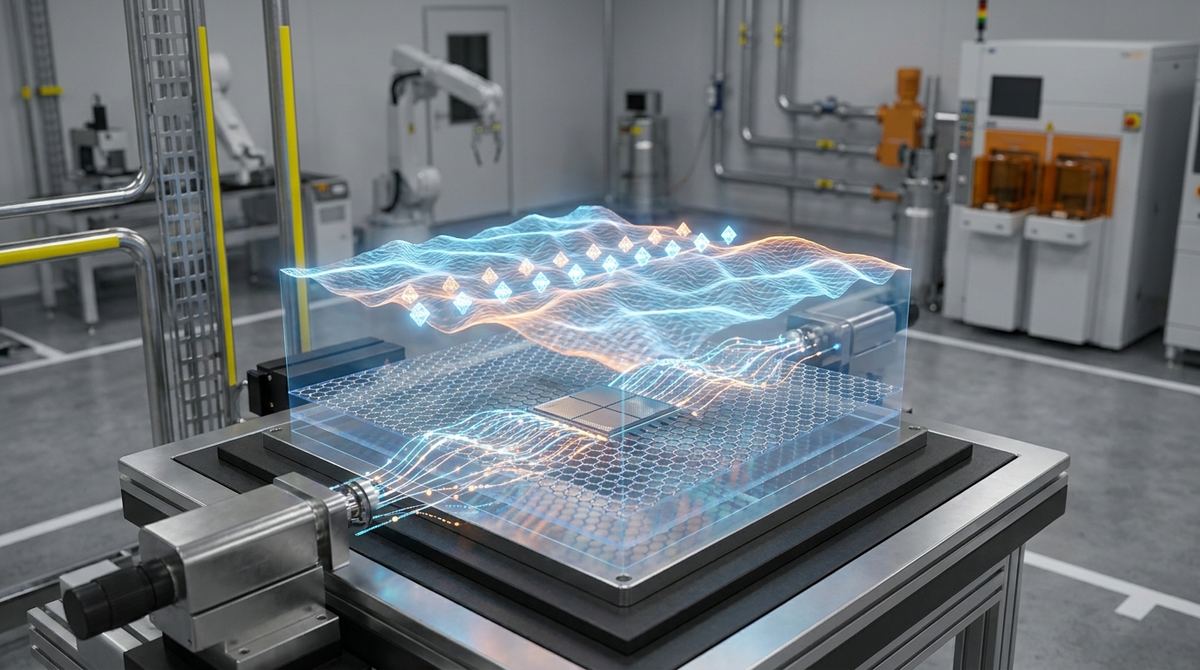
Imagine a dance floor so sparsely populated that the few dancers on it, all wanting their own space, arrange themselves into a perfectly ordered, static pattern. You would expect them to stay put. But what if this entire frozen pattern could somehow glide across the floor as a single entity? This seeming paradox is at the heart of a breathtaking new discovery in the world of quantum materials. For decades, physicists predicted that under specific conditions, electrons in a material could do the same thing: stop moving individually and form a fixed, crystalline structure called a Wigner crystal. Now, a groundbreaking study provides compelling evidence for a Wigner crystal that defies expectations by behaving not as a stationary insulator, but as a flowing metal.
In the quantum realm, electrons are in a constant tug-of-war. Their kinetic energy makes them want to zip around, while their mutual electrostatic repulsion—the fact that like charges repel—pushes them apart. In most metals, the kinetic energy wins, and electrons form a chaotic, fluid-like "sea" that allows for the free flow of electricity. However, the physicist Eugene Wigner theorized in 1934 that if you could create a system with very few electrons in a very clean environment and cool it to near absolute zero, the repulsion would dominate. The electrons' kinetic energy would be so low that their most stable arrangement would be to "freeze" into a regular, crystalline lattice to maximize the distance between them. This exotic state of matter, the Wigner crystal, has been a long-sought-after prize in condensed matter physics. A critical, long-held assumption was that because the electrons are locked into place, a Wigner crystal should be a perfect insulator, unable to conduct any electrical current. The central problem this new research tackles is to experimentally test this very assumption. Recent theoretical work has hinted that quantum mechanics might allow for a loophole, a scenario where the entire electron crystal could move collectively, but finding a material system clean and tunable enough to observe this has been an immense challenge. The work by a team of researchers including Tonghang Han, Jackson P. Butler, Shenyong Ye, Zhenqi Hua, Surajit Dutta, Zach Hadjri, Zhenghan Wu, Jixiang Yang, Junseok Seo, Phatthanon Pattanakanvijit, Emily Aitken, Kenji Watanabe, and their collaborators set out to create such a system and precisely measure its properties, searching for this elusive state.
To create the ideal environment for a Wigner crystal to form, the researchers turned to a very special form of graphene. Not just a single atomic layer, but three layers stacked in a specific, repeating "ABC" pattern known as rhombohedral stacking. This material is exceptionally clean and has a unique electronic structure. The key idea was to use this rhombohedral trilayer graphene as a pristine container for electrons. By applying an external electric field, they could act like a faucet, precisely controlling the number of electrons inside this container. They turned the faucet down until the electron density was incredibly low. At the same time, they cooled the entire system to temperatures just fractions of a degree above absolute zero. In these extreme conditions, the electrons’ kinetic energy was almost completely quenched, allowing their mutual repulsion to become the dominant force. This forced the electrons to settle into the predicted Wigner crystal lattice. The truly innovative step was what they did next. Instead of just confirming the crystal's existence, they measured its ability to conduct electricity. To everyone's surprise, it was not a perfect insulator. The material showed a finite electrical resistance, meaning current could flow. This suggested that the entire, rigid crystal of electrons was sliding through the underlying graphene lattice, much like a sheet of ice sliding over a smooth surface. They had found evidence of a metallic Wigner crystal.
The experimental device is a marvel of nano-engineering, constructed like a delicate sandwich. The core is the rhombohedral trilayer graphene (RTG). This specific stacking is critical because it creates what physicists call a "flat band" electronic structure. In simple terms, this means that the electrons within a certain energy range have very little kinetic energy, making them highly susceptible to the effects of their mutual repulsion. This RTG layer is encapsulated between two ultra-pure, atomically flat insulating layers of hexagonal boron nitride (hBN). The hBN serves two purposes: it protects the graphene from impurities that could disrupt the fragile electron crystal, and it acts as an electrical insulator. Metallic gates are placed above and below this stack. A voltage applied to these gates creates a perpendicular electric field. This field allows the researchers to finely tune the carrier density—the number of electrons per unit area in the graphene. By adjusting the voltage, they can add or remove electrons, effectively controlling how "crowded" the electronic dance floor is. To observe the Wigner crystal, they dialed the density down to a very low value. The entire device was then cooled in a dilution refrigerator to temperatures below 100 millikelvin. At this point, the researchers passed a tiny electrical current through the graphene and measured the voltage drop to determine its resistance. This transport measurement is the primary tool used to probe the electronic state of the material.
The measurements revealed a series of striking signatures that pointed directly to the formation of a metallic Wigner crystal. As the researchers lowered the electron density into the target range, they saw a dramatic spike in the material's electrical resistance. This initial spike is expected, as the electrons begin to localize and resist flowing freely. However, the resistance did not become infinite, as it would in a true insulator. It settled at a large but finite value. This was the first clue that something unusual was happening. The definitive evidence came when they applied a weak magnetic field perpendicular to the graphene. In a typical metal, a magnetic field causes electrons to move in circular paths, leading to periodic fluctuations in resistance known as quantum oscillations. The team observed precisely these kinds of oscillations emanating from the high-resistance Wigner crystal state. This was the smoking gun. Quantum oscillations are a hallmark of mobile charge carriers with a well-defined Fermi surface, a concept central to the theory of metals. Finding them in a state where electrons were supposed to be locked in a crystal was profound. It demonstrated that the charge carriers were not individual electrons but the collective motion of the entire Wigner crystal itself. The electron solid was behaving like a single, massive charged object that could conduct electricity. This discovery provides a powerful new lens for the world of [/blog/category/electronics-photonics/], pushing the boundaries of what we thought was possible for electron behavior in materials.
This discovery is a landmark achievement in fundamental physics. It confirms a new state of quantum matter that was theoretically predicted but never before observed with such clarity. It fundamentally alters the textbook definition of a Wigner crystal, transforming it from a simple insulating state into a far more complex and interesting phenomenon. By demonstrating that a collective crystal of electrons can be metallic, the research opens up entirely new avenues for exploring what is known as "strongly correlated electron physics," the study of how electrons behave when their interactions with each other are paramount. These systems are notoriously difficult to understand but are believed to hold the keys to solving some of science's biggest mysteries, including the mechanism behind high-temperature superconductivity. The ability to create and control such an exotic state in a relatively simple material like graphene provides a powerful experimental platform. Scientists can now use this system to poke and prod this new state, testing theories and potentially uncovering even more strange quantum behaviors. It underscores the incredible potential of graphene and related 2D materials not just for their material properties, but as pristine laboratories for exploring the very frontiers of physics.
While the evidence is compelling, it is important to acknowledge the limitations of the current work. The primary barrier to any practical application is the extreme conditions required. The metallic Wigner crystal state was only observed at temperatures of a few millikelvin, close to absolute zero. Recreating these conditions requires highly specialized and expensive laboratory equipment, placing it far from everyday use. Furthermore, the evidence presented is indirect, based on electrical transport measurements. While these measurements are powerful and convincing, they do not provide a direct picture of the electron crystal. The next major step for the field will be to use techniques like scanning tunneling microscopy (STM) to directly visualize the spatial arrangement of the electrons, which would provide definitive, visual confirmation of the crystalline lattice. Researchers also need to explore the precise mechanism that allows the crystal to slide. Understanding whether it is a purely quantum mechanical effect or if it is influenced by tiny imperfections in the graphene lattice is a key question that remains to be answered.
It is crucial to state that this is fundamental science, and direct commercial products based on metallic Wigner crystals are likely decades away, if they ever materialize. The value lies in the new knowledge and the potential it unlocks for future technologies. Understanding how to make an entire collective of electrons move without breaking apart could inspire new paradigms for ultra-low-power electronics. In conventional electronics, energy is lost as individual electrons scatter off imperfections. A sliding Wigner crystal, in theory, might move with far less scattering and dissipation. The insights gained from this highly tunable graphene system could also inform the design and discovery of other quantum materials. The specific electronic properties of the rhombohedral stacking used in this experiment could influence the manufacturing of advanced carbon nanomaterials, such as specialized [/products/turbostratic-graphene-flakes/], where layer orientation is key. Ultimately, this work contributes to a vast library of knowledge that underpins all modern technology, influencing a wide range of future [/applications/], from quantum computing to novel sensors.
If you take away just one concept from this research, let it be this: in a specially prepared, ultra-cold graphene device, electrons can collectively freeze into a solid crystal due to their mutual repulsion, but this entire electron solid can then slide through the material to conduct electricity, forming a paradoxical new state of matter called a metallic Wigner crystal.
What exactly is a Wigner crystal?
A Wigner crystal is an exotic state of matter that forms when electrons in a material are at a very low density and temperature. Their mutual electrostatic repulsion becomes stronger than their tendency to move around (kinetic energy), forcing them to arrange themselves into an ordered, crystalline lattice, much like atoms in a solid.
Why is it so surprising that this Wigner crystal is metallic?
For decades, the standard model of a Wigner crystal assumed it would be a perfect insulator. Because the electrons are "frozen" into fixed positions in the lattice, they shouldn't be able to move individually to carry a current. The discovery that the entire crystal can slide collectively as a single entity, thereby conducting electricity, fundamentally challenges this long-held picture.
What is special about the rhombohedral graphene used in this experiment?
Rhombohedral graphene refers to a specific ABC stacking sequence of three graphene layers. This arrangement creates a unique electronic band structure that is very "flat," meaning the electrons have very low kinetic energy. This condition makes it much easier for the repulsive forces between electrons to dominate, providing an ideal platform to coax them into forming a Wigner crystal.
Does this discovery mean we will have new types of electronics soon?
No, not directly. This is foundational research performed under extreme laboratory conditions, requiring temperatures near absolute zero. The primary value is in the new scientific understanding it provides, which could inspire future technological concepts for things like quantum computing or low-dissipation electronics, but these are very long-term goals that require much more research. For now, the commercial outlook is more in line with long-range [/market-research/] forecasts for quantum materials.
How do scientists know the crystal was formed if they couldn't see it directly?
They used a technique called electrical transport measurement. By analyzing how electrical resistance changed with temperature, electron density, and an applied magnetic field, they found unique signatures. The observation of quantum oscillations, a phenomenon typically associated with metals, coming from the high-resistance Wigner crystal state was the key piece of evidence that the state was both crystalline and conductive.
The discovery of a metallic Wigner crystal in rhombohedral graphene represents a significant triumph in experimental physics. The work by Han, Butler, Ye, and their colleagues provides a beautiful demonstration of how quantum mechanics can lead to collective behaviors that defy classical intuition. By engineering a near-perfect material system, they were able to isolate and probe a fragile state of matter, revealing that a solid made of pure electrons can indeed conduct electricity. This result not only solves a long-standing puzzle but also opens the door to a new and exciting chapter in the study of correlated electron systems. It reinforces the role of graphene and its layered cousins as unparalleled platforms for uncovering the deepest secrets of the quantum world, secrets that will undoubtedly shape the scientific and technological landscape of the future.
For related commercial context, explore turbostratic graphene flakes and graphene production machinery.
Serious about B2B integration? Test our premium Pulsed Electrical Resistive Carbon Heating turbostratic graphene in your lab. 100g sample packs available now.
Explore More
Researchers predict a new state of matter in rhombohedral graphene: the metallic Wigner crystal. This paradoxical phase, where electrons are both frozen and...

Researchers show how dielectric substrates can control ultrafast carrier dynamics in graphene, offering a new method for designing next-gen terahertz and...

Researchers demonstrate a gate-tunable graphene Josephson junction, creating a highly sensitive and adaptable detector for terahertz frequencies. Learn how...