
Probing 2D Metals: Unlocking Electronic Secrets with Raman Spectroscopy
Researchers reveal how breaking inversion symmetry in 2D metals enables electronic Raman scattering, a powerful, non-destructive tool for characterizing...
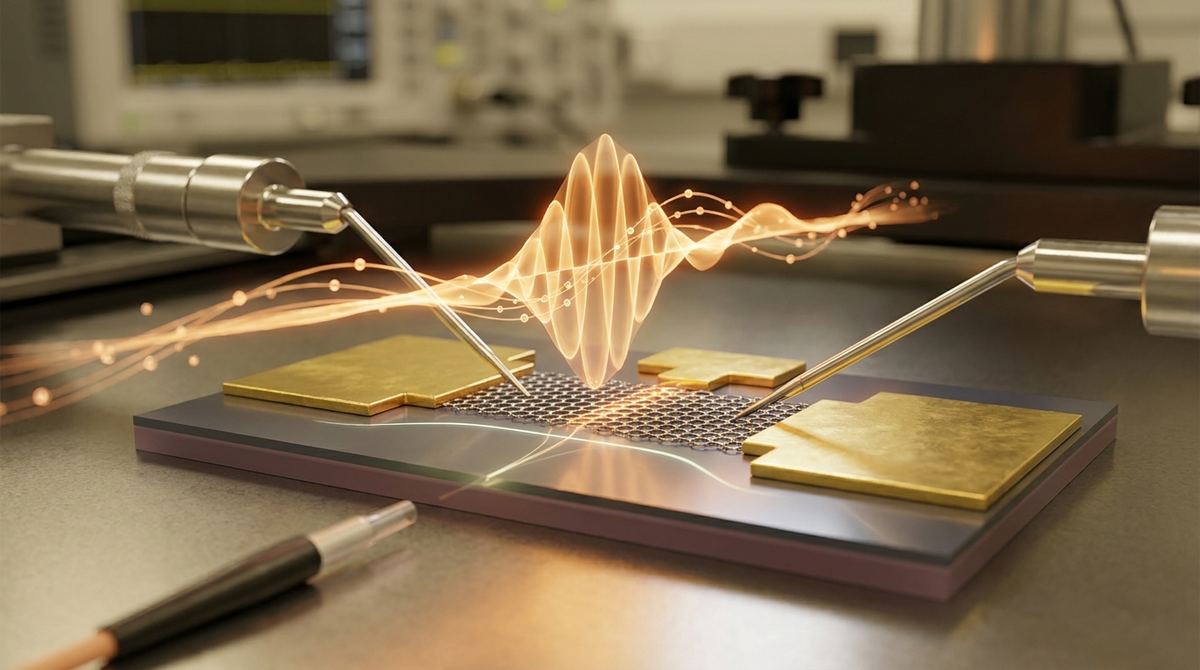
The world is filled with invisible light. Beyond the reds and violets our eyes can see lies a vast electromagnetic spectrum, and nestled between microwaves and infrared is a band of frequencies known as terahertz radiation. This "T-ray" region holds immense promise for everything from next-generation wireless communication to non-invasive medical diagnostics. There's just one problem: it's notoriously difficult to create and detect. This challenge, often called the "terahertz gap," has stymied engineers for decades. Now, a groundbreaking development in quantum materials offers a new path forward. By combining the unique electronic properties of graphene with the strange physics of superconductivity, a team of researchers has created a highly sensitive and, crucially, electronically tunable terahertz detector, opening a new door to harnessing this elusive part of the spectrum.
The terahertz gap exists because conventional electronic and photonic technologies struggle to operate at these frequencies. Electronics, which excel at generating and detecting lower-frequency radio waves and microwaves, become too slow. The electrons simply cannot oscillate fast enough. Photonics, which work well for higher-frequency infrared and visible light, run into a different wall. The energy of a single terahertz photon is very low, making it difficult to detect with standard semiconductor-based photodetectors that rely on kicking electrons across an energy band gap. As a result, current terahertz systems are often bulky, inefficient, expensive, and require cumbersome cooling systems, limiting their practical use. A new approach is needed, one that leverages novel materials and quantum phenomena. A recent paper by X. Zhou, I. Gayduchenko, A. Kudriashov, K. Shein, A. Kuksov, L. Elesin, M. Kravtsov, A. Shilov, O. Popova, S. Jana, T. Taniguchi, K. Watanabe, and their colleagues tackles this problem head-on by designing a device that operates on principles entirely different from conventional detectors.
Imagine two large, deep lakes representing two superconducting materials. In a superconductor, electrons pair up and flow with zero resistance, like a frictionless river. Now, imagine these two lakes are connected by a very short, shallow, and narrow channel. This channel is a single-atom-thick sheet of graphene. This entire structure—superconductor, graphene, superconductor—is called a Josephson junction. Because the graphene channel is so thin, some of the electron pairs from the superconductors can "tunnel" through it, allowing a supercurrent to flow between the lakes without any voltage pushing it. This delicate quantum flow is extremely sensitive to its environment. If you shine terahertz light on the graphene channel, the energy from the light disrupts the electron pairs, weakening the supercurrent in a measurable way. This is the basis of the detector. The researchers' key innovation was adding a "gate," which is like an electric lever. By applying a voltage to this gate, they can control the number of charge carriers inside the graphene channel. This is akin to changing the depth of the channel, making it easier or harder for the supercurrent to flow. This control allows them to "tune" the detector's sensitivity and response on the fly, optimizing it for different tasks without physically changing the device.
The device is a marvel of materials engineering known as a van der Waals heterostructure. It begins with a silicon wafer that acts as a substrate and also as a back gate. On top of this is a layer of insulating silicon dioxide, followed by a pristine sheet of hexagonal boron nitride (hBN). The active components are then carefully stacked: a bottom superconducting electrode, a single layer of graphene, and a top superconducting electrode. This entire sandwich is then encapsulated in another layer of hBN to protect the graphene from environmental contamination and preserve its exceptional electronic properties. The superconductors, likely a material like niobium nitride, provide the source of "Cooper pairs," the coupled electrons responsible for supercurrent. The graphene serves as the "weak link" in the Josephson junction. Unlike a traditional insulator, graphene's electrical properties can be dramatically altered. Because it is a semimetal with no band gap, the concentration of its charge carriers—electrons and their positive counterparts, "holes"—can be continuously adjusted by the electric field from the silicon back gate. When terahertz radiation hits the device, it is absorbed primarily by the electrons in the graphene. This absorption heats the electron system, raising its effective temperature. This increase in temperature disturbs the delicate quantum coherence of the Cooper pairs trying to pass through the graphene, which in turn reduces the maximum supercurrent the junction can sustain. This change in supercurrent is the detected signal. The gate voltage controls the Fermi level in the graphene, essentially setting the baseline energy of its electrons. By adjusting this level, the researchers can modify how efficiently the graphene absorbs terahertz photons and how that absorbed energy translates into a change in supercurrent, effectively tuning the device's responsivity. This is a central theme in the growing field of graphene electronics.
The central achievement of the study is the demonstration of a highly gate-tunable photoresponse. The researchers illuminated their graphene Josephson junction with terahertz radiation and measured the resulting change in its electrical characteristics as they systematically varied the gate voltage. They found that the device's sensitivity was not static; it could be dramatically modified. By applying different voltages to the gate, they could shift the charge carrier density in the graphene from being electron-dominated to hole-dominated, passing through a point of minimum conductivity known as the Dirac point. They observed that the photoresponse was strongest near this Dirac point, where the graphene is most resistive and its electronic properties are most susceptible to change. This tunability means the detector's performance can be optimized in real-time. For one application, an operator might tune the gate voltage for maximum sensitivity to detect a very faint signal. For another, they might tune it for the fastest possible response time to capture data from a high-speed communication link. This ability to electrically control the key performance metrics of a terahertz detector represents a significant advance over previous static designs.
This work is more than just a scientific curiosity; it's a critical step toward practical terahertz technology. The ability to tune a detector's response is a powerful engineering tool. It allows a single device to be adapted for multiple functions, much like how a radio can be tuned to different stations. In a complex system like a communications network or an imaging array, this tunability could be used to calibrate detectors, switch between operating frequencies, or optimize performance based on changing environmental conditions. Furthermore, the use of graphene points toward a future of compact, chip-scale terahertz systems. Graphene is compatible with standard semiconductor fabrication techniques, suggesting that these sophisticated quantum devices could one day be integrated directly onto silicon chips. This would drastically reduce the size, weight, and power consumption of terahertz equipment, enabling its use in portable and even handheld devices. The fundamental research into these unique material properties is what ultimately drives new graphene applications.
While the results are exciting, it is important to maintain a realistic perspective. The primary limitation of this device, like many based on Josephson junctions, is its operating temperature. Superconductivity only occurs at extremely low, cryogenic temperatures, typically just a few degrees above absolute zero. This means the device must be housed inside a sophisticated and bulky cooling apparatus, which currently precludes its use in consumer electronics or field-deployed sensors. The next major challenge is to explore superconductors that operate at higher temperatures to make the cooling requirements less stringent. Additionally, the fabrication of these high-quality, multi-layer heterostructures is an intricate, labor-intensive process. Significant advancements in graphene manufacturing techniques will be needed to produce these devices reliably and at a scale suitable for commercialization. Further testing is also required to characterize the detector's full performance spectrum, including its response speed, dynamic range, and long-term stability under continuous operation.
Assuming the engineering challenges of cooling and fabrication can be overcome, the potential applications for a tunable, high-performance terahertz detector are vast and transformative. In medicine, T-rays can penetrate clothing and skin but are stopped by water, allowing for non-invasive imaging of skin cancers or monitoring of burn healing. In security, they could enable airport scanners that can "see" through clothing to detect concealed objects without using ionizing radiation like X-rays. For industry, terahertz spectroscopy can be used for quality control, such as inspecting the thickness and integrity of paint on cars or coatings on pharmaceuticals. Perhaps the most anticipated application is in next-generation wireless communications. The terahertz band offers enormous bandwidth, promising data transfer rates hundreds of times faster than today's 5G. Tunable detectors like this one would be essential components in the receivers for such 6G-and-beyond networks. The development of such advanced graphene sensors is a key area of focus in materials science.
If you take away just one thing from this research, let it be this: By embedding graphene into a superconducting circuit, scientists have created a terahertz detector that can be tuned with a simple electric field. This marriage of quantum mechanics and materials science provides a powerful new tool for unlocking the potential of the terahertz gap, paving the way for future revolutions in communication, imaging, and sensing.
What is a Josephson junction?
A Josephson junction is a quantum device formed by separating two superconducting materials with a very thin non-superconducting barrier. In this research, graphene acts as that barrier. It allows a supercurrent of paired electrons to flow between the superconductors without any voltage, and this flow is extremely sensitive to external energy, like terahertz radiation.
Why is graphene used in this device?
Graphene is ideal for this application for two main reasons. First, as a single layer of carbon atoms, it is the ultimate thin barrier for the junction. Second, and most importantly, its electronic properties can be easily and dramatically tuned by an external electric field. This tunability is what allows researchers to control the detector's sensitivity on the fly.
What is the "terahertz gap"?
The terahertz gap refers to a range of frequencies in the electromagnetic spectrum, roughly between 0.1 and 10 terahertz, that is historically difficult to generate and detect. Conventional electronics are too slow to work here, and conventional photonics are inefficient because terahertz photons have very low energy. New technologies, like the one in this study, are needed to bridge this gap.
Is this technology ready for my phone?
No, not for a long time. The primary hurdle is the extreme cold required for the superconductors to work. The device must be cooled to just a few degrees above absolute zero, which requires bulky and expensive cryogenic equipment. Until high-temperature superconducting materials can be integrated, this technology will be limited to specialized laboratory and industrial settings.
How is the device "tunable"?
The device is tuned using a gate electrode, which works much like a transistor. By applying a voltage to the gate, an electric field is created that changes the number of free charge carriers (electrons and holes) in the graphene sheet. This change alters the graphene's conductivity and how it interacts with both the supercurrent and the incoming terahertz light, thereby changing the detector's sensitivity and response.
The work by Zhou and colleagues provides a compelling demonstration of how combining disparate areas of physics—superconductivity and the unique Dirac electronics of graphene—can lead to novel device functionalities. The creation of a gate-tunable terahertz photodetector based on a graphene Josephson junction is a significant milestone. It not only offers a potential solution for the long-standing challenges of the terahertz gap but also showcases a platform for exploring rich new physical phenomena. While practical hurdles like operating temperature remain, this research illuminates a clear path forward. It is a testament to the power of fundamental science to lay the groundwork for the technologies that will shape our future, from unimaginably fast wireless networks to life-saving diagnostic tools.
Serious about B2B integration? Test our premium Pulsed Electrical Resistive Carbon Heating turbostratic graphene in your lab. 100g sample packs available now.
Explore More
Researchers reveal how breaking inversion symmetry in 2D metals enables electronic Raman scattering, a powerful, non-destructive tool for characterizing...

Researchers use AI to accelerate the discovery of new materials, identifying a graphene-boron nitride composite for interstellar spacecraft shielding.

In BN-encapsulated graphene, the ultimate limit on electron speed is not graphene itself, but remote phonon scattering from the insulating layers that...