
Graphene’s Ultimate Speed Limit: The Boron Nitride Casing Is the Bottleneck
In BN-encapsulated graphene, the ultimate limit on electron speed is not graphene itself, but remote phonon scattering from the insulating layers that...
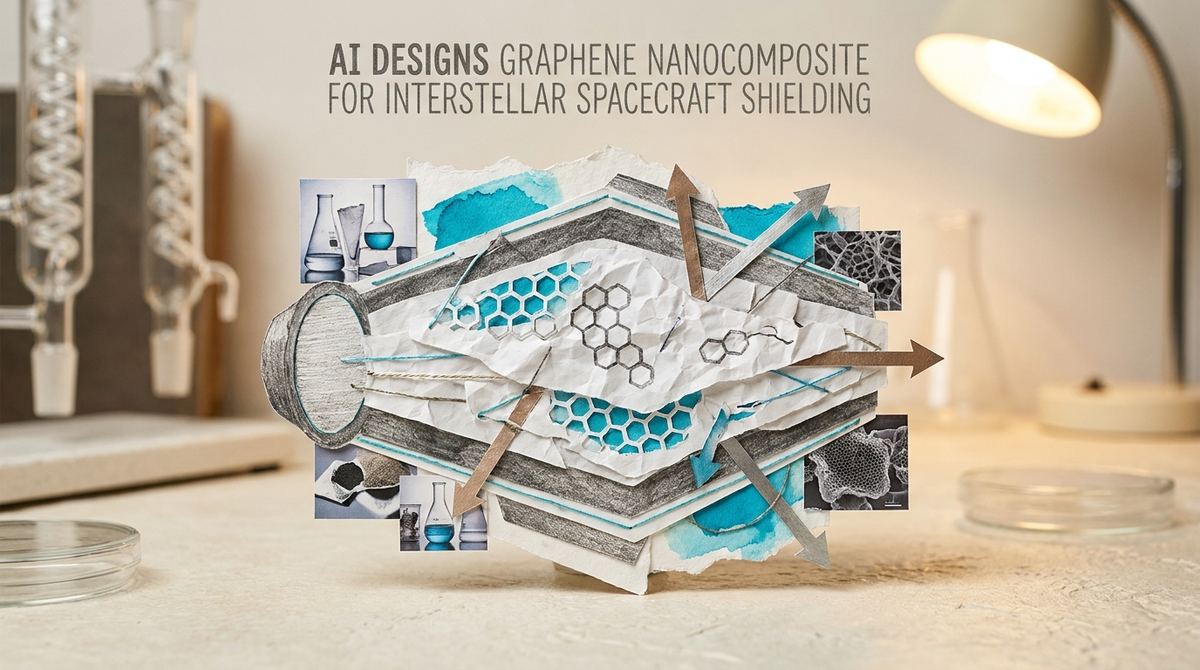
The vast, silent emptiness between the stars is anything but empty. It is a shooting gallery, a lethal environment filled with threats moving at incomprehensible speeds. For any craft daring to make the interstellar journey, the void presents a relentless hailstorm of microscopic dust particles packing the kinetic energy of rifle bullets and a constant bath of high-energy cosmic radiation that can fry electronics and tear through living tissue. Building a shield capable of withstanding this dual assault, without weighing so much that the spacecraft can never leave orbit, has been one of the greatest barriers to deep space exploration. A new computational approach, however, may have finally broken the stalemate, pointing the way toward a new class of ultra-resilient materials.
To travel to another star, a spacecraft must be both incredibly fast and incredibly durable. The shielding protecting it must defend against two distinct but equally dangerous phenomena. The first is kinetic impact from micro-meteoroids and interstellar dust. Even a grain of sand, when traveling at a significant fraction of the speed of light, can strike with explosive force, capable of puncturing conventional hulls. The second threat is ionizing radiation, primarily in the form of galactic cosmic rays (GCRs). These are atomic nuclei, stripped of their electrons and accelerated to near light-speed by distant supernovae. When these particles strike a spacecraft's shield, they can not only damage systems but also trigger a dangerous cascade of secondary radiation called spallation, where fragments of the shield itself become projectiles, potentially causing more harm inside the craft than the original particle would have.
For decades, engineers have relied on materials like aluminum and beryllium. Aluminum is a workhorse, but effective radiation shielding requires thick, heavy layers. Beryllium is lighter and stiffer, but it is expensive, toxic to work with, and can be brittle. Both materials suffer from the spallation problem. This entire challenge is governed by the “tyranny of the rocket equation,” where every single kilogram of mass requires an exponential increase in fuel to launch and accelerate. A heavy shield makes an interstellar mission prohibitively expensive and complex. In their 2026 paper, researchers Yue Li, Xu Pan, and Kaiyuan Guo sought to escape this materials trap not by mixing chemicals in a lab, but by teaching an artificial intelligence to dream up a better solution from first principles.
The central innovation in this work is a radical shift in the process of materials discovery. Instead of the slow, methodical, and often serendipitous process of traditional laboratory testing, the researchers employed an AI-driven platform to design and evaluate new materials virtually. They began by creating a massive digital library containing the known physical, chemical, and mechanical properties of thousands of existing materials. This data, likely sourced from both experimental results and high-fidelity physics simulations, served as the training ground for a sophisticated machine learning model.
The AI was then tasked with a specific mission: find a hypothetical material that satisfies a set of seemingly contradictory requirements for interstellar shielding. It needed to be exceptionally strong to resist hypervelocity impacts, possess a low density to minimize mass, and be composed of specific elements capable of absorbing high-energy radiation without producing a deadly shower of secondary particles. The AI algorithm sifted through millions of potential atomic combinations and structural arrangements, predicting the emergent properties of each one. It learned the complex relationships between atomic structure and real-world performance, allowing it to identify promising candidates that a human researcher might never conceive of. After this exhaustive computational search, the AI pinpointed a clear winner: a precisely structured nanocomposite made from graphene and hexagonal boron nitride.
The material proposed by the AI is not a simple mixture but a sophisticated nanoscale architecture designed to counter both interstellar threats synergistically. It leverages the unique and complementary properties of its two components: graphene and hexagonal boron nitride (h-BN).
Graphene, a single layer of carbon atoms arranged in a honeycomb lattice, provides the system's incredible mechanical strength and impact resistance. With a tensile strength over 200 times that of steel at a fraction of the weight, graphene is the strongest material ever tested. When a micro-meteoroid strikes the shield, the graphene layers are designed to act like a subatomic trampoline. They can stretch and deform elastically, distributing the concentrated kinetic energy of the impact over a massive area. This process, known as energy dissipation through membrane deformation, effectively catches the projectile and prevents it from penetrating deeper into the spacecraft’s hull. The layered nature of the composite, potentially made with turbostratic graphene flakes, ensures that even if one layer is compromised, the layers beneath it can continue to absorb the energy.
While graphene handles the physical impacts, the hexagonal boron nitride component tackles the radiation. Structurally, h-BN is almost identical to graphene—a 2D honeycomb lattice sometimes called “white graphene”—but it is composed of alternating boron and nitrogen atoms. This atomic difference is critical. The high-energy protons and heavy ions of GCRs are difficult to stop. When they hit a shield, they can knock neutrons loose from the shield's own atoms. These secondary neutrons are particularly dangerous as they are highly penetrating and can cause significant biological and electronic damage. The boron atom, specifically the Boron-10 isotope, is one of the most effective neutron absorbers known to physics. By integrating h-BN into the composite, the shield gains a built-in radiation sink. The boron atoms effectively capture the secondary neutrons generated by cosmic ray impacts, converting their energy harmlessly and suppressing the spallation cascade before it can begin.
The findings presented in the paper are based on the AI's predictions and subsequent high-fidelity simulations that validate those predictions. The AI model forecasted that the optimized graphene-boron nitride (G-BN) composite would possess a specific strength and radiation attenuation capability far exceeding any existing aerospace material, including beryllium and advanced aluminum alloys.
Simulations of hypervelocity impacts showed that the G-BN shield could withstand kinetic energies orders of magnitude higher than a conventional shield of the same mass. The unique ability of the 2D layers to slide past one another and delaminate locally was key to absorbing the impact without catastrophic failure. Furthermore, the radiation transport simulations were particularly striking. Compared to a pure aluminum shield, the G-BN composite was predicted to reduce the flux of secondary neutrons inside the spacecraft by over 90%. This drastically lowers the radiation dose that would be received by the crew or sensitive electronics, making long-duration missions safer. The AI also suggested that the material might possess limited self-healing capabilities for micro-fractures, as the powerful van der Waals forces between the 2D sheets could pull small cracks back together, though this remains a more speculative finding requiring experimental proof.
This research represents a potential paradigm shift on two fronts. First, it offers a tangible solution to one of the most stubborn engineering problems blocking human and robotic exploration of deep space. By providing a pathway to a lightweight, multi-functional shield, it could dramatically reduce the launch mass of interstellar probes, making such missions more feasible and affordable. It directly addresses the rocket equation, freeing up precious mass for more fuel, more scientific instruments, or better life support systems.
Second, and perhaps more importantly, the success of the AI-accelerated discovery process itself is a monumental achievement. This methodology can be adapted to solve countless other high-stakes materials science challenges. The same AI-driven approach could be used to design novel materials for containing plasma in fusion reactors, creating more efficient battery electrodes, developing superior catalysts for clean energy production, or engineering next-generation biomedical implants. It transforms materials science from a discipline of patient discovery to one of intentional, accelerated design. We can now define the properties we need for a given application and use AI to tell us which atoms to combine and how to arrange them.
It is crucial to recognize that this work, while groundbreaking, is a computational proof-of-concept. The AI has provided an incredibly promising blueprint, but the physical material must still be built and tested in the real world. The primary limitation is the immense challenge of manufacturing. Producing large, defect-free sheets of a graphene-boron nitride heterostructure with atomic precision is currently beyond our industrial capabilities. Developing the next generation of graphene production machinery capable of scalable synthesis will be the critical next step to turn this digital design into a physical reality.
Furthermore, laboratory tests must be conducted to verify the AI’s predictions. This includes subjecting prototypes to hypervelocity impacts in a vacuum and exposing them to particle accelerators that can mimic the GCR environment of deep space. The long-term durability of the composite also remains an open question. How it will withstand decades of thermal cycling, from the cold of deep space to the heat of a star system, as well as degradation from ultraviolet light and atomic oxygen, can only be answered through rigorous, long-duration testing.
The most direct and ambitious application for this G-BN composite is, of course, shielding for interstellar spacecraft, whether they are small, laser-propelled probes or large, crewed vessels. However, the technology has numerous near-term applications within our own solar system. It could be used to create lighter and more effective shielding for satellites in low Earth orbit, protecting them from the growing threat of space debris and the harsh radiation in the Van Allen belts. It could also be incorporated into the next generation of spacesuits and habitats for astronauts on missions to the Moon and Mars. These advanced aerospace composites would provide superior protection while reducing the overall mass that needs to be lifted from Earth.
Beyond space, the material's unique combination of strength, low weight, and radiation resistance could lead to significant terrestrial spin-offs. It could be used in lightweight body armor for military and law enforcement personnel, protective casings for sensitive medical or scientific equipment, and even as anti-corrosion graphene coatings in reactors or other extreme industrial environments. The AI discovery platform itself is a powerful tool that could be commercialized for any industry that relies on advanced materials.
This research demonstrates how artificial intelligence is no longer just a tool for analyzing data but a creative partner in scientific discovery. By teaching an AI to understand the fundamental laws of physics and chemistry, researchers have designed a new type of graphene-based material that could one day serve as the essential shield protecting humanity's first explorers on their journey to the stars.
What is interstellar shielding and why is it so hard to make?
Interstellar shielding is the protective outer layer of a spacecraft designed to defend against the harsh environment of deep space. The primary challenge is that it must counter two very different threats simultaneously: high-speed physical impacts from dust and micro-meteoroids, and intense, high-energy particle radiation. A material good at stopping one is often poor at stopping the other, and a solution that does both, like thick lead, is usually far too heavy to launch into space.
How does AI help discover new materials?
AI accelerates material discovery by replacing slow and expensive physical experiments with rapid virtual ones. Scientists train a machine learning model on a vast database of known materials and their properties. The AI then learns the underlying rules connecting atomic structure to performance and can predict the properties of millions of new, hypothetical material combinations in a fraction of the time it would take in a lab, pointing researchers toward the most promising candidates.
Why combine graphene and boron nitride for a shield?
Graphene and boron nitride offer complementary strengths. Graphene is exceptionally strong and lightweight, making it ideal for absorbing and dissipating the kinetic energy from physical impacts. Boron nitride, particularly with the Boron-10 isotope, is an excellent absorber of the harmful secondary neutrons created when cosmic rays strike the shield. By combining them, you get a single, lightweight material that handles both physical and radiological threats effectively.
Is this material ready to be used on a spacecraft today?
No, not yet. The research presents a highly promising computational design and simulation. It is a blueprint for a material that, in theory, has superior properties. The next critical steps involve overcoming significant manufacturing challenges to produce the material at scale and then subjecting physical samples to rigorous laboratory testing that mimics the conditions of space to verify the AI's predictions.
What is spallation and why is it a problem for shielding?
Spallation is a process where a high-energy particle, like a cosmic ray, strikes the nucleus of an atom in a shield material. The impact is so violent that it shatters the nucleus, sending a shower of secondary particles—protons, neutrons, and other fragments—out the other side. This is a major problem because this secondary radiation can be more intense and damaging to a crew or electronics than the original cosmic ray, meaning the shield itself can become a source of radiation.
The journey from a computational model to the hull of a starship is long and fraught with challenges. Yet, the work of Li, Pan, and Guo provides more than just a promising new material; it offers a glimpse into the future of scientific discovery. By wedding the predictive power of artificial intelligence with the principles of materials science, we are gaining an unprecedented ability to design matter from the atom up, tailored to meet our most ambitious challenges. The dream of interstellar travel has always been a story of overcoming impossible barriers. With AI as a co-pilot, we are now better equipped than ever to design the very materials that will make that dream a reality.
Serious about B2B integration? Test our premium Pulsed Electrical Resistive Carbon Heating turbostratic graphene in your lab. 100g sample packs available now.
Explore More
In BN-encapsulated graphene, the ultimate limit on electron speed is not graphene itself, but remote phonon scattering from the insulating layers that...

Determinant Monte Carlo simulations are key to materials science but fail at low temperatures. New research offers a stable algorithm, enabling accurate...

Researchers developed coupled dynamical Boltzmann transport equations that include long-range interactions, creating a more accurate model for electron...