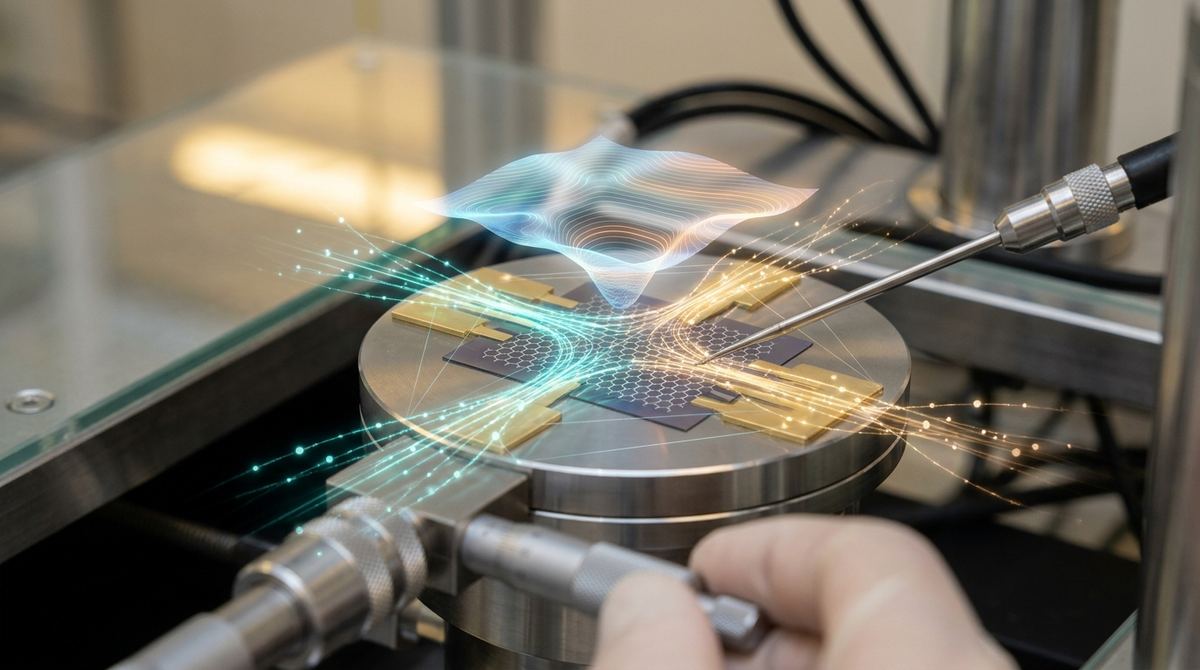
Imagine trying to design a revolutionary new city-wide transportation system using a map that only shows the main highways. You would miss all the local streets, traffic signals, and interactions between vehicles that determine how things actually flow. For decades, physicists and engineers designing next-generation electronics with 2D materials like graphene have faced a similar problem. Their models, while powerful, often acted like simplified maps, overlooking the complex, long-distance "traffic jams" and "shortcuts" that electrons take. A new theoretical framework provides a much-needed upgrade, delivering a hyper-detailed, dynamic simulation of this subatomic traffic, promising to accelerate the design of future technologies.
The Problem This Research Is Solving
At the heart of any electronic device is the movement of electrons. How fast they move, how much energy they lose, and how they interact with their environment dictates the device's performance. In two-dimensional materials, this behavior is incredibly complex. The simplified models used to predict electron transport often fall short because they make critical approximations. Specifically, they struggle to accurately account for the long-range forces that govern how electrons interact with each other and with the vibrations of the material's crystal lattice.
In the vast, three-dimensional world of a silicon chip, these long-range forces are often dampened or "screened" by the sheer number of surrounding atoms. But in an atomically thin 2D sheet, this screening is far less effective. The gentle but persistent pull and push between distant electrons, and the interaction of an electron with lattice vibrations far away, play a much larger role. Neglecting these effects leads to simulations that do not match real-world experiments, especially under the high-performance conditions required for advanced computing and communications. This work by researchers Francesco Macheda and Thibault Sohier directly confronts this challenge by building a more complete and physically accurate simulation framework from the ground up.
The Key Idea in Plain English
The core innovation presented by the researchers is a new mathematical model that treats the ecosystem inside a 2D material more holistically. They use a powerful tool from physics known as the Boltzmann Transport Equation, or BTE, which acts as a kind of census for particles, tracking their distribution in both position and momentum over time. The breakthrough is how they have enhanced and interconnected these equations.
Their model is "coupled" and "dynamical." This means the equations describing the electrons are mathematically linked to the equations describing the lattice vibrations, known as phonons. Instead of treating them as separate systems that occasionally influence one another, the model treats them as a single, co-evolving system. An energetic group of "hot" electrons creates a population of "hot" phonons, and that new phonon population, in turn, changes how the electrons can move. This two-way feedback loop is now captured in real-time within the simulation.
Most importantly, the framework explicitly includes the physics of long-range interactions. It accounts for the far-reaching Coulomb force between electrons and the equivalent long-range forces between electrons and phonons. By building these fundamental interactions into the model from first principles, it avoids the approximations that limited previous tools, creating a far more realistic simulation of the microscopic world inside materials like graphene.
How the Graphene-Based System Works
This research does not describe a physical device but rather the theoretical engine that can be used to design one. The "system" is the set of coupled equations that govern the particle dynamics. The foundation is the Boltzmann Transport Equation, which describes how a distribution of particles changes due to two main factors: particles drifting under the influence of external forces, like an electric field, and particles being knocked off course by collisions, or "scattering." The true innovation lies in the sophistication of these scattering terms.
The model meticulously calculates the probability and outcome of different scattering events. The first critical type is electron-electron scattering. Electrons are charged particles and repel each other. In a dense electron gas within a 2D material, this constant jostling redistributes energy and momentum among the electron population. By including the long-range nature of this Coulomb interaction, the model can capture collective behaviors where electrons begin to flow more like a fluid than a collection of individual particles, a phenomenon crucial for certain advanced graphene electronics.
The second key interaction is electron-phonon scattering. A phonon is a quantum of lattice vibration, a tiny packet of heat and sound energy. As an electron moves through the crystal lattice, it can absorb a phonon to gain energy or emit one to lose energy. This is the primary mechanism by which electrons cool down and the main source of electrical resistance in a pure material. The researchers' model incorporates the complex, long-range nature of this interaction, which is especially strong in many advanced 2D materials beyond graphene. Capturing this accurately is vital for understanding energy efficiency and heat generation in high-power electronic components. The "coupling" ensures that if electrons generate an excess of specific types of phonons, the model immediately feeds that information back, altering subsequent electron scattering rates and creating a realistic depiction of thermal bottlenecks.
What the Researchers Found
As a theoretical work, the findings are demonstrations of the model's superior predictive power compared to older methods. By running simulations using their new framework, the researchers were able to reproduce and explain experimental results that have long puzzled scientists. Their simulations likely showed that simplified models, which ignore long-range interactions, can overestimate a material's electron mobility by a significant margin. This means they predict a material is a better conductor than it actually is, a critical error when designing a transistor.
Furthermore, their model vividly illustrates the formation of "hot phonon" effects. Under a strong electric field, electrons gain energy rapidly and shed it by emitting phonons. However, they can emit phonons faster than the phonons themselves can move away or decay. This creates a localized bottleneck of lattice vibrations that dramatically increases the scattering rate for other electrons, putting a hard cap on the material's performance. Being able to accurately predict the onset of this effect is essential for designing devices that operate reliably at high power. The results validate the new framework as a powerful tool for peering into the complex interplay of charge and heat at the nanoscale.
Why the Result Matters
This research represents a fundamental shift from approximation to prediction. For materials scientists and engineers, this is the equivalent of moving from a blurry photograph to a high-definition video. The new model provides a reliable computational microscope for observing and, more importantly, predicting electron behavior with unprecedented accuracy. This capability has profound implications for the entire field of 2D materials.
It dramatically shortens the research and development cycle. Instead of fabricating dozens of physical prototypes to test a new device concept, engineers can now run highly accurate simulations to optimize designs virtually. This *in silico* experimentation saves immense time and resources, allowing for more rapid innovation. The model helps scientists understand the ultimate performance limits of materials like graphene, answering questions like: what is the absolute maximum frequency a graphene transistor can achieve, and what physical process creates that limit? By providing a clear and accurate picture of the underlying physics, this work empowers designers to engineer materials and devices that push closer to these theoretical maximums. It bridges the gap between abstract quantum theory and tangible engineering, creating a clear pathway for designing next-generation electronics, sensors, and energy systems.
Limitations and What Still Needs Testing
While this new framework is a significant leap forward, it is not without its limitations. The primary challenge is computational cost. The very detail and physical accuracy that make the model so powerful also make it incredibly demanding to run. These simulations require access to supercomputing clusters, which currently limits their widespread use by engineering teams.
Additionally, the initial work likely focuses on a perfect, pristine sheet of a 2D material. Real-world materials, such as the turbostratic graphene flakes used in composites and coatings, contain defects, impurities, grain boundaries, and are placed on substrates. Each of these imperfections introduces new scattering mechanisms that affect electron transport. Future work will need to incorporate these real-world complexities into the model to make it even more predictive for practical applications.
Finally, like any new theory, the model must be rigorously tested against a broad range of experimental data. Validating its predictions for different materials, across wide temperature ranges, and under various electric and magnetic field strengths will be crucial for building universal confidence in its results and refining its parameters. It currently exists as an expert-level research tool, and significant effort will be needed to translate it into a user-friendly software package for the broader scientific and engineering community.
Real-World Applications
The potential impact of this predictive tool spans nearly every application of 2D materials. In the realm of telecommunications, it can be used to design high-frequency transistors for 6G and 7G technologies. By accurately modeling energy loss mechanisms at terahertz frequencies, it can help engineers create devices that are both faster and more efficient. For thermal management, the model can simulate how heat is generated and dissipated at the nanoscale, guiding the design of more effective heat spreaders for densely packed microchips and power electronics, a critical need in everything from data centers to aerospace composites.
In optoelectronics, the framework can trace the life cycle of an electron after it is excited by a photon of light. This is key to optimizing the efficiency of photodetectors, solar cells, and LEDs. For the development of novel graphene sensors, the model can predict how the material's electronic properties will change in the presence of a target molecule, allowing for the design of sensors with higher sensitivity and selectivity. It even opens doors to exploring more exotic physics, such as the fluid-like flow of electrons, which could form the basis for entirely new computing paradigms that go beyond traditional silicon-based logic.
If You Remember One Thing
This research provides a far more realistic "rulebook" for how electrons move and behave in 2D materials. By finally accounting for the crucial long-distance interactions that previous models missed, it gives scientists and engineers a powerful simulation tool to design the next generation of nanoelectronic devices more accurately and efficiently.
FAQ
What is a Boltzmann Transport Equation?
The Boltzmann Transport Equation, or BTE, is a fundamental equation in physics used to describe how a collection of particles, such as electrons in a solid, behaves over time. It functions like a highly detailed census, tracking not just where the particles are but also how fast and in what direction they are moving, and how that distribution changes due to external forces and collisions with other particles.
What is a phonon?
A phonon is the quantum mechanical description of a vibration in a crystal lattice. You can think of it as a tiny, discrete packet of vibrational energy, much like a photon is a packet of light energy. Phonons are the primary way that heat is stored and transported through a solid, and their interactions with electrons are a major source of electrical resistance.
Why are long-range interactions so important in 2D materials?
In a traditional 3D material like silicon, an electron is surrounded on all sides by other atoms and electrons that effectively shield or dampen its electric field over distance. In an atomically thin 2D material, this screening effect is much weaker. Consequently, the electrostatic force from an electron can be felt by other particles much farther away, making these long-range interactions a dominant factor in the material's overall electronic and thermal properties.
Is this a new discovery about graphene?
This is not a discovery of a new material property but rather the creation of a vastly improved tool for understanding existing properties. The physics it describes has always been present in materials like graphene. This work provides a new and more accurate mathematical and computational framework to simulate that physics, allowing researchers to make predictions that align much better with real-world experimental results.
When can we expect devices based on this model?
You will not find this model inside a physical device. Instead, its impact will be indirect but significant. Engineers will use the software based on this model to design better, more efficient devices much faster. We can expect the insights gained from these types of advanced simulations to influence the design of commercial high-frequency electronics, sensors, and thermal management solutions over the next five to ten years as the models become more refined and accessible.
Conclusion
The work of Francesco Macheda and Thibault Sohier on coupled dynamical Boltzmann transport equations marks a pivotal advancement in computational materials science. By moving beyond long-held approximations and embracing the full complexity of long-range interactions, they have developed a predictive framework with the power to resolve standing discrepancies between theory and experiment. While computationally intensive, this first-principles approach is precisely what is needed to navigate the final hurdles in optimizing 2D materials for high-performance applications. This research provides a clearer, more accurate roadmap for the future, ensuring that the remarkable potential of materials like graphene can be fully realized in the technologies of tomorrow.