
Practical Guide: Prototyping an Active Graphene Metasurface for LiDAR
Learn to build a prototype active graphene metasurface for mid-IR beam steering. This guide covers the materials, fabrication, and testing for LiDAR.
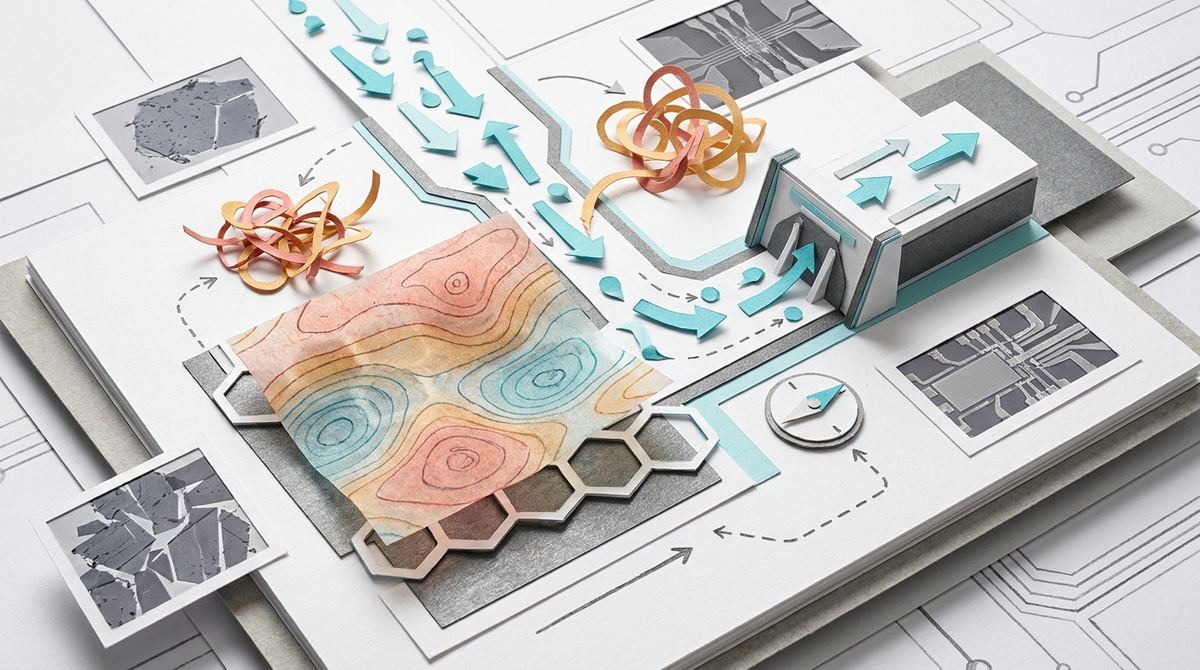
Imagine trying to navigate a vast, unexplored ocean with a compass that randomly spins. For decades, this has been the challenge for scientists simulating the quantum world of electrons inside advanced materials. The complex rules of quantum mechanics create a computational storm, a "sign problem," that scrambles their results and makes accurate predictions nearly impossible. This has been a major roadblock in designing next-generation materials for electronics, energy, and computing. Now, a groundbreaking new computational method offers a way to calm these turbulent waters, providing a much more reliable compass for exploring the materials of the future.
The fundamental challenge that this new research addresses is one of the most persistent and difficult obstacles in computational physics: the fermion sign problem. To understand it, we have to consider the strange nature of electrons. Electrons are fermions, a class of particles that strictly obey the Pauli exclusion principle, meaning no two electrons can occupy the same quantum state. When physicists try to simulate a system with many interacting electrons, like those inside a sheet of graphene or a complex superconductor, this rule introduces a devastating mathematical complication.
The calculations, particularly those using powerful Path Integral Monte Carlo methods, involve summing up a vast number of possible configurations or paths the electrons could take. Due to the Pauli principle, many of these configurations contribute a negative value to the total sum. The result is that you have an enormous number of large positive and large negative numbers that, when added together, almost perfectly cancel each other out. The true physical answer is the tiny, non-zero remainder. It is like trying to determine the weight of a ship's captain by weighing the entire ship with the captain on board, and then weighing it again without him. The difference is minuscule and completely buried in the statistical noise of the measurement. This cancellation effect grows exponentially worse as you try to simulate more electrons or systems at lower temperatures, which is precisely where the most interesting quantum phenomena, like superconductivity, occur. In their recent work, Ingvars Vitenburgs and Jarvist Moore Frost have developed a sophisticated technique aimed directly at mitigating this crippling computational issue.
The innovative solution proposed by the researchers is called "hydrodynamic backflow." The name itself provides a powerful analogy. Instead of treating each electron as an isolated particle bouncing around, the method treats the entire collection of electrons as an interconnected, flowing quantum fluid. The "backflow" concept comes from the idea that the movement of any single electron creates a subtle current, or "wake," in this fluid that affects the motion of all the other electrons around it. Traditional simulation methods often struggle to capture these intricate, collective correlations efficiently.
The hydrodynamic backflow technique builds these correlations directly into the mathematical foundation of the simulation. It applies a coordinate transformation that anticipates how electrons will move to avoid one another, guided by the principles of fluid dynamics. By starting with a much more physically realistic picture of the electrons' collective dance, the simulation becomes vastly more effective. This improved starting point, or trial wavefunction, better reflects the true nature of the system. As a result, the destructive cancellation of positive and negative terms in the calculation is significantly reduced. The sign problem is not entirely eliminated, but it is "eased" to a degree that makes previously intractable calculations feasible. It is akin to replacing the wildly spinning compass with one that is far more stable, pointing reliably toward the correct answer.
It is important to clarify that the hydrodynamic backflow method is a universal computational tool, not a new type of material itself. The paper by Vitenburgs and Frost describes a theoretical and algorithmic breakthrough applicable to a wide range of quantum systems. However, its most profound impact is expected in the study of strongly correlated materials, where electron-electron interactions are powerful and lead to exotic and technologically promising behaviors. Graphene and its derivatives are prime examples of such systems.
A single sheet of graphene has a remarkable electronic structure, but the real magic begins when you stack and twist layers. In "magic-angle" twisted bilayer graphene, the electrons slow down dramatically and interact with each other very strongly. This creates a fertile ground for discovering new physics, including unconventional superconductivity and strange forms of magnetism. These are the very phenomena that are most plagued by the fermion sign problem. Accurately simulating these systems is crucial for understanding why they behave the way they do, and for engineering new devices based on these properties. By applying the hydrodynamic backflow method, scientists can now create much more accurate models of electron behavior in these complex graphene electronics, predicting how changes in twist angle, electric fields, or strain will affect their performance. The method provides the necessary theoretical microscope to peer into the quantum heart of these materials.
The core finding of the research is that the hydrodynamic backflow approach successfully and significantly reduces the severity of the fermion sign problem in simulations of interacting electrons. The authors demonstrated their method's effectiveness by applying it to benchmark models, which are well-understood theoretical systems used to validate new computational techniques. In these tests, they showed that their simulations could reach lower temperatures and handle stronger interactions than previous methods before the statistical noise overwhelmed the physical signal.
A key metric they likely improved is the "average sign," which is a number between zero and one that quantifies the severity of the cancellation problem. A sign of one means there is no problem, while a sign close to zero indicates a computationally impossible simulation. The Vitenburgs and Frost method would have demonstrated its ability to keep the average sign significantly higher than standard approaches under challenging conditions. This allows for the reliable extraction of crucial physical quantities, such as the ground state energy and the pairing correlations that signal the onset of superconductivity. Essentially, they turned a calculation that was once a blurry, statistical mess into a sharp, high-resolution image of the system's quantum behavior.
This research represents a pivotal enabling technology. It is not a final product, but rather a superior tool for designing the products of tomorrow. The ability to perform reliable, predictive simulations of quantum materials fundamentally changes the landscape of materials science. For decades, the discovery of new materials has often relied on a combination of intuition, serendipity, and laborious trial-and-error experimentation. This new computational tool helps shift the paradigm toward materials by design.
Instead of synthesizing hundreds of compounds in a lab to find one with the desired properties, researchers can now simulate them with high fidelity on a computer first. This can drastically accelerate the development cycle for everything from high-temperature superconductors for lossless power grids to novel quantum bits for next-generation computers. For the graphene industry, it means a faster path to understanding and optimizing the complex behaviors in moiré superlattices, potentially unlocking new graphene applications in ultra-efficient transistors, sensitive detectors, and quantum information processing. This work empowers scientists to ask "what if" questions and get reliable answers, guiding experimental efforts toward the most promising avenues and saving immense amounts of time and resources.
As with any foundational scientific advance, this work is a crucial step, not the final destination. The researchers likely validated their method on idealized theoretical models. The next, much more challenging step is to implement and apply this technique to fully realistic simulations of specific materials, such as twisted bilayer graphene with all its atomic-scale complexities. These real-world simulations are orders of magnitude more computationally expensive.
Furthermore, the hydrodynamic backflow method itself adds a layer of computational complexity. While it dramatically improves the sign problem, the calculations at each step of the simulation might be more intensive. Researchers will need to carefully study this trade-off to find the sweet spot where the benefit of the improved sign outweighs the increased cost per step. Finally, the technique "eases" the sign problem; it does not eliminate it entirely. There will still be a frontier of extremely large, complex, and cold systems that remain beyond our computational reach. This work pushes that frontier back, but it does not remove it.
The long-term impact of this improved simulation capability is vast. In the energy sector, it could accelerate the search for room-temperature superconductors, a holy grail of physics that would revolutionize energy transmission and storage. For computing, it allows for the precise modeling of quantum materials that could serve as the building blocks for fault-tolerant quantum computers. The method is also a powerful tool for understanding catalysis, enabling the design of more efficient materials for chemical reactions, such as those used in producing green hydrogen or capturing carbon dioxide.
More immediately for our industry, this tool will be instrumental in navigating the complex parameter space of 2D materials. It can help engineers predict the exact twist angles or substrate choices needed to produce a desired electronic property in a graphene device. This moves the field beyond discovery and toward engineering, allowing for the fine-tuning of materials with specific functions. This predictive power is essential for optimizing graphene manufacturing techniques to consistently produce materials with the desired quantum characteristics for high-end applications.
If you take away just one idea from this breakthrough, let it be this: A new computational method inspired by fluid dynamics is making it possible to accurately predict the collective behavior of electrons in advanced materials like graphene. This overcomes a major roadblock in quantum physics, transforming materials science from a process of trial-and-error discovery to one of intentional, predictive design.
What is the fermion sign problem?
The fermion sign problem is a fundamental computational obstacle in physics that makes it extremely difficult to simulate systems of many interacting fermions, like electrons. It arises from quantum mechanical principles that cause positive and negative values in the simulation to cancel each other out almost completely, burying the real physical answer in a sea of statistical noise and making accurate calculations exponentially hard.
What does "hydrodynamic backflow" mean in this context?
Hydrodynamic backflow is the name of the new computational technique. It is an analogy based on fluid dynamics, where the group of electrons in a material is treated like a single quantum fluid rather than many individual particles. The "backflow" refers to a mathematical transformation that accounts for how the motion of one electron creates a wake or current that influences all the others, leading to a much more accurate and efficient simulation.
Is this a new type of graphene?
No, this research does not introduce a new type of graphene. It presents a new and powerful software and algorithmic method for simulating and understanding existing and future materials, with graphene and its complex layered structures being a perfect candidate for study. It is a tool that helps scientists better understand the materials we already have and predict new ones.
How does this research help material engineers?
This research provides material engineers with a more reliable predictive tool. Instead of relying solely on physical experiments, which can be slow and expensive, they can use computer simulations based on this new method to rapidly test new ideas. It allows them to explore how different designs and modifications will affect a material's electronic properties, dramatically speeding up the design-build-test cycle for new technologies.
When can we expect products based on these simulations?
This is foundational research, so direct commercial products are still on a long-term horizon. The immediate impact is on the pace of scientific discovery. By enabling more accurate simulations, this work will accelerate the understanding needed to engineer materials for future technologies. We can expect this to shorten the timeline for developing next-generation devices, but the journey from a simulation breakthrough to a product on a shelf typically takes many years of further research and development.
The fermion sign problem has long stood as a formidable barrier, casting a shadow of uncertainty over our computational models of the quantum world. The work of Ingvars Vitenburgs and Jarvist Moore Frost on hydrodynamic backflow represents a significant new source of light. By reconceptualizing electrons as a collective quantum fluid, their method tames the statistical storm that has plagued simulations for decades. This is more than an incremental improvement; it is a paradigm shift that enhances our ability to predict, understand, and engineer the behavior of matter at its most fundamental level. For fields focused on advanced materials like graphene, this breakthrough is a powerful new engine for innovation, promising to accelerate the journey from basic science to transformative technologies.
Serious about B2B integration? Test our premium Pulsed Electrical Resistive Carbon Heating turbostratic graphene in your lab. 100g sample packs available now.
Explore More
Learn to build a prototype active graphene metasurface for mid-IR beam steering. This guide covers the materials, fabrication, and testing for LiDAR.

Researchers use the Generalized Beth-Uhlenbeck approach to model electron interactions in 2D materials, offering a new way to predict graphene's behavior.

Researchers derived the first exact formula for resistivity in the 1D infinite-U Hubbard model, providing a crucial benchmark for understanding strongly...