
Practical Guide: Engineering Pure Spin Current Generators with Ferromagnetic GNRs
Learn how to utilize bipartite-lattice symmetry to generate pure spin shift currents in graphene nanoribbons for advanced spintronic device prototyping.
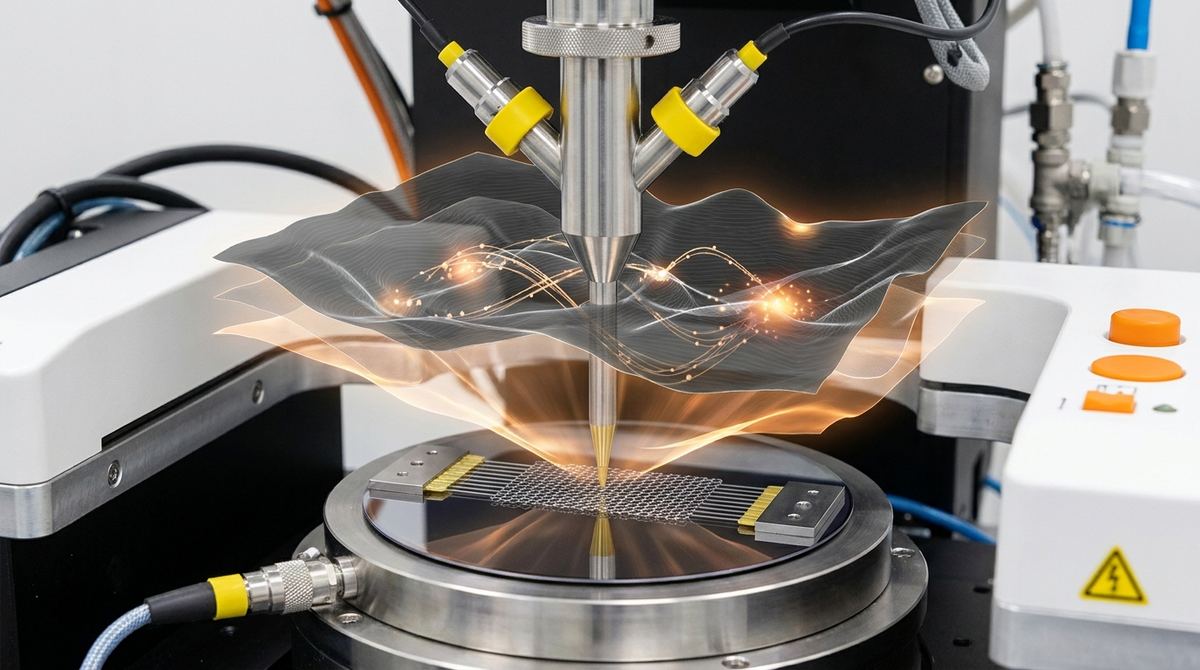
Imagine a crowded hallway where people are trying to move in both directions. If they ignore each other, the flow is simple to predict. But what if they have a strict personal space rule and strongly repel anyone who gets too close? Their movement becomes a complex, collective dance that is incredibly difficult to describe with simple equations. In the world of advanced materials, electrons often behave like this, and understanding their dance is one of the biggest challenges in modern physics. This challenge is central to developing next-generation electronics, superconductors, and quantum computers. For the first time, a team of physicists has provided the complete "sheet music" for this dance in a crucial, simplified setting, offering a perfect model that will guide the field for decades to come.
In the realm of condensed matter physics, one of the most persistent challenges is accurately describing the behavior of electrons in what are known as "strongly correlated" materials. In simple metals like copper, electrons can be pictured as a "gas" of nearly independent particles, a model that works remarkably well for explaining basic conductivity. However, in many exotic materials, from high-temperature superconductors to certain magnetic compounds, this picture breaks down completely. The electrons interact so intensely with one another that the motion of one particle is inextricably linked to the motion of all its neighbors. To tackle this complexity, physicists developed a simplified theoretical framework called the Hubbard model. It captures the two most essential behaviors of electrons in a crystal lattice: their ability to "hop" between atomic sites and their powerful electrostatic repulsion, which makes it energetically costly for two electrons to occupy the same site. Despite its apparent simplicity, solving the Hubbard model exactly has proven to be an immense task. For decades, researchers have relied on approximations and numerical simulations, each with its own limitations. The specific problem addressed in new research from Shuo Liu, Yuhao Ma, Hitesh J. Changlani, Philip W. Phillips, and B. Andrei Bernevig was to find a complete, exact, and analytical solution for the electrical resistivity of the Hubbard model in a specific but fundamentally important case: a one-dimensional chain of atoms where the electron repulsion is infinitely strong. This long-standing goal has now been achieved, providing a definitive answer to how transport behaves in this foundational system.
The key to the researchers' breakthrough lies in tackling an extreme but clean version of the problem. They focused on the "infinite-$U$" Hubbard model. Here, the "U" represents the energy cost of two electrons occupying the same atomic site. Setting this value to infinity creates a strict rule: no two electrons can ever be in the same place at the same time. This is like the personal space rule in our hallway analogy being absolute. They also constrained the problem to one dimension, meaning electrons can only move forward and backward along a single line. While a simplification, this scenario is physically relevant to systems like carbon nanotubes and atomic chains. In this highly constrained environment, the collective behavior of electrons becomes manageable, yet it still exhibits incredibly rich physics. A fascinating phenomenon known as spin-charge separation occurs. Because electrons cannot pass through each other, the collective excitations of the system split into two distinct types of "quasiparticles": holons, which carry the electron's charge but not its spin, and spinons, which carry its spin but no charge. To calculate resistivity, one must understand how these quasiparticles scatter off each other as they move. The central idea of the paper was to use a powerful mathematical technique known as the Bethe ansatz to find the exact energy levels, or spectrum, of every possible configuration of these electrons. By having this complete and exact spectrum, they could then derive a precise, closed-form formula for resistivity as a function of temperature, without any approximations. It is the theoretical equivalent of moving from a blurry, estimated photograph to a perfectly sharp, high-resolution image of the system's electronic behavior.
While the paper by Liu and his colleagues is a work of pure theory, its implications are deeply connected to real-world materials like graphene. The abstract one-dimensional chain of atoms in their model serves as an excellent theoretical proxy for physical structures such as narrow graphene nanoribbons or carbon nanotubes. In these nanomaterials, the carbon atoms form a lattice that confines electron movement primarily along a single axis, effectively creating a real-world one-dimensional system. Furthermore, the electrons within graphene's unique honeycomb lattice can interact very strongly, particularly in low-dimensional structures where screening effects are reduced. This makes the Hubbard model, especially its large-$U$ limit, a highly relevant starting point for describing their electronic properties. The theoretical system solved by the researchers consists of a line of sites where spin-endowed electrons can hop between neighbors under the absolute condition that no site is ever doubly occupied. The researchers' work provides a fundamental mathematical blueprint for predicting how electrical current flows and dissipates energy in such a system. For scientists and engineers working on future graphene electronics, this theoretical foundation is invaluable. It establishes the ideal performance limits and behaviors one could expect from a perfect, one-dimensional carbon-based conductor governed by strong electronic correlations, serving as a baseline against which real, fabricated devices can be compared.
The primary finding of the study is the first-ever derivation of an exact, analytical formula for the electrical resistivity of the one-dimensional infinite-$U$ Hubbard model. This formula is valid across all possible temperatures and electron densities (the "filling" of the atomic chain). This single equation elegantly captures a wealth of complex physical behaviors. The researchers showed that the material's resistivity follows a highly non-trivial path as temperature changes. At very low temperatures, the resistivity is close to zero, and the system behaves as an almost perfect conductor known as a Tomonaga-Luttinger liquid. As the temperature rises, the resistivity increases, which is typical for a metal. However, instead of continuing to rise, the resistivity reaches a peak at a characteristic temperature and then begins to decrease as the temperature is increased even further. This peak-and-decline behavior is a hallmark of strongly correlated systems and is often referred to as "bad metal" behavior. At extremely high temperatures, their formula shows that the resistivity approaches a constant value that is directly related to the randomness, or entropy, of the electron spins. This demonstrates that at high temperatures, the primary obstacle to electron flow is the thermal disorder of the spins. To confirm their monumental theoretical result, the team compared their formula's predictions to the results of large-scale, state-of-the-art numerical simulations. The agreement was perfect, leaving no doubt as to the correctness of their exact solution.
This achievement is a landmark in theoretical physics for several reasons. First and foremost, it provides a definitive and exact benchmark. For many years, physicists have used a variety of approximate methods to estimate the properties of the Hubbard model. Now, any new numerical technique or approximate theory for strongly correlated systems can be tested against this exact solution in the one-dimensional case. If a new method fails to reproduce this result in the appropriate limit, it is flawed. This acts as a powerful filter for theoretical development. Second, the work provides deep insight into the mysterious nature of "bad metals." This unusual behavior, where resistivity peaks and then falls with temperature, is observed in many of the most fascinating and technologically promising materials, including the copper-oxide materials that host high-temperature superconductivity. While this 1D solution does not directly solve the 2D problem of the cuprates, it provides a perfectly understood example of this phenomenon, allowing physicists to dissect the underlying mechanisms with unprecedented clarity. It helps clarify precisely how the interplay between charge carriers (holons) and spin carriers (spinons) gives rise to such unconventional transport, knowledge that can inform the design of novel graphene sensors that exploit subtle electronic effects.
Despite its significance, it is crucial to understand the limitations of this work. The most significant constraint is that the solution is for a one-dimensional system. Most conventional electronic devices and materials exist in three dimensions. The physics of electron interactions can change dramatically when moving from a line (1D) to a plane (2D) or a volume (3D). Extending this type of exact solution to the two-dimensional Hubbard model is a vastly more difficult problem and remains one of the greatest unsolved challenges in physics. Another limitation is the assumption of infinite electron-electron repulsion ($U$). In real materials, this repulsion is very strong but finite. While the infinite-$U$ case is an excellent approximation for many systems, a complete theory would need to account for the effects of a large but finite $U$. Finally, the model is an idealization. It does not include other effects present in real materials, such as impurities, crystalline defects, or interactions between electrons and lattice vibrations (phonons), all of which also contribute to electrical resistivity. Future work will involve incorporating these additional complexities to build an even more realistic picture of electron transport.
As this is a foundational theoretical study, its real-world applications are not immediate but are broad and far-reaching. The primary impact is in guiding the search for and design of future quantum materials. By providing a complete understanding of a key model system, this research equips materials scientists with a deeper theoretical toolkit. It can help them interpret experimental results from one-dimensional materials and predict which chemical or structural modifications might lead to desired electronic properties, like lower resistance or novel switching behaviors. In the long term, this knowledge is critical for the development of revolutionary technologies. For instance, the Hubbard model is widely believed to contain the essential physics of high-temperature superconductivity. Every piece of the puzzle solved, even in a simplified version, brings us closer to the ultimate goal of designing a room-temperature superconductor. Such a material would transform society by enabling lossless power grids, ultra-powerful magnets for transportation and medicine, and dramatic improvements in all forms of electronics. The fundamental insights gained could also influence the development of certain quantum computing architectures and advanced energy storage nanocomposites, where controlling the collective quantum states of interacting particles is paramount.
For the first time, physicists have an exact mathematical formula describing the complete electrical resistance behavior of a fundamental model for materials with strong electron interactions. This result provides an invaluable and perfect benchmark that will shape the future of theoretical physics and the design of next-generation quantum materials.
What is the Hubbard model?
The Hubbard model is a foundational tool in physics used to study the behavior of electrons in solid materials. It simplifies the incredibly complex quantum world into two key ingredients: the ability of electrons to hop between atoms in a crystal lattice and the strong electrical repulsion they feel if they try to occupy the same atom, providing a framework for understanding materials where electron-electron interactions are dominant.
Why is a one-dimensional model useful?
Studying a system in one dimension often makes it simple enough to solve exactly with mathematics, which is usually impossible in two or three dimensions. These exact solutions provide profound and unambiguous insights into the underlying physics, like spin-charge separation, that can then guide our understanding of more complex, real-world materials. A 1D model is also directly applicable to real physical systems like carbon nanotubes and polymer chains.
What does "strongly correlated" mean?
In physics, "strongly correlated" describes a system of particles, such as electrons, where the interactions between them are so strong that they cannot be considered independent. The behavior of any single electron is heavily dependent on the positions and states of all the other electrons, leading to collective, emergent phenomena like high-temperature superconductivity and "bad metal" behavior.
How does this research relate to graphene?
This work is highly relevant to one-dimensional forms of graphene, such as very narrow nanoribbons. In these structures, electrons are confined to move along a line, and their interactions are very strong. This theoretical solution provides a perfect, idealized model for the intrinsic electrical resistivity of such a graphene wire, helping scientists understand its fundamental transport properties.
Is this research about building a new device?
No, this is not about a specific device. This is fundamental scientific research that establishes the underlying physical laws for a particular class of materials. This knowledge is the essential foundation upon which future engineers and materials scientists will build, potentially leading to new types of transistors, sensors, or other advanced graphene applications.
The work by Shuo Liu and his co-authors represents a significant triumph of theoretical physics. By deriving the first-ever exact, analytical expression for the resistivity of the 1D infinite-$U$ Hubbard model, they have solved a problem that has occupied the field for decades. This solution does more than just fill a gap in our knowledge; it provides a rigid, unassailable benchmark against which all future theories and numerical methods for strongly correlated systems will be measured. It offers a crystal-clear window into the complex physics of bad metals and the intricate dance of charge and spin in one dimension. While the path from an idealized 1D model to a functional 3D device is always long, this work lays down a critical and permanent marker on that path, illuminating the way forward in our quest to understand and engineer the quantum materials that will define the technology of the future.
Serious about B2B integration? Test our premium Pulsed Electrical Resistive Carbon Heating turbostratic graphene in your lab. 100g sample packs available now.
Explore More
Learn how to utilize bipartite-lattice symmetry to generate pure spin shift currents in graphene nanoribbons for advanced spintronic device prototyping.

Researchers propose a novel method to detect spin- and valley-polarized states in van der Waals materials, a key step for next-gen spintronics and...

Researchers developed the CARBON-2D Topological Descriptor (C2DTD), an interpretable, physics-informed method to rapidly predict the properties of new 2D...