
Practical Guide: Patterning Graphene Doping on Germanium
Learn how to create p-n junctions in graphene by selectively oxidizing the underlying germanium substrate. This guide covers a practical method for...
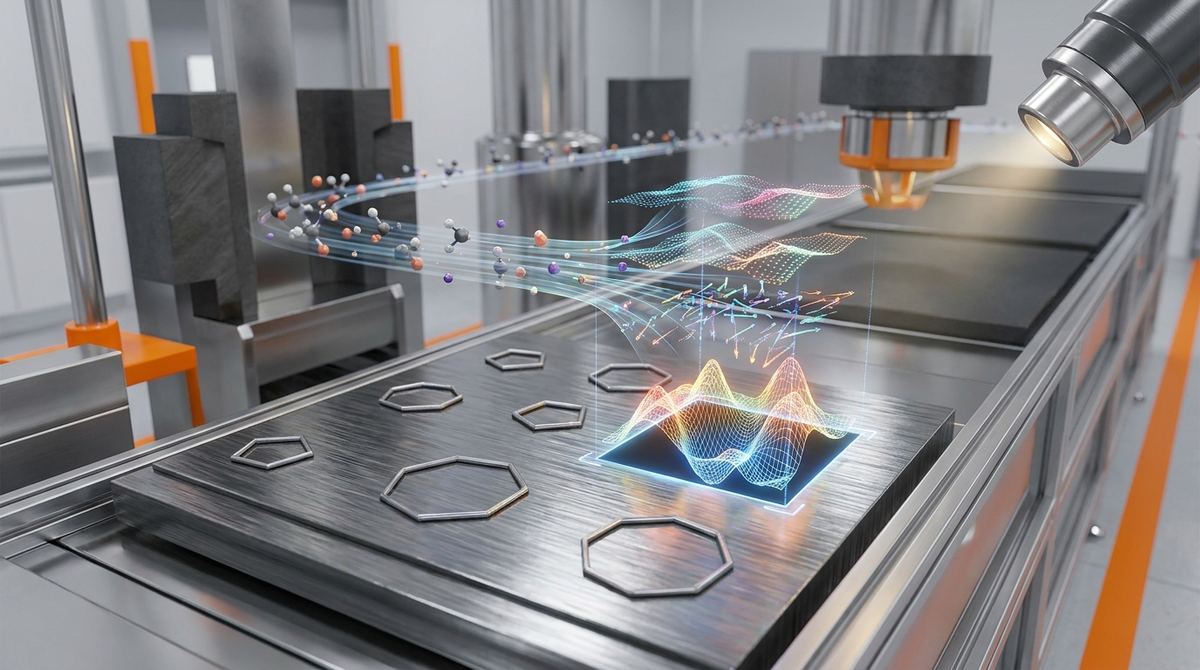
Imagine you are an engineer tasked with designing a material that is stronger than steel, more conductive than copper, and transparently thin. Nature has already provided a template in the form of graphene, a single layer of carbon atoms arranged in a honeycomb lattice. But what if the perfect material isn't exactly graphene? What if it requires a slightly different arrangement of those carbon atoms, perhaps with a few five or seven-sided rings mixed in with the usual hexagons? There are millions, if not billions, of possible arrangements, known as allotropes. Testing each one in a lab would be an impossible task, taking centuries of effort. This is the grand challenge of modern materials science: navigating an almost infinite library of potential materials to find the one with the exact properties we need. A new computational method offers a powerful map and compass for this daunting exploration.
The discovery of new materials has historically been a slow process, relying on a combination of serendipity, chemical intuition, and laborious trial-and-error experimentation. While computational tools have helped, they often present a trade-off. On one hand, highly accurate simulations like Density Functional Theory (DFT) can predict a material's properties from first principles, but they are incredibly time-consuming and computationally expensive. Running a DFT simulation on a single new structure can take hours or days, making it impractical for screening thousands or millions of candidates. On the other hand, machine learning models can make predictions almost instantly, but they are often "black boxes." They learn correlations from data but don't provide a deep, intuitive understanding of the underlying physics. A model might tell you a certain structure is a semiconductor, but it can't easily explain which specific atomic features are responsible for that property. This lack of interpretability hinders rational design, where scientists use their understanding to intelligently create new materials rather than just searching for them blindly. A team of researchers, Felipe Hawthorne, Marcelo Lopes Pereira Junior, Fabiano Manoel de Andrade, Cristiano Francisco Woellner, and Raphael Matozo Tromer, have addressed this critical gap by developing a method that is both fast and physically insightful.
The core innovation presented in this research is a new type of "fingerprint" for two-dimensional carbon materials, which the team has named the CARBON-2D Topological Descriptor, or C2DTD. Think of it like a material's unique genetic code. Just as a DNA sequence encodes the traits of a living organism, the C2DTD encodes the essential structural features of a 2D carbon network into a compact set of numbers. This numerical representation, or descriptor, can then be fed into a computer to rapidly predict the material's properties. What makes C2DTD special are two key characteristics: it is "physics-informed" and "interpretable." "Physics-informed" means that the fingerprint isn't just an abstract collection of numbers; it's designed to capture the specific structural details that physicists and chemists know are important for determining a material's behavior. This includes information about the types of atomic rings (hexagons, pentagons, etc.), the lengths of the bonds between atoms, and the angles at which these bonds meet. "Interpretable" means that a scientist can look at the C2DTD fingerprint and understand what it represents in physical terms. A high value in one part of the code might directly correspond to a high density of seven-membered rings, giving the scientist a clear, actionable insight into the structure-property relationship.
The C2DTD method provides a systematic way to translate a complex atomic arrangement into a simple, standardized vector of numbers. The process begins with the known coordinates of every carbon atom in a given 2D structure. The algorithm first identifies the fundamental building blocks of the network, which are the rings formed by the carbon atoms. While pristine graphene is made exclusively of six-membered hexagonal rings, other allotropes can feature rings with five, seven, or more atoms. The C2DTD system meticulously analyzes this topology. It doesn't just count the different ring types; it also characterizes their local environment. For instance, it records how many hexagons are adjacent to a pentagon, or how two heptagons might share an edge. This captures the short-range and medium-range order of the atomic network, which is crucial for determining electronic and mechanical properties. In addition to this connectivity data, the system also incorporates geometric information. It measures the precise lengths of the carbon-carbon bonds and the angles between them. Deviations from the ideal bond lengths and angles found in perfect graphene create strain and alter the way electrons move through the material. By quantifying these structural features—ring statistics, connectivity, bond lengths, and angles—and organizing them into a fixed-length numerical vector, the C2DTD creates a comprehensive and unambiguous representation of the material. This descriptor serves as the perfect input for machine learning models, allowing them to learn the complex relationships between a material's atomic blueprint and its resulting real-world performance. The development of such descriptors is a critical step in advancing the field of graphene manufacturing techniques, as it provides a target for synthesis efforts.
The authors of the paper demonstrated the effectiveness of their C2DTD by applying it to a large, established database of theoretical 2D carbon structures. They used their descriptor to train a machine learning model to predict a fundamentally important electronic property: the band gap. The band gap determines whether a material is a metallic conductor, a semiconductor, or an insulator, and is therefore a critical parameter for all electronic applications. The results showed that their model could predict the band gap of these diverse carbon allotropes with a high degree of accuracy, closely matching the values obtained from far more computationally expensive DFT calculations. More importantly, they validated the "interpretable" nature of their descriptor. They were able to analyze their trained model and identify exactly which components of the C2DTD fingerprint had the strongest influence on the predicted band gap. This confirmed that the model wasn't just finding arbitrary correlations; it was learning the underlying physics. For example, the model might learn that the presence of specific combinations of five- and seven-membered rings systematically opens a band gap, a known concept in carbon materials science. This ability to extract human-understandable rules from the model is a significant advantage over black-box approaches.
This work has profound implications for the future of materials science. Its primary impact is the massive acceleration of the materials discovery process. By replacing slow, brute-force simulations with a fast and accurate predictive model, researchers can now perform high-throughput virtual screening. They can generate millions of hypothetical 2D carbon structures on a computer, calculate their C2DTD fingerprint in an instant, and use the trained model to predict their properties. This allows them to quickly sift through a vast chemical space and identify a small number of highly promising candidates for further study and eventual synthesis. This dramatically lowers the barrier to innovation, enabling smaller research groups and companies to participate in cutting-edge materials design. Furthermore, the interpretability of the C2DTD fosters a deeper scientific understanding. It helps build intuition about how manipulating a material at the atomic level affects its macroscopic properties. This moves the field away from simple screening and towards rational, goal-oriented design. Instead of asking "What are the properties of this structure?", scientists can start asking "What structure do I need to build to achieve these properties?". This paradigm shift is essential for creating bespoke materials for specific, high-value graphene applications.
While the C2DTD represents a significant advance, it is important to recognize its current limitations. The model presented in the paper was specifically designed for and trained on pure, two-dimensional carbon networks. Its performance on materials that include other elements (doping) or have molecules attached to their surface (functionalization) is unknown and would require extending the descriptor. The framework would need to be modified to account for different atom types and bonding chemistries. Additionally, the study focused on predicting the electronic band gap. While this is a crucial property, the descriptor's ability to predict other important characteristics, such as thermal conductivity, mechanical strength, or catalytic activity, still needs to be rigorously tested. Each property may depend on different structural features, potentially requiring fine-tuning of the descriptor or the training of new models. Finally, this is a computational tool. The most promising materials identified through C2DTD-based screening must still be synthesized in a laboratory and their properties experimentally verified. The path from a promising computer model to a commercially available product like turbostratic graphene flakes involves overcoming significant challenges in scalable production and material characterization.
The practical applications of a tool like C2DTD are vast and span numerous industries. In electronics, it could be used to rapidly discover new 2D carbon semiconductors with optimal band gaps for building faster, more energy-efficient transistors, potentially leading to a new era of carbon-based computing. The design of next-generation devices in graphene electronics could be significantly accelerated. In the energy sector, the descriptor could guide the design of carbon materials with tailored porosity and surface area, creating superior electrodes for supercapacitors and batteries. By understanding how ring structures influence ion adsorption, engineers could develop materials that charge faster and store more energy. In the field of advanced composites, C2DTD could identify carbon allotropes with unprecedented tensile strength and stiffness, leading to lighter and stronger materials for the aerospace and automotive industries. The insights gained could help design reinforcement materials that form stronger interfaces with polymer matrices, revolutionizing everything from airplane wings to vehicle chassis.
If you take away just one concept from this research, let it be this: The C2DTD is a powerful new digital fingerprinting method that allows computers to understand the language of 2D carbon materials. It translates complex atomic structures into a simple, interpretable code, enabling the rapid prediction of their properties and accelerating the search for the next generation of advanced materials by making the discovery process smarter, faster, and more intuitive for scientists.
What exactly is a topological descriptor in materials science?
In materials science, a topological descriptor is a set of numbers that serves as a quantitative fingerprint for a material's atomic structure. Instead of just listing atomic coordinates, it focuses on the connectivity—how atoms are bonded to each other—and the arrangement of these bonds into features like atomic rings. This numerical representation allows for easy comparison between different structures and is an ideal input for machine learning algorithms.
Why is it so important for a machine learning model to be "interpretable"?
An interpretable model is one where humans can understand the reasoning behind its predictions. In materials science, this is crucial because it moves beyond a "black box" that simply gives an answer. It allows scientists to learn why a certain atomic arrangement leads to a desired property, providing fundamental insights that can guide the intelligent design of new materials, rather than relying on random searching.
Is C2DTD a new type of graphene material?
No, C2DTD is not a material itself. It is a computational tool, or a mathematical method, used to describe and analyze materials like graphene and its many variations (allotropes). Think of it as a powerful piece of software for materials scientists, not a new substance you can hold. Its purpose is to help researchers discover and design new physical materials more efficiently.
How does a tool like this actually speed up the process of discovering new materials?
It speeds up discovery by replacing extremely slow and costly physical experiments or high-fidelity computer simulations with nearly instantaneous predictions. A researcher can computationally generate thousands of potential material structures and, instead of spending months testing each one, can use the C2DTD and a trained model to get an accurate estimate of their properties in minutes, quickly identifying the most promising candidates to focus on.
Can the C2DTD method be applied to materials that are not made of carbon?
The specific version of the descriptor developed in this research is tailored for the unique bonding chemistry of two-dimensional carbon networks. However, the underlying principles of creating a physics-informed, interpretable descriptor are general. The methodology could be adapted and extended by other research teams to create similar fingerprinting tools for other classes of materials, such as 2D silicon (silicene), boron nitride, or transition metal dichalcogenides.
The development of the CARBON-2D Topological Descriptor marks a pivotal step forward in the era of data-driven materials science. By creating a tool that is simultaneously predictive, fast, and physically intuitive, Felipe Hawthorne and his colleagues have provided the research community with a powerful new lens through which to explore the vast landscape of 2D carbon allotropes. This work bridges the critical gap between the brute-force power of machine learning and the nuanced insight of human scientific expertise. It paves the way for a future of rational materials design, where novel materials with precisely tailored properties for electronics, energy storage, and structural applications are not just discovered by chance, but designed with intention.
Serious about B2B integration? Test our premium Pulsed Electrical Resistive Carbon Heating turbostratic graphene in your lab. 100g sample packs available now.
Explore More
Learn how to create p-n junctions in graphene by selectively oxidizing the underlying germanium substrate. This guide covers a practical method for...

Explore a breakthrough graphene-silicon slot-waveguide modulator. This high-speed device operates at both 1.5 μm and 2 μm, promising next-gen optical networks.

New research reveals that mechanical strain doesn't just reduce but fundamentally reshapes heat flow in graphene, a critical insight for flexible...