
Practical Guide: Building a Gate Reflectometry Sensor for 2D Material Analysis
Learn to build a gate reflectometry sensor using bilayer graphene. This practical guide details a non-contact method for material characterization.
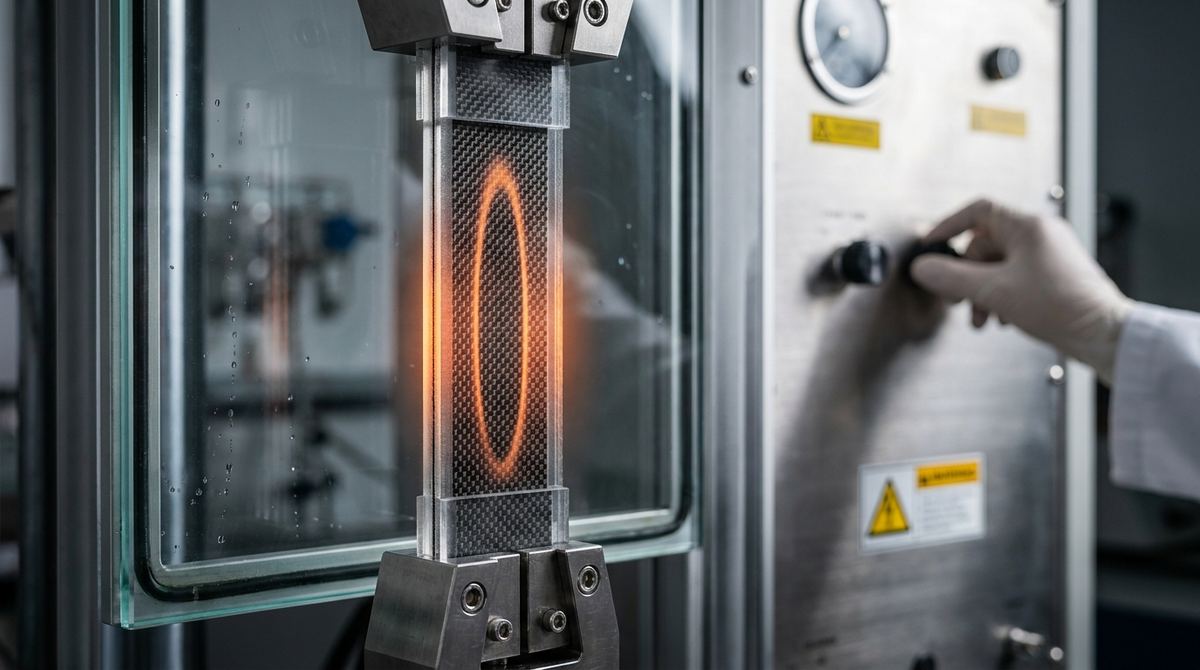
When you stretch a rubber band, it feels different. It becomes taut, stores energy, and its physical properties change. We intuitively understand that mechanical forces can alter a material. But what if those same forces could fundamentally change how heat moves through it? For a material like graphene, known for its record-breaking ability to conduct heat, this question is not just an academic curiosity. It is a critical engineering challenge that could define the success or failure of next-generation electronics, composites, and thermal management systems. The answer, it turns out, is more complex and fascinating than a simple reduction in performance.
Graphene’s reputation as a thermal superstar is well-earned. Its ability to dissipate heat is orders of magnitude better than copper, making it a prime candidate for solving overheating problems in everything from microchips to high-power LEDs. The physics behind this is rooted in how vibrations travel through its perfectly ordered, one-atom-thick lattice of carbon atoms. These vibrations, called phonons, are like particles of heat, and they zip through pristine graphene with almost no resistance.
The problem is that our theoretical understanding is largely based on this ideal, perfectly flat, and unstressed sheet of graphene. In the real world, this is rarely the case. When graphene is mixed into a polymer to create a stronger composite, embedded into a flexible screen, or deposited onto a substrate, it is inevitably subjected to mechanical strain. It gets pulled, pushed, wrinkled, and compressed. This introduces a significant gap between theory and practice. Engineers designing real-world graphene applications have been forced to wonder: How does this constant, unavoidable mechanical stress affect graphene’s ability to do its primary job of moving heat? Does stretching it simply make it a worse conductor, or is something more profound happening? A foundational study from Navaneetha K. Ravichandran aims to answer this question, bridging the gap between the mechanical and thermal worlds of this remarkable material.
The central idea of this research is that elasticity does not just diminish heat flow in graphene; it actively reshapes it. To understand this, we must first picture how heat moves. It is not a fluid flowing through a pipe. Instead, it is the transfer of vibrational energy from one atom to its neighbors. These collective vibrations travel in waves, or phonons. In an unstressed sheet of graphene, these phonons can travel freely and quickly in all directions, leading to its exceptional, isotropic (direction-independent) thermal conductivity.
This research proposes that applying elastic strain—stretching or compressing the atomic lattice—changes the fundamental rules governing phonon transport. Stretching the bonds between carbon atoms is like tightening the strings on a violin; it alters the frequencies at which they can vibrate. This change affects how phonons move, how they interact with each other, and which types of vibrations carry the most thermal energy. The result is not a simple bottleneck. Instead, the strain can create preferred pathways for heat, making the material conduct heat better in one direction than another. It transforms graphene from a uniform thermal superhighway into a system with fast lanes and slow lanes, where the traffic flow of heat can be directed by mechanical force.
This research appears to be a work of theoretical physics and computational modeling, a common and powerful approach for exploring atomic-scale phenomena that are incredibly difficult to measure directly. The "system" in this case is not a physical device but a sophisticated computer simulation of a single graphene sheet. Researchers likely employed a technique such as molecular dynamics (MD) simulations.
In this method, a virtual model of the graphene lattice is constructed, representing each carbon atom and the forces that bind it to its neighbors. This digital recreation behaves according to the laws of quantum mechanics and classical physics. To investigate the effects of elasticity, the researchers would apply a virtual force to the edges of this simulated graphene sheet, pulling or pushing it to induce a precise amount of tensile or compressive strain.
With the lattice held in this strained state, a thermal gradient is established. This is done by adding kinetic energy to the atoms at one end of the sheet (a "hot" region) and removing it from the atoms at the other end (a "cold" region). The simulation then runs, calculating the motion of every single atom over time. By tracking how quickly energy moves from the hot side to the cold side, the scientists can precisely calculate the thermal conductivity of the strained graphene. Crucially, this method allows them to dissect the heat flow, identifying which specific phonon modes are contributing the most and how their behavior changes under strain.
The study uncovered a complex and nuanced relationship between strain and heat transport. The most significant finding is that mechanical strain induces thermal anisotropy. While unstrained graphene conducts heat equally well in all directions, a sheet under tensile strain becomes a directional conductor. The simulation showed that heat flows more readily along the direction of the stretch, while conduction perpendicular to the stretch is suppressed. This is the "reshaping" effect described in the title; the uniform, circular pattern of heat spreading from a point source becomes an ellipse, elongated in the direction of strain.
Furthermore, the researchers identified the microscopic reason for this change. Heat in graphene is carried by different types of phonons, including in-plane (longitudinal and transverse acoustic) modes and out-of-plane (flexural acoustic) modes. These flexural modes, often called ZA phonons, involve atoms vibrating up and down, like the surface of a drum. They are a major contributor to graphene's high thermal conductivity. The study found that these crucial ZA phonons are particularly sensitive to tensile strain. Stretching the sheet flattens out the ripples and suppresses these out-of-plane vibrations, effectively closing down a major channel for heat transport. The remaining in-plane phonons then dominate, and their movement is naturally biased along the direction of the strained bonds, leading to the observed anisotropy.
This work is foundational because it provides engineers with a more accurate and dynamic model of graphene's thermal behavior. For designers of graphene electronics, this is a game-changer. Instead of relying on a single, idealized value for thermal conductivity, they can now use models that account for the mechanical stresses a component will face during operation. This allows for more accurate thermal simulations, preventing device failure due to unexpected overheating in flexible or strained components.
Beyond better prediction, this research opens the door to "strain engineering" of thermal properties. It suggests we could intentionally apply strain to graphene layers to control and direct the flow of heat at the nanoscale. Imagine creating "thermal diodes" that guide heat away from sensitive components or "thermal channels" etched into a material not by removing material, but by patterning strain. This concept of using mechanical force as a tool to manipulate thermal energy flow is a powerful one for advanced thermal management. It also provides crucial insights for developers of reinforced polymer composites, helping them understand how the internal stresses within a material will influence its overall ability to handle thermal loads.
As with any fundamental research, especially computational studies, there are important limitations to consider. This work likely focused on a perfect, defect-free monolayer of graphene. Real-world graphene, such as the turbostratic graphene flakes used in industrial composites and coatings, is far from perfect. It contains defects, grain boundaries, and wrinkles, and is often stacked in multiple layers. The interplay between pre-existing defects and applied strain is a complex area that requires further investigation. How does stretching a sheet with a grain boundary affect heat flow compared to stretching a perfect one?
Another critical area for future work is the role of interfaces. In most applications, graphene is not suspended in a vacuum; it is part of a larger system, bonded to a substrate or embedded in a polymer matrix. The transfer of heat across the interface between graphene and its surrounding material is often the limiting factor in thermal performance. Future studies will need to model how strain affects this interfacial thermal conductance. Finally, and most importantly, these computational predictions require rigorous experimental validation. Measuring thermal conductivity in a suspended graphene sheet while precisely controlling mechanical strain is an exceptionally difficult experiment, but it is the necessary next step to confirm these theoretical findings.
The immediate impact of this research will be in the design and modeling of devices where graphene is already being considered. In flexible and wearable electronics, components are constantly bent, creating tensile and compressive strains in the conductive graphene layers. This work provides the physical understanding needed to design circuits that remain cool and reliable even when deformed.
In aerospace composites, materials must withstand both mechanical stress and extreme temperature changes. This research can help engineers design graphene-reinforced materials that not only are strong and lightweight but also have predictable and reliable thermal properties under operational stress. For thermal interface materials (TIMs), which are used to draw heat from computer chips, graphene fillers are compressed during assembly. This study can guide the formulation of new TIMs that are optimized to perform best under that specific compressive load. Lastly, it hints at novel sensor applications. If thermal conductivity is a reliable function of strain, one could potentially build highly sensitive strain sensors by measuring minute changes in temperature or heat flow.
Remember this: applying mechanical force to graphene does more than just hinder its ability to conduct heat. It fundamentally reshapes the pathways that heat can take, transforming it from a uniform conductor into a tunable, directional one. This insight elevates our view of graphene's properties from static numbers in a textbook to dynamic, controllable characteristics that can be engineered for specific purposes.
What exactly is a phonon?
A phonon is the quantum mechanical description of a collective vibration in a crystal lattice. You can think of it as a particle of heat or sound. Just as light can be described as both a wave and a particle (a photon), the vibrational energy that constitutes heat in a solid can be described as discrete packets, or phonons. The way these phonons travel and scatter determines a material's thermal conductivity.
Why is high thermal conductivity in graphene so important for applications?
High thermal conductivity is crucial for thermal management, which is the process of controlling and dissipating unwanted heat. In modern electronics, components like CPUs generate immense heat in a small area. If this heat is not removed efficiently, the device will overheat, perform poorly, and eventually fail. Graphene's ability to quickly spread and conduct heat away from these hotspots makes it a highly promising material for next-generation cooling solutions.
Does this research mean graphene is a worse thermal conductor than we thought?
Not necessarily. It means its thermal conductivity is more complex and depends on its mechanical state. In some cases, like under significant strain, the overall conductivity might be lower than the ideal value. However, the research also shows that this property can be controlled and directed. This transforms it from a simple limitation into a potential engineering tool for actively managing heat flow, which could be more valuable than just having a high, static conductivity value.
What does "elastic strain" mean in this context?
Elastic strain refers to the deformation of a material when a force is applied, but in a way that is reversible. When the force is removed, the material returns to its original shape and size, like a rubber band that has been stretched and released. This is different from plastic deformation, where the material is permanently altered. This research focuses on how these temporary, elastic changes to the graphene lattice affect heat flow.
How soon can we expect products that use "strain engineering" for heat?
This research represents a fundamental scientific discovery. While it provides immediate value for engineers creating more accurate models of existing systems, products based explicitly on "strain engineering" of thermal properties are likely many years away. First, the findings need to be confirmed with physical experiments, and then methods to precisely control strain at the nanoscale in a commercial device would need to be developed. This work provides the scientific blueprint, but the engineering and manufacturing challenges are still significant.
The connection between a material's mechanical and thermal properties is often overlooked, yet it is fundamental to performance in the real world. The work by Navaneetha K. Ravichandran provides a critical and elegant look into this relationship for graphene. By demonstrating that elasticity can reshape and direct heat flow, this study moves beyond the static picture of a perfect material and offers a dynamic understanding that is essential for real-world engineering. It lays the groundwork for more robust and intelligent thermal design in flexible electronics and advanced composites, and it opens up the exciting possibility of using mechanical force as a subtle yet powerful tool to control energy at the atomic scale.
Serious about B2B integration? Test our premium Pulsed Electrical Resistive Carbon Heating turbostratic graphene in your lab. 100g sample packs available now.
Explore More
Learn to build a gate reflectometry sensor using bilayer graphene. This practical guide details a non-contact method for material characterization.

Explore how theoretical physics unlocks the secrets of strongly correlated superconductivity in twisted bilayer graphene, a key step toward future quantum...

Explore how the intrinsic band geometry of 2D materials can induce valley polarization of chiral excitons, a key step toward next-gen valleytronics.