
Practical Guide: Building a High-Sensitivity Graphene-BN Piezotronic Sensor
Explore a new class of pressure sensors using graphene to detect pressure-enhanced polarization in ferroelectric boron nitride, a novel slidetronic effect.
In the world of conventional electronics, information is binary. A transistor is either on or off, representing a one or a zero. This simple principle has powered our digital world for decades. But as we push the limits of miniaturization, scientists are exploring new ways to encode and manipulate information using the more subtle and complex properties of quantum mechanics. Instead of just on or off, what if we could use an electron's spin, or another intrinsic property, to create richer information states? This quest has led to fields like spintronics and, more recently, valleytronics. Valleytronics seeks to utilize an electron's "valley" degree of freedom—a property related to its momentum in a crystal lattice—as an information carrier. The central challenge, however, has always been achieving precise and stable control over which valley the electrons occupy. A new theoretical paper offers a fascinatingly elegant solution: engineering the material itself so that its fundamental geometry naturally guides information into the desired state.
To build a functional valleytronic device, you need a reliable way to create and maintain a population of electrons in one valley but not the other. This is called valley polarization. Achieving it is difficult. Most current methods rely on brute force, using powerful external magnetic fields, precisely engineered mechanical strain, or specific kinds of light to push electrons into the desired valley. While these methods work in laboratory settings, they are often impractical for real-world devices. They can be bulky, energy-intensive, and the polarization they create is often fragile, easily disrupted by heat or material imperfections. The core problem is that we are trying to impose control from the outside. The research by Archisman Panigrahi and Daniel Kaplan, detailed in their recent paper, tackles this problem from a completely different angle. Instead of forcing the system into a state, they ask: can we design a material where the laws of physics governing its electrons create this polarization automatically?
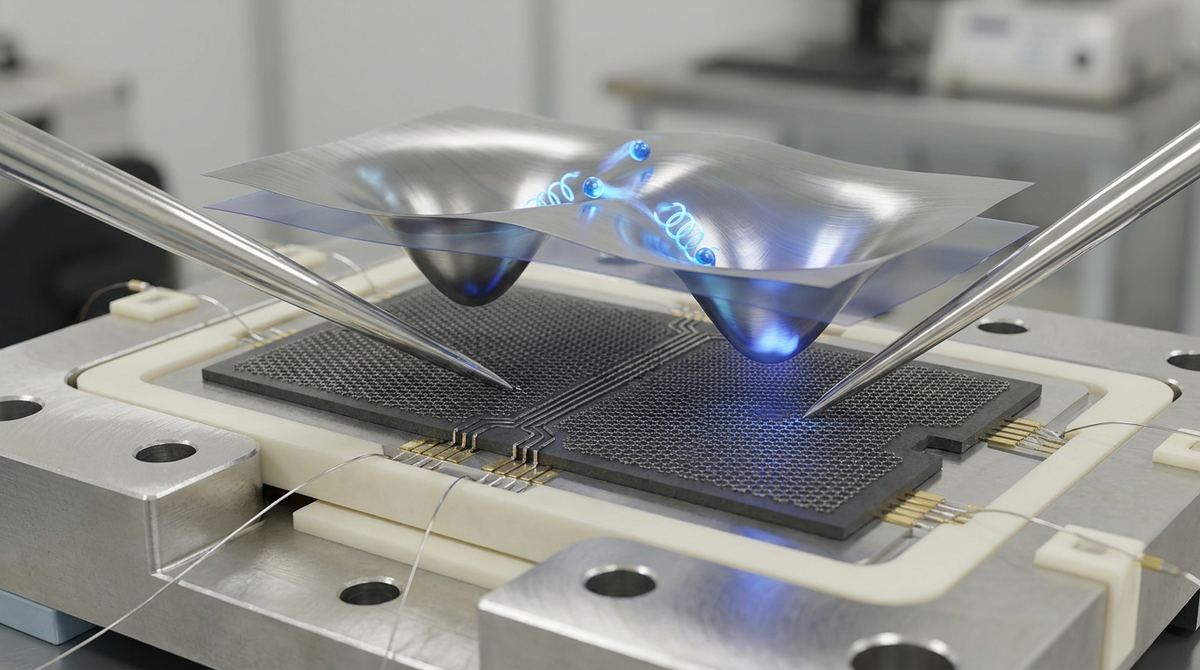
The central insight of the research is to use the material's intrinsic "band geometry" to achieve control. Imagine the possible energy states of an electron inside a crystal as a vast, rolling landscape. The low points in this landscape are the "valleys" where electrons prefer to reside. In many advanced materials, like those used in graphene electronics, there are two or more identical valleys at the same energy level, known as K and K' valleys. The key idea from Panigrahi and Kaplan is that this energy landscape isn't just a simple surface; it has a complex, underlying geometry. This geometry includes properties like curvature and distance, which, while invisible on a macro scale, profoundly affect the behavior of quantum particles.
The researchers focused on excitons, which are bound pairs of an electron and a positively charged "hole" it leaves behind. These pairs can be "chiral," meaning they have a specific handedness, like a left-handed or right-handed screw. Their theoretical work shows that this chirality can couple directly to the underlying geometry of the energy landscape. In essence, the material can be designed so that its geometry makes one valley a more comfortable and stable home for left-handed excitons, while the other valley becomes the preferred home for right-handed excitons. By creating only one type of chiral exciton (for instance, using circularly polarized light), you can coax them to populate a single valley by default. The control is no longer external; it's woven into the very fabric of the material.
While the paper is theoretical, it describes a system rooted in the properties of 2D materials. These materials, such as graphene and transition metal dichalcogenides (TMDs), are single-atom-thick sheets that provide the perfect platform for exploring valleytronics. The system works by linking three concepts: light, chirality, and band geometry. First, an incoming photon of light with sufficient energy strikes the material, exciting an electron and leaving behind a hole. This electron-hole pair, attracted by their opposite charges, forms an exciton. The key is that the polarization of the incoming light determines the exciton's properties. Specifically, circularly polarized light can selectively generate excitons with a specific chirality, or handedness.
This is where the novel physics comes in. In a typical material, this chiral exciton would have an equal chance of forming in either the K or K' valley. However, in the system modeled by the researchers, the intrinsic geometry of the electronic bands breaks this symmetry. The band structure possesses properties known as the Berry curvature and the quantum metric, which act like a hidden force field that interacts differently with left-handed and right-handed excitons. This interaction changes the binding energy of the exciton—how tightly the electron and hole are held together. The model shows that the geometry can be tailored such that a left-handed exciton is more stable (has a higher binding energy) in the K valley, while a right-handed one would be more stable in the K' valley. Therefore, when you shine left-circularly polarized light on the material, the resulting left-handed excitons naturally form and persist in the K valley, creating a robust valley polarization without any external magnetic field. The material sorts the excitons automatically based on their chirality.
Through rigorous theoretical modeling, Panigrahi and Kaplan demonstrated a direct and powerful connection between band geometry and the stability of chiral excitonic states. Their calculations predict that this geometric effect can be remarkably strong, leading to a high degree of valley polarization. They established a clear cause-and-effect relationship: the specific geometric properties of the electron bands dictate the difference in binding energy for a chiral exciton between the two valleys. This energy difference acts as a barrier, effectively locking the exciton into its preferred valley and making the polarization stable against thermal fluctuations and other disturbances. A crucial finding is that this effect can be engineered. For example, in systems like twisted bilayer TMDs, the twist angle between the layers directly modifies the band geometry. This suggests that engineers could tune a material to optimize this valley-locking effect for specific applications, turning a fundamental physical phenomenon into a design parameter.
This research represents a potential paradigm shift in how we approach the design of quantum devices. It moves away from the concept of external manipulation and toward a philosophy of intrinsic design. By encoding the desired function directly into the geometric DNA of the material, we can envision devices that are far more efficient, robust, and compact. The energy that would have been spent on a powerful electromagnet to polarize the valleys is no longer needed. The resulting polarization is inherently more stable because it arises from the material's ground-state properties, not a fragile, externally imposed condition. This opens up a new toolbox for materials scientists and device physicists. It provides a clear theoretical roadmap for creating materials that self-organize information at the quantum level. This fundamental understanding is a critical prerequisite for advancing the entire field of valleytronics from a laboratory curiosity toward a viable technology platform. The broader graphene applications landscape could one day include these geometrically-engineered materials for information processing.
It is essential to recognize that this work is a theoretical prediction. The model makes certain idealizations and does not yet account for all the complexities of a real-world material. The first and most significant hurdle is experimental verification. Scientists will need to fabricate materials with the precise geometric properties described in the paper and then use advanced optical spectroscopy techniques to measure the binding energies of chiral excitons in each valley. This is a formidable challenge, requiring pristine materials and extremely precise characterization. The influence of defects, impurities, and thermal effects in a real sample could potentially weaken or mask the predicted phenomenon. Furthermore, the efficiency of creating these excitons with light and reading out their valley state needs to be studied in a practical device structure. While the theory is elegant and compelling, the path from a theoretical model to a working prototype involves overcoming substantial engineering and materials science challenges, from scalable production to device integration.
While commercialization is distant, the long-term implications of this research are profound. If these theoretical predictions can be realized experimentally, they could form the basis for a new class of optoelectronic devices. In quantum computing, a stable, valley-polarized exciton could serve as a qubit, the fundamental unit of quantum information. The ability to write information with one color of polarized light and read it with another could lead to ultra-fast optical transistors and modulators, far exceeding the speed of current electronics. These valleytronic logic gates could also be incredibly energy-efficient, as they would not rely on moving large numbers of electrons around, which generates heat. This could impact everything from data centers to mobile computing. As our understanding grows, we may see this principle applied to highly sensitive optical sensors or even new forms of information storage. The graphene market research points towards a future where such advanced material properties drive significant value in high-technology sectors.
If you take away just one idea from this research, let it be this: we are learning to program matter at its most fundamental level. Instead of using external forces to control quantum information, we can design the very geometry of a material's electronic structure to do the work for us, creating a built-in, robust form of quantum control.
What is an exciton?
An exciton is a quasiparticle that exists inside a semiconductor or insulator. It forms when a photon of light excites an electron, causing it to jump to a higher energy level and leave behind a positively charged "hole." The negatively charged electron and the positively charged hole are then attracted to each other and form a short-lived, bound pair, which is the exciton.
What is "valleytronics"?
Valleytronics is an emerging field of electronics that aims to use the "valley" degree of freedom of an electron as an information carrier. In the energy-momentum landscape of certain crystalline materials, there exist multiple minimums, or valleys. Valleytronics explores encoding information by controlling which of these distinct valleys an electron population occupies, similar to how spintronics uses electron spin.
What does "chiral" mean in this context?
In this context, chiral refers to the "handedness" of the exciton's internal state. Much like your left and right hands are mirror images but cannot be superimposed, an exciton can exist in a left-handed or right-handed state. This property is often linked to its interaction with circularly polarized light, where left-circularly polarized light creates left-handed excitons and vice-versa.
Why is controlling this with "band geometry" special?
Controlling valley polarization with band geometry is special because it is an intrinsic, built-in mechanism. Traditional methods use external forces like magnetic fields, which are inefficient and cumbersome. By engineering the fundamental geometric properties of the material itself, the control becomes part of the system's natural state, making it potentially far more robust, stable, and energy-efficient.
Is this technology ready for my phone?
No, this technology is not ready for consumer devices. This paper represents fundamental, theoretical research that explores the basic physics of how such a system might work. There are many significant experimental and engineering challenges to overcome before these concepts could be translated into a practical, commercially viable technology. It is a glimpse into the future of electronics, not the present.
The theoretical work of Archisman Panigrahi and Daniel Kaplan provides a profound and elegant new perspective on controlling quantum information in solid-state systems. By revealing the deep connection between the geometry of electron bands and the stability of chiral excitons, they have laid out a blueprint for a new class of materials with built-in valleytronic functionality. This research shifts the focus from external manipulation to intrinsic design, a move that could ultimately lead to more powerful, efficient, and stable devices for computing and communications. The journey from this beautiful theory to tangible technology will be long and challenging, but it points toward a future where the very structure of matter is the ultimate information processor.
Serious about B2B integration? Test our premium Pulsed Electrical Resistive Carbon Heating turbostratic graphene in your lab. 100g sample packs available now.
Explore More
Explore a new class of pressure sensors using graphene to detect pressure-enhanced polarization in ferroelectric boron nitride, a novel slidetronic effect.

Researchers predict a new physical effect in gapless Dirac materials like graphene, where propagating waves can induce a direct DC current without a p-n...

Explore how the superfluid weight in magic-angle graphene is driven by quantum geometry, a discovery that could redefine our search for new superconductors.