
Deconstructing Superfluid Weight in Magic-Angle Graphene: The Geometric Key
Explore how the superfluid weight in magic-angle graphene is driven by quantum geometry, a discovery that could redefine our search for new superconductors.
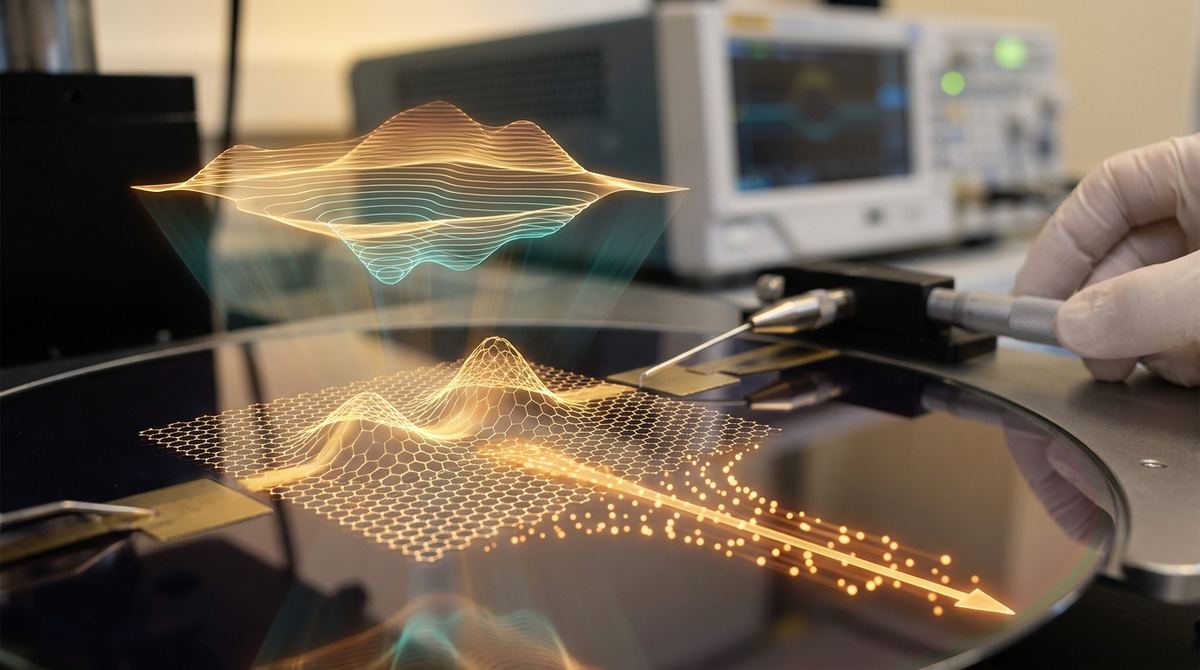
Imagine a world where the sea of ambient energy surrounding us—from Wi-Fi signals to radio waves—could be directly harvested and converted into usable electrical power. Instead of plugging in a device, the device itself could sip energy from the air. This vision of ubiquitous, low-level energy harvesting has been a long-standing goal in electronics, but creating efficient converters, especially for high-frequency signals, remains a significant challenge. A groundbreaking theoretical paper explores a novel physical mechanism that could make this a reality, using the unique properties of advanced materials like graphene to turn propagating waves directly into a steady stream of electrical current.
To convert an alternating current (AC), like that in an electromagnetic wave, into a direct current (DC) that can power electronics or charge a battery, we rely on devices called rectifiers. The most common rectifier is a diode, which acts as a one-way gate for electricity. While effective for many applications, conventional diodes have fundamental limitations. They often require a specific voltage to turn on, they can be inefficient, and their performance drops dramatically at very high frequencies, particularly in the terahertz (THz) range. This "terahertz gap" is a slice of the electromagnetic spectrum that holds immense promise for ultra-fast communications and advanced sensing, but it is notoriously difficult to work with using conventional electronic components.
Scientists are constantly searching for new physical principles to overcome these hurdles. The goal is to find a way to generate a DC current that is more direct, more efficient, and doesn't rely on the complex, multi-material junctions found in traditional diodes. In a recent theoretical study, researchers Keisuke Kitayama and Masao Ogata from the University of Tokyo have predicted a powerful new effect in a class of materials known as gapless Dirac materials. Their work suggests that a simple, pristine sheet of a material like graphene could intrinsically perform this AC-to-DC conversion, opening a new frontier for energy harvesting and high-frequency electronics.
At its core, the idea proposed by the researchers is a form of "electron surfing." In a typical conductive material, when an electromagnetic wave passes through, it causes the electrons to oscillate back and forth. They wiggle in place, but there is no net movement in one direction, so no DC current is produced. It is like a buoy in the ocean bobbing up and down as a wave passes but ultimately staying in the same spot.
Kitayama and Ogata’s theory predicts that something entirely different happens in gapless Dirac materials. In these materials, electrons behave in a very peculiar way, as if they have no mass and are moving near the speed of light, governed by the principles of relativistic physics. Because of this unique behavior, a propagating wave can do more than just make the electrons wiggle; it can actually drag them along, forcing them to surf the wave. This creates a net, directional flow of electrons, which is, by definition, a direct current. This phenomenon, known as a photogalvanic or wave-drag effect, turns the material itself into a converter. It is not a component built from the material, but rather an inherent property of the material’s fundamental physics.
The theoretical system is elegantly simple. It consists of a single, two-dimensional sheet of a gapless Dirac material. Graphene is the quintessential example. The defining feature of graphene's electronic structure is the "Dirac cone," a graphical representation of its electron energy levels. In pristine, undoped graphene, the conduction and valence bands meet at a single point, the Dirac point, with no energy gap between them. This gapless nature means that electrons can be excited into a conductive state with almost no energy input. This is the first key ingredient.
The second ingredient is the propagating wave. This could be an electromagnetic wave, such as a radio wave, a terahertz beam, or even light. The wave creates a fluctuating electric and magnetic field that permeates the graphene sheet. This field interacts with the "massless" Dirac fermions—graphene's charge carriers. The researchers' calculations, rooted in quantum transport theory, analyze the response of these electrons to the wave's influence.
The magic happens in the non-linear response. The first-order, or linear, response is the simple oscillation described earlier. However, the unique physics of the Dirac cone introduces a strong second-order, or non-linear, effect. This non-linearity breaks the symmetry of the electron's motion. Instead of moving back and forth equally, the electrons are nudged slightly further in the direction of the wave's propagation with each cycle. This tiny, repeated nudge accumulates into a significant, steady flow of charge. The result is a DC current that flows through the graphene sheet, powered directly by the energy of the incoming wave. The process of creating such pristine materials is a field of study in itself, involving sophisticated /blog/category/graphene-production/ techniques to achieve the necessary quality.
The theoretical investigation by Kitayama and Ogata yielded several key predictions about this wave-induced current. First and foremost, they confirmed that a DC current should indeed be generated and derived a mathematical formula describing its magnitude. Their results indicate that the strength of the current is directly proportional to the intensity (the square of the amplitude) of the incoming wave. This is a classic signature of a second-order non-linear effect and confirms the underlying physical mechanism.
Furthermore, their model predicts how the current depends on other factors. For instance, the efficiency of the conversion is expected to be highly dependent on the wave's frequency and the chemical potential of the graphene, which can be tuned by applying an external voltage or through chemical doping. This tunability is a powerful feature, suggesting that devices based on this principle could be optimized for specific frequencies or applications. The theory also predicts the direction of the current, which is expected to flow along the same direction as the wave's propagation. This is a crucial detail for designing the geometry of a potential device, as it dictates where to place electrical contacts to collect the generated power. A significant conclusion is that the effect should be most pronounced in clean, high-quality graphene where the unique Dirac physics is not obscured by defects or impurities.
This theoretical discovery is significant for several reasons. It proposes an entirely new physical mechanism for rectification that is intrinsic to a material, eliminating the need for complex p-n junctions that form the basis of all modern diodes. A device could be as simple as a single sheet of graphene with two contacts. This inherent simplicity could lead to cheaper, more robust, and more easily manufactured electronic components.
The potential to operate efficiently at extremely high frequencies is perhaps the most exciting implication. Because the effect relies on the near-instantaneous response of massless Dirac fermions, it should not suffer from the same speed limitations as conventional electronics. This could finally provide a practical solution for creating detectors, mixers, and energy harvesters in the terahertz gap, unlocking a wealth of technological graphene applications in security, medical imaging, and next-generation 6G communications.
Moreover, the work provides a powerful new way to explore the fundamental quantum physics of Dirac materials. By experimentally measuring the induced current and comparing it to the theoretical predictions, scientists can gain deeper insights into the exotic behavior of electrons in these systems. It transforms a theoretical curiosity into a measurable phenomenon that can be used to test and refine our understanding of quantum mechanics in condensed matter.
It is crucial to remember that this work is a theoretical prediction. While the underlying physics is sound, the real world is always more complex. The primary limitation is the absence of experimental verification. Experiments will be needed to confirm that the effect exists and to measure the magnitude of the generated current. The practical usefulness of this phenomenon hinges on whether the current is large enough to be detected easily and to power other devices.
The model used by the researchers likely assumes an ideal scenario: a perfect, defect-free graphene lattice at very low temperatures. Real-world /products/turbostratic-graphene-flakes/ contain impurities, grain boundaries, and other imperfections. These defects can scatter electrons and potentially disrupt the coherent "surfing" motion required to generate the DC current. Furthermore, thermal vibrations at room temperature can also interfere with the process. Future research, both theoretical and experimental, will need to investigate how robust this effect is in the face of these real-world non-idealities.
If experimentally confirmed and proven to be efficient, the implications of this work are vast. The most immediate application would be in ambient energy harvesting. Imagine self-powered sensors for the Internet of Things (IoT) that continuously draw power from surrounding Wi-Fi and cellular signals, eliminating the need for batteries. Wearable medical devices could be powered in the same way, making them smaller and more convenient.
In the realm of high-frequency electronics, this principle could revolutionize terahertz technology. It could lead to simple, sensitive, and room-temperature detectors for THz radiation, which are currently expensive and cumbersome. Such detectors are critical for applications ranging from airport security scanners that can see through clothing to non-invasive medical diagnostics. This research could be a key enabler for the future of /blog/category/electronics-photonics/. Finally, the principle could be applied to wireless power transfer, creating highly efficient rectennas (rectifying antennas) that convert transmitted microwave energy into DC power to charge everything from electric vehicles to consumer electronics without cables.
This research predicts that a simple sheet of graphene can act as a natural power converter. By shining a wave on it, the unique, relativistic-like behavior of its electrons allows them to "surf" the wave, creating a steady DC electrical current from what was an AC input. This offers a new, junction-less path toward harvesting energy and building ultra-high-speed electronics.
What is a Dirac material?
A Dirac material is a substance in which the behavior of its electrons is described by the Dirac equation, which is typically used for relativistic particles like photons. This gives the electrons unique properties, most notably making them behave as if they have zero mass. Graphene is the most famous example, but other Dirac materials include topological insulators and certain types of semimetals.
What does "gapless" mean for a material?
In materials science, a "band gap" is an energy range where no electron states can exist. For an electron to conduct electricity, it must be excited across this gap. A gapless material, like pristine graphene, has no band gap. This means it takes an infinitesimally small amount of energy to get its electrons moving, making it an exceptionally good conductor.
How is this different from a solar cell?
A conventional solar cell uses a p-n junction, a boundary between two different types of semiconductor material. When a photon of light strikes the junction, it creates an electron-hole pair, and an inbuilt electric field separates them to produce a current. The mechanism described in this research is fundamentally different. It does not require a junction or the creation of electron-hole pairs; instead, it uses the non-linear interaction of a wave with the charge carriers within a single, uniform material to create a directional flow.
Is this technology ready to be used?
No, this technology is currently at the theoretical stage. The research paper presents a mathematical prediction of a physical effect. The next crucial step is for experimental physicists to design and conduct experiments to verify that the effect occurs in real materials and to measure its efficiency. Only after successful experimental demonstration can engineering work begin to develop practical devices.
What kind of waves can be used to generate this current?
The theory is quite general and should apply to various types of propagating waves. The most likely candidates for practical applications are electromagnetic waves, which include everything from radio waves and microwaves to terahertz radiation and visible light. It may also be possible to generate a current using other types of waves, such as surface acoustic waves, which are nanoscale mechanical vibrations.
The theoretical work of Keisuke Kitayama and Masao Ogata provides a fascinating glimpse into the rich physics of Dirac materials and their potential to redefine the boundaries of electronics. By predicting a novel mechanism for converting wave energy directly into DC current, they have laid the groundwork for a new class of junction-less rectifiers and energy harvesters. While the path from a theoretical prediction to a commercial technology is long and requires rigorous experimental validation, the promise is undeniable. If proven, this wave-drag effect in graphene and similar materials could solve long-standing challenges in high-frequency electronics and provide a new tool in our quest for sustainable energy sources. It underscores the profound connection between fundamental quantum mechanics and the applied technologies that will shape our future.
Serious about B2B integration? Test our premium Pulsed Electrical Resistive Carbon Heating turbostratic graphene in your lab. 100g sample packs available now.
Explore More
Explore how the superfluid weight in magic-angle graphene is driven by quantum geometry, a discovery that could redefine our search for new superconductors.

This guide details building a prototype quantum device with twisted rhombohedral multilayer graphene, a platform for topological quantum computing.

Researchers have directly observed Néel vector switching in a single-layer antiferromagnet, Cr2S3, at the atomic scale, a breakthrough for future spintronic...