
Valley polarization of chiral excitonic bound states induced by band geometry
Explore how the intrinsic band geometry of 2D materials can induce valley polarization of chiral excitons, a key step toward next-gen valleytronics.
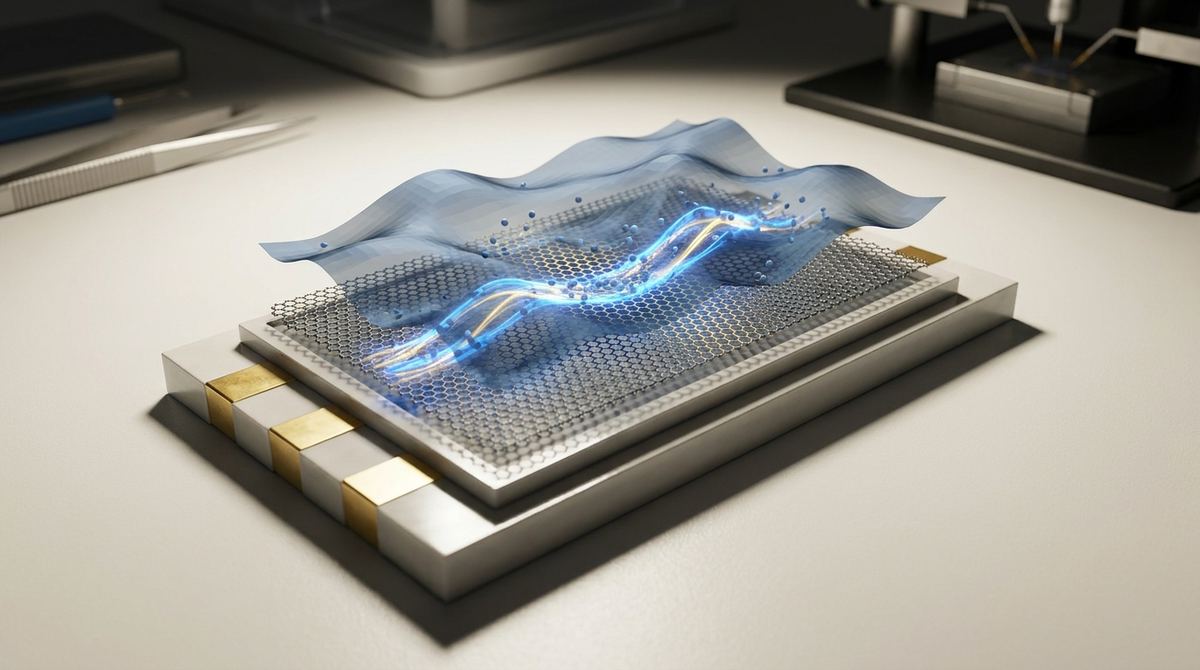
The dream of superconductivity, the flow of electricity with zero resistance, has captivated scientists for over a century. A world with lossless power grids, hyper-efficient motors, and powerful, compact magnets for everything from medical imaging to levitating trains is a powerful motivator. Yet, most known superconductors operate only at frigid temperatures, requiring expensive and cumbersome liquid helium or nitrogen cooling. The quest for higher-temperature, and ideally room-temperature, superconductivity is one of the holy grails of materials science. In a surprising twist, one of the most promising new platforms for exploring this exotic phenomenon is made from the simplest of materials: carbon. Specifically, two atom-thin sheets of graphene stacked together and twisted by a tiny, precise "magic angle." This material, known as twisted bilayer graphene, becomes a superconductor, but its behavior defies the standard textbook explanations. This is where deep theoretical work becomes essential, not just to understand what we see, but to guide the search for what comes next.
When twisted bilayer graphene (TBG) first revealed its superconducting abilities, it sent a shockwave through the physics community. The phenomenon was clearly "unconventional," meaning it did not follow the well-understood Bardeen-Cooper-Schrieffer (BCS) theory that explains conventional superconductors. In BCS theory, electrons pair up by interacting with vibrations in the material's atomic lattice. In TBG, however, the evidence points to a different culprit: the electrons themselves. The strong electrostatic repulsion between electrons, a force that normally keeps them apart, somehow becomes the glue that binds them into superconducting pairs. This is the hallmark of a "strongly correlated" system, where the behavior of any single electron is inextricably linked to the behavior of all the others.
The central problem is that modeling these strong correlations is incredibly difficult. Simple approximations that work for conventional metals and superconductors break down completely. This leaves a critical gap in our knowledge. Experimentalists can create TBG and measure its properties, but without a robust theoretical framework, they are navigating a complex landscape of temperature, twist angle, and electron density with an incomplete map. To push the boundaries and potentially enhance this superconductivity, we need to understand its fundamental mechanism. A new theoretical study by researchers Matthew Shu Liang, Yi-Jie Wang, Geng-Dong Zhou, Zhi-Da Song, and Xi Dai tackles this very problem by employing a sophisticated computational technique to build a more accurate map of TBG's electronic world.
To understand the researchers' approach, imagine a dance floor. In a simple model, you might describe the dancers as independent individuals moving freely. But on a crowded dance floor, people constantly have to adjust their movements to avoid bumping into each other. Their behavior is "correlated." Electrons in a material are similar. In many simple metals, the electrons move so fast that their mutual repulsion is just a minor background effect. But in TBG at the magic angle, the electrons slow down dramatically. The dance floor becomes extremely crowded, and their mutual repulsion, the Coulomb force, becomes the most important interaction governing their behavior.
The key idea in this research is to use a theoretical tool called the "Gutzwiller variational method" to account for this intense crowding. The Gutzwiller method acts like a filter on the possible mathematical descriptions of the electrons. It systematically penalizes or removes any configurations where two electrons try to occupy the same spot at the same time, which is energetically very costly due to their repulsion. By doing so, it creates a more realistic picture of the ground state—the lowest energy arrangement—of these strongly interacting electrons. Applying this refined method allows the researchers to calculate whether these electrons, despite their repulsion, will find it energetically favorable to form Cooper pairs and condense into a superconducting state. It helps answer the "why" and "how" of superconductivity in this exotic material.
The system itself is a marvel of materials engineering. It begins with two sheets of graphene, which are single layers of carbon atoms arranged in a honeycomb lattice. These sheets are placed one on top of the other. The magic happens when they are twisted relative to each other by a very specific angle, approximately 1.1 degrees. This slight misalignment creates a large-scale interference pattern called a Moiré superlattice. This new, larger periodic pattern fundamentally alters the electronic properties of the graphene.
The most critical consequence of this Moiré pattern is the formation of "flat bands" in the material's electronic structure. In a typical material, an electron's energy is strongly dependent on its momentum. In TBG's flat bands, however, a large number of electronic states exist at almost the exact same energy, regardless of their momentum. This means the electrons have very low velocity; they are essentially trapped within the Moiré superlattice cells. When kinetic energy is suppressed like this, other, weaker energy scales come to dominate. The primary one is the Coulomb repulsion between the electrons. This is what transforms TBG into a strongly correlated system and a fertile ground for novel physics. The Gutzwiller study takes a theoretical model that describes these flat-band electrons and then applies its corrective filter to accurately capture these dominant correlation effects, providing a new window into the world of graphene electronics.
By applying their Gutzwiller-enhanced model, the researchers were able to simulate the behavior of electrons in twisted bilayer graphene with high fidelity. Their theoretical results successfully reproduced key features that have been observed in real-world experiments. Most importantly, their calculations showed the emergence of superconductivity within specific ranges of electron density, or "doping." This creates what is known in the field as a "superconducting dome" in the material's phase diagram, where the system is superconducting at certain densities but not at others. The ability of the model to replicate this complex, non-linear behavior is a strong indicator of its accuracy.
Furthermore, the study provides crucial insights into the nature of the superconducting pairing itself. Unlike the simple, symmetric pairing found in conventional superconductors (known as s-wave), the pairing in strongly correlated systems is often more complex, with symmetries described as p-wave or d-wave. The Gutzwiller calculations allowed the team to determine the most likely pairing symmetry driven purely by electron-electron repulsion. Their findings point toward an unconventional pairing mechanism, potentially a chiral d-wave state, which has profound implications for the fundamental physics at play. They effectively demonstrated that the strong Coulomb repulsion, often seen as an enemy of superconductivity, can in fact be the very ingredient that enables it in this unique system.
This research is a significant step forward because it provides a quantitative, microscopic explanation for an observed phenomenon. It's the difference between knowing that a recipe works and understanding the chemistry of why it works. This deeper understanding is transformative for scientific progress. A validated theoretical model acts as a powerful predictive tool. It allows scientists to perform "what if" scenarios on a computer that would be difficult, time-consuming, or expensive to test in a lab.
For instance, experimentalists can now use this model to predict how the superconducting state might change if the material is subjected to pressure, an electric field, or placed on a different substrate. It can help identify new pathways to potentially increase the critical temperature at which TBG superconducts. By identifying the key ingredients and interactions, this work helps distill a very complex problem into a more manageable set of rules. This accelerates the cycle of discovery, where theory guides experiment, and experiment refines theory. This fundamental knowledge is a critical investment in the future of quantum materials and is tracked closely by those following graphene market research for long-term trends. It lays the groundwork necessary before any true engineering can begin.
It is crucial to recognize the limitations of this work. First and foremost, this is a theoretical study based on a computational model. While powerful, models are always simplifications of reality. The model used here likely focuses on an idealized, perfect crystal of twisted bilayer graphene. Real materials, however, contain imperfections, such as small variations in twist angle across the sample, strain, and interactions with the substrate it rests on. These factors are not always included in the initial model and could play an important role in the material's real-world behavior.
The Gutzwiller method itself is an approximation, albeit a very sophisticated one. It provides a highly accurate picture of the ground state but may be less precise in describing excited states or dynamic properties. The next essential step is rigorous experimental verification. Other research groups can now design experiments specifically to test the unique predictions of this model. For example, they could use high-resolution scanning tunneling microscopy to probe the electronic structure and attempt to directly measure the specific superconducting pairing symmetry predicted by the calculations. Agreement between these future experiments and the model's predictions would be a major validation of our understanding of this fascinating system.
While this research is purely fundamental, its implications point toward a distant but exciting technological future. A complete understanding of unconventional superconductivity in a tunable platform like graphene could be a game-changer. One of the most promising areas is quantum computing. Many leading quantum bits, or qubits, are based on superconducting circuits. A deeper understanding of new superconducting mechanisms could lead to the design of more stable, fault-tolerant qubits.
In the longer term, the lessons learned from TBG could be applied to the broader search for high-temperature superconductors. While TBG's superconductivity still occurs at very low temperatures, the mechanism it reveals—superconductivity driven by pure electron correlations in a flat-band system—provides a brand new recipe for materials scientists to follow. This could guide the discovery of new materials that exhibit similar properties at more practical temperatures. The ultimate goal remains the development of materials that could enable lossless power grids, ultra-powerful magnets for fusion reactors, and hyper-fast electronics. This foundational science is a necessary step on the long road toward these transformative graphene applications.
If you take away just one idea from this research, let it be this: twisted bilayer graphene's superconductivity is a puzzle driven by the intense repulsion between its own electrons, and this theoretical study provides a powerful new tool to solve it. By accurately modeling these strong electron interactions, scientists are moving from simple observation to deep understanding, which is the first and most critical step toward engineering the quantum materials of the future.
What is twisted bilayer graphene? Twisted bilayer graphene, or TBG, is a material made by stacking two single-atom-thick sheets of graphene and rotating one of them by a very small, specific "magic angle" of about 1.1 degrees. This twist creates a new electronic structure with unique properties, including the ability to become a superconductor.
What makes the superconductivity in TBG "unconventional"? Conventional superconductivity is explained by electrons pairing up through interactions with vibrations of the atomic lattice. In TBG, the superconductivity is believed to be "unconventional" because the pairing mechanism is thought to arise from the strong electrical repulsion between the electrons themselves, a much more complex and poorly understood phenomenon.
What is the Gutzwiller method? The Gutzwiller method is a sophisticated mathematical technique used in theoretical physics to study materials where electron-electron interactions are very strong. It refines simpler models by filtering out unrealistic scenarios, such as two electrons occupying the same physical location, to provide a more accurate description of the material's electronic ground state.
Is this research experimental or theoretical? This work is entirely theoretical. The researchers did not physically create or measure twisted bilayer graphene. Instead, they used powerful computational methods and the principles of quantum mechanics to build a mathematical model that simulates the material's behavior, providing insights that can guide future experimental work.
When can we expect devices based on this? Devices based directly on this specific research are not on the immediate horizon. This is fundamental science aimed at understanding a physical phenomenon. However, this knowledge is a crucial building block. The insights gained could, over the next decade or more, influence the design of new quantum computing components or guide the search for other materials with even more robust superconducting properties.
The work by Matthew Shu Liang and his colleagues represents a significant advance in our theoretical understanding of one of the most exciting materials in modern physics. By successfully using the Gutzwiller variational method to model the strongly correlated superconductivity in twisted bilayer graphene, they have provided a robust framework that not only explains existing experimental data but also offers a predictive lens for future exploration. It highlights the indispensable synergy between theory and experiment in pushing the frontiers of science. While lossless power lines and quantum computers built from twisted graphene are not yet a reality, this kind of deep, rigorous theoretical investigation is precisely the work that paves the long road toward them.
Serious about B2B integration? Test our premium Pulsed Electrical Resistive Carbon Heating turbostratic graphene in your lab. 100g sample packs available now.
Explore More
Explore how the intrinsic band geometry of 2D materials can induce valley polarization of chiral excitons, a key step toward next-gen valleytronics.

Explore a new class of pressure sensors using graphene to detect pressure-enhanced polarization in ferroelectric boron nitride, a novel slidetronic effect.

Researchers predict a new physical effect in gapless Dirac materials like graphene, where propagating waves can induce a direct DC current without a p-n...