
Chiral Fermion Localization: A New Blueprint for Graphene Nanoelectronics
Explore chiral fermion localization in two-kink systems. This theoretical physics research offers a powerful new model for controlling electrons in...
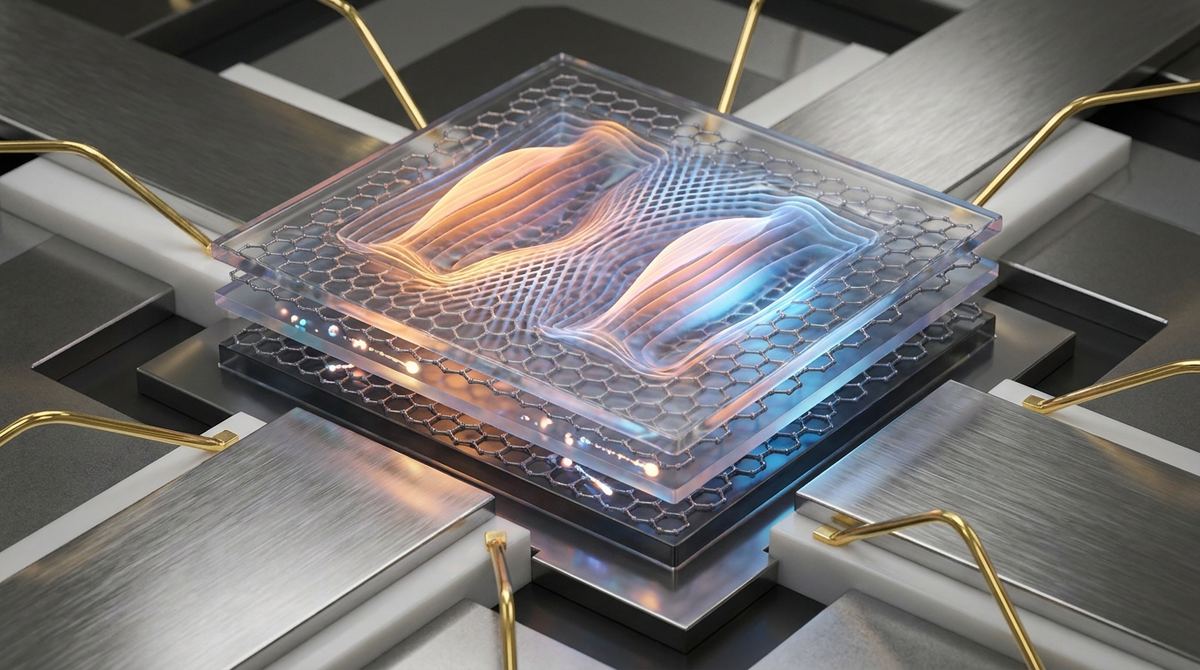
Imagine a crowded room where you can control how people interact simply by changing the tempo of the music. At a fast tempo, people move around quickly, barely noticing each other. But as you slow the music to a crawl, they are forced to interact, forming intricate dance patterns and social groups. In the quantum world of materials, scientists are learning to play a similar role as the DJ, using cleverly designed structures to control the "music" for electrons. This control allows them to coax electrons into exotic, collective "dances" known as correlated states, which are the foundation for future technologies like quantum computing and ultra-efficient electronics. A recent breakthrough in this field demonstrates a new level of finesse in this control, opening doors to materials that can be continuously tuned between different quantum phases.
The discovery of moiré superlattices—formed by stacking two-dimensional materials like graphene with a slight twist—revolutionized condensed matter physics. The twist creates a large-scale interference pattern that dramatically alters the material's electronic properties. Specifically, it can create "flat bands" in the electronic energy structure. In these flat bands, electrons slow to a crawl, and their mutual repulsion and other quantum interactions begin to dominate their behavior. This leads to the emergence of fascinating correlated states, including unconventional superconductivity and exotic forms of magnetism.
However, controlling these states has been a delicate and often binary process. Scientists could typically tune a system to become, for instance, a superconductor or an insulator, but transitioning smoothly between these and other states in a single device has remained a formidable challenge. The underlying physics often locks the material into one specific correlated state at a given set of conditions. This limitation hinders the development of "programmable quantum matter," where a single material could be reconfigured on demand to perform different functions. The central problem, therefore, is how to design a material platform that offers not just access to these states, but continuous and granular control over the transitions between them.
The groundbreaking research by a team including Mohammed M. Al Ezzi, Na Xin, Yanmeng Shi, Shuigang Xu, Julien Barrier, Alexey Berdyugin, Shubhadeep Bhattacharjee, Angelika Knothe, Kenji Watanabe, Takashi Taniguchi, Vladimir Falko, Giovanni Vignale, and their colleagues introduces a powerful new concept: "dual-flatness." Instead of creating a system with just one flat electronic band, they engineered a moiré heterostructure that possesses two distinct flat bands at different energy levels.
This dual-band structure is the key to their breakthrough. Think of it as having two separate, slow-tempo dance floors, one above the other. By using an electric field—much like a valve controlling the flow of a fluid—the researchers can precisely control how many electrons populate each of these flat bands. They can fill the first band completely, then start adding electrons to the second. Because each flat band promotes different types of electron interactions, this careful, layer-by-layer filling allows the system's overall quantum state to be tuned continuously. The researchers can smoothly guide the material through a landscape of different correlated states, rather than just jumping from one to another. This dual-flatness design provides a new knob for physicists to turn, offering unprecedented control over the collective behavior of electrons.
The device at the heart of this study is a precisely engineered stack of two-dimensional materials, known as a van der Waals heterostructure. The core components are likely layers of graphene, potentially combined with other 2D materials like tungsten diselenide (WSe2) or hexagonal boron nitride (hBN). The critical feature is the creation of a moiré superlattice by intentionally misaligning, or twisting, the crystallographic axes of two adjacent layers by a very specific, small angle. This engineered twist is a highly controlled version of the random stacking found in some forms of industrial graphene supply.
This twisted stack is then encapsulated in layers of atomically smooth hexagonal boron nitride, which protects the delicate structure from environmental contaminants and provides a clean dielectric environment. Metallic contacts, or gates, are placed above and below the stack. These gates are essential for the device's function. By applying a voltage to these gates, an electric field is generated that permeates the heterostructure. This field allows the researchers to precisely add or remove electrons from the system, a process known as electrostatic doping.
The "dual-flatness" arises from the specific combination of materials and the twist angle. The complex interplay between the atomic lattices of the different layers creates an electronic band structure with two separate, nearly flat energy bands. The applied gate voltage then acts as a chemical potential lever, allowing the experimentalists to raise or lower the Fermi level—the energy threshold that separates occupied electron states from empty ones. By sweeping the gate voltage, they can sequentially fill the first flat band, observe the resulting correlated states, and then continue to add electrons to populate the second flat band, inducing a new series of quantum phenomena. The entire system is operated at cryogenic temperatures, typically just a few degrees above absolute zero, to minimize thermal noise and allow these fragile quantum effects to manifest clearly.
Through meticulous electronic transport measurements, the research team mapped out the behavior of their dual-flat band device. They measured its electrical resistance as they varied both the number of electrons (via the gate voltage) and an external magnetic field. The results provided clear and compelling evidence of a rich sequence of correlated electronic states.
As they began to fill the first flat band with electrons, they observed the emergence of states consistent with Mott insulators—a phase where electrons, despite having available sites to move to, become locked in place by their strong mutual repulsion. As they continued to add electrons and began populating the second flat band, the system's behavior changed dramatically. New and distinct correlated phases appeared, which were tunable in ways not seen in single flat-band systems.
The most significant finding was the continuous nature of the transitions. The data showed that by carefully adjusting the gate voltages, the researchers could smoothly evolve the system from one correlated phase to another. This demonstrated that the two flat bands were not just independent entities but were electronically coupled, allowing for a continuous transfer of electrons and a corresponding continuous evolution of the material's quantum state. This experimental verification of continuous tuning, enabled by the dual-flatness design, is the central achievement of the paper.
This work represents a significant conceptual advance in the field of twistronics and quantum materials. The ability to continuously tune between correlated states in a single device is a major step towards the goal of creating programmable quantum matter. Instead of fabricating dozens of different devices, each optimized for a single quantum phase, researchers might one day use a single, reconfigurable dual-flat-band device to study a whole family of quantum phenomena.
This has profound implications for fundamental science. It provides a highly controllable platform for exploring the complex physics of electron correlations, which is central to understanding high-temperature superconductivity and other mysterious quantum effects. By observing how the system transitions from one state to another, physicists can gain deeper insights into the delicate competition and interplay between different quantum orders. Furthermore, the principles of dual-flatness engineering can likely be applied to a wide range of 2D materials, opening up a vast design space for new quantum systems with tailored properties. This work provides a new blueprint for how to engineer electron interactions with unprecedented precision.
While this breakthrough is scientifically exciting, it is important to recognize its current limitations. This is fundamental research conducted under extreme laboratory conditions. The devices are fabricated individually on a microscopic scale and must be cooled to temperatures near absolute zero. The fabrication process itself, which requires nanometer-scale precision in stacking and twisting atomic layers, is incredibly challenging and difficult to scale. The development of industrial synthesis equipment capable of producing such structures reliably and in large quantities is a distant, though critical, future goal.
Further research is needed to fully characterize the nature of all the observed correlated states. While the transport data is compelling, complementary experimental techniques, such as scanning tunneling microscopy, could provide direct visualization of the electron wavefunctions in these dual-flat bands. Moreover, the long-term stability and reproducibility of these devices need to be rigorously tested. Understanding how small variations in twist angle or sample impurities affect the dual-flatness and the resulting correlated states is crucial for moving the technology forward. Finally, while the current work demonstrates control, exploring the speed at which these states can be switched will be vital for any potential computational applications.
The immediate applications of this research are in the realm of fundamental scientific exploration. However, the long-term vision it inspires is transformative. The ability to program quantum matter could be a cornerstone of future graphene electronics. For example, a single transistor-like device could be electrically switched to become a superconductor for lossless current flow, a magnet for data storage, or a topological insulator for spintronic applications. This could lead to a new paradigm in computing, moving beyond the simple on/off logic of today's silicon chips.
In the field of quantum computing, such tunable materials could be used to create more robust and adaptable qubits, the fundamental building blocks of quantum computers. The continuous tuning could also be harnessed to develop novel quantum simulators—specialized devices that can model complex quantum systems that are intractable for even the most powerful supercomputers. This could accelerate the discovery of new drugs, catalysts, and materials. Furthermore, the extreme sensitivity of these correlated states to their environment suggests potential applications in next-generation graphene sensors. A device based on this principle could be configured to become an incredibly sensitive detector of magnetic fields, with applications in medical imaging and geological surveying.
If you take away just one concept from this research, it should be the power of "dual-flatness." By engineering a moiré heterostructure with two distinct flat electronic bands, scientists have unlocked the ability to continuously tune the material between different exotic quantum states using a simple electric field. This provides an unprecedented level of control over the collective behavior of electrons and opens a new chapter in the quest for programmable quantum matter.
What is a moiré heterostructure?
A moiré heterostructure is an artificial material created by stacking two or more atomically thin, two-dimensional crystals, such as graphene, on top of each other. When the layers are stacked with a slight twist angle or a mismatch in their crystal lattice sizes, a large-scale interference pattern, known as a moiré pattern, emerges. This pattern profoundly modifies the material's electronic properties, creating new behaviors not found in the individual layers.
What does a "flat band" mean for electrons?
In solid-state physics, a material's electronic band structure describes the allowed energy levels for its electrons. A "flat band" refers to a range of energies where the energy of an electron does not change much with its momentum. This implies that the electrons move very slowly, as if they have an extremely large effective mass. This sluggishness dramatically increases the relative strength of the interactions between electrons, leading to the emergence of exotic collective quantum phenomena called correlated states.
What are correlated electronic states?
Correlated electronic states are phases of matter that arise not from the properties of individual electrons, but from the strong, collective interactions among a large group of them. In materials with flat electronic bands, these interactions can cause electrons to organize themselves into highly ordered patterns, resulting in behaviors like superconductivity (where electricity flows with zero resistance), Mott insulation (where electrons lock each other in place), and unconventional forms of magnetism.
Why is "continuous tuning" of these states so important?
Continuous tuning is the ability to smoothly transform a material from one correlated state to another by gradually changing an external parameter, like an applied voltage. This is a significant advance because it moves beyond simply switching a material "on" or "off." It offers a new level of control, enabling a single device to be precisely configured to access a whole spectrum of quantum behaviors, which is a key step toward creating reconfigurable, multi-functional quantum devices.
Is this technology ready for commercial use in products?
No, this technology is still in the early stages of fundamental scientific research. The experiments are performed on microscopic, individually fabricated devices that require cryogenic temperatures near absolute zero to function. Significant engineering and materials science challenges related to scalability, manufacturing precision, and operation at higher temperatures must be overcome before this discovery could be translated into commercial products. It represents a crucial proof-of-concept for future electronic technologies, not a near-term solution.
The discovery of dual-flatness and the subsequent demonstration of continuous tuning between correlated states marks a pivotal moment in the study of quantum materials. The work by Mohammed M. Al Ezzi, Na Xin, and their collaborators provides a sophisticated new tool for manipulating the quantum world. By moving beyond single flat-band systems, they have introduced a new design principle for engineering the interactions of electrons with unprecedented precision. While the path to practical application is long, this research illuminates that path, pointing toward a future where materials are not static entities but dynamic, programmable platforms for a new generation of quantum technology.
Serious about B2B integration? Test our premium Pulsed Electrical Resistive Carbon Heating turbostratic graphene in your lab. 100g sample packs available now.
Explore More
Explore chiral fermion localization in two-kink systems. This theoretical physics research offers a powerful new model for controlling electrons in...

Explore how a gate-defined graphene superlattice can create a versatile quantum sensor, leveraging unique electron states for advanced magnetic field detection.

New research introduces a controlled loop expansion for the topological heavy fermion model, a powerful theoretical tool for designing future quantum materials.