
Twisted Bilayer Graphene: A New Formula for Electron Lifetimes
Researchers derived an analytic formula for twisted bilayer graphene electron lifetimes, providing a key design tool for future quantum and electronic devices.
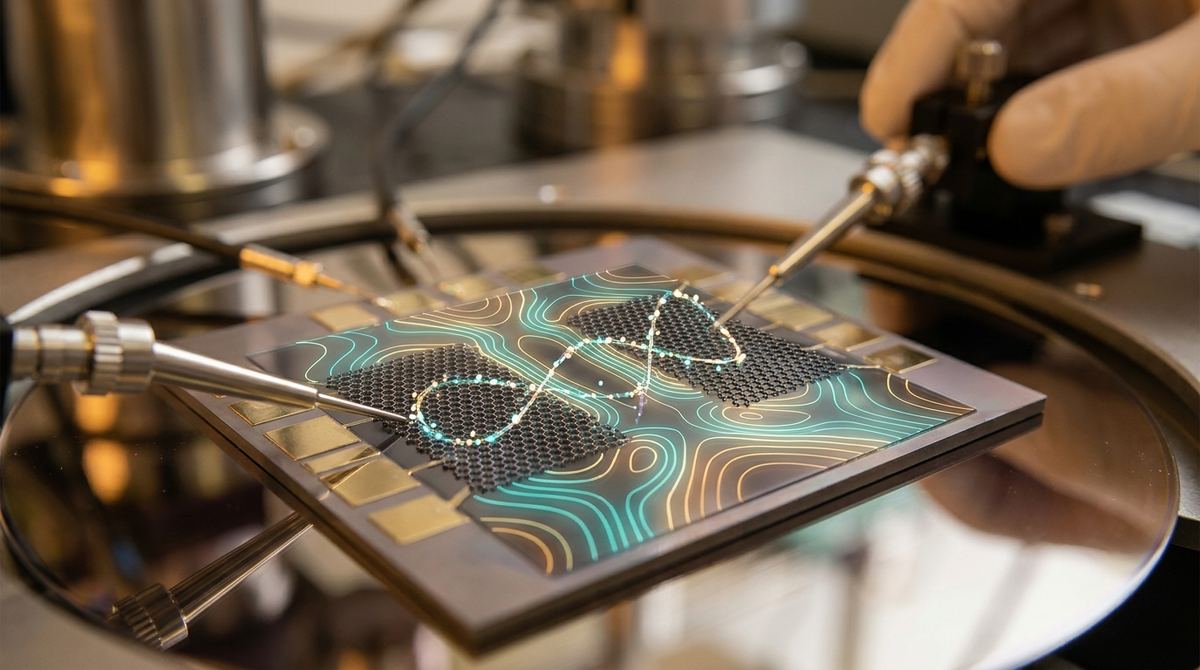
Imagine trying to predict the exact path of a single gust of wind within a hurricane. The system is overwhelmingly complex, with countless air molecules interacting in chaotic and unpredictable ways. Physicists face a similar challenge when trying to understand the bizarre world of advanced quantum materials, where billions upon billions of electrons interact with each other in strange and powerful ways. These interactions give rise to incredible phenomena, but they also make the materials nearly impossible to describe with conventional mathematics. A new breakthrough in theoretical physics, however, offers a much clearer map for navigating this quantum storm, providing a powerful new tool to design the materials that will shape our future.
In the realm of condensed matter physics, one of the most significant and persistent challenges is understanding systems of "strongly correlated electrons." In a simple metal like copper, electrons flow more or less independently, like cars on a wide-open highway. This makes their collective behavior relatively easy to predict. But in more exotic materials, electrons interact so strongly with each other that the movement of one profoundly affects all the others. It’s less like a highway and more like a crowded dance floor where every dancer’s move is constrained by everyone around them. This collective, correlated dance can lead to spectacular properties, such as high-temperature superconductivity or massive effective electron masses.
The problem is that our standard mathematical tools often fail in this regime. Many successful theories in physics rely on a method called perturbation theory, which starts with a simple, solvable picture and adds in the effects of interactions as small, manageable corrections. For strongly correlated systems, the interactions are not small corrections; they are the main event. Trying to use standard perturbation theory here is like trying to describe a tidal wave by adding small corrections to the physics of a placid pond; the entire framework breaks down. This challenge becomes even more daunting when these strong correlations are combined with another quantum phenomenon: topology. Topological materials have properties, such as conducting surfaces on an insulating bulk, that are protected by the fundamental geometry of their quantum wavefunctions. Understanding a material where both strong correlations and topology are at play has been a monumental task, leaving a significant gap in our ability to predict and engineer new quantum materials.
The recent theoretical work by Yaar Vituri and Erez Berg from the Weizmann Institute of Science introduces a powerful new method to tackle this very problem. They developed a technique they call a "controlled loop expansion" specifically for a class of systems known as topological heavy fermion models. In essence, they have found a way to make a perturbative-like approach work even when interactions are strong. The "loop expansion" is a concept from quantum field theory, where each "loop" in a calculation represents a more complex set of particle interactions. In many difficult problems, adding more loops (more complexity) makes the calculations diverge into meaningless infinities. The key innovation from Vituri and Berg is the "controlled" aspect of their method. They have devised a mathematical framework that tames these calculations, ensuring that each new layer of complexity brings the answer closer to the correct result rather than pushing it further away. It provides a systematic and reliable way to calculate the properties of these incredibly complex systems, turning a previously intractable problem into a solvable one. This is less like inventing a new material and more like inventing a new, far more powerful microscope that allows us to see the fundamental rules governing these materials for the first time.
While the paper by Vituri and Berg focuses on a generalized theoretical model, the physics it describes has profound implications for cutting-edge materials, including advanced graphene-based systems. The "heavy fermion" part of the model refers to materials where electrons behave as if they are hundreds or even thousands of times more massive than they should be. This isn't because the electrons themselves gain mass, but because their movement is dramatically slowed by their constant interactions with a lattice of localized magnetic moments. This interaction, known as the Kondo effect, effectively dresses the electron in a thick coat of interactions, making it sluggish and "heavy."
The "topological" aspect means the system has special, protected states. A common analogy is a coffee mug and a donut. To a topologist, they are the same because they both have one hole. You can deform one into the other without tearing it. This robustness to deformation is mirrored in topological materials, whose unique electronic properties are protected against minor impurities and defects in the material—a highly desirable trait for building reliable devices.
This combination of heavy fermion physics and topology, once thought to be confined to exotic rare-earth compounds, is now emerging in engineered two-dimensional materials. Specifically, in twisted bilayer graphene, where one sheet of graphene is placed on another and twisted by a small "magic" angle, a moiré superlattice is formed. This larger periodic pattern dramatically changes the electronic landscape. It can cause electrons to slow down and become localized, forcing them to interact very strongly with each other. This creates a strongly correlated state that mimics the physics of heavy fermion systems. By applying electric fields or introducing other layers, it may also be possible to induce topological phases in these graphene structures. Therefore, the theoretical tool developed by Vituri and Berg for a general model could become an indispensable guide for understanding and designing the next generation of graphene electronics. It provides the foundational mathematics needed to predict how these twisted graphene systems will behave and how they can be tuned to achieve specific quantum states.
The primary success of this research is the validation of the method itself. Vituri and Berg demonstrated that their controlled loop expansion provides stable, convergent, and physically sensible results when applied to the topological heavy fermion model. They were able to calculate the system's "phase diagram," which is essentially a map that shows how the material's properties change under different conditions, such as temperature or interaction strength. Their calculations successfully charted the transitions between different quantum states. For example, they could pinpoint the conditions under which the system behaves as a topological insulator versus when it transitions into a heavy fermion metal. This predictive power is the crucial finding. It proves that their technique isn't just a mathematical curiosity but a functional tool capable of yielding concrete, testable predictions about the behavior of a complex quantum system. This allows physicists to move beyond qualitative descriptions and perform quantitative calculations that can guide real-world experiments.
Fundamental theoretical breakthroughs are the bedrock upon which future technologies are built. This work matters because it provides a more reliable blueprint for materials discovery. The ability to accurately model strongly correlated and topological systems accelerates the search for materials with revolutionary properties. Instead of a costly and time-consuming trial-and-error process in the laboratory, researchers can use this theoretical framework to simulate potential materials on a computer, predicting their properties before a single atom is synthesized. This guided approach can drastically shorten the development cycle for technologies that rely on exotic quantum phenomena. For example, the search for materials suitable for building a fault-tolerant quantum computer, which requires stable and protected quantum states, could be significantly advanced. This research provides a quantitative, rather than just qualitative, understanding, which is the critical step needed to move from basic science to applied engineering. The insights gained could influence everything from the graphene manufacturing techniques needed to create precise superlattices to the design of entirely new classes of quantum devices.
It is crucial to recognize the context and limitations of this work. The paper presents a theoretical calculation for an idealized model. Real materials are inevitably more complex; they contain impurities, structural defects, and other interactions not included in this simplified model. The controlled loop expansion, while powerful, has so far only been applied to one specific type of model. Its applicability and accuracy for other classes of strongly correlated systems, including more realistic models of twisted bilayer graphene or other moiré materials, still need to be established. The next essential step is experimental verification. The theoretical predictions made by Vituri and Berg about phase transitions and other properties need to be compared with precise measurements made on actual heavy fermion materials. This feedback loop between theory and experiment is vital. Success in these comparisons would build confidence in the model and pave the way for its use in predicting the properties of yet-to-be-discovered materials.
While this research is foundational, it points toward a future rich with technological possibilities. The most prominent potential application lies in the field of quantum computing. Topological quantum bits, or "qubits," are predicted to be far more robust against environmental noise than other qubit designs, a major hurdle in building scalable quantum computers. A theoretical tool that can accurately guide the search for materials that host these topological states is invaluable. Another major area is spintronics, a future electronics paradigm that uses the intrinsic spin of electrons, rather than their charge, to carry information. This could lead to devices that are faster and vastly more energy-efficient than current technology. Materials with combined topological and correlated properties are prime candidates for spintronic applications. Furthermore, the extreme sensitivity of these quantum states to their environment could be harnessed to create ultra-precise sensors for magnetic fields, temperature, or chemical signatures. Understanding these materials is the first step toward a wide range of new graphene applications in sensing, computing, and communications.
If you take away just one idea from this research, let it be this: Physicists have developed a new, more reliable mathematical tool that significantly improves our ability to understand and predict the behavior of some of the most complex and promising quantum materials known to science. This opens a clearer path toward designing the materials of the future.
What is a heavy fermion material?
A heavy fermion material is one in which the electrons behave as if they have a much larger mass, sometimes hundreds of times greater, than a free electron. This effect arises not from a change in the electron itself, but from strong interactions between the conducting electrons and a lattice of magnetic atoms in the material, which dramatically slows their movement through the crystal.
What makes a material "topological"?
In physics, a topological material is one whose electronic properties are protected by a fundamental aspect of its quantum mechanical wave function's shape, or topology. A key feature is often the existence of conducting states on the surface or edge of the material while the bulk remains an insulator. These protected states are remarkably robust against impurities and defects.
Why is this research theoretical and not experimental?
This research is theoretical because its primary contribution is the development of a new mathematical method, or tool, for calculation and prediction. The authors did not create a new physical device or material in a lab. Instead, they established a more powerful framework for understanding a class of materials, which experimental scientists can now use to guide their own research.
How does this research relate to graphene?
While the paper does not model graphene directly, the type of physics it describes—strong electron correlations combined with topology—is precisely what is being observed in new, engineered graphene systems like twisted bilayer graphene. The theoretical tool developed in this research could therefore be crucial for understanding these advanced graphene structures and predicting how to design them for specific applications.
What is a "loop expansion" in simple terms?
A loop expansion is a calculation technique used in quantum physics to approximate the behavior of interacting particles. You can think of it as starting with a very simple picture (the "zero-loop" level) and then systematically adding in layers of complexity, or corrections, that account for particle interactions. Each "loop" represents a more intricate set of virtual particle interactions that refine the final answer.
The work of Yaar Vituri and Erez Berg represents a significant step forward in the theoretical physicist's toolkit. By developing a controlled loop expansion for the topological heavy fermion model, they have provided a much-needed method for bringing quantitative clarity to a previously murky area of condensed matter physics. This is not merely an academic exercise. The history of technology is filled with examples of abstract theoretical concepts—from Maxwell's equations to quantum mechanics—that eventually became the foundation for world-changing innovations. This research continues that tradition, providing the fundamental understanding required to one day engineer quantum materials with properties tailored for specific, revolutionary applications in computing, electronics, and beyond. It is a powerful reminder that the path to the future is often paved with a deeper understanding of the present.
Serious about B2B integration? Test our premium Pulsed Electrical Resistive Carbon Heating turbostratic graphene in your lab. 100g sample packs available now.
Explore More
Researchers derived an analytic formula for twisted bilayer graphene electron lifetimes, providing a key design tool for future quantum and electronic devices.

Learn to build a high-responsivity 1.5 µm graphene photodetector. This guide details the materials and steps for a prototype based on upconversion...

New software for the modal analysis of electromagnetic resonators now includes 2D materials, accelerating the design of advanced graphene optical and...