
Practical Guide: Building a High-Responsivity 1.5 µm Graphene Photodetector
Learn to build a high-responsivity 1.5 µm graphene photodetector. This guide details the materials and steps for a prototype based on upconversion...
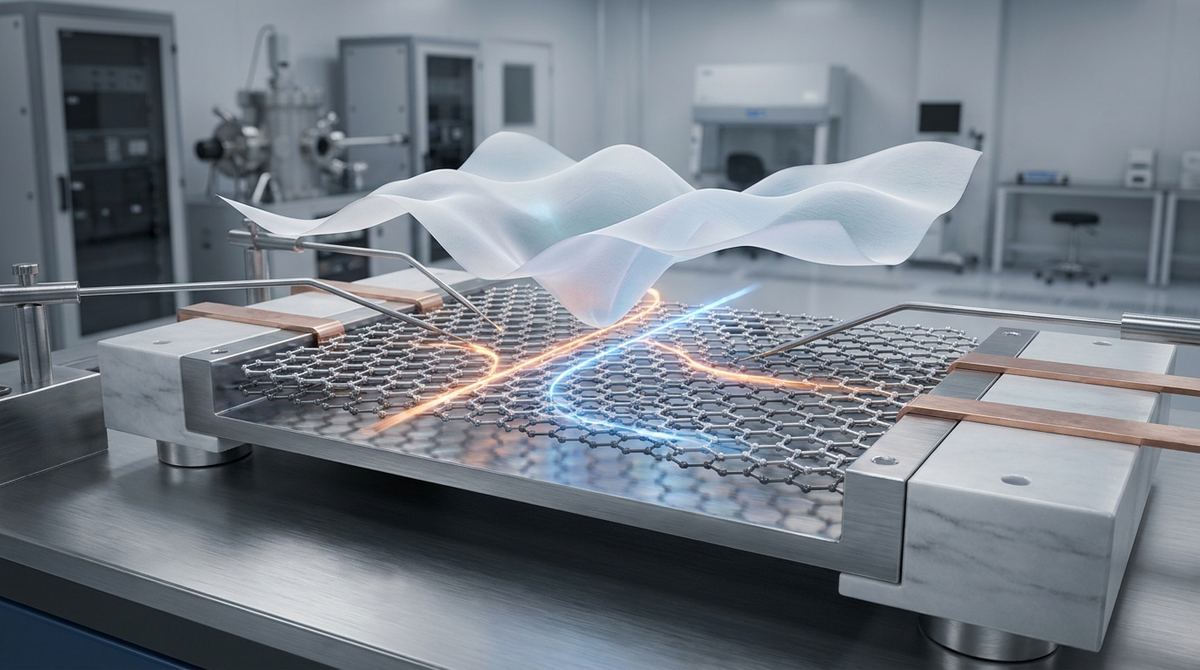
Imagine trying to walk through a crowded room in a straight line. The distance you can travel before bumping into someone and changing direction is a measure of your "free path." In the world of materials science, electrons face a similar challenge. Their ability to move unimpeded, a property known as their "lifetime," is fundamental to how any electronic device works. In the strange and wonderful material known as twisted bilayer graphene, these electron lifetimes are the key that unlocks exotic behaviors like superconductivity and correlated insulation. For years, predicting these lifetimes required immense computational power, yielding results without revealing the underlying "why." Now, a new theoretical breakthrough provides an elegant mathematical formula that acts as a roadmap, explaining precisely what governs an electron's life in this quantum landscape.
Twisted bilayer graphene (TBG) has captivated the physics community since the discovery that stacking two sheets of graphene and rotating one by a precise "magic angle" of about 1.1 degrees creates a material with an astonishing range of electronic properties. At this angle, a new, larger repeating pattern called a moiré superlattice emerges, which fundamentally alters how electrons behave. They slow down dramatically, and their interactions with each other become paramount. This leads to the emergence of states that are perfect insulators and others that are superconductors, all within the same material, tunable by a simple electric field.
Despite this promise, designing devices with TBG is incredibly difficult because its properties are exquisitely sensitive. A tiny deviation in twist angle can erase the magic. Furthermore, predicting the stability of these exotic electronic states has been a significant hurdle. A key metric for stability is the quasiparticle lifetime—essentially, how long an excited electron can exist before it scatters off another electron and loses its energy. Until now, calculating this lifetime required brute-force numerical simulations that are computationally expensive and time-consuming. While these simulations can provide a number, they often obscure the deeper physical principles at play. There was no simple, clear equation that a physicist or engineer could use to understand how the lifetime depends on crucial parameters like twist angle or electron energy. This gap in understanding has been a major roadblock to the systematic design and optimization of future graphene electronics. Seeking to fill this void, a team of researchers including Haoyu Hu, Yuelin Shao, Lorenzo Crippa, Dumitru Călugăru, Giorgio Sangiovanni, Tim Wehling, Leonid I. Glazman, and B. Andrei Bernevig developed a new theoretical approach to solve this problem directly.
The central achievement of this research is the derivation of an "analytic result"—a clean mathematical formula—that describes the electron lifetime in TBG. Instead of relying on a computer to simulate every complex interaction, the researchers built a theoretical model that distilled the problem down to its most essential components. They identified the primary mechanism by which an excited electron, or "quasiparticle," decays in TBG when the electronic bands are precisely filled with an integer number of electrons per moiré cell.
Their key insight was that the dominant decay pathway involves an electron in one of the special "flat bands" scattering off the sea of other electrons. In this process, the original electron loses its energy by creating a new excitation elsewhere in the material, specifically by kicking another electron from a lower energy band to a higher energy band. This is known as interband scattering. The researchers managed to capture the physics of this complex, many-body interaction in a solvable mathematical form. The resulting equation provides a direct, intuitive link between the electron's lifetime and the fundamental properties of the material, such as the twist angle, the interaction strength between electrons, and the energy of the electron itself. This transforms the problem from a black-box computation into a transparent physical relationship, offering a powerful new tool for understanding and engineering this quantum material.
To appreciate the breakthrough, one must first understand the system itself. Graphene is a single layer of carbon atoms arranged in a honeycomb lattice. It is renowned for its incredible strength, transparency, and electrical conductivity. When you place two of these sheets on top of each other, you get bilayer graphene. The magic happens when you introduce a slight rotational misalignment, or twist, between the two layers.
This twist creates a moiré interference pattern, a superlattice with a much larger length scale than the original carbon honeycomb. This moiré pattern acts as a new, artificial landscape for the electrons. At the "magic angle," this landscape has a profound effect: it creates what are known as "flat bands" in the material's electronic energy structure. In a normal conductor, the relationship between an electron's energy and its momentum is steep, meaning it can speed up easily. In a flat band, this relationship is nearly horizontal, meaning electrons have almost the same energy regardless of their momentum. They effectively slow to a crawl.
When electrons are confined to these flat bands, they are forced into close proximity for longer periods, causing their mutual repulsion (the Coulomb interaction) to dominate their behavior. This is the realm of "strongly correlated electron physics." By adding or removing electrons with an electric field, scientists can control the "filling" of these flat bands. At "integer fillings"—where there is exactly one, two, or three electrons for every unit cell of the moiré pattern—the system can spontaneously rearrange itself into highly ordered states, such as a Mott insulator (where electrons lock into place, preventing current flow) or a superconductor (where they pair up and flow with zero resistance). The lifetime of an electron in this system determines how perfect and stable these states are. A short lifetime means the state is fragile and noisy, whereas a long lifetime is essential for building robust quantum and electronic devices.
The team successfully derived a concise analytic formula for the quasiparticle lifetime in magic-angle twisted bilayer graphene at integer fillings. This formula is the paper's core contribution. It explicitly shows how the rate at which an electron scatters (the inverse of its lifetime) depends on various physical parameters. One of the most significant findings confirmed by their formula is the dominant role of interband scattering. An excited electron in the flat band doesn't decay by simply bumping into another electron within the same band. Instead, its energy is most efficiently dissipated by creating an electron-hole pair in the more distant, or "remote," energy bands of the graphene system.
The formula also reveals a strong dependence on the electron's own energy. For an electron with very low energy (just above the minimum required to be in the band), its lifetime is extremely long. As its energy increases, more decay pathways become available, and the lifetime drops sharply. This theoretical prediction provides a clear signature that experimentalists can look for. Furthermore, the results obtained from their elegant formula show excellent agreement with the results from prior, far more complex numerical studies. This validates their theoretical approach and confirms that their model successfully captures the essential physics governing electron dynamics in TBG. They have essentially created a powerful and efficient shortcut to understanding a deeply complex quantum system.
The importance of an analytic result over a purely numerical one cannot be overstated. It represents a shift from mere calculation to genuine understanding. A simulation might tell you that at a 1.08-degree twist angle, the lifetime is X, but a formula tells you *why* it is X and how it will change if you adjust the angle to 1.09 degrees. This provides physicists with deep intuition about the system's behavior.
For engineers, this formula is akin to a design rule. If a team is trying to build a new type of transistor or a quantum bit using TBG, they need to maximize the electron lifetime to improve performance and reduce noise. This formula provides a direct guide, indicating how to tune the material's parameters to achieve the desired outcome, dramatically accelerating the research and development cycle. It also establishes a clear theoretical benchmark. When experimentalists measure lifetimes in real samples of turbostratic graphene flakes, which contain a range of twist angles, they can compare their data to the formula's predictions. Any deviation between theory and experiment could signal the presence of new physics, or it could highlight the role of real-world imperfections like strain or defects, guiding efforts to improve material synthesis. The ultimate goal is to enable scalable graphene production of high-quality twisted systems, a challenge that requires both advanced theory and machinery.
As with any theoretical work, this study has limitations. The model is an idealization, assuming a perfect, clean TBG crystal free from the strain, defects, and substrate interference that are present in all real-world samples. The formula was derived specifically for the case of integer fillings of the flat bands. The behavior in doped systems—where the filling is fractional—is equally important for many electronic applications and may be governed by different scattering mechanisms not captured by this formula.
The next critical step is rigorous experimental validation. Techniques like angle-resolved photoemission spectroscopy (ARPES) can, in principle, measure quasiparticle lifetimes, but performing these experiments on delicate, microscopic TBG devices is extraordinarily challenging. Direct comparison between the predictions of this new formula and high-precision experimental data is needed to fully confirm the theory and understand the impact of real-world non-idealities. Further theoretical work is also needed to extend this powerful analytic approach to other twist angles, other correlated states, and other emerging two-dimensional moiré materials.
While this research is foundational, its long-term implications for technology are significant. The insights it provides are crucial for harnessing the exotic properties of TBG for practical purposes. One of the most exciting potential graphene applications is in quantum computing. The stability of quantum information stored in a TBG-based qubit would be directly related to the electron lifetimes within the material. Longer lifetimes translate to lower decoherence rates and more reliable quantum computations.
In the realm of classical computing, the work could inform the development of ultra-fast, energy-efficient transistors. The speed at which a transistor can switch is limited by how quickly electrons can move through it without scattering. By providing a guide to maximizing electron lifetimes, this research lays the groundwork for devices that could operate at terahertz frequencies, far beyond the capabilities of silicon. Furthermore, the extreme sensitivity of TBG's electronic states to their surroundings makes it a promising platform for next-generation sensors. A deep understanding of the intrinsic stability of these states, as provided by this work, is a prerequisite for designing highly sensitive and low-noise graphene sensors for detecting molecules or electromagnetic fields.
If you take away just one idea, let it be this: Scientists have exchanged a complex, slow computer simulation for a fast, elegant mathematical formula that predicts how long electrons "live" in twisted bilayer graphene. This breakthrough provides the fundamental insight needed to design the next generation of quantum computers and ultra-efficient electronics using this revolutionary material.
What is twisted bilayer graphene?
Twisted bilayer graphene, or TBG, is a material created by stacking two single-atom-thick sheets of graphene and rotating one layer slightly relative to the other. At a specific "magic angle" of about 1.1 degrees, this twist creates a new, larger moiré pattern that dramatically slows down electrons, causing their interactions to dominate and giving rise to exotic properties like superconductivity and correlated insulation.
Why is an "analytic result" or formula better than a computer simulation?
While a computer simulation can calculate a specific outcome for a given set of inputs, an analytic result, or formula, reveals the underlying relationship between all the variables. It provides deep physical intuition, showing not just *what* the answer is, but *why* it is that way. This makes it a much more powerful and flexible tool for scientists and engineers to predict behavior and design new systems without having to run a new, complex simulation for every single change.
What does "electron lifetime" mean in this context?
In this context, electron lifetime, or more precisely quasiparticle lifetime, refers to the average amount of time an excited electron can travel through the material before it is scattered by another particle, typically another electron. This scattering event causes the electron to lose its initial energy and momentum. Longer lifetimes are generally desirable for electronic applications as they correspond to better conductivity and less signal noise.
What are "integer fillings" and why do they matter?
The moiré pattern in twisted bilayer graphene creates a superlattice, and "filling" refers to the average number of electrons per unit cell of this superlattice. "Integer fillings" occur when there are exactly one, two, or three electrons per cell. These specific densities are special because the strong electron-electron interactions can cause the electrons to organize themselves into highly ordered, collective states, such as insulators or superconductors, which are of great scientific and technological interest.
Is this technology ready for commercial products?
No, this research is a fundamental theoretical advancement, not a commercially ready technology. It provides a crucial piece of the scientific puzzle that will guide future research and development. Significant experimental and engineering challenges remain in fabricating high-quality, large-scale twisted bilayer graphene devices before its remarkable properties can be translated into commercial products, a topic often covered in graphene market research.
The derivation of an analytic formula for quasiparticle lifetimes in twisted bilayer graphene is a significant step forward in our quest to understand and control quantum materials. The work by Hu and his collaborators replaces computational complexity with physical clarity, providing an invaluable tool for both theorists and experimentalists. It shines a light on the fundamental mechanisms that govern the stability of the exotic correlated states that make this material so fascinating. While the path from a theoretical formula to a finished product is long, this research provides a vital roadmap. It lays a solid foundation of understanding upon which the future technologies of quantum computing, ultra-fast electronics, and novel sensors can be built, solidifying the role of moiré materials as a key frontier in 21st-century physics and engineering.
Serious about B2B integration? Test our premium Pulsed Electrical Resistive Carbon Heating turbostratic graphene in your lab. 100g sample packs available now.
Explore More
Learn to build a high-responsivity 1.5 µm graphene photodetector. This guide details the materials and steps for a prototype based on upconversion...

New software for the modal analysis of electromagnetic resonators now includes 2D materials, accelerating the design of advanced graphene optical and...

New research provides a theoretical framework for calculating the lifetime and spectral function of topological heavy fermions, a key step for developing...