
Understanding the Lifetime of Topological Heavy Fermions in Graphene Systems
New research provides a theoretical framework for calculating the lifetime and spectral function of topological heavy fermions, a key step for developing...
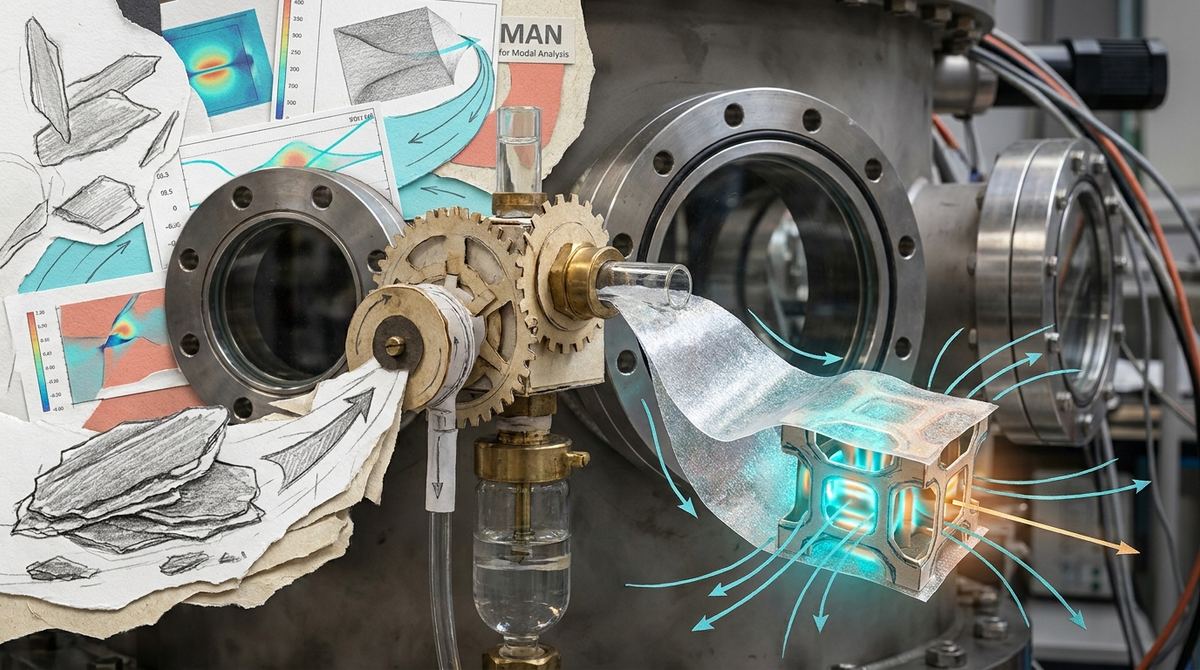
Imagine trying to design a Formula 1 car without a wind tunnel or computer fluid dynamics software. You could build prototypes based on intuition, but the process would be incredibly slow, expensive, and full of failures. For engineers working at the nanoscale, designing components that manipulate light, a similar challenge has hindered progress. The unique and powerful properties of 2D materials like graphene offer incredible potential for next-generation optical devices, but modeling their behavior has been a bottleneck. A recent breakthrough in computational physics by researchers Thomas Christopoulos, Tong Wu, and P. Lalanne directly addresses this challenge, providing the specialized "digital wind tunnel" needed to design and test these complex systems virtually, long before any physical manufacturing begins.
At the heart of modern optics and photonics are electromagnetic resonators. These are microscopic structures engineered to trap and control light of specific frequencies, much like a guitar string is designed to vibrate and produce a specific musical note. These resonators are the building blocks for countless technologies, from lasers and filters in fiber optic communications to the pixels in some advanced displays. The goal is always to make them smaller, faster, and more efficient.
Graphene and other 2D materials have emerged as game-changing candidates for enhancing these resonators. Graphene’s unique electronic structure allows it to interact with light across a huge spectrum, from the visible to the terahertz range. Critically, its properties can be tuned in real-time with an electric field. This opens the door to creating reconfigurable, ultra-fast optical switches, modulators, and sensors.
The problem is that the very properties that make graphene so powerful also make it incredibly difficult to simulate. It behaves as a two-dimensional conductive sheet, a concept that doesn't fit neatly into traditional 3D electromagnetic modeling software. Its quantum mechanical nature means its interaction with light is complex. When you couple a sheet of graphene with a three-dimensional silicon or gold resonator, the physics becomes even more intricate. This computational gap has forced researchers into a slow cycle of fabricating a device, testing it, finding it doesn't work as expected, and starting over. This trial-and-error approach is a major barrier to innovation and commercialization.
The core contribution of this research is not a new physical device but a powerful new software tool. The researchers took a highly respected and accurate simulation software, known as MAN for Modal Analysis of Nanoresonators, and expanded its capabilities. They taught the software the language of 2D materials.
Think of it this way: modal analysis is a technique for breaking down a complex vibration or wave pattern into its fundamental components, or "modes." For our guitar string analogy, the main note you hear is the fundamental mode, while the subtler overtones are higher-order modes. In an optical resonator, these modes describe the specific patterns of the trapped light. Understanding these modes is essential to designing a functional device.
The researchers developed and integrated a new mathematical framework into the MAN software that specifically describes a 2D material like graphene. It treats graphene as a true two-dimensional surface with a specific "surface conductivity," a parameter that captures its unique electronic and optical properties. This expansion now allows the software to accurately calculate the resonant modes of "coupled systems"—hybrid structures where a 2D material interacts with a conventional 3D resonator. In essence, they built a bridge between the physics of two-dimensional materials and the established world of three-dimensional optical design, creating a robust tool that allows scientists to see how a proposed device will behave before it is ever built.
While the paper focuses on the software, the "system" it is designed to model is a hybrid electromagnetic resonator. This typically consists of a microscopic structure made from a dielectric material like silicon or a metal like gold, which forms the main body of the resonator. This structure is designed to confine light waves of a certain wavelength.
The key innovation that this software now models is the addition of a single layer of graphene on or near this structure. Graphene is an atomically thin sheet of carbon atoms arranged in a honeycomb lattice. From an electromagnetic perspective, its most important feature is its population of charge carriers—electrons and "holes"—that are not bound to individual atoms. These carriers can move freely across the 2D plane, behaving like a "2D electron gas."
When a light wave hits the graphene, its oscillating electric field interacts with these free carriers, causing them to oscillate as well. This interaction is exceptionally strong. The energy from the light can be absorbed by the graphene, and the graphene's response, in turn, alters the light's properties. Most importantly, the number of available charge carriers in the graphene can be changed by applying a voltage, a process called electrostatic gating. Adding more carriers increases conductivity and changes how the graphene absorbs and reflects light. This tunability is the central mechanism for creating active devices.
The MAN software expansion models this entire interaction. It calculates the resonant frequencies and field patterns (the modes) of the combined graphene-resonator system. It can predict how the resonance will shift when the graphene's conductivity is changed via gating, which is the exact information an engineer needs to design a functional optical modulator or switch. The software solves the complex Maxwell's equations for this hybrid geometry, accounting for the graphene sheet as a boundary condition with tunable surface impedance, a task that was previously intractable for tools of this precision.
The primary finding of the paper is the successful development and validation of their expanded software. The authors demonstrated that their new tool can accurately and efficiently calculate the resonant modes of complex systems involving 2D materials. To prove this, they likely performed several key validation steps, which are standard practice in computational physics.
First, they would have tested the software on simple, known cases for which an analytical or theoretical solution already exists. By showing that the software's output matches the known correct answer for these simple cases, they build confidence in its underlying code and algorithms.
Second, they would have compared their simulation results to previously published experimental data from other research groups. They could take the exact geometry and material properties of a physically fabricated and tested graphene-based resonator and run it through their simulation. A close match between the simulated optical response and the measured experimental response serves as powerful validation that the model captures the real-world physics.
The paper's contribution is therefore not a discovery of new physical phenomena, but the creation of a validated, reliable, and powerful design tool. They established that their modal analysis approach is a viable and highly accurate method for understanding and engineering the optical properties of these advanced, coupled nanostructures.
This development is a critical enabling step for the entire field of graphene photonics. It fundamentally changes the design cycle for new devices, shifting the emphasis from costly physical iteration to rapid and inexpensive virtual prototyping. The ability to accurately predict device performance before fabrication has profound implications.
For researchers and engineers, it means they can explore a much wider design space. They can test dozens of different geometries, materials, and configurations on a computer in a matter of days, a process that would take years and millions of dollars in a cleanroom. This accelerates the pace of discovery and optimization, allowing for the creation of more complex and higher-performance devices.
For the graphene industry, this is a crucial step toward commercialization. A major hurdle for the adoption of new materials is the difficulty in designing products that reliably leverage their properties. By providing a robust simulation tool, this work de-risks the development process for companies looking to integrate graphene into their products. It provides the engineering certainty needed to justify investment in manufacturing and product development. This directly stimulates demand for high-quality materials, such as the turbostratic graphene flakes needed for consistent electronic and optical performance. Ultimately, better design tools lead to better products, which in turn drives market growth and provides clearer data for graphene market research.
Like any simulation tool, the expanded MAN software has limitations. The model likely makes certain idealizing assumptions. For instance, it may treat the graphene as a perfect, defect-free monolayer. Real-world graphene produced at scale can have defects, wrinkles, grain boundaries, and impurities, all of which can affect its electronic and optical properties. The current model may not fully capture these non-idealities, meaning there could still be a gap between simulated performance and the performance of a real-world device.
Furthermore, the software models the electromagnetic response but may not fully incorporate other multi-physics effects. For example, at very high light intensities, thermal effects can become important, as absorbed energy heats the graphene and changes its conductivity. These thermal effects might not be included in the current version of the model.
The next crucial step is extensive validation against a wider range of novel and complex experimental devices. As research groups around the world design and build new types of graphene-based resonators, they can use this software to model their devices. This continuous feedback loop of comparing simulation with real-world measurement is essential for refining the model, understanding its boundaries, and adding new physics to improve its predictive power. The tool is powerful, but it is the beginning, not the end, of the road for predictive design in 2D material photonics.
The immediate applications for this technology lie in the design of components for telecommunications and data processing. Graphene-based optical modulators, which encode data onto beams of light, promise to be significantly faster and more energy-efficient than current silicon-based versions. This software allows engineers to precisely design the resonator geometry to maximize modulation depth and speed, a key step for next-generation data centers. More information on this area can be found in our coverage of graphene electronics and photonics.
Another significant area is in the development of highly sensitive detectors. By designing a resonator that strongly interacts with a specific molecule, it's possible to create a sensor that can detect its presence in minute quantities. The tunability of graphene allows for the creation of sensors that can be adjusted to detect different targets. This software provides the means to design the optimal structure for maximum sensitivity. This is a key area of research for advanced graphene sensors.
Beyond these areas, the ability to model graphene's interaction with light opens doors in terahertz (THz) technology, which sits between microwaves and infrared light. THz waves are useful for security screening and medical imaging, but components to control them are difficult to make. Graphene is a natural THz material, and this software will be instrumental in designing the THz modulators, switches, and detectors of the future.
If you remember just one thing from this research, it should be this: a powerful new software tool now allows us to accurately simulate and design advanced optical devices that use graphene. This removes a major bottleneck in research and development, dramatically accelerating the path from a theoretical concept to a functional, real-world technology. It is the virtual prototyping engine that the field of graphene photonics has been waiting for.
What is an electromagnetic resonator in simple terms?
Think of an electromagnetic resonator as a tiny, microscopic echo chamber for light. Just as an echo chamber is shaped to make sound waves bounce around and reinforce certain tones, a resonator is shaped to trap light waves and make them build up in intensity at very specific frequencies or colors. These are the fundamental building blocks for controlling light in chips.
What makes graphene so special for optical devices?
Graphene's specialty comes from its unique electronic structure. Its electrons behave as if they have no mass, allowing them to respond very quickly and strongly to the oscillating fields of a light wave. Crucially, you can use a simple electric voltage to add or remove electrons from the graphene sheet, which changes how it interacts with light. This electrical tunability is what allows graphene to be used as an active component, like a switch or modulator, not just a passive material.
Can I download and use this MAN software myself?
This type of software is typically a specialized research code developed and used within academic or industrial research labs. It is not consumer software like a mobile app or a standard office program. It requires significant expertise in computational physics and optics to operate and to interpret the results correctly. Its main users will be scientists and engineers who are actively designing new photonic devices.
How does a better simulation tool help a company that sells graphene?
A better design tool directly enables potential customers. If a company wants to build a next-generation optical switch, they need to be confident that their design will work. This software gives them that confidence, making them more likely to move forward with the project and purchase the necessary high-quality graphene materials to build their prototypes and, eventually, their final products. It lowers the barrier to entry for companies wanting to innovate with graphene.
Does this research mean we will have graphene-based phones next year?
No, this is a foundational engineering step, not a final product. While this software greatly speeds up the design phase, the journey to a consumer product like a phone involves many other challenges, including scalable manufacturing, integration with existing silicon electronics, long-term reliability testing, and cost reduction. This work is a critical piece of the puzzle that brings those future products closer to reality, but the timeline for commercialization is still measured in years, not months.
The work by Christopoulos, Wu, and Lalanne represents a significant milestone in the maturation of nano-optics and 2D material engineering. By expanding the powerful MAN software to accurately model coupled systems containing graphene, they have provided the community with a much-needed tool to bridge the gap between theoretical promise and practical design. This is not just an academic exercise; it is the creation of essential infrastructure for innovation. By enabling rapid, accurate, and low-cost virtual prototyping, this software will undoubtedly accelerate the development of next-generation photonic technologies, paving the way for faster communications, more sensitive detectors, and entirely new ways of controlling light. It transforms the design process from an art of intuition and expensive experimentation into a predictive science, bringing the remarkable potential of graphene one giant step closer to the marketplace.
Serious about B2B integration? Test our premium Pulsed Electrical Resistive Carbon Heating turbostratic graphene in your lab. 100g sample packs available now.
Explore More
New research provides a theoretical framework for calculating the lifetime and spectral function of topological heavy fermions, a key step for developing...

Learn to build a prototype strain-tunable magnetic device using graphene as a sacrificial layer to create freestanding MnPtGa membranes. This guide covers...

Researchers revisit a graphene, n-heptane, and permalloy system, observing apparent ideal diamagnetism at ambient conditions, a key property of superconductors.