
Generalized Beth-Uhlenbeck Model for Graphene Electronics
Researchers use the Generalized Beth-Uhlenbeck approach to model electron interactions in 2D materials, offering a new way to predict graphene's behavior.
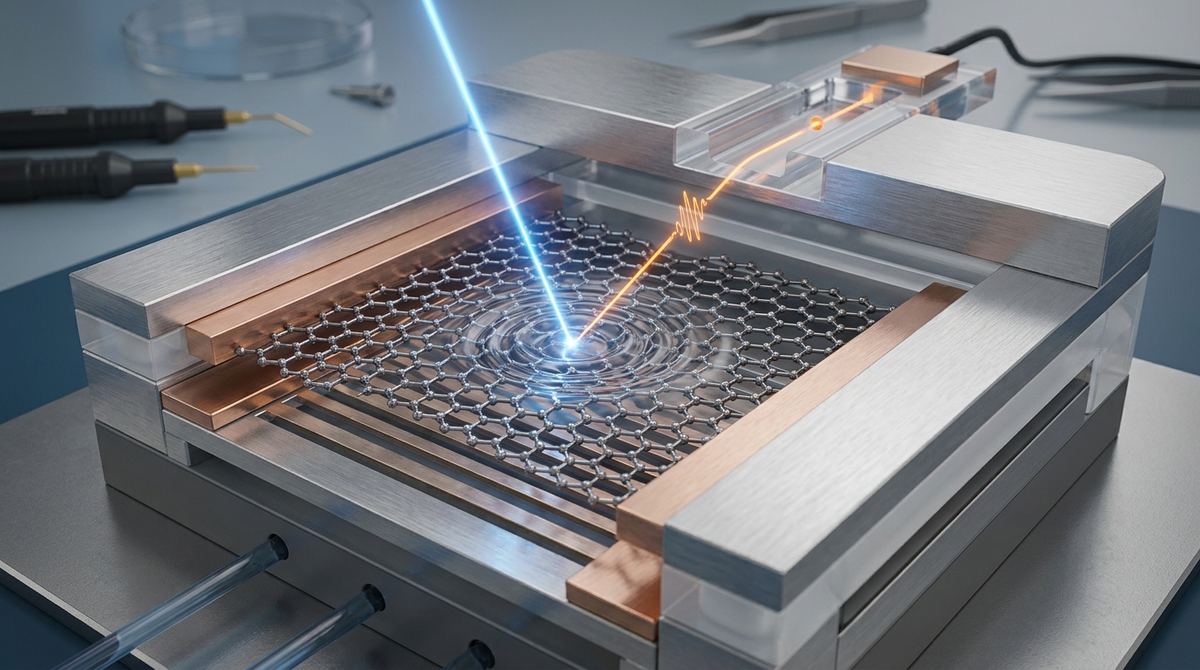
Imagine you are trying to measure the exact speed of a person jumping off a small rowing boat. As the person leaps forward, the boat moves backward in the opposite direction. If you only measure the person's speed and ignore the boat's movement, your calculations will be slightly off because you failed to account for the recoil of the platform. In the world of ultra-fast electronics and advanced materials, scientists face a nearly identical problem when they try to observe the electrons inside graphene. When a high-energy X-ray strikes an electron to kick it out of the material for study, the entire graphene sheet experiences a tiny, sudden recoil. This movement can distort the very data scientists use to understand how graphene works. Understanding this recoil is not just a matter of academic curiosity; it is a requirement for the next generation of precision engineering in semiconductors and quantum computing.
The pursuit of faster, smaller, and more efficient electronics has placed graphene at the center of intense scientific scrutiny. Because graphene is a single layer of carbon atoms, its electronic properties are incredibly sensitive to its structural integrity and its environment. To understand these properties, researchers use a technique called X-ray photoemission spectroscopy. In this process, a high-energy X-ray photon is fired at the sample, knocking an electron out of its atomic orbit. By measuring the energy and momentum of that ejected electron, scientists can reconstruct a map of how electrons behave within the material.
However, as researchers move toward using harder, higher-energy X-rays to look deeper into materials and complex interfaces, a significant complication arises. Standard models of photoemission often assume that the lattice—the organized grid of carbon atoms—remains stationary during the electron's ejection. This assumption is generally safe for heavy elements, but for light elements like carbon, the physics changes. When a high-energy photon transfers its momentum to an electron, that momentum is also shared with the remaining lattice. This creates a recoil effect, similar to the rowing boat scenario. This recoil shifts the energy of the detected electron, leading to inaccuracies in the data. If scientists do not account for this movement, they might misinterpret the electronic structure of the graphene, leading to incorrect conclusions about its conductivity, stability, or potential for use in advanced devices.
The core concept addressed by the researchers is the interaction between the energy of the incoming X-ray and the physical response of the carbon lattice. To solve this, the team needed to bridge the gap between theoretical physics and experimental reality. They realized that the recoil effect is not just an error to be subtracted, but a physical phenomenon that must be integrated into the mathematical models used to interpret spectroscopy. By combining experimental observations with advanced theoretical calculations, they aimed to create a way to distinguish between the true electronic state of the graphene and the artifacts caused by the lattice's sudden movement.
To understand how this works, we must look at the mechanics of a hard X-ray photon interacting with a 2D lattice. Graphene is a hexagonal lattice of carbon atoms. When a hard X-ray hits an electron, the interaction is governed by the conservation of momentum. The momentum from the photon is transferred to the electron, which then flies out of the material. However, because the electron is bound to the carbon atoms, the momentum is also distributed across the entire lattice.
In a material made of heavy atoms, such as gold or lead, the mass of the atoms is so large that the recoil energy is negligible. It is like a person jumping off a massive cruise ship; the ship does not move perceptibly. But graphene is composed of carbon, which is one of the lightest elements. When an electron is ejected from such a light structure, the momentum transfer causes the lattice to undergo a sudden, localized vibration or shift. This process involves the coupling of the electronic transition to the vibrational modes of the lattice, a concept known as phonon coupling. The researchers, including Simone Ritarossi, Alice Apponi, Orlando Castellano, José Lorenzana, Domenica Convertino, Camilla Coletti, Tien-Lin Lee, Francesco Offi, and Alessandro Ruocco, investigated how this coupling manifests when using hard X-rays, which possess enough energy to penetrate deeper into the material but also enough momentum to trigger this noticeable recoil.
The research, published in mid-2026, successfully demonstrated that the recoil effect is a dominant factor in hard X-ray photoemission of light 2D materials. Through high-precision experiments and rigorous theoretical modeling, the team proved that the energy spectrum of the ejected electrons is shifted in a predictable way due to the lattice's response. This shift is not random; it follows specific physical laws related to the momentum transfer and the mass of the carbon atoms.
The study confirmed that when the energy of the X-ray increases, the error introduced by ignoring the recoil becomes more pronounced. This means that while soft X-rays (lower energy) might be sufficient for surface-level studies, hard X-rays (higher energy) require a fundamental shift in how data is interpreted. The researchers were able to show that by applying their new theoretical framework, they could accurately account for the momentum shared with the lattice, effectively "correcting" the data to reveal the true electronic structure of the graphene. This allows for a much more precise mapping of the energy bands and electron dynamics that define graphene's unique properties.
The implications of this research are profound for the field of materials science and the future of semiconductor manufacturing. As the electronics industry moves toward "more than Moore" technologies, which involve stacking different 2D materials to create complex, multi-layered devices, the ability to characterize these layers accurately is vital.
If we cannot accurately measure the electronic states of graphene within a multi-layered stack because of recoil-induced errors, we cannot optimize the device's performance. For example, the efficiency of a graphene-based transistor depends on the precise alignment of its energy levels. If our spectroscopic tools give us a distorted view of these levels due to lattice recoil, our designs will be based on flawed data. This research provides the mathematical and experimental foundation needed to correct those distortions, ensuring that the next generation of high-speed, low-power electronics is built on a foundation of accurate physical data. It provides the "calibration" needed for the most advanced probes available to human science.
While this research is a significant leap forward, it is important to note that it is a fundamental physics study rather than a commercial product. The research focuses on the fundamental interaction between photons and the carbon lattice; it does not itself create a new type of graphene or a new type of X-ray machine. Instead, it provides the theory and experimental proof required to use existing high-energy synchrotron facilities more effectively.
Furthermore, while the researchers have successfully modeled the recoil in pristine graphene, there is still much to learn about how this effect changes in more complex environments. For instance, how does the recoil behave in graphene that is heavily doped with chemical impurities, or in graphene that is part of a twisted bilayer structure (moiré patterns)? These complex systems involve many more degrees of freedom and potential interactions between the electrons and the lattice. More testing is required to see how these sophisticated theoretical models hold up when applied to real-world, "messy" materials used in industrial settings.
The real-world impact of this research will be felt most strongly in the research and development laboratories of semiconductor giants and quantum computing startups. As companies attempt to integrate 2D materials into standard silicon manufacturing processes, they will require highly accurate characterization tools to ensure quality control and device performance.
One primary application is in the development of quantum materials. Quantum computers rely on the precise control of individual electrons and their quantum states. If the measurement of these states is skewed by lattice recoil during characterization, the development of stable qubits becomes much more difficult. By providing a way to account for lattice recoil, this research helps scientists ensure that the materials they are using for quantum computing are exactly what they think they are. Additionally, in the field of high-speed telecommunications, where graphene's high carrier mobility is a key advantage, having accurate data on electronic band structures allows engineers to design much more efficient modulators and detectors for 5G and 6G networks.
If you remember only one thing from this research, let it be this: accuracy in the atomic world requires accounting for movement. Just as a person jumping off a boat moves the boat, an electron being kicked out of graphene moves the graphene itself, and scientists must account for that movement to truly understand the material.
How does hard X-ray photoemission spectroscopy work?
Hard X-ray photoemission spectroscopy is a technique where high-energy X-ray photons are directed at a material to knock electrons out of their orbits. By measuring the kinetic energy and the direction of these ejected electrons, scientists can determine the binding energy of the electrons, which tells us how they were being held by the atoms. This essentially provides a fingerprint of the material's electronic structure.
Why is graphene's light weight a problem in these experiments?
In spectroscopy, we often assume the material stays still when an electron is ejected. However, the mass of the atom determines how much it reacts to the momentum of the process. Because carbon is a very light element, the momentum transferred during photoemission causes a noticeable physical recoil in the lattice. This movement changes the energy of the electron, which can confuse scientists if they are not expecting it.
What is the difference between soft X-rays and hard X-rays in this context?
Soft X-rays have lower energy and are more surface-sensitive, meaning they primarily interact with the very top layer of a material. Hard X-rays have much higher energy, allowing them to penetrate much deeper into the material or through multiple layers. While hard X-rays are better for looking at complex, multi-layered structures, they also cause the much more problematic lattice recoil effect described in this research.
Will this research lead to new graphene-based products immediately?
No, this is a fundamental physics discovery. This research provides the necessary scientific tools and mathematical corrections that engineers and material scientists need to use. Once the scientific community has fully integrated these corrections into their measurement models, it will eventually lead to better design processes for graphene-based products, but it is a foundational step rather than an immediate commercial application.
How does this research help in the development of faster computers?
Faster computers require materials that can move electrons with minimal resistance and extreme precision. Graphene is a candidate for this because of its incredible electron mobility. To use it effectively, engineers must know exactly how it behaves under different conditions. By correcting the errors caused by lattice recoil, this research gives engineers the accurate data they need to design more efficient and faster electronic components.
The study of graphene lattice recoil represents a vital step in the evolution of materials characterization. By recognizing that the lattice is a dynamic participant in the photoemission process, the researchers—Simone Ritarossi, Alice Apponi, Orlando Castellano, José Lorenzana, Domenica Convertino, Camilla Coletti, Tien-Lin Lee, Francesco Offi, and Alessandro Ruocco—have provided a way to look through the "noise" of atomic movement. This ability to see the true electronic state of a material is essential as we push the boundaries of nanotechnology, moving from simple surface studies to complex, multi-layered quantum and electronic systems. As we continue to probe the atomic world with higher energies, the lessons learned from the recoil of the carbon lattice will become the standard for precision in the 21st century.
Serious about B2B integration? Test our premium Pulsed Electrical Resistive Carbon Heating turbostratic graphene in your lab. 100g sample packs available now.
Explore More
Researchers use the Generalized Beth-Uhlenbeck approach to model electron interactions in 2D materials, offering a new way to predict graphene's behavior.

Researchers derived the first exact formula for resistivity in the 1D infinite-U Hubbard model, providing a crucial benchmark for understanding strongly...

Learn how to utilize bipartite-lattice symmetry to generate pure spin shift currents in graphene nanoribbons for advanced spintronic device prototyping.