
Hydrodynamic Backflow for Easing the Fermion Sign in Finite-Temperature Electron
Researchers have developed a hydrodynamic backflow method to ease the fermion sign problem, a major hurdle in quantum simulations of materials like graphene.
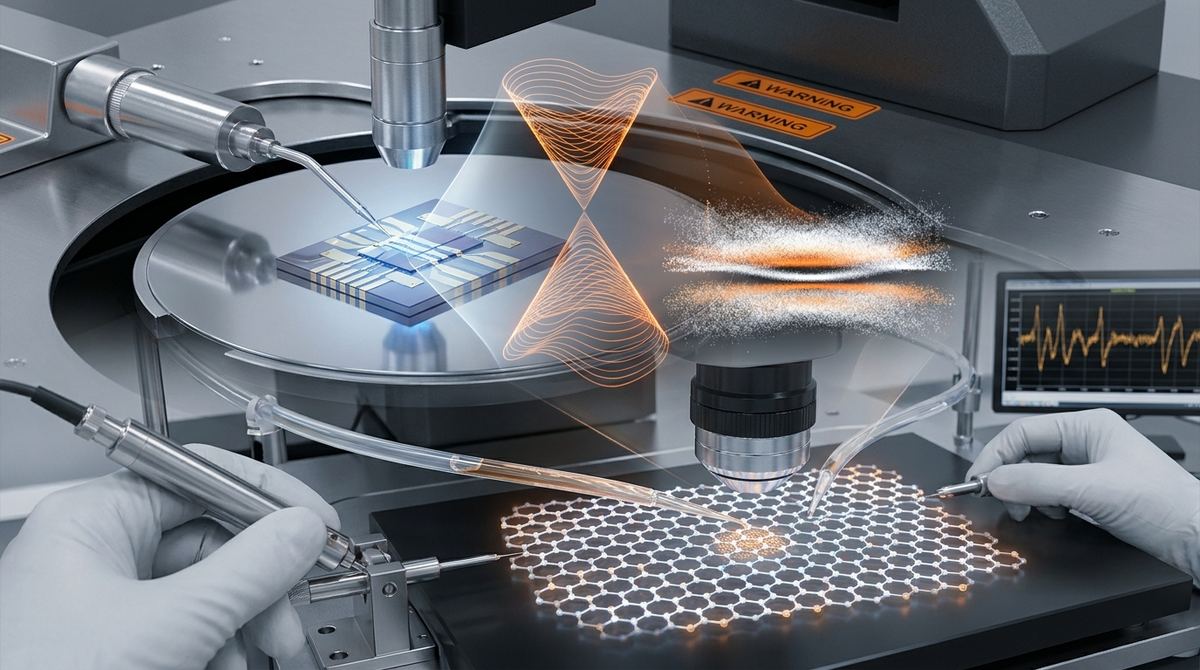
Imagine a material that is so conductive it can move electrons faster than almost anything else known to science, yet possesses a fundamental limitation: its properties are essentially fixed by the nature of carbon itself. This is the paradox of graphene. While its carbon-based structure grants it incredible speed and strength, the inherent physics of the material limits how we can use it for specialized tasks like quantum computing or high-temperature superconductivity. But what if we could take this legendary material and "retune" its internal physics, almost like adjusting the frequency on a radio? By introducing a different element, such as sulfur, into the graphene layers, scientists are discovering ways to fundamentally rewrite the rules of how electrons behave within the material. This research, spearheaded by Armin Sahinovic and Rossitza Pentcheva, explores a transformative method of engineering few-layer graphene to unlock entirely new physical phenomena.
In the world of advanced materials science, graphene is often treated as a near-perfect conductor. In its pristine, pure form, the carbon atoms are arranged in a perfect hexagonal lattice. This specific arrangement creates a unique electronic environment known as linear dispersion. In simple terms, this means that electrons in pristine graphene behave like particles with no mass; they move with incredible speed and are highly sensitive to electrical fields. This makes graphene ideal for high-frequency electronics and fast transistors. However, this "perfection" is also a constraint.
The very reason graphene is such a great conductor—its highly symmetric and uniform structure—means that its electronic energy levels are very specific. In a pristine state, the density of electrons at certain energy levels is relatively low. For many cutting-edge applications, however, engineers do not want electrons that simply fly through a material. They want materials where electrons can be more effectively "trapped" or concentrated at specific energy levels to interact with one another. For instance, to create new types of superconductors or to develop quantum bits for computing, we need high "density of states," which occurs when many electrons can occupy the same energy level simultaneously.
The challenge is that you cannot easily change the fundamental band structure of a crystal once it is formed. To change how a material conducts electricity, you usually have to change the material itself. For graphene, this means finding a way to disrupt its perfect symmetry just enough to manipulate the energy levels of its electrons without destroying the material's structural integrity. We need a way to transition from the "fast" behavior of linear dispersion to a state where electrons are more localized in energy, known as flat bands.
The solution proposed by Sahinovic and Pentcheva involves a process called doping. Doping is the intentional introduction of impurities into a pure crystal to change its electrical properties. In this specific research, the researchers focused on sulfur. Sulfur is a larger atom than carbon and has a different number of valence electrons. When a sulfur atom replaces a carbon atom in the graphene lattice, or sits within a vacancy in the lattice, it acts as a powerful chemical lever.
By adding sulfur, we are essentially introducing "bumps" and "weight" into the smooth highway of the graphene lattice. These sulfur atoms create local changes in the electrical potential and the physical shape of the material at an atomic scale. This disruption breaks the perfect symmetry that allows electrons to move so freely. When that symmetry is broken in a controlled way, the electronic energy levels—which previously looked like a steep, narrow cone—begin to flatten out. This transition from a "slope" to a "flat" line in the energy landscape is the key to unlocking new physics. This allows engineers to move from a material that is just a fast conductor to a material that can support complex, highly interactive electron states.
To understand how this works, we must look at the relationship between the crystal lattice and the electronic band structure. In few-layer graphene, which consists of a few stacked layers of carbon atoms, the electrons move through the periodic potential created by the carbon nuclei. In a pure system, this potential is highly periodic and symmetric, leading to the characteristic Dirac cones where the energy and momentum of an electron are linearly related.
When sulfur is introduced via doping, several things happen simultaneously. First, there is a chemical effect. Sulfur has six valence electrons, whereas carbon has four. This difference in electron count changes the local charge density. This process, often referred to as charge transfer, can shift the Fermi level—the highest energy level occupied by electrons at absolute zero—making the material more n-type or p-type.
Second, there is a structural effect. A sulfur atom is significantly larger than a carbon atom. When it is integrated into the graphene lattice, it creates local strain. The lattice must bend or stretch to accommodate the larger sulfur atom. This strain alters the overlapping of the atomic orbitals (the p-orbitals) that facilitate electron movement. In a perfect lattice, these orbitals overlap in a way that produces linear dispersion. However, the distortion caused by sulfur changes the way these orbitals communicate with each other.
Finally, there is the effect of symmetry breaking. The most critical factor in creating flat bands is the disruption of the lattice symmetry. By placing sulfur atoms in specific configurations or concentrations, the researchers can manipulate the electronic wavefunctions. Instead of the wavefunctions being spread across the entire lattice in a way that favors rapid movement, the presence of sulfur can cause the energy-momentum relationship to flatten. In these flat bands, the velocity of the electrons—which is defined by the slope of the energy-momentum curve—drops toward zero. While this sounds like it would make the material a poor conductor, it actually creates a high density of available electronic states at a single energy level, which is the prerequisite for many exotic quantum states.
The research conducted by Armin Sahinovic and Rossitza Pentcheva provides a roadmap for how sulfur concentration and placement can be used to tune these electronic properties. Their findings highlight that the transition from linear dispersion to flat bands is not a simple "on or off" switch but a tunable gradient.
The study suggests that by carefully controlling the amount of sulfur, one can move through different electronic phases. At low doping levels, the material might still maintain much of its high-speed, linear dispersion characteristics, making it suitable for traditional high-speed electronics. However, as the sulfur content increases or as the atoms are arranged in specific patterns, the dispersion curves begin to lose their steepness.
The researchers found that the formation of these flat bands is highly dependent on the number of graphene layers and the specific arrangement of the sulfur dopants. In few-layer graphene, the interaction between the layers adds an extra dimension of complexity. The sulfur doesn't just affect the layer it is on; it influences the electronic environment of the adjacent layers through electrostatic coupling. This means that by using sulfur, we can manipulate the three-dimensional electronic landscape of a multi-layered material, not just a single sheet. This ability to transition from the "Dirac regime" (where electrons act like light) to the "flat-band regime" (where electrons are highly correlated) is the most significant outcome of the research.
The implications of being able to engineer flat bands in graphene are profound for the future of nanotechnology. In standard conductors, electrons are like commuters on a high-speed rail system; they move quickly from point A to point B, but they don't interact much with each other. In a material with flat bands, the electrons are more like a crowd of people in a room; because they are moving so slowly relative to their energy, they are much more likely to collide, interact, and influence one another's behavior.
This high level of electron-electron interaction is the "holy grail" for several fields. First, it is a primary requirement for discovering and controlling new forms of superconductivity. Superconductivity is the ability of a material to conduct electricity with zero resistance, and many theorists believe that flat-band systems are the most efficient way to achieve this. If we can engineer flat bands via sulfur doping, we might be able to design materials that superconduct at much higher temperatures than current superconductors.
Second, the high density of states provided by flat bands is essential for quantum computing. Quantum bits, or qubits, require very specific and controllable electronic states to maintain coherence. A material that can be precisely tuned to provide a specific energy level could act as a platform for advanced quantum information processing. This research moves us away from using "found" materials and toward "designed" materials, where the electronic properties are custom-built through atomic-scale engineering.
While the theoretical and computational insights provided by Sahinovic and Pentcheva are groundbreaking, it is important to recognize that this research is currently in the realm of advanced modeling and theoretical prediction. There is a significant gap between predicting a flat band in a computer model and successfully manufacturing a few-layer graphene sheet with perfectly placed sulfur atoms in a laboratory.
One major challenge is the precision of the doping process. Currently, adding sulfur to graphene often results in a random distribution of atoms. For the specific electronic effects discussed in the research to be realized, the sulfur atoms might need to be arranged in very specific, periodic patterns to create the desired band structure. Achieving this level of atomic-scale control during large-scale manufacturing is a monumental engineering task.
Furthermore, the stability of these doped structures over time must be tested. Sulfur is a reactive element, and there are concerns about whether the doped graphene will remain stable under different environmental conditions, such as exposure to oxygen or heat. Experimentalists will need to find ways to passivate the material or stabilize the sulfur atoms to ensure that the engineered properties remain consistent over the lifetime of a device. Finally, while the theoretical models show incredible potential, the actual performance of these materials in a real-world circuit remains to be proven through rigorous physical experimentation.
The ability to engineer the electronic structure of graphene via sulfur doping has several potential real-world applications that could redefine technology. In the field of sensing, a material with highly tuned electronic states is extremely sensitive to external stimuli. This could lead to a new generation of ultra-sensitive chemical or biological sensors capable of detecting a single molecule of a toxin or a specific protein in a medical sample.
In the electronics industry, the ability to switch a material from a high-speed conductor to a high-density state could lead to more efficient transistors. As we approach the physical limits of silicon, graphene-based components offer a way forward. Specifically, the ability to control the movement and interaction of electrons could lead to the development of "neuromorphic" computing—chips that mimic the way the human brain processes information by using highly interactive electronic states.
Finally, the energy sector stands to benefit from the potential discovery of new superconductors. If sulfur-doped graphene can be used to create high-temperature superconductors, it could revolutionize power grids by allowing electricity to be transported across continents with zero energy loss, or lead to incredibly efficient Maglev transportation systems. While these applications are still on the horizon, the fundamental science provided by this research creates the necessary foundation.
If you remember only one thing from this research, let it be this: sulfur doping acts as a "tuning knob" for graphene. By adding sulfur, we can transform graphene from a material that merely conducts electricity quickly into a material that can be engineered to have entirely new, highly interactive electronic properties, opening the door to a new era of quantum materials.
How does doping work in a material like graphene?
Doping is the process of adding a small amount of a different element into a pure substance to change its properties. In graphene, adding sulfur changes how the carbon atoms interact with one another. This disruption changes how the material handles electricity, allowing us to move away from its natural state to one that is more useful for specific high-tech applications.
Why is sulfur used instead of other elements?
Sulfur was chosen because its atomic size and the number of its valence electrons create a specific kind of disruption in the carbon lattice. Sulfur is large enough to cause structural strain but behaves in a way that allows for the flattening of electronic energy levels, which is a very specific and desirable effect for creating flat bands.
What is the difference between linear dispersion and flat bands?
Linear dispersion means that the electrons move through the material very quickly and follow a predictable, high-speed path, similar to light. Flat bands mean that the energy levels are concentrated, causing electrons to move much more slowly and interact more strongly with each other. This makes the material behave more like a dense crowd of interacting particles rather than a stream of fast-moving ones.
Why do researchers want to create flat bands?
Flat bands are important because they create a high density of electronic states at a single energy level. This high density is necessary for many advanced physical phenomena, such as superconductivity and quantum effects. Without these flat bands, it is much harder to force electrons to interact strongly enough to produce these specialized states.
Is this technology ready to be used in consumer electronics?
Not yet. This research is currently focused on understanding the fundamental physics and the potential of these materials. There are still significant engineering challenges to overcome, such as how to place the sulfur atoms precisely and how to manufacture these materials reliably at scale. We are looking at long-term development rather than immediate commercial availability.
The work of Armin Sahinovic and Rossitza Pentcheva represents a vital step in the evolution of graphene technology. By moving beyond the study of pristine graphene and into the realm of engineered sulfur-doped systems, we are beginning to understand how to manipulate the very essence of electronic behavior. The ability to transition from linear dispersion to flat bands provides a powerful new tool for material scientists, offering a path toward the next generation of superconductors, quantum computers, and ultra-sensitive sensors. As we move from discovering materials to designing them at the atomic level, the potential for sulfur-doped graphene to transform our technological landscape is immense.
Serious about B2B integration? Test our premium Pulsed Electrical Resistive Carbon Heating turbostratic graphene in your lab. 100g sample packs available now.
Explore More
Researchers have developed a hydrodynamic backflow method to ease the fermion sign problem, a major hurdle in quantum simulations of materials like graphene.

Learn to build a prototype active graphene metasurface for mid-IR beam steering. This guide covers the materials, fabrication, and testing for LiDAR.

Researchers use the Generalized Beth-Uhlenbeck approach to model electron interactions in 2D materials, offering a new way to predict graphene's behavior.