
Controlled Loop Expansion for the Topological Heavy Fermion Model
New research introduces a controlled loop expansion for the topological heavy fermion model, a powerful theoretical tool for designing future quantum materials.
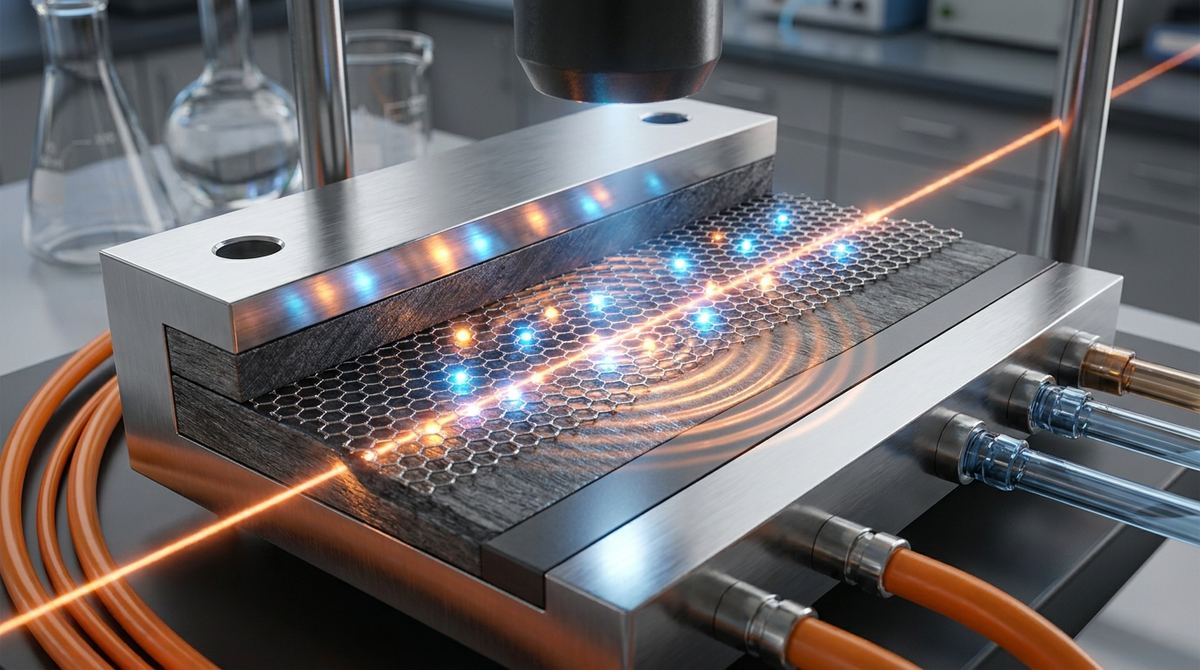
Imagine a high-performance racing engine that generates an intense amount of heat every time it accelerates. In traditional engines, if you cannot dissipate that heat fast enough, the engine overheats and loses power, or worse, breaks down. In the microscopic world of ultra-fast electronics, electrons act much like those racing cars. When they move through a material like graphene, they gain immense energy and become "hot." If we cannot control how these hot electrons lose their energy, our devices will struggle to operate at high speeds and will eventually fail due to thermal damage. Recently, a team of scientists has discovered a way to control this cooling process by using light to create a strategic bottleneck in the energy flow. This breakthrough, achieved through the meticulous work of Sachin Sharm, Elliott Walker, Rachael Myers-Ward, Jenifer Hajjus, Yijing Liu, Paola Barbara, and Ioannis Chatzakis, provides a new way to manage the thermal energy of electrons using light as a precision tool.
As our digital world pushes toward higher frequencies and smaller components, we are hitting a fundamental physical wall: heat. In traditional silicon-based semiconductors, the movement of electrons generates significant heat through a process called scattering. As electrons travel through the atomic lattice of a material, they bump into atoms, transferring their kinetic energy into the material as heat. This heat is not just a nuisance; it is a fundamental limit to how fast a processor can run and how small its components can be. If the heat is not removed quickly, the temperature of the electrons becomes much higher than the temperature of the material itself, a state known as hot-carrier excitation.
These hot carriers are problematic for several reasons. First, they can cause the electronic properties of the material to shift unpredictably, leading to errors in signal processing. Second, the accumulation of energy can lead to the degradation of the material's structure over time. In two-dimensional materials like graphene, which are being touted as the successor to silicon, managing this energy is even more critical. Because graphene is only one atom thick, it has a very high surface-to-volume ratio, meaning the way energy moves from the electrons to the surrounding environment is the single most important factor in determining how the device performs. The challenge is that we currently lack a way to selectively control how these electrons shed their energy without affecting the rest of the system.
To understand the solution proposed by the researchers, we have to look at how energy moves from an electron to a material. Think of the electrons as people running through a crowded hallway. As they run, they bump into the walls and the people standing still. The energy from those bumps travels through the crowd as a wave of movement. In physics, these waves of movement through a crystal lattice are called phonons.
The researchers found a way to create a "bottleneck" in this hallway. By using specific colors of light, they can cause the "people" (electrons) to move in a way that makes it very difficult for the "waves" (phonons) to pass through. This bottleneck essentially traps the energy for a brief moment, allowing us to control exactly how long the electrons stay "hot." By choosing the right energy of light to shine on the graphene, we can decide whether the electrons cool down instantly or hold onto their energy for a longer period. This is the "excitation-energy-selective control" mentioned in their findings, and it turns the management of heat from a passive problem into an active, controllable process.
The physics behind this phenomenon lies in the complex interaction between electrons and the vibrations of the carbon atoms in the graphene lattice. In graphene, electrons do not move like heavy balls; they behave as massless particles, following specific energy-momentum relationships that allow them to travel at incredibly high speeds. When a photon—a particle of light—hits a graphene sheet, it can transfer its energy to an electron, kicking it into a higher energy state. This electron is now a "hot carrier."
Once an electron is excited, it must eventually lose that energy to return to its resting state. It does this primarily by emitting phonons. In a crystal lattice, there are two main types of phonons: acoustic phonons and optical phonons. Acoustic phonons are low-energy vibrations that move through the material like sound waves and are very efficient at carrying heat away from the electron. Optical phonons, however, involve the atoms moving against each other in a more complex, high-energy pattern.
The interaction between a hot electron and these phonons is highly dependent on the energy of the electron. When the energy of the hot carrier matches the energy required to create an optical phonon, a resonance occurs. This is where the bottleneck happens. If the electrons are excited to an energy level that perfectly matches the optical phonon energy, they will rapidly emit these phonons. However, these optical phonons themselves then need to decay into lower-energy acoustic phonons to move the heat away. If the optical phonons cannot decay fast enough, they pile up. This accumulation of phonons creates a bottleneck that prevents the electrons from cooling down any further. The researchers discovered that by tuning the energy of the initial light excitation, they could move the electrons into or out of this resonant state, effectively turning the cooling rate on or off.
The investigation conducted by Sharm, Walker, Myers-Ward, Hajjus, Liu, Barbara, and Chatzakis revealed that the cooling rate of hot carriers in graphene is not a static property of the material. Instead, it is highly sensitive to the energy of the light used to excite the electrons. By using advanced spectroscopic techniques, the team was able to map out how the energy distribution of the carriers changed over time when subjected to different excitation energies.
The most significant finding was the observation of the resonant optical-phonon bottleneck. They demonstrated that when the excitation energy was precisely tuned to the energy of the optical phonons, the cooling process was significantly slowed down. This confirmed that the "bottleneck" was a real, measurable phenomenon that could be manipulated. Essentially, the researchers proved that we can use light to tune the "electronic temperature" of graphene. By selecting the specific energy of the incoming photons, they could control the rate at which the electrons shed their energy, providing a level of control that had never been demonstrated in this manner for graphene.
This discovery is a significant step forward for the field of condensed matter physics and materials science because it moves us from observing thermal effects to controlling them. In most electronic applications, heat is an enemy that must be managed through bulky heat sinks or cooling fans. This research suggests a future where we can manage heat at the atomic level using light, which is much more precise and faster.
For the development of next-generation optoelectronics, this is vital. Optoelectronics involves devices that convert light into electricity or vice versa. In these devices, the speed at which an electron can relax after being hit by light determines how fast the device can reset for the next signal. If we can control that relaxation time through light-driven resonance, we can create sensors and detectors that are significantly faster and more efficient than anything currently available. Furthermore, the ability to control energy distribution allows for more stable device performance, reducing the noise and interference caused by thermal fluctuations.
While the findings are groundbreaking, it is important to maintain a realistic perspective on their current application. This research is fundamental in nature, meaning it explores the basic laws of physics that govern how matter and energy interact. The experiments were conducted in a highly controlled laboratory environment, using specialized equipment to isolate the effects of phonons and electrons.
In a real-world electronic device, graphene is rarely sitting in a vacuum; it is usually placed on a substrate like silicon dioxide or other insulating materials. These substrates can introduce their own phonons and defects, which might interfere with or dampen the resonant bottleneck effect. Additionally, the scalability of this control mechanism remains to be seen. While it is possible to tune energy using a laser in a lab, doing so in a densely packed microchip with billions of transistors would require incredibly sophisticated light-integrated circuitry. Future research must determine how this effect holds up in practical, multi-layered device architectures and under varying environmental conditions.
The practical implications of this research are vast, particularly as we move toward the era of "all-optical" computing and ultra-high-frequency electronics. One major application is in the creation of ultrafast photodetectors. These are sensors used in fiber-optic communications to turn light signals into electrical data. If we can control the carrier cooling rate, we can design photodetectors that operate at much higher frequencies, enabling faster internet speeds and more efficient data centers.
Another application lies in the development of high-performance transistors for high-frequency communications, such as those used in 6G networks. As these networks operate at much higher frequencies than 5G, the heat management issues become exponentially more difficult. Using light-driven control to manage the hot-carrier effect could allow these transistors to operate at higher speeds without the risk of thermal degradation. Finally, in the realm of quantum computing and advanced sensing, the ability to precisely control the energy state of electrons could be essential for maintaining the stability required for quantum operations.
If you remember only one thing from this research, let it be this: we are learning how to use light to control the temperature of electrons in graphene, allowing us to manage heat at the atomic level to enable faster and more efficient electronics.
What exactly are hot carriers in graphene?
Hot carriers are electrons or holes that have absorbed a large amount of energy, typically from light or an electric field, and are moving much faster than they would be at room temperature. They are called "hot" because their kinetic energy is much higher than the thermal energy of the surrounding material, making them much hotter than the material itself.
Why is heat such a big problem for small electronics?
As electronic components get smaller and more powerful, they generate more heat in a much smaller space. If this heat is not managed, it can change the electrical properties of the material, causing the device to malfunction, or it can physically damage the delicate atomic structures that make the device work.
What is the difference between acoustic and optical phonons?
Phonons are essentially vibrations of atoms in a solid. Acoustic phonons are low-energy vibrations where adjacent atoms move together, similar to how sound waves move through air; they are the primary way heat is carried through a material. Optical phonons are higher-energy vibrations where adjacent atoms move in opposite directions, which is the primary way electrons lose their excess energy.
How does light help control the cooling process?
By using light of a specific energy, we can "kick" the electrons into a specific energy state that matches the energy of the optical phonons. This creates a resonance that causes the phonons to pile up, creating a bottleneck that slows down the cooling process, giving us a way to tune how long the electrons stay at a high energy level.
Is this technology going to be in my phone next year?
Not directly. This is fundamental scientific research that explores how materials behave at the atomic scale. While it provides the blueprint for future technologies like faster sensors and better communication chips, it will take many years of engineering and testing to move these concepts from a laboratory setting into commercial products.
The ability to manipulate the thermal behavior of electrons is a holy grail for material science. The work of Sharm, Walker, Myers-Ward, Hajzus, Liu, Barbara, and Chatzakis has brought us a significant step closer to that goal. By identifying and utilizing the resonant optical-phonon bottleneck in graphene, they have demonstrated that we can use light to master the flow of energy at the most fundamental level. As we continue to push the boundaries of what is possible in nano-electronics, these insights into the control of hot carriers will undoubtedly play a crucial role in the next generation of high-speed, high-efficiency technology.
Serious about B2B integration? Test our premium Pulsed Electrical Resistive Carbon Heating turbostratic graphene in your lab. 100g sample packs available now.
Explore More
New research introduces a controlled loop expansion for the topological heavy fermion model, a powerful theoretical tool for designing future quantum materials.

Researchers derived an analytic formula for twisted bilayer graphene electron lifetimes, providing a key design tool for future quantum and electronic devices.

Learn to build a high-responsivity 1.5 µm graphene photodetector. This guide details the materials and steps for a prototype based on upconversion...