
Graphene Systems Show Apparent Ideal Diamagnetism at Room Temperature
Researchers revisit a graphene, n-heptane, and permalloy system, observing apparent ideal diamagnetism at ambient conditions, a key property of superconductors.
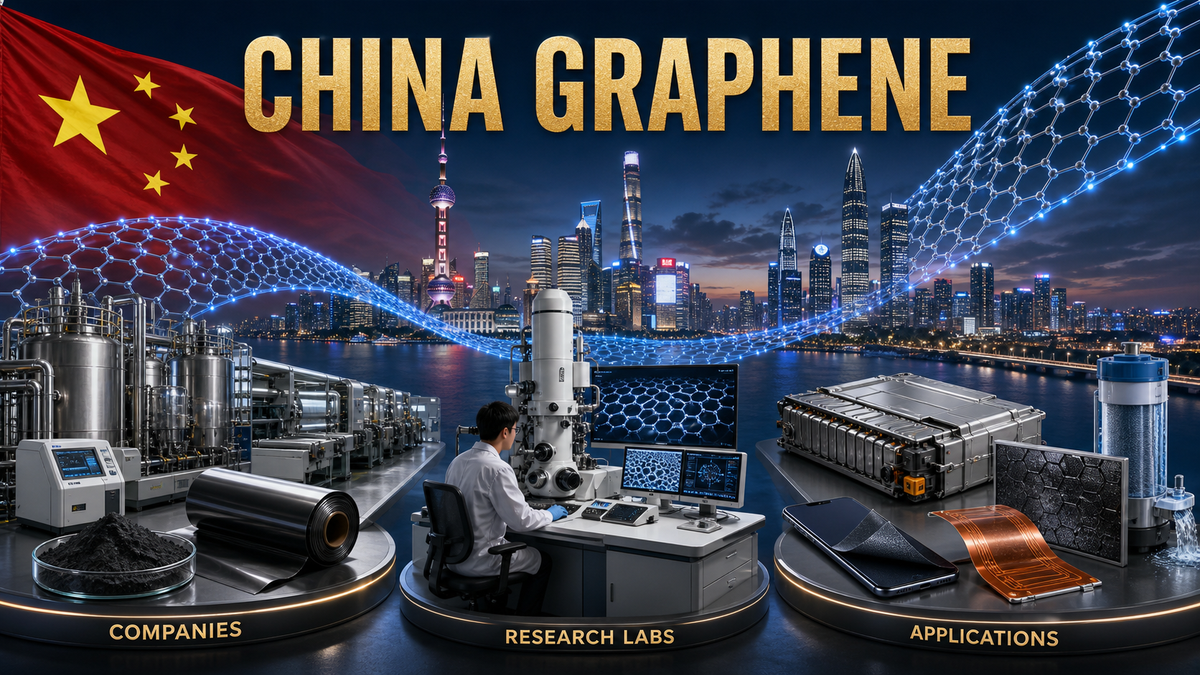
China’s graphene advantage is practical rather than magical. It does not rest on a single revolutionary “graphene battery” or a semiconductor that has displaced silicon. It comes from adding carefully engineered carbon materials to supply chains China already operates at enormous scale: lithium-ion batteries, smartphones, industrial coatings, polymers, power equipment, textiles and water-treatment systems.
That distinction matters because “the graphene market” is not one measurable commodity market. Graphene oxide powder, few-layer nanoplatelets, water-based dispersions, battery slurry and heat-spreading film are different products sold in different units. A tonne of battery slurry is mostly solvent and formulation ingredients, while a square metre of thermal film cannot be added to powder output. China has no authoritative national series for annual graphene production or sales, and consultancy estimates often combine incompatible categories.
The credible picture is nevertheless substantial. China has built dense commercialization clusters, large application-driven manufacturers and some of the world’s strongest graphene laboratories. Its most mature businesses are thermal-management film for electronics, conductive additives for batteries, anticorrosion coatings and selected composites. Sensors, biochips, semiconductor devices and atomically precise membranes remain important—but mostly future-facing.
China’s greatest asset is the distance between laboratory and customer. It can be very short. A material developer in Changzhou can work beside coating, cable, battery and electronics manufacturers; a Ningbo research team can test technology with established appliance or textile groups; and a Shenzhen laboratory can connect with the region’s electronics supply chain.
Changzhou is the clearest commercial cluster. The city reported more than 160 companies across its graphene value chain, 12 backbone enterprises and cluster output above RMB 5 billion in 2025. Those numbers come from local-government reporting and include downstream products in which graphene may be only a small ingredient, so they should not be mistaken for pure graphene-material revenue. They do, however, show the breadth of the ecosystem—from powder and slurry to films, cables, clothing and water treatment. Changzhou municipal government
Ningbo is more explicitly organized around technology transfer. China’s Ministry of Industry and Information Technology approved the National Graphene Innovation Center there in 2022. By early 2025, local authorities reported more than 30 R&D teams, over 20 incubated companies and more than 300 authorized patents. Cooperation with Youngor, Fotile and Bull Group aims to move graphene into fibres, batteries, electrothermal products and household equipment. Patents and agreements are pipeline indicators, not sales, but they reveal a deliberate commercialization machine. MIIT approval, Ningbo report, Ministry of Science and Technology
Beijing supplies fundamental research, specialist companies and policy direction; Fujian links graphene production to graphite processing, batteries, footwear, textiles and marine coatings; Shenzhen brings electronics and metrology; Wuhan is emerging in large-area films and aerospace-related materials.
It is difficult to rank China’s “biggest graphene companies” because most are private, product definitions differ and audited graphene-only revenue is rare. The following businesses are among the most commercially important based on disclosed capacity, shipments, revenue or customer adoption—not promotional headlines alone.
The Sixth Element (Changzhou) is one of China’s best-known upstream specialists. The company reports annual capacity of 1,100 tonnes of graphene oxide and 150 tonnes of graphene products, with powders and dispersions aimed at coatings, polymers, tyres, fibres, batteries and thermal management. Its quality credentials include ISO 9001, ISO 14001, IATF 16949 and EU REACH. Changzhou also reports commercialization of graphene-modified HDPE rollers for mining machinery. The capacity figures are company claims rather than proof of utilization, and the company delisted from China’s NEEQ market in 2020, limiting access to recent audited accounts. The Sixth Element
Changzhou Fuxi Technology shows how the strongest market may be downstream film rather than bulk powder. Its graphene-derived heat spreaders are designed for smartphones and tablets. Documents submitted during its former Shanghai STAR Market application reported RMB 261.8 million in graphene-film revenue in 2022 and installation in more than 173 million smartphones and 2.47 million tablets by the end of that year. Changzhou reported in 2025 that Fuxi’s fourth-generation film, quoted at 2,000 W/m·K in-plane thermal conductivity, had entered mass production for Huawei. The listing application ended in 2023, so later audited comparability is limited, and customer concentration was very high. Even with those caveats, this is unusually concrete evidence of volume adoption. Shanghai Stock Exchange filing
Xiamen Knano Graphene Technology is a major powder and battery-additive producer. Fujian’s industry authority reported capacity of 500 tonnes per year of graphene powder and 10,000 tonnes per year of lithium-battery conductive agent in 2023. A Yong’an production base began operating in December 2024. The crucial qualification is that the conductive-agent figure describes a formulated product, not 10,000 tonnes of neat graphene. Fujian Department of Industry and Information Technology
Jiangsu Shanyuan Technology is a strong example of formulation scale. Changzhou reported more than ten production lines, 20,000 tonnes per year of graphene composite conductive-slurry capacity and bulk supply to BYD, BAK and Microvast. Again, slurry mass includes solvent, graphene and other conductive materials; capacity is not production. Still, the disclosed lines and customer relationships place Shanyuan near the center of commercial battery use.
Other companies illustrate the market’s diversity. Hangzhou Gaoxi focuses on high-quality graphene oxide, fibres, aerogels and thermal products. Wuhan Hanene makes large-area graphene films and has reported batch shipments and relationships with Huawei and COMAC. Yueda Xi Wang completed a thermal-film plant with reported capacity of 600,000 square metres per year. Suntar Environmental Technology, a listed membrane company, describes a graphene-modified PVDF hollow-fibre membrane with higher water flux and fouling resistance, although it does not break out product revenue. These are commercially relevant signals, but not all provide independently verified utilization or sales.
China’s research strength is not concentrated in one institution. It is a network spanning atomic-scale science, scalable synthesis, testing and industrial engineering.
At Peking University, Zhongfan Liu’s teams and the university-supported Beijing Graphene Institute work on controlled chemical-vapour deposition, single-crystal wafers, clean transfer, membranes, sensors and composites. The institute opened in 2018 and reports more than 320 R&D personnel. Its product portfolio includes graphene films, four- and six-inch single-crystal wafers and graphene-coated glass fibres. In July 2026, Peking University researchers reported step-guided growth of large-area, high-purity rhombohedral graphene reaching roughly 200 layers—a frontier result with potential electronic and photonic significance, but not yet a volume product. Peking University, Beijing Graphene Institute
The Chinese Academy of Sciences’ Institute of Metal Research in Shenyang combines fundamental work with an unusually broad transfer catalogue: graphene powders, inks, dispersions, thermal-interface materials, flexible electrodes, foams and greener graphene-oxide equipment. Its teams study controlled preparation, energy, catalysis, electronics, aerospace and thermal management. A 2024 graphene–germanium hot-electron transistor published in *Nature* achieved steep switching at room temperature. It is scientifically important, while commercialization remains longer-term. CAS Institute of Metal Research, Chinese Academy of Sciences
The Tsinghua Shenzhen International Graduate School and its Geim Graphene Research Center sit close to one of the world’s deepest electronics ecosystems. Their work covers scalable preparation, energy devices, environmental membranes, thermal management, standards and testing. The platform reports more than RMB 100 million in equipment and service to roughly 300 outside organizations per year—an institutional claim that nevertheless demonstrates its role as shared infrastructure. Tsinghua SIGS
The National Graphene Innovation Center in Ningbo is designed specifically to close the commercialization gap through pilot manufacturing, quality improvement, shared testing and partnerships with downstream manufacturers. Meanwhile, Shanghai Jiao Tong University, Nanjing University and Zhejiang University remain important sources of graphene nanoribbons, quantum transport, stacked structures, fibres, aerogels, sensing and electronic-skin research. Their breakthroughs expand the opportunity set, but they should not be counted as current market volume.
Battery conductive additives are commercially real. Small loadings of graphene nanoplatelets or reduced graphene oxide can help form conductive networks in cathodes, frequently alongside carbon nanotubes. China’s standard YB/T 6254-2024, effective from May 2025, formally covers composite conductive slurries containing graphene-related two-dimensional materials plus other conductive media. The commercial product is an additive to conventional lithium-ion chemistry—not a new “graphene battery.” CNTs are both competitors and partners, and hybrid formulations may win more often than graphene alone. National standards database
Thermal management is arguably China’s clearest volume application. Ultra-thin, in-plane heat-spreading films and interface materials help distribute hotspots in smartphones, tablets and compact electronics. Fuxi’s disclosed device count, Yueda Xi Wang’s film line and batch shipments reported by Wuhan Hanene collectively show a market beyond the pilot stage. MIIT’s new-material demonstration catalogue adds performance thresholds for graphene heat-dissipation materials, supporting customer qualification and clearer product definitions. MIIT catalogue
Anticorrosion coatings and composites are also established niches. Graphene additives can increase the tortuous path through which water and ions reach a metal surface, while improving mechanical or conductive properties when dispersion is well controlled. China Aerospace Science and Industry Corporation lists a graphene heavy-duty anticorrosion coating at technology-readiness level 9 for marine engineering, bridges, petrochemicals, power and machinery. Commercial examples also include mining rollers, cable shielding, graphene-modified carbon-fibre prepreg and graphene–copper electrical contacts. State-owned Assets Supervision and Administration Commission
Heating films, textiles and membranes form a more uneven middle tier. Electric-heating films are a genuine product class with defined MIIT performance requirements. Graphene-modified garments and fibres are sold, but inventory write-downs at some manufacturers show that adding the word “graphene” does not guarantee customer value. Membrane products and engineering demonstrations exist, while precise ion-sieving, desalination and bioseparation membranes remain largely in validation.
China’s next graphene challenge is not simply building more capacity. It is proving that products work consistently and economically at customer scale. Particle size, layer number, oxygen content, defects, contamination and dispersion all change performance. Qualification can take years in batteries, aerospace, electronics and protective coatings. Announced factories may run below capacity, and city-level “graphene industry output” often includes the entire value of downstream goods.
Standards are therefore becoming as important as synthesis. China has formal terminology for graphene-related materials, a battery-slurry standard and new structural-characterization guidance for powders and dispersions. Beijing’s 2024–2027 plan also prioritizes thermal spreaders, sensors, membranes, composites, aerospace and new-energy applications—but its output targets are ambitions, not achieved market data. Beijing Municipal Bureau of Economy and Information Technology
The most investable opportunities are likely to be companies that sell a verified result rather than a fashionable ingredient: lower cell resistance, faster heat spreading, longer coating life, stronger composite parts or more reliable filtration. China is unusually well positioned because it can connect materials science to large downstream customers. Its weakness is transparency: private-company accounts are sparse, capacity and output are often confused, and product labels are inconsistent.
The conclusion is neither that graphene has failed nor that it is about to transform every industry. China has already moved selected graphene products into genuine mass manufacturing. The winners are mostly invisible inside familiar products—phones, batteries, coatings, cables and membranes. That may be less spectacular than the original hype, but it is how a new industrial material becomes a real market.
All production and capacity figures in this article retain the unit used by the source. Powder, slurry, film area and finished-product output have not been added together. Company or local-government claims are identified as such; capacity is not treated as actual production, and policy targets are not treated as achieved sales.
Serious about B2B integration? Test our premium Pulsed Electrical Resistive Carbon Heating turbostratic graphene in your lab. 100g sample packs available now.
Explore More
Researchers revisit a graphene, n-heptane, and permalloy system, observing apparent ideal diamagnetism at ambient conditions, a key property of superconductors.

Researchers are using artificial intelligence to autonomously discover optimal recipes for growing graphene, a breakthrough in AI-driven graphene synthesis...

Explore how environment-dependent tight-binding models, derived from ab initio principles, are revolutionizing materials simulation for graphene applications.