
Graphene Systems Show Apparent Ideal Diamagnetism at Room Temperature
Researchers revisit a graphene, n-heptane, and permalloy system, observing apparent ideal diamagnetism at ambient conditions, a key property of superconductors.
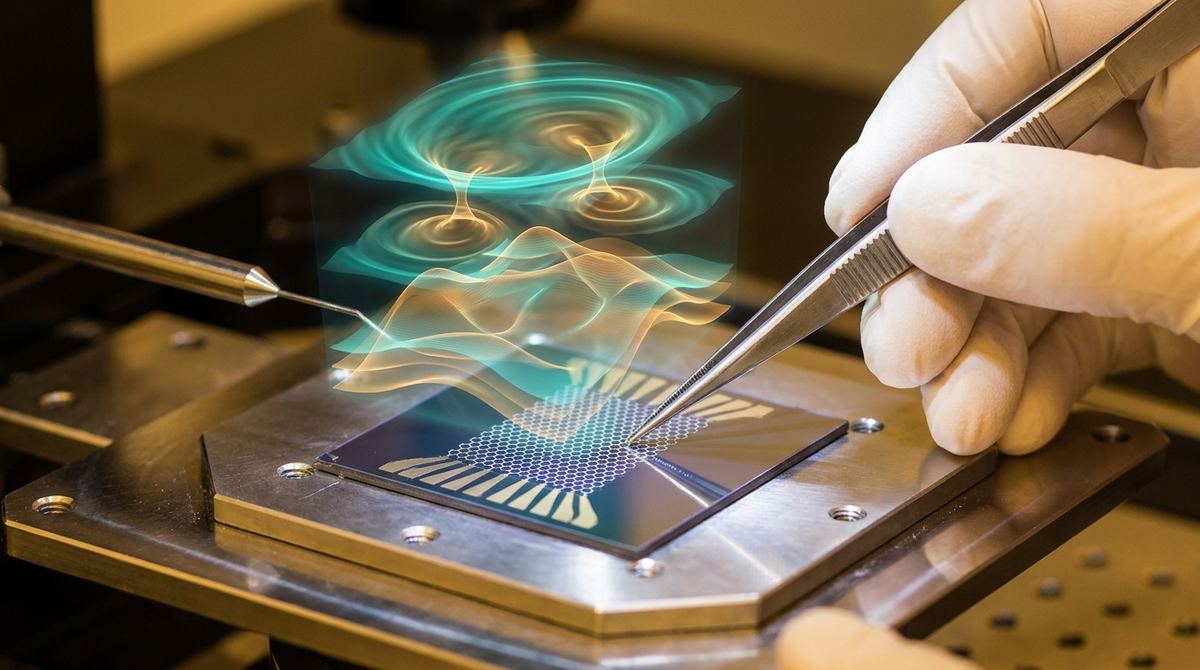
Imagine a material where electricity flows without any resistance, but it does so with a built-in sense of direction. In the standard world of superconductors, electron pairs move through a lattice in a way that is essentially symmetric; they do not have a "handedness." However, if we could engineer materials that possess a fundamental geometric twist in their electronic structure, we could create a new class of superconductors that are "chiral." These materials would not only conduct electricity perfectly but would also exhibit unique topological properties that could protect quantum information from the chaotic noise of the environment. This theoretical breakthrough, recently detailed by L. David Le Nir, Asimpunya Mitra, and Yong Baek Kim, suggests that we can use the pre-existing geometry of a material's electronic bands to dictate the behavior of its superconducting state.
For decades, the search for topological superconductors has been one of the most significant challenges in condensed matter physics. While conventional superconductors are incredibly useful for high-power applications like MRI machines, they lack the specific topological "protection" required for the next generation of quantum technologies. In a standard superconductor, the electron pairs—known as Cooper pairs—behave in a uniform manner. If a defect or a stray magnetic field disrupts these pairs, the superconductivity can be easily degraded, leading to energy loss or the destruction of quantum states.
The core problem is how to reliably induce chirality—a property where the superconducting state breaks time-reversal symmetry—within a material. Without this symmetry breaking, we cannot access the exotic quasiparticles, such as Majorana fermions, which are the building blocks of fault-tolerant topological quantum computing. Currently, finding materials that naturally exhibit these properties is like looking for a needle in a haystack. Scientists have struggled to identify which parent electronic states can be transitioned into a superconducting phase while maintaining the specific topological textures needed to protect quantum information.
To understand the solution proposed by L. David Le Nir, Asimpunya Mitra, and Yong Baek Kim, we must first understand the concept of Berry curvature. Think of an electron moving through a crystal lattice not just as a particle moving through space, but as a traveler moving through a landscape of hills, valleys, and twists. This "landscape" is the electronic band structure. Berry curvature is a mathematical description of how this landscape is twisted. If the landscape is twisted in a non-uniform way, the electrons experience an effective magnetic field that exists only in momentum space—the mathematical space that describes how fast and in what direction particles are moving.
The key insight of this research is that we do not need to create new, complex materials from scratch to achieve chirality. Instead, we can start with a "parent" material that already has a highly textured, non-uniform Berry curvature. When this material is cooled down into a superconducting state, the "twists" in the electronic landscape act as a blueprint. The superconductivity is forced to follow the geometry of the parent state, resulting in the formation of momentum-space vortices. These are not physical holes like the vortices found in a magnetic field, but rather "twists" in the way the electron pairs are organized in momentum space. This topological blueprint is what gives the superconductor its chiral, protected properties.
The mechanism described in this research relies on the interplay between the underlying electronic structure and the Bogoliubov-de Gennes (BdG) formalism. The BdG formalism is a mathematical framework used to describe how electrons and holes (the absence of an electron) mix together to form Cooper pairs in a superconductor. In a traditional system, this mixing is relatively straightforward. However, when the parent state possesses a non-uniform Berry curvature, the mixing becomes topologically complex.
As the temperature drops and the material enters the superconducting state, the electrons begin to pair up. Because the Berry curvature is non-uniform, the energy landscape for these pairs is not smooth. The non-uniformity acts as a driving force that prevents the superconducting order parameter from being a simple, uniform constant. Instead, the order parameter must vary across momentum space to accommodate the "geometry" of the electronic bands. This variation manifests as momentum-space vortices.
These vortices are essential because they are the signature of the broken time-reversal symmetry. In a chiral superconductor, the electron pairs have a specific orbital angular momentum, meaning they "rotate" as they move. The non-uniform Berry curvature ensures that this rotation is topologically locked. This means that the way the electron pairs behave is fundamentally tied to the mathematical topology of the material's band structure, making the resulting superconducting state incredibly robust against local perturbations.
The study conducted by L. David Le Nir, Asimpunya Mitra, and Yong Baek Kim provides a rigorous theoretical link between the geometry of the parent state and the measurable physical properties of the resulting superconductor. Specifically, the researchers focused on the thermal Hall conductivity as a primary diagnostic tool. While electrical conductivity is often used to measure superconductors, thermal Hall conductivity measures how heat flows perpendicularly to a temperature gradient when a magnetic field or a topological effect is present.
The researchers found that the magnitude and sign of the thermal Hall conductivity are directly determined by the non-uniformity of the Berry curvature in the parent state. This is a profound result because it means that by measuring how a material conducts heat, we can work backward to understand the topological complexity of its electronic structure. They demonstrated that the momentum-space vortices created during the superconducting transition lead to a quantized or semi-quantized thermal Hall response. This response serves as a "smoking gun" for the presence of chiral superconductivity and the specific topological order of the system.
This research is significant because it provides a roadmap for material discovery in the field of quantum materials. Instead of relying on trial and error, scientists can now look at the electronic band structures of known materials—such as certain transition metal dichalcogenides or specialized graphene-based heterostructures—and identify those with the specific non-uniform Berry curvature required to host chiral superconductivity.
The implications for quantum computing are particularly profound. One of the greatest hurdles in quantum computing is decoherence, where the quantum state of a qubit is lost due to interaction with the environment. Topological superconductors offer a way around this through "topological protection." Because the chiral state is protected by the global geometry of the electronic bands, local defects or noise are unlikely to disrupt the state. By using the parent state's Berry curvature to "lock" the superconductivity into a chiral phase, we increase the likelihood of creating stable, fault-tolerant qubits that could form the basis of a scalable quantum computer.
While the theoretical framework provided by the researchers is robust, it is important to recognize that this work is currently at a foundational, theoretical stage. The paper describes a mechanism and a method of observation, but it does not present a specific material that has been successfully synthesized and measured to confirm these findings. Moving from a theoretical model to a physical device is a monumental task in condensed matter physics.
Several challenges remain for experimentalists. First, creating materials with precisely controlled, non-uniform Berry curvature requires extreme precision in chemical vapor deposition (CVD) or molecular beam epitaxy (MBE). Second, measuring the thermal Hall conductivity in a superconducting sample is an incredibly delicate operation that requires extremely low temperatures and highly sensitive thermal sensors. Finally, distinguishing between different types of topological orders in real-world samples remains a significant experimental hurdle. Extensive experimental validation is required to prove that these momentum-space vortices can be reliably harnessed in a device.
If the theoretical predictions of this research can be realized in the laboratory, the applications could transform several high-tech industries. In the realm of information technology, the most direct application is in the development of topological quantum computers. Such computers would be capable of solving problems—such as complex molecular simulations or advanced cryptography—that are entirely out of reach for current classical and even noisy intermediate-scale quantum computers.
Beyond computing, these materials could revolutionize ultra-sensitive sensing. Topological superconductors could lead to the development of new types of magnetometers and thermal sensors that operate with unprecedented precision. Additionally, the ability to control heat flow at the quantum level through thermal Hall effects could lead to new developments in "phononic" or "thermal" logic, where heat, rather than electricity, is used to process information in specialized low-power electronics.
If you remember only one thing from this research, let it be this: the "shape" of a material's electronic energy levels can dictate the fundamental properties of its superconducting state, allowing us to use geometry to create new, topologically protected states of matter.
What is Berry curvature and why is it important?
Berry curvature is a property of a material's electronic band structure that acts like an effective magnetic field in momentum space. Instead of acting on a particle's position in physical space, it influences how the particle's momentum changes as it moves through the crystal. It is vital because it defines the topological "twists" in a material that can lead to exotic behaviors like the quantum Hall effect or chiral superconductivity.
How does a chiral superconductor differ from a normal superconductor?
A normal superconductor has a symmetric superconducting state where electron pairs move without a preferred direction or "handedness." A chiral superconductor breaks time-reversal symmetry, meaning the electron pairs possess a specific direction of rotation or orbital angular momentum. This asymmetry is what grants the material its unique topological properties and potential for quantum computing.
What is a momentum-space vortex?
Unlike a vortex in a liquid or a magnetic field, which is a physical swirl in real space, a momentum-space vortex is a topological defect in the way the superconducting order parameter changes as you move through momentum space (the space of possible electron velocities). These vortices are a direct consequence of the material's underlying electronic geometry and are essential for establishing a chiral superconducting state.
How can scientists prove a material is a chiral superconductor?
One of the most effective ways is by measuring the thermal Hall conductivity. If a material shows a specific, non-zero response where heat flows perpendicular to a temperature gradient due to its topological structure, it provides strong evidence of broken time-reversal symmetry and chiral behavior. This measurement acts as a signature of the material's underlying topology.
Why is "topological protection" important for quantum computing?
Quantum information is incredibly fragile and can be easily destroyed by heat or electromagnetic interference, a process called decoherence. Topological protection uses the global geometric properties of a material to shield quantum states. Because the information is stored in the "shape" or topology of the system rather than in a single local point, a small local disturbance cannot easily change the overall state, making the information much more stable.
The research by L. David Le Nir, Asimpunya Mitra, and Yong Baek Kim represents a significant step forward in our ability to engineer the quantum properties of materials. By identifying how the non-uniform Berry curvature of a parent state can drive the formation of chiral superconductors and momentum-space vortices, they have provided a mathematical and physical bridge between electronic band structure and topological superconductivity. As experimentalists move to find and synthesize these elusive materials, the transition from theoretical topology to practical, topological quantum technology draws one step closer to reality.
Serious about B2B integration? Test our premium Pulsed Electrical Resistive Carbon Heating turbostratic graphene in your lab. 100g sample packs available now.
Explore More
Researchers revisit a graphene, n-heptane, and permalloy system, observing apparent ideal diamagnetism at ambient conditions, a key property of superconductors.

Researchers are using artificial intelligence to autonomously discover optimal recipes for growing graphene, a breakthrough in AI-driven graphene synthesis...

Explore how environment-dependent tight-binding models, derived from ab initio principles, are revolutionizing materials simulation for graphene applications.