
Building Better Models: A Faster Path to Simulating Graphene's Complex World
Explore how environment-dependent tight-binding models, derived from ab initio principles, are revolutionizing materials simulation for graphene applications.
The quest to produce perfect, single-atom-thick sheets of graphene has often felt more like a delicate culinary art than a precise industrial science. For years, success has depended on the finely tuned intuition of experienced researchers, who meticulously adjust temperatures, pressures, and timings to coax carbon atoms into forming a flawless hexagonal lattice. This reliance on tacit knowledge and painstaking trial and error has been a fundamental barrier, slowing the transition of graphene from a laboratory marvel to a ubiquitous industrial material. But what if we could teach a machine to have that intuition? What if an algorithm could not only learn the craft of growing graphene but also explore new, unconventional recipes that surpass human discovery? This is the frontier now being explored, where artificial intelligence is stepping into the lab to become the master chef of materials science.
Synthesizing high-quality graphene is an exceptionally complex challenge. The goal is typically to create a large, pristine, single-layer sheet of carbon atoms. The process, however, is a delicate dance of multiple variables. Temperature, gas pressure, substrate material, and the duration of each step in the synthesis process all interact in intricate ways. A slight deviation in one parameter can result in a cascade of unintended consequences: the graphene might grow with multiple layers, be riddled with structural defects, or fail to form at all. Finding the optimal "recipe" within this vast, high-dimensional parameter space is like searching for a single specific grain of sand on an entire beach. This work, a collaboration by Leonardo Sabattini, Annalisa Coriolano, Corneel Casert, Stiven Forti, Edward S. Barnard, Fabio Beltram, Massimiliano Pontil, Stephen Whitelam, Camilla Coletti, and Antonio Rossi, directly confronts this grand challenge of discoverability and reproducibility in materials science. Their research aims to move beyond the slow, expensive, and often unrepeatable nature of manual synthesis, which represents a major bottleneck for the widespread commercial adoption of graphene.
The central idea behind this research is to create a self-correcting, autonomous system that learns how to grow graphene from scratch. Imagine a student chef who has never cooked before but is given access to an oven, ingredients, and a food critic. The student proposes a recipe, cooks the dish, and gives it to the critic. The critic tastes it and gives it a score from 1 to 10 without explaining why. The student takes this score, makes some adjustments to the recipe, and tries again. Over many iterations, the student’s recipes get progressively better until they are creating gourmet meals.
This study implements that exact concept, but with advanced technology. The "student chef" is an artificial neural network, a type of AI modeled loosely on the human brain. The "oven" is a specialized cold-wall reactor used to grow graphene on a silicon carbide wafer. The "recipe" is a precise, time-dependent temperature protocol that the AI devises. The "critic" is a Raman spectrometer, an instrument that analyzes the finished graphene and assigns it a quality score. The system operates in a closed loop: the AI proposes a temperature profile, the experiment is run automatically, the Raman spectrometer scores the result, and that score is fed back to the AI. The AI uses this feedback to update its internal model and propose a new, hopefully better, recipe for the next cycle. Crucially, the AI begins with no preconceived notions of what a good recipe looks like, allowing it to explore the possibilities without human bias.
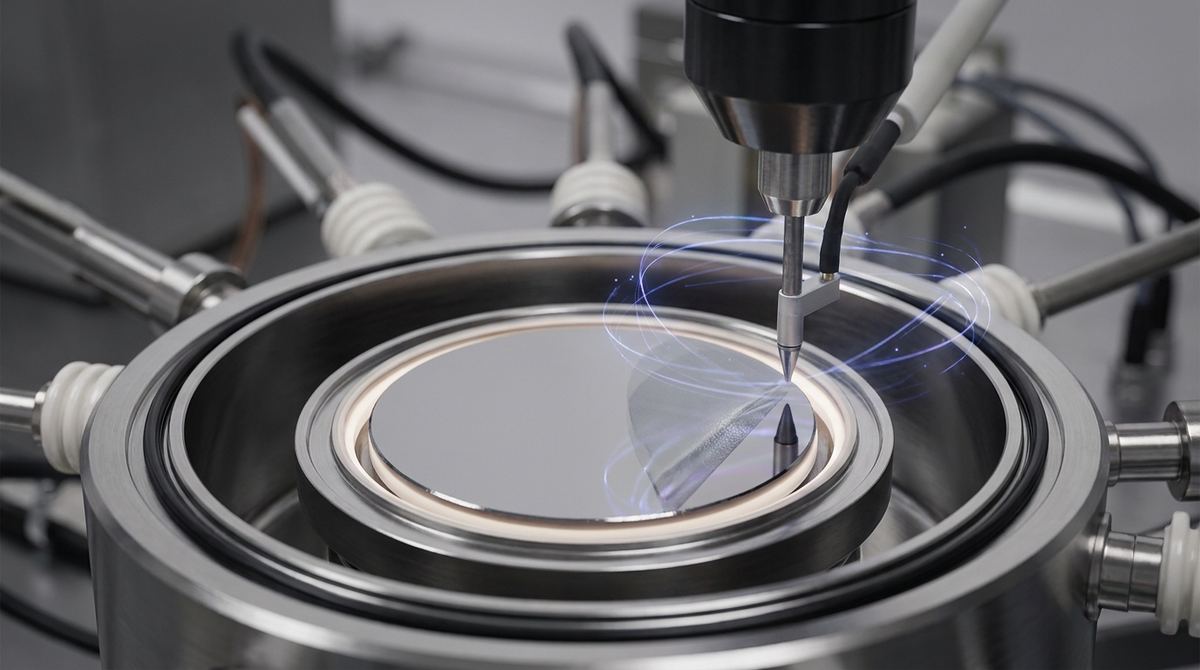
The experimental setup is a fusion of materials science hardware and sophisticated software. The physical synthesis occurs via the thermal decomposition of a silicon carbide (SiC) substrate inside a cold-wall chemical reactor. In this method, the SiC wafer is heated to very high temperatures. This intense heat causes silicon atoms to sublimate, or turn directly from a solid into a gas, leaving the surface of the wafer. The remaining carbon atoms, now freed from their bond with silicon, rearrange themselves on the hot surface, self-assembling into the characteristic honeycomb lattice of graphene.
The variable that the AI controls is the temperature profile over the course of the experiment. Instead of a simple "heat to 1600°C and hold for 30 minutes," the AI can design a complex sequence of heating ramps, holding periods (soaks), and cooling phases. This time-dependent protocol is the "recipe" it is trying to perfect.
Once a growth cycle is complete, the sample is analyzed using Raman spectroscopy. This non-destructive technique shines a laser on the graphene sheet. The graphene’s atomic lattice vibrates in response to the laser light, scattering it in a unique way. By analyzing the spectrum of this scattered light, scientists can determine critical properties with high precision. Key features in the spectrum, known as the G, D, and 2D peaks, reveal the number of graphene layers, the presence and density of structural defects, and the amount of strain within the material. This complex spectral data is then condensed into a single numerical score that quantifies the sample's quality, essentially measuring how closely it matches the ideal signature of monolayer graphene.
This score becomes the feedback for the AI. The learning algorithm guiding the neural network is an evolutionary adaptive Monte Carlo method. In simple terms, the algorithm treats successful recipes like a biological population. It takes the best-performing temperature profiles, makes small, random changes to them (mutation), and creates new "offspring" recipes to test. The recipes that yield higher scores are more likely to be selected for the next round of mutations (survival of the fittest). This evolutionary approach allows the AI to efficiently explore the vast landscape of possible recipes, avoiding getting stuck on a mediocre solution and progressively climbing toward the peak of optimal performance in AI-driven graphene synthesis.
The results demonstrated a clear and compelling success story for the autonomous system. The AI began its journey with no knowledge, proposing random and chaotic temperature profiles. As expected, these initial attempts produced very poor-quality material, which received low scores from the Raman analysis. However, with each iterative cycle of proposing, growing, and scoring, the system learned. The quality of the graphene samples showed a steady, progressive improvement.
After numerous cycles, the AI converged on highly effective and non-intuitive temperature protocols that consistently produced high-quality monolayer graphene. The Raman spectra of these later samples showed the characteristic hallmarks of excellent graphene: a sharp, symmetrical 2D peak that was significantly taller than the G peak, and a nearly non-existent D peak, indicating a very low defect density. The AI had successfully navigated the complex parameter space and discovered a reliable pathway to synthesizing the target material. This demonstrated that a machine learning model, guided only by experimental feedback, can autonomously master a complex materials synthesis process.
This research is significant far beyond this specific experiment. It serves as a powerful proof-of-concept for a new paradigm in materials science: autonomous discovery. By closing the loop between synthesis and characterization with an intelligent algorithm, the process of finding optimal growth conditions can be dramatically accelerated. This is particularly important for the exploration of new and exotic 2D materials beyond graphene, where established recipes do not yet exist.
Furthermore, this approach removes the inherent biases of human researchers. A human scientist might follow established conventions or be hesitant to try a radically different heating profile. An AI has no such constraints and can explore unconventional pathways that may lead to superior materials or more efficient processes. For commercialization, this is critical. Automating the optimization process could lead to more reliable and scalable graphene production, making high-quality material more accessible and affordable. It transforms material synthesis from a craft-based art into a reproducible, data-driven science, which is essential for any high-tech industry.
While groundbreaking, this work represents a first step. The study intentionally simplified the problem by focusing on optimizing only one variable: the time-dependent temperature profile. A fully industrial process would require simultaneously optimizing other parameters like chamber pressure and the flow rates of different gases. A more complex AI model would be needed to handle this multi-variable optimization without the number of required experiments becoming unmanageable.
The findings are also specific to the synthesis method (thermal decomposition of SiC) and the industrial synthesis equipment used (a cold-wall reactor). Further research is needed to determine if this AI-driven approach can be successfully transferred to other common production methods, such as chemical vapor deposition (CVD) on copper or nickel foils, which are more widely used for large-area graphene films.
Finally, while the system is designed to enable scalability, the experiments themselves were conducted at the lab scale. Translating these AI-discovered recipes to large-scale industrial reactors presents its own set of challenges, such as maintaining perfect temperature uniformity across much larger substrates. The definition of "quality" itself, derived here from Raman spectroscopy, may also need to be expanded to include other metrics like electronic mobility or domain size, depending on the target graphene applications.
The implications of perfecting an autonomous synthesis platform are enormous. The ability to reliably produce large sheets of high-quality, defect-free monolayer graphene is the key to unlocking its potential in next-generation graphene electronics. Consistent material quality is non-negotiable for manufacturing dependable transistors, transparent conductive films, and ultra-sensitive sensors. An AI-driven process promises the level of quality control and reproducibility that industrial fabrication demands.
Beyond electronics, the principle of autonomous optimization can accelerate the development cycle for countless other advanced materials. For example, it could be adapted to fine-tune the synthesis of graphene-based composites for aerospace, create designer catalysts for chemical reactions, or optimize the production of other 2D materials like molybdenum disulfide for new types of optoelectronics. Ultimately, this method provides a blueprint for faster, smarter, and more efficient discovery and manufacturing across the entire field of materials science.
If you take away just one idea from this research, let it be this: By creating a closed loop where an artificial intelligence proposes a material recipe, an experiment provides real-world feedback, and the AI learns from the result, we have forged a powerful new path toward the autonomous and intelligent manufacturing of graphene and other advanced materials.
What is an artificial neural network? In simple terms, an artificial neural network is a computational model inspired by the structure and function of the human brain. It is composed of interconnected nodes, or "neurons," that process information and learn from data to recognize patterns, make predictions, or, in this case, decide on an optimal synthesis recipe.
Why is growing high-quality graphene so hard? Growing perfect, single-layer graphene is difficult because it requires an extremely precise balance of multiple factors like temperature, time, and substrate chemistry. Even minor deviations can introduce defects, create unwanted extra layers, or disrupt the crystalline structure, all of which can degrade the material's remarkable electronic and mechanical properties.
What is Raman spectroscopy and why is it used here? Raman spectroscopy is a powerful analytical technique that uses a laser to probe the vibrational modes of a material's atomic structure. For graphene, it acts as a fingerprint, revealing crucial information about the number of layers, the quality of the crystal lattice, and the density of defects. This makes it an ideal tool for providing the fast, accurate quality-control feedback the AI needs to learn.
Does this mean robots will replace scientists in the lab? This technology is better viewed as a powerful collaborator rather than a replacement for scientists. The AI excels at the repetitive and time-consuming task of process optimization. This frees up human researchers to focus on more creative, high-level challenges like designing new types of experiments, interpreting the complex results, and asking the next big scientific questions.
Is AI-grown graphene ready for commercial sale? This study is a critical proof-of-concept, not a market-ready technology. It validates the AI-driven approach but was performed at a lab scale on a specific type of graphene. Significant engineering work is still required to scale this method up for industrial production and adapt it for different material forms, such as the turbostratic graphene flakes used in composites and coatings.
The research presented here marks a pivotal moment in materials science. It demonstrates a tangible and effective pathway to escape the limitations of traditional, intuition-led synthesis. The successful implementation of an autonomous, AI-guided system for growing graphene is more than just an academic achievement; it is a blueprint for the future of advanced manufacturing. This approach of AI-driven graphene synthesis promises to shorten development timelines, lower costs, and enhance the reliability of high-performance materials. By empowering intelligent algorithms to explore, learn, and perfect the complex art of material creation, we are opening the door to an era of accelerated innovation, bringing the remarkable potential of graphene and other 2D materials closer to our everyday lives.
Serious about B2B integration? Test our premium Pulsed Electrical Resistive Carbon Heating turbostratic graphene in your lab. 100g sample packs available now.
Explore More
Explore how environment-dependent tight-binding models, derived from ab initio principles, are revolutionizing materials simulation for graphene applications.

Learn how a graphene support layer can mechanically reinforce ultra-thin polymer membranes, boosting water flux without compromising filtration efficiency.

Researchers have developed a breakthrough method for growing twisted bilayer graphene with pre-designed angles, a key step toward manufacturable quantum...