
A New Era of Graphene Engineering: Pre-Designing Twist Angles on Demand
Researchers have developed a breakthrough method for growing twisted bilayer graphene with pre-designed angles, a key step toward manufacturable quantum...
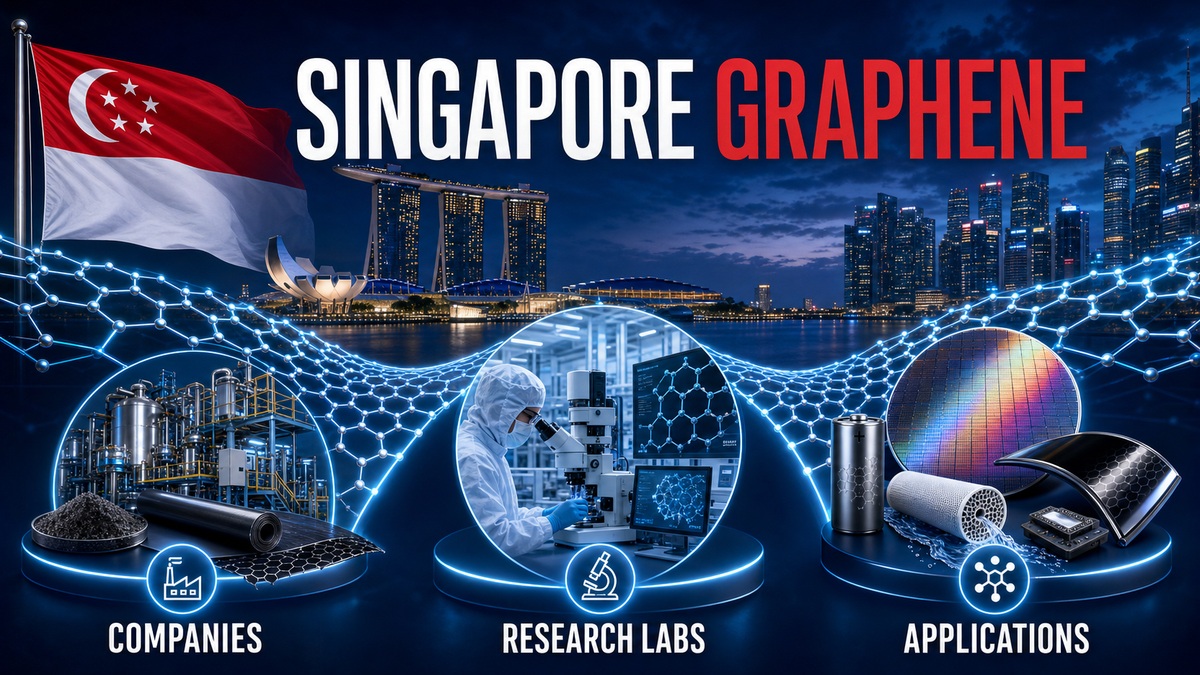
Singapore is one of Asia’s most sophisticated graphene research hubs, but it is not a bulk-production rival to China. Its competitive position is more specialised: characterising graphene correctly, fabricating devices, building prototypes and integrating graphene into high-value products. That distinction matters because there is no reliable public evidence that Singapore produces hundreds of tonnes of graphene per year. The strongest evidence points instead to kilogram-scale material batches, research infrastructure, certified water-treatment products, specialty coatings and application-development programmes.
For buyers and investors, this makes Singapore a useful test case. The country shows how graphene can move from a celebrated laboratory material into batteries, membranes, sensors, coatings and biomedical surfaces—and how difficult it remains to turn excellent science into durable companies.
Singapore’s graphene ecosystem sits inside a larger advanced-manufacturing economy. The country has semiconductor fabs, precision-engineering suppliers, water-technology expertise and public institutions built to move research toward industry. Those downstream capabilities are more important than a headline production number.
The historical patent record supports that view. An Intellectual Property Office of Singapore graphene landscape study, using applications published from 2010 through 2019, found almost 100 Singapore-originated graphene inventions. NUS accounted for 42, NTU for 33 and A*STAR for nine. The concentration in universities and public institutes made Singapore research-rich but comparatively company-thin. Energy storage, water purification and biomedical technologies were recurring strengths.
Those figures are a historical baseline, not a 2026 market total. What they reveal is the shape of the ecosystem: Singapore’s strongest assets are intellectual property, specialist facilities, materials characterisation and product engineering.
There is no transparent ranking of Singapore graphene companies by revenue or output. Most are private, and audited capacity data is rare. The most defensible list therefore ranks companies by the quality of public evidence, not by unsupported claims of size.
SG Graphene Technologies is an active Singapore company and NTU spin-off founded in 2021. It markets one-to-three-layer graphene flakes, graphene oxide, graphene nanoplatelets and specialty products in powders and suspensions. Its stated application targets include batteries, supercapacitors, paints, coatings and composites.
The company describes a water-based, mild-chemical process and says it can achieve high yields of few-layer graphene with low impurity levels. These are company claims rather than independently audited specifications. More importantly, the public evidence supports “kilograms per batch” and product packages from grams to kilograms—not hundreds of tonnes per year. SG Graphene Technologies is therefore best described as an emerging specialty-material supplier with application-development ambitions.
De.mem’s Singapore business offers a graphene-oxide-enhanced hollow-fibre ultrafiltration membrane for drinking-water and industrial-water systems. The company has reported 20–40% higher water flux than its standard polymer ultrafiltration membrane, successful NSF Standard 53 testing for selected contaminants and its first Singapore revenue from standardised ultrafiltration systems in 2024.
This is one of Singapore’s most credible graphene commercialisation stories because it combines a defined product, certification work, disclosed system performance and market revenue. It is still important to describe it correctly: De.mem is a water-treatment company using graphene oxide supplied through a partner, not a Singapore graphene producer. Its system rating—up to one cubic metre of water per hour—measures treatment throughput, not graphene output.
Artdeshine manufactures automotive protective coatings in Singapore, including products described as reduced-graphene-oxide-modified polymer coatings. The technology was developed with Republic Polytechnic’s New Materials Technology Centre, and current safety sheets and installer documentation show an actively supported product line.
This is a different type of commercial proof. The value is not in selling raw graphene; it is in formulating a coating that installers and vehicle owners can buy. Performance and international-distribution figures remain company claims, but Artdeshine demonstrates how graphene may reach revenue faster as a small additive in a finished product than as an undifferentiated powder.
Other active but less transparent names include True 2 Materials, which holds graphene-related intellectual property, and industrial distributors offering imported graphene coatings or legacy powders. Buyers should verify the original manufacturer, batch date, safety documentation and certificate of analysis before treating a catalog listing as evidence of current production.
Older market lists often cite 2D Materials and Graphene Watts as leading Singapore graphene companies. Both emerged from the National University of Singapore’s commercialisation programme, but official strike-off records show that Graphene Watts was struck off in 2023 and 2D Materials in 2025.
That does not erase their contribution. A Singapore standards case study on 2D Materials documented its work on graphene additives for batteries, coatings, polymers, composites and lubricants. It also helped make quality assurance central to the local market. The closures simply illustrate a hard truth: advanced materials can produce valuable patents, trials and partnerships without achieving lasting product-market fit.
The NUS Centre for Advanced 2D Materials is the core institution in Singapore’s graphene story. It began as the Graphene Research Centre in 2010. NUS reports S$40 million in initial funding, about 1,000 square metres of laboratory space and an 800-square-metre cleanroom. In 2014, the National Research Foundation awarded a further S$50 million over ten years to support CA2DM, its micro- and nanofabrication facility and research across graphene and other two-dimensional materials.
CA2DM’s importance is not just publication volume. Its facilities support synthesis, lithography, spectroscopy, microscopy, device fabrication and industry collaboration. Researchers associated with the centre have worked on graphene chemistry, scalable exfoliation, wafer-scale transfer, electronic and thermal transport, membranes, energy storage and biomedical surfaces.
The centre’s 2018 study of products from more than 60 graphene suppliers was especially influential. NUS reported that most samples contained less than 10% material qualifying as graphene flakes, while only one contained more than 40% high-quality graphene. That result explains why Singapore has emphasised metrology and standards alongside invention.
NUS’s Institute for Functional Intelligent Materials adds a broader layer of expertise led by Nobel laureate Sir Konstantin Novoselov. Its portfolio includes many materials beyond graphene, so it should not be counted as a graphene-only centre. Its value lies in connecting two-dimensional materials with adaptive systems, automated discovery, smart membranes, electronics and advanced manufacturing.
Nanyang Technological University does not concentrate all graphene work in one centre. Its capabilities are distributed across materials science, physics, electrical engineering, photonics and entrepreneurship. The NTU advanced-materials programme covers scalable manufacturing, flexible electronics and two-dimensional materials. Professor Shen Zexiang’s group has worked on graphene characterisation and graphene-hybrid electrodes for lithium-ion batteries and supercapacitors.
NTU also offers graphene technology through its translation portal. One example is an integrated broadband graphene modulator aimed at communications, imaging and sensing in difficult wavelength ranges. Other teams have demonstrated laser-written graphene electronics on flexible substrates and graphene structures for photonics and thermal management. These are credible device and prototype capabilities, not evidence that graphene is about to replace silicon processors.
A*STAR’s Institute of Materials Research and Engineering contributes advanced characterisation, nanofabrication, optics, electronics, polymers, composites and productisation. Much of its current two-dimensional-semiconductor work concerns materials such as molybdenum disulfide and tungsten disulfide rather than graphene. Keeping that distinction clear prevents the broader 2D-material boom from being misreported as graphene growth.
In 2023, NUS and Brazilian niobium producer CBMM opened a S$5 million advanced battery laboratory at CA2DM. The facility can fabricate coin and pouch cells and, according to NUS, test thousands of prototypes per month. Graphene is used as a conductive and stabilising additive in both electrodes, while niobium plays the principal active-material role.
The partners announced targets including charging in under ten minutes and an estimated 30-year operating life. These remain programme targets from the 2023 announcement; no later official release located for this review confirms a commercially certified battery, mass production or sales. The laboratory is nevertheless real and strategically important because it gives companies an end-to-end environment for cell formulation, assembly and testing.
Water is a natural Singapore priority. The IPOS study found eight Singapore-originated graphene inventions related to water treatment in its 2010–2019 window. NUS and NTU researchers have investigated graphene and graphene-oxide membranes, antifouling surfaces and graphene electrodes for electrochemical wastewater treatment. De.mem provides the clearest current commercial bridge.
The remaining challenge is durability outside the laboratory. Membranes must tolerate fouling, pressure, cleaning chemicals and long operating cycles while competing with mature polymer and ceramic systems. A strong paper or short pilot is not equivalent to municipal deployment.
Graphene’s conductivity, optical response and surface sensitivity make it attractive for mid-infrared modulators, biochemical sensing, flexible electronics and thermal interfaces. Singapore’s semiconductor ecosystem could make these high-value niches more realistic than a domestic commodity-powder industry. The opportunity is to integrate small quantities of well-characterised material into devices where performance justifies qualification cost.
Coatings and composites may commercialise faster because graphene flakes can be dispersed into existing material systems. Potential benefits include electrical conductivity, corrosion resistance, barrier performance, mechanical reinforcement and heat spreading. Biomedical work at NUS has also examined graphene nanocoatings on titanium. Reported laboratory studies are encouraging, but these surfaces are not approved medical implants; toxicology, sterilisation, particle-release and regulatory evidence remain essential.
Singapore Standard SS 643:2019 contains four parts covering sample preparation, lateral flake size, Raman assessment of defects and atomic-force-microscopy measurement of layer count. It does not guarantee that a battery, coating or membrane will perform. It does help answer the more basic procurement question: is the supplied material actually the graphene grade being claimed?
That is commercially valuable. Buyers should still request batch-specific Raman data, layer-count distribution, lateral size, oxygen content, impurity data, surface area, dispersion protocol and application-level test results. “Graphene” is a family label, not a single commodity specification.
Singapore’s best path is not a race for the cheapest tonne. It is a portfolio of higher-value positions:
Public programmes such as RIE2030, semiconductor research funding and Startup SG Equity can support the wider translation environment, but they are not graphene-specific sales or production. Commercial success will still depend on repeatable batches, qualification data, competitive system cost and customers willing to redesign products.
Singapore’s graphene market is therefore smaller than its scientific reputation, but potentially more valuable per kilogram. Its strongest proposition is not “we make the most graphene.” It is “we can prove what the material is, engineer it into a demanding application and validate whether it delivers.”
Serious about B2B integration? Test our premium Pulsed Electrical Resistive Carbon Heating turbostratic graphene in your lab. 100g sample packs available now.
Explore More
Researchers have developed a breakthrough method for growing twisted bilayer graphene with pre-designed angles, a key step toward manufacturable quantum...

Learn how deep learning is revolutionizing the structural characterization of twisted bilayer materials, accelerating the development of next-generation...

Learn to build a prototype graphene FET biosensor for sensitive DNA detection. This guide covers materials, fabrication, and testing for point-of-care...