
A New Era of Graphene Engineering: Pre-Designing Twist Angles on Demand
Researchers have developed a breakthrough method for growing twisted bilayer graphene with pre-designed angles, a key step toward manufacturable quantum...
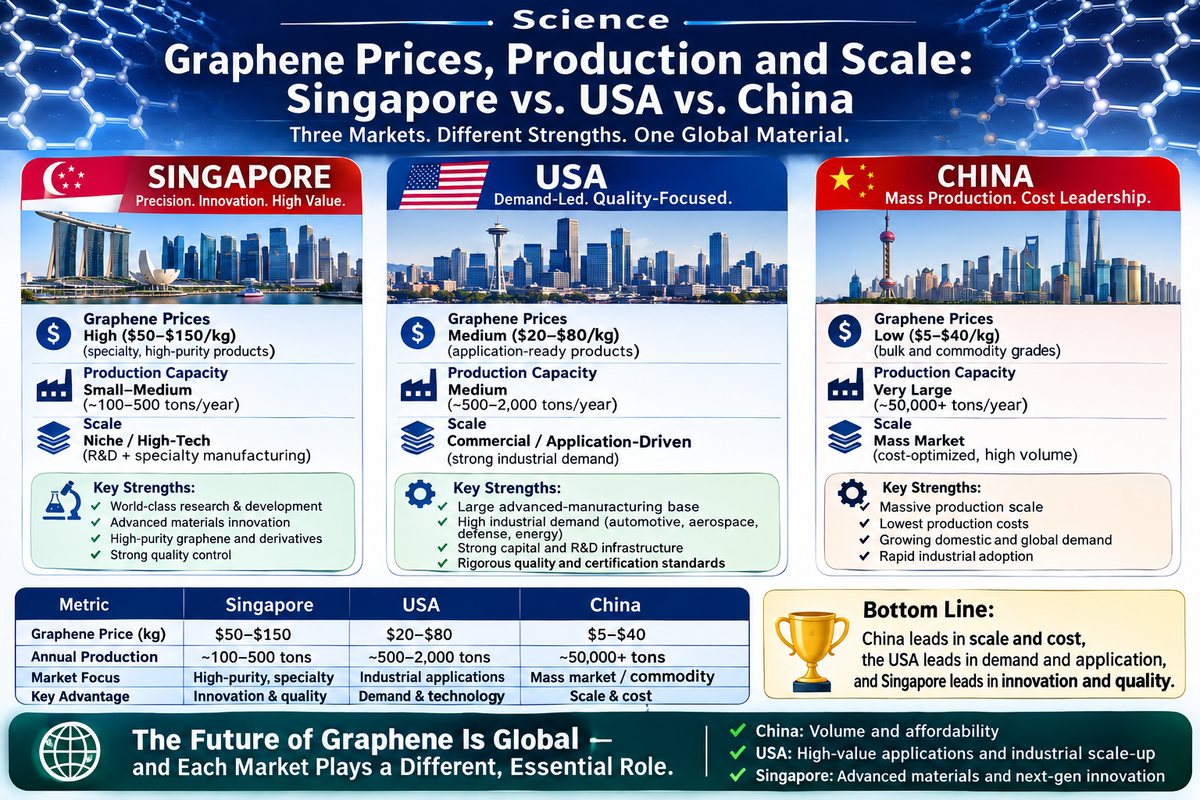
Singapore, the United States and China are all important to the commercial graphene story, but they are not competing in exactly the same way. It is crucial at the outset to clearly distinguish natural graphite resources—which are mined from the earth and traded as a bulk commodity—from engineered graphene production and subsequent graphene product sales. They represent entirely different markets, supply chains and value propositions. Understanding these distinctions is essential for any procurement team or investor navigating the advanced materials sector.
China has the strongest publicly disclosed example of bulk graphene and graphene-oxide capacity among the three. The United States has a broader mix of specialist production formats, including roll-to-roll chemical-vapor-deposition (CVD) film and powder made for composites, coatings and other advanced applications. Singapore has a much smaller manufacturing base, yet it has built a serious position around university spinouts, quality standards, regional trade and application engineering.
Price comparisons tell a similarly nuanced story. A low marketplace quote from China is not comparable with a characterized research product sold in the United States or Singapore. A kilogram of multilayer industrial nanoplatelets, a few grams of high-surface-area laboratory powder, a liter of dispersion and a square meter of CVD film are fundamentally different products. The correct question is not simply “Which country has the cheapest graphene?” It is “What form, specification, documentation and order volume does the buyer receive for the price?”
This analysis uses public catalog listings and company disclosures available in July and August 2026. Currency conversions are approximate, using July 2026 reference exchange rates of approximately US$1 to S$1.29 and US$1 to RMB6.8. Prices can change without notice and should be treated strictly as snapshots, not national averages or firm industrial quotations. Furthermore, readers must treat catalog prices, marketplace quotes, nameplate capacity and verified production as entirely different kinds of evidence.
The cleanest international price comparison comes from examining the exact same catalog product across different regions. Tokyo Chemical Industry (TCI) lists product G0675 as graphene nanoplatelets approximately 5 nanometers thick, 18 micrometers in diameter and 170 square meters per gram in surface area. On the TCI America product page, the displayed price is US$94 for 5 grams and US$283 for 25 grams. That equals US$18.80 per gram at the smaller pack and US$11.32 per gram at the 25-gram volume.
The TCI Singapore listing for the same G0675 material shows S$97.50 for 5 grams and S$337.50 for 25 grams. Those prices equal S$19.50 and S$13.50 per gram. At the July 2026 reference rate of roughly S$1.29 per US dollar, the 25-gram Singapore price is approximately US$262, or about US$10.47 per gram, before accounting for differences in local taxes, delivery fees and account terms. In this like-for-like example, Singapore and US laboratory pricing are in the exact same range; Singapore is not automatically a high-price market for characterized materials.
Singapore also has locally developed material. An official reseller for 2D Materials lists general-purpose graphene powder at S$250 for 10 grams and S$12,500 for 500 grams, holding the displayed rate near S$25 per gram. Its extra-performance grade is listed at S$400 for 10 grams and S$20,000 for 500 grams, or S$40 per gram. The page describes different surface area and lateral-size ranges for the two grades, which is exactly why price alone cannot determine value. Differently specified graphene products are not directly interchangeable.
For China, a current domestic research-market example lists Aladdin graphene nanoplatelets with a stated purity of at least 99.5 percent at RMB164.90 for 1 gram, RMB587.90 for 5 grams and RMB1,999.90 for 25 grams. The 25-gram pack works out to about RMB80 per gram, or approximately US$11.76 per gram at the July 2026 reference rate of RMB6.8 per dollar. It is not the exact same specification as TCI G0675, but it demonstrates that documented, small-pack research pricing in China can sit in the same broad band as US and Singapore catalog material.
Chinese marketplace offers go much lower—and become much harder to compare. A July 2026 Alibaba graphene nanoplatelet listing page displayed examples ranging from roughly US$150–180 per kilogram at a one-kilogram minimum to US$2.20–4 for a 100-gram minimum, alongside much more expensive gram-scale products. Such listings are leads for supplier qualification, not evidence that equivalent, characterized graphene is available at a universal Chinese price. When evaluating these figures, buyers must remember that catalog prices reflect the cost of convenience, quality assurance and immediate availability for small-scale research, whereas marketplace quotes often represent unverified bulk commodity claims. Before using a marketplace quote in a business plan, a buyer should obtain a recent certificate of analysis, Raman data, layer-count method, carbon and oxygen content, particle-size distribution, moisture data, batch tolerances and a delivered-volume quotation. Graphite is not graphene, and unverified marketplace quotes must not be treated as verified production sales.
Three core conclusions emerge from analyzing these public pricing examples:
Price per kilogram becomes commercially meaningful only after the buyer fixes a specific grade and an application. For a polymer masterbatch, dispersion behavior and the loading needed to reach a performance target can matter far more than the raw powder price. For a sensor or transparent electrode, continuous area, transfer quality, defect density and sheet resistance matter more than mass. For industrial coatings, the cost of a stable formulation and repeatable application can easily outweigh the underlying carbon-material cost.
China’s main advantage is not that every graphene product is necessarily cheaper. It is the depth of its materials-processing and industrial supply chain, plus company disclosures that point to substantial nameplate capacity.
The clearest example is The Sixth Element in Changzhou. The company states that its group has reached annual production capacity of 1,100 metric tons of graphene oxide and 150 metric tons of graphene. It also reports certifications including ISO 9001, ISO 14001 and IATF 16949, as well as EU REACH registrations. It is vital to remember that these are company-reported capacity figures, not audited proof that every tonne is produced and sold each year. Nameplate capacity is not verified annual output. However, they demonstrate a powder-scale platform well beyond a laboratory operation.
China has also pursued graphene film manufacturing. A Changzhou government report described a transparent conductive graphene film line with annual capacity of 30,000 square meters. That announcement is historical rather than a current national total, but it illustrates the range of Chinese scale-up—from powders and graphene oxide to films and downstream electronics.
China’s commercial strengths include immediate access to graphite conversion, chemical processing, batteries, coatings, tires, plastics, electronics and contract manufacturing. Those adjacent industries shorten the distance between producing a carbon nanomaterial and testing it inside a real commercial product. The distinction between natural graphite and engineered graphene is particularly critical here, as the sheer volume of carbon materials processed in China can blur the lines for inexperienced buyers. The main buyer risk is variation. The visible market contains high-quality, certified material as well as products described loosely as “graphene” that may simply be milled graphite. Procurement discipline is therefore just as important in China as price negotiation.
The United States has no reliable, current national total for graphene production. Its advantage is a diversified specialist ecosystem and access to high-value customers in aerospace, defense, electronics, energy storage, coatings and advanced composites.
General Graphene in Tennessee provides a useful film-scale benchmark. Its GG 3.0 atmospheric roll-to-roll CVD system is described as capable of producing 65,000 to 100,000 square meters of graphene annually. That output cannot be converted meaningfully into tonnes and compared with graphene-oxide powder. It is a completely different production category serving applications where continuous area and film consistency matter.
For powder, HydroGraph’s recent corporate reporting says its Manhattan, Kansas production unit can produce a minimum of 10 tonnes of graphene per year. The company presents its process as modular. As with every producer disclosure, nameplate capacity should be strictly separated from actual shipments, customer acceptance and facility utilization. The distinction between nameplate capacity and verified production is vital when assessing these historical and current figures; a facility capable of producing 10 tonnes may only run at a fraction of that capacity depending on market demand.
Older US disclosures also show why dates matter in market analysis. XG Sciences reported to the SEC that its two facilities had an estimated 225 to 450 metric tonnes of annual graphene-nanoplatelet capacity as of December 2019. That historical figure should not be treated as 2026 operating output. It remains useful evidence that US firms have built meaningful powder capacity in the past, while also warning readers not to repeat an old nameplate number as a current market statistic.
The US market is therefore best characterized by production diversity, application engineering and qualification for demanding customers. Its disadvantages include higher operating costs, longer customer-validation cycles and the absence of a transparent national production dataset.
Singapore does not disclose powder capacity comparable with China’s largest public figures, and that absence should be stated plainly. Its graphene position is built instead around a compact cluster of research, intellectual property, quality control, finance, logistics and industrial partnerships.
SG Graphene Technologies describes itself as a Nanyang Technological University spinout focused on commercial-scale production of one-to-three-layer graphene. It offers graphene, graphene oxide, graphene nanoplates and customized specialty products, but its public site does not state annual tonnage. The wording establishes commercial intent, not a verified production number that can be inserted into a country production table.
2D Materials is another important local manufacturer. A Singapore standards case study says the company manufactures high-performance graphene for paints, coatings, batteries, composites, polymers and lubricants. It also says the company planned to increase production capacity and had expanded into China, Europe, Japan, Korea and South America, without publishing the specific tonnage.
Singapore’s SS 643 standard is commercially important because it helps buyers distinguish true graphene from graphite and compare material characteristics objectively. A national ecosystem report commissioned by Singapore’s National Research Foundation and produced by IPOS International examines graphene technologies, intellectual property and commercialization. This standards-and-IP role is a form of scale, even if it does not appear as tonnes leaving a factory.
Singapore’s limitations are equally clear: a small domestic market, limited land for large chemical plants and fewer publicly disclosed volume producers. Its opportunity is to become the trusted bridge between material developers, Southeast Asian manufacturing and global customers that need verified performance rather than the lowest headline powder price.
Ask every supplier—regardless of country—for the exact same information to ensure a fair comparison:
The cheapest container can easily be the most expensive option if it requires high loading, long dispersion time, repeated testing or rejected batches. Conversely, a premium small-pack price does not prove that a supplier will be expensive at commercial volume.
China leads this three-country comparison in publicly disclosed bulk production capacity and supplier breadth. The United States leads in the diversity of advanced production formats and proximity to high-value application markets. Singapore leads in compact ecosystem efficiency: standards, research translation, regional access and quality-focused commercialization.
There is no honest single national graphene price. The best public evidence shows research-grade nanoplatelets in all three countries occupying a similar order of magnitude when specifications and pack sizes are reasonably comparable, while bulk Chinese offers extend much lower and require much more verification. For manufacturers, the winning country is therefore entirely application-dependent. China is the natural starting point for qualified bulk sourcing, the United States for advanced production partnerships and regulated high-value applications, and Singapore for specialized Asian commercialization built around consistent, documented material.
Serious about B2B integration? Test our premium Pulsed Electrical Resistive Carbon Heating turbostratic graphene in your lab. 100g sample packs available now.
Explore More
Researchers have developed a breakthrough method for growing twisted bilayer graphene with pre-designed angles, a key step toward manufacturable quantum...

Learn how deep learning is revolutionizing the structural characterization of twisted bilayer materials, accelerating the development of next-generation...

Learn to build a prototype graphene FET biosensor for sensitive DNA detection. This guide covers materials, fabrication, and testing for point-of-care...