
A New Era of Graphene Engineering: Pre-Designing Twist Angles on Demand
Researchers have developed a breakthrough method for growing twisted bilayer graphene with pre-designed angles, a key step toward manufacturable quantum...
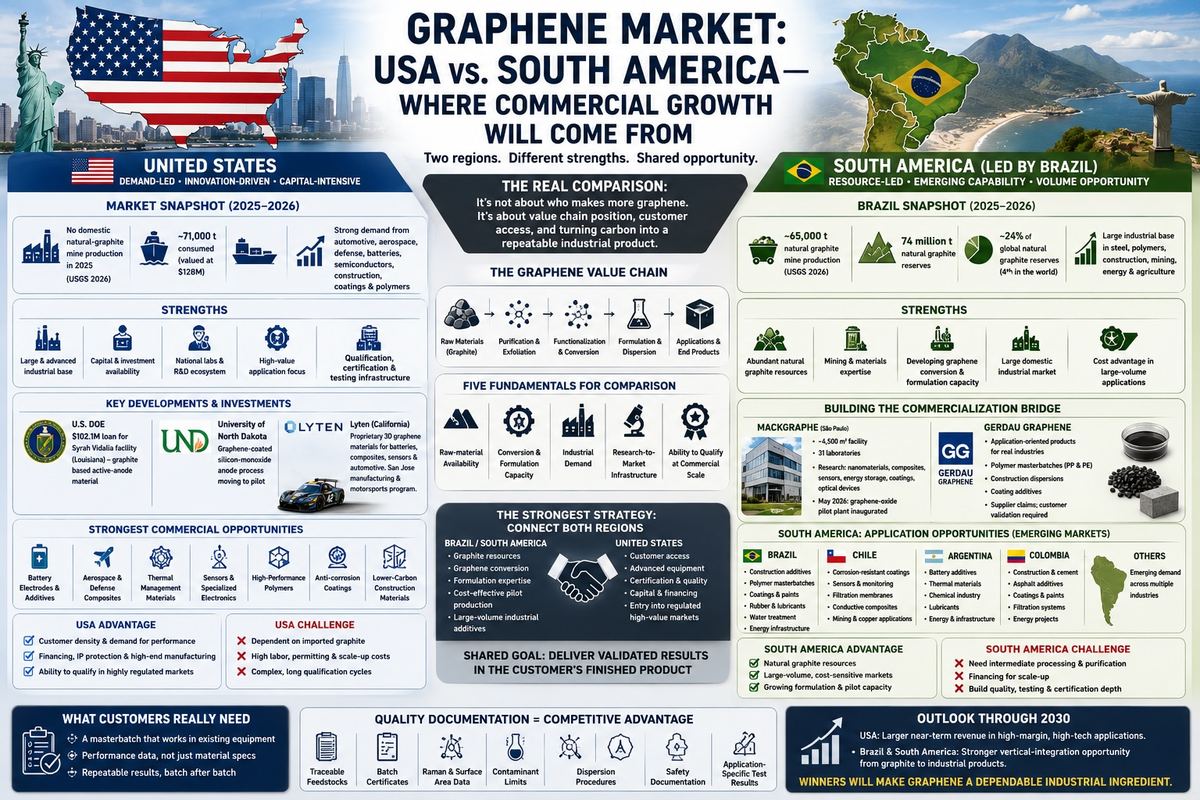
The graphene market is often presented as one global race, but the reality is more regional and more practical. The United States has a deep base of advanced-manufacturing customers, investment capital, national laboratories and application developers. South America, led overwhelmingly by Brazil, holds an important natural-graphite resource position and is developing its own capability in graphene oxide, industrial dispersions, polymer masterbatches, coatings and construction additives.
The comparison is therefore not simply about which region produces more graphene. It is about where each region sits in the value chain, which customers can qualify new materials, and whether suppliers can transform a promising carbon powder into a repeatable industrial product.
Commercial reports publish widely different estimates for the size and growth of the graphene industry. These estimates are difficult to reconcile because suppliers use the word graphene for many different products: graphene nanoplatelets, graphene oxide, reduced graphene oxide, functionalized powders, liquid dispersions, masterbatches, conductive inks and large-area films.
Natural graphite statistics are more dependable, but graphite production is not the same as graphene production. A country may mine large quantities of graphite without possessing the purification, exfoliation, functionalization, quality-control and application-engineering capabilities required to sell high-value graphene products.
A useful comparison must therefore examine five measurable fundamentals: raw-material availability, graphene conversion and formulation capacity, industrial demand, research-to-market infrastructure, and the ability to qualify a product at commercial scale.
The United States represents a large potential market because it already has substantial automotive, aerospace, defense, semiconductor, battery, construction, coatings and polymer industries. These sectors can pay for performance, but they also demand extensive safety data, batch consistency, technical support and long qualification programs.
America's weakness is raw-material dependence. The USGS 2026 natural-graphite summary reports that the United States recorded no domestic natural-graphite mine production in 2025. American companies consumed an estimated 71,000 metric tons valued at $128 million and imported approximately 79,000 tons. Five domestic mining projects were under consideration or development, while several companies were building or evaluating spherical purified graphite capacity.
These figures describe graphite rather than graphene, but they reveal the commercial environment around advanced carbon materials: strong demand, significant capital and concern about supply security.
The federal government classifies natural graphite as a critical material and has supported domestic processing. The Department of Energy issued a $102.1 million loan for the Syrah Vidalia facility, a Louisiana operation producing graphite-based active-anode material. The government has also funded projects closer to graphene, including a University of North Dakota program to move a graphene-coated silicon-monoxide anode process toward pilot readiness.
Private companies follow a similar application-first model. California-based Lyten reports that it manufactures proprietary three-dimensional graphene materials and is developing applications in lithium-sulfur batteries, composites, sensors and automotive components. The company's individual performance claims still require customer qualification, but its San Jose manufacturing and motorsports program illustrates the American strategy: protect a material platform with intellectual property and connect it to high-value products.
The strongest U.S. opportunities are likely to include battery electrodes, conductive additives, aerospace and defense composites, thermal-management materials, anticorrosion coatings, sensors, specialized electronics, high-performance polymers and lower-carbon construction materials.
South America is not one integrated graphene market. Brazil has a much more developed graphite and graphene ecosystem than the rest of the continent. Chile, Argentina, Colombia and other countries have attractive industrial applications, but publicly visible graphene production and commercialization infrastructure remains more limited.
Brazil's raw-material position is substantial. USGS estimates that Brazil produced approximately 65,000 metric tons of natural graphite in 2025 and held 74 million tons of reserves. That represented roughly 24% of reported global reserves and placed the country fourth in estimated mine production. Brazil's 2026 critical-minerals investment guide identifies graphite as one of the country's strategic advantages.
Brazil also recognizes the gap between mining and high-value manufacturing. The Brazilian National Mining Agency says the country exports natural graphite in different grades while importing spherical graphite and processed anode material for batteries. That imbalance is a challenge, but it is also the clearest investment opportunity: retain more value by moving from ore and concentrate into purified graphite, graphene derivatives, stable dispersions and qualified formulations.
Brazil has more than geological potential. It has organizations specifically designed to connect graphene research with industry.
MackGraphe, the graphene and nanotechnology institute at Mackenzie Presbyterian University in São Paulo, operates approximately 4,500 square meters and 31 laboratories. Its work includes nanomaterial synthesis, composites, sensors, energy storage, optical devices and coatings. In May 2026, the institute inaugurated a graphene-oxide pilot plant intended to support internal production, company partnerships and technology transfer.
Pilot capacity matters because industrial customers cannot qualify a material from one excellent laboratory batch. They need enough product to conduct repeated formulation, processing, durability and safety tests.
Gerdau Graphene provides another commercialization model. Instead of expecting customers to purchase raw graphene and solve dispersion themselves, the company markets application-oriented products for polymers, paints and construction. Its Poly-G portfolio includes polypropylene- and polyethylene-based graphene masterbatches designed for conventional processing. Gerdau also markets construction dispersions and coating additives. These are supplier performance claims that customers should validate independently, but the product-oriented portfolio demonstrates an important market principle: manufacturers generally want a compatible ingredient, not an unfamiliar nanomaterial powder.
The United States has the advantage in customer density, financing, qualification infrastructure and advanced manufacturing. Its graphene businesses can target specialized applications where a small material improvement creates significant economic value. However, the region remains dependent on imported graphite and faces high labor, permitting and scale-up costs.
Brazil offers natural-graphite resources, existing mining expertise, a large domestic industrial base and promising formulation capacity. It may be particularly competitive in masterbatches, coatings, concrete additives, rubber, lubricants, water treatment and other applications that use graphene in small concentrations across large material volumes. Its principal challenge is financing and operating the intermediate processing steps that transform graphite into consistent, application-ready graphene products.
Outside Brazil, South America's strongest opportunity may be as an application market. Chile's mining and copper industries could use corrosion-resistant coatings, sensors, filtration membranes and conductive composites. Argentina's lithium and chemical industries create potential demand for battery additives and thermal materials. Colombia's construction, infrastructure and energy sectors could support graphene-enhanced cement, asphalt, coatings and filtration systems. Based on currently visible commercial infrastructure, these countries remain emerging opportunity markets rather than production hubs comparable with Brazil.
In the United States, near-term revenue is most likely to come from high-margin applications with substantial intellectual property and qualification requirements. Batteries, aerospace, defense, electronics, thermal management and specialty coatings fit this model. Customers will pay more for a material when its performance is documented and the economic value of failure prevention, weight reduction or longer service life is high.
In Brazil and the broader South American market, growth may come faster from practical industrial additives. Construction, polymer processing, packaging, mining equipment, marine coatings, water treatment and energy infrastructure offer large addressable volumes. Success will depend less on producing perfect monolayer graphene and more on delivering stable, affordable formulations that work with existing manufacturing equipment.
The most commercially effective model may combine the strengths of the United States and South America. Brazil can contribute graphite resources, graphene conversion, application formulations and cost-effective pilot production. American partners can contribute customer access, advanced equipment, certification experience, capital and entry into highly regulated markets.
For graphene suppliers, the sales lesson is straightforward: do not sell only surface area, layer count or price per kilogram. Sell a validated result.
Quality documentation will become a competitive advantage. Buyers increasingly need traceable feedstocks, batch certificates, Raman and surface-area data, contaminant limits, dispersion procedures, safety documentation and application-specific test results. A supplier that provides these consistently can compete more effectively than one offering an impressive but poorly defined graphene powder.
The United States is likely to remain the larger near-term revenue opportunity because it concentrates advanced industrial demand and has greater capacity to finance specialized technologies. Brazil, however, may hold the stronger vertical-integration opportunity, connecting natural graphite resources with graphene production, formulation and finished industrial products.
South America will not gain an advantage simply because it has graphite in the ground. The region must add purification, conversion, formulation, testing and commercial manufacturing capacity. The 2026 opening of Brazil's graphene-oxide pilot infrastructure and the appearance of market-ready additive portfolios are meaningful steps in that direction.
The winning companies in both regions will be those that make graphene behave like a dependable industrial ingredient. They will define the material precisely, manufacture it consistently, integrate it into familiar production processes and prove that the customer receives more value than the graphene costs.
The USA-versus-South-America comparison reveals two complementary markets. The United States is demand-led, capital-intensive and focused on high-value applications. South America is resource-led, with Brazil building a credible bridge from graphite and research into formulations for large industrial sectors.
The real competition is not between continents. It is between companies that continue selling graphene as a scientific novelty and those that deliver measurable, repeatable performance inside a customer's finished product.
Serious about B2B integration? Test our premium Pulsed Electrical Resistive Carbon Heating turbostratic graphene in your lab. 100g sample packs available now.
Explore More
Researchers have developed a breakthrough method for growing twisted bilayer graphene with pre-designed angles, a key step toward manufacturable quantum...

Learn how deep learning is revolutionizing the structural characterization of twisted bilayer materials, accelerating the development of next-generation...

Learn to build a prototype graphene FET biosensor for sensitive DNA detection. This guide covers materials, fabrication, and testing for point-of-care...