
Practical Guide: Building a Graphene Support for High-Flux Water Filtration Membranes
Learn how a graphene support layer can mechanically reinforce ultra-thin polymer membranes, boosting water flux without compromising filtration efficiency.
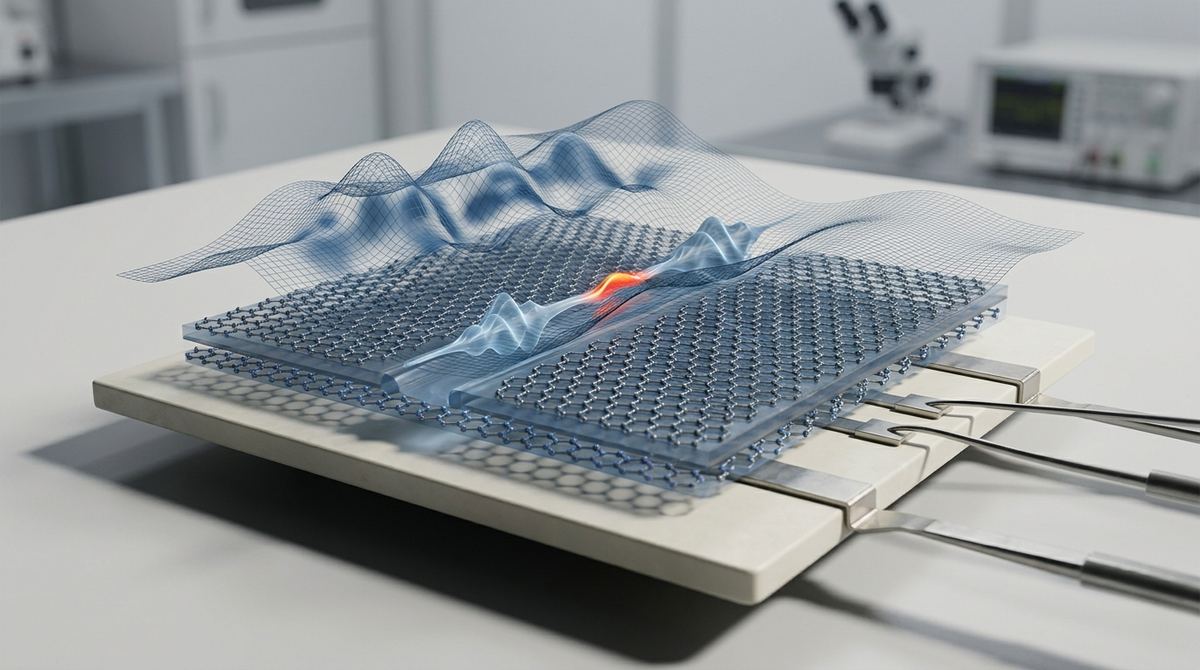
Imagine a material that can conduct electricity with absolutely zero resistance, allowing power to travel across a continent without losing a single watt of energy. This is the promise of superconductivity, a quantum phenomenon that could revolutionize everything from ultra-fast maglev trains to the quantum computers of the future. However, discovering these materials is currently a process of intense trial and error. To move from accidental discovery to intentional design, scientists need a perfect mathematical map of how electrons behave inside a solid. They need to know not just how electrons move, but how they dance with the vibrations of the atoms around them and how they ripple through the sea of other electrons. Recent theoretical work has begun to provide this map by bridging two previously separate worlds of physics.
The primary challenge in modern condensed matter physics is the extreme complexity of electron behavior. In a solid, an electron is never truly solitary. It is constantly interacting with its environment, and these interactions are what determine whether a material is a standard conductor, an insulator, or a superconductor. To predict these states, physicists typically rely on two different mathematical models. One model focuses on phonons, which are the mechanical vibrations of the atoms in a crystal lattice. This is the traditional way we understand conventional superconductivity, where a passing electron creates a ripple in the lattice that pulls another electron toward it, creating a pair.
The second model focuses on plasmons, which are collective oscillations of the electron density itself. These are essentially waves of charge moving through the electron sea. In many advanced materials, particularly those that are highly two-dimensional or highly correlated, these two types of interactions do not happen in isolation. They are deeply intertwined. A vibration in the lattice can trigger a wave in the electron density, and an oscillation in the electron density can shake the lattice. Currently, most computational models treat these as separate entities. If a scientist uses a model that only accounts for phonons, they might miss the critical role that plasmons play in forming superconducting pairs. This leads to inaccurate predictions regarding the critical temperature, the threshold below which a material becomes superconducting. Without a unified way to calculate both simultaneously, the hunt for room-temperature superconductors remains a game of guesswork.
To solve this, researchers are turning to a more sophisticated mathematical framework known as the quasiparticle GW approximation. To understand this, we must first understand the concept of a quasiparticle. When an electron moves through a material, it doesn't move as a simple, lonely particle. Instead, it carries a "cloud" of disturbances with it—it pulls some atoms closer and pushes others away, and it creates a wake in the surrounding electrons. This complex entity, the electron plus its cloud of interactions, is what physicists call a quasiparticle. It behaves like a single particle, but its mass and charge are effectively modified by its environment.
The GW method is a high-level way of calculating the properties of these quasiparticles. The G stands for the Green's function, which is a mathematical way of tracking how a particle moves through a medium, and the W stands for the screened Coulomb interaction, which describes how the electric field of the electron is "shielded" or "screened" by all the other electrons around it. The breakthrough idea presented by the research is to move beyond treating the electron-phonon and electron-plasmon interactions as separate problems. Instead, the researchers aim to integrate them into a single, unified mathematical treatment. This means instead of calculating the lattice vibrations and then separately calculating the electron waves, the model looks at the total, unified "screening" effect that all these interactions provide. This allows for a much more precise description of the energy environment that electrons experience, which is the key to understanding superconductivity.
While the research provides a broad theoretical framework, its implications are most profound when applied to low-dimensional systems, such as graphene-based architectures or layered superconducting materials. In these highly structured environments, the distinction between different types of excitations becomes blurred. In a standard three-dimensional metal, an electron might be far enough from the surface that its interactions are somewhat predictable. However, in a graphene-like system, the electrons are confined to a nearly two-dimensional plane. This confinement amplifies the effect of both lattice vibrations and charge density oscillations.
In these systems, the interplay between phonons and plasmons is not just a minor correction; it is a fundamental driver of the material's electronic properties. When an electron moves through a graphene-based structure, the thinness of the material means that the electric field it produces is not easily shielded by the surrounding environment. This makes the electron-plasmon coupling particularly strong. At the same time, because the lattice is so thin, the vibrations of the carbon atoms (phonons) have a massive impact on the electronic path. The unified GW approach is uniquely suited for these materials because it does not force a choice between treating the lattice or the electron sea as the primary driver. Instead, it allows the model to capture how a vibration in the carbon lattice can directly trigger a plasmonic oscillation, and how that oscillation, in turn, can reinforce the pairing of electrons. By treating the system as a whole, the physics of the material is captured in its most honest and complex form.
The research conducted by Catalin D. Spataru, Christopher Renskers, and Elena R. Margine provides a rigorous theoretical path toward this unified treatment. The authors have demonstrated how the quasiparticle GW framework can be extended to include both electron-phonon and electron-plasmon couplings within a single, consistent mathematical structure. This is a significant technical achievement because it requires reconciling different energy scales and different mathematical descriptions of how particles interact.
The researchers have shown that by using this unified approach, it becomes possible to calculate the self-energy of an electron—the energy change caused by its interactions—much more accurately. This self-energy is the fundamental quantity that tells us whether electrons will pair up to become superconductors. The work moves toward a framework where the distinction between a lattice-mediated interaction and an electron-mediated interaction is naturally handled by the math. This removes the need for the "additive" approach used in older models, where scientists would simply calculate one effect and then add it to the other. Adding them separately often leads to errors because it misses the way the two effects interact with each other. The Spataru, Renskers, and Margine study provides the theoretical foundation needed to ensure that when we calculate the properties of a new, potentially groundbreaking material, we are not ignoring the subtle, complex harmony between its parts.
The importance of this research lies in the transition from observation to design. For decades, the field of superconductivity has been characterized by the discovery of materials that work, followed by years of trying to figure out why they work. This is because our mathematical tools were too blunt to capture the intricate details of electron behavior. By providing a more precise way to calculate these interactions, this research provides a "high-resolution lens" for material scientists.
If we can accurately model how phonons and plasmons interact, we can simulate thousands of different material combinations on a supercomputer before ever stepping into a laboratory. We can look for specific combinations of atoms and structures that are mathematically predicted to have high-temperature superconductivity. This could drastically shorten the timeline for discovering materials that function at room temperature or under ambient pressure. In the broader context of materials science, this unified treatment provides a template for studying any phenomenon where multiple types of collective excitations interact, such as in advanced semiconductors or topological insulators. It represents a shift toward a more holistic and accurate way of understanding the quantum world.
It is important to note that this research is a fundamental theoretical advancement, not a direct recipe for a new material. The researchers have provided a mathematical and theoretical framework, which is essentially a new set of highly advanced tools. These tools are incredibly complex and require immense computational power to implement. Currently, running a full quasiparticle GW calculation for a large, complex crystal structure is a monumental task for even the most powerful supercomputers.
Furthermore, while the theory is robust, the practical application requires testing against real-world experimental data. The mathematical model is only as good as our understanding of the underlying physical constants. Scientists will still need to refine these models by comparing their results with actual observations of material behavior in laboratories. There is also the challenge of scaling these theories up from simple models to the incredibly messy and imperfect reality of manufactured materials, where defects, impurities, and temperature fluctuations play a massive role. This research is a critical step forward, but it is part of a much longer journey toward the commercial realization of new superconducting technologies.
The ultimate goal of refining our understanding of superconductivity is to unlock technologies that are currently limited by energy loss and heat. In the realm of power infrastructure, room-temperature superconductors would allow for the creation of power grids that operate with zero loss. This would make renewable energy sources, like wind and solar, much more efficient because the energy generated at a remote site could be transported thousands of miles without diminishing.
In the field of computing, these advancements could lead to a revolution in quantum processing. Many current quantum computers rely on superconducting circuits to create qubits. Improving our ability to predict and control the electronic interactions in these circuits could lead to much more stable and scalable quantum computers. Additionally, the medical and transportation sectors would see massive shifts. MRI machines, which currently require expensive and heavy liquid helium to maintain superconductivity, could become smaller, cheaper, and more accessible. High-speed maglev trains, which use superconducting magnets to levitate, could become a standard for ground transportation, making travel faster and more energy-efficient.
If you remember only one thing from this research, let it be this: the future of high-performance materials depends on our ability to understand the complex, unified dance of electrons, lattice vibrations, and charge waves. By treating these interactions as a single, integrated system rather than separate events, we are gaining the ability to design the materials of tomorrow with unprecedented precision.
What is a quasiparticle in a scientific context? In a solid, an electron is never truly alone. As it moves, it pushes other electrons away and pulls positive ions toward it. This combination of the electron and its surrounding disturbance moves through the material as a single entity called a quasiparticle. This concept is central to understanding how modern materials function at the quantum level.
Why is it difficult to predict superconductivity in new materials? Superconductivity depends on how electrons pair up. This pairing is driven by subtle interactions like lattice vibrations and charge oscillations. Because these interactions are so complex and intertwined, even small errors in our mathematical models can lead to massive errors in predicting whether a material will be a superconductor or not.
What is the difference between a phonon and a plasmon? Phonons are essentially sound waves or mechanical vibrations traveling through the crystal lattice of atoms. Plasmons, on the other hand, are collective oscillations of the electron density itself. One involves the movement of the nuclei, while the other involves the movement of the electrons.
What does the GW approximation actually do for physicists? The GW approximation is a sophisticated mathematical tool used to calculate how electrons interact with their environment. It accounts for the fact that an electron's charge is screened by the other electrons around it. This makes it much more accurate than simpler models for calculating the energy levels of electrons in complex materials.
Can this theoretical research lead to room-temperature superconductors? While this research is theoretical and focuses on the mathematical framework, it is a vital step. By providing more accurate tools to simulate materials, scientists can more effectively identify which chemical compositions have the potential to become room-temperature superconductors, potentially accelerating the path to commercial use.
The quest for transformative materials like room-temperature superconductors is one of the greatest challenges in modern science. As we have seen, the key to this challenge lies in the incredibly complex interactions between electrons and their environment. The work by Spataru, Renskers, and Margine offers a vital path forward by providing a unified mathematical framework that treats electron-phonon and electron-plasmon couplings as a single, integrated phenomenon. While challenges remain in terms of computational complexity and experimental validation, this move toward a quasiparticle GW treatment marks a significant milestone. It moves us away from fragmented approximations and toward a complete, unified understanding of the quantum world, bringing us one step closer to a future of lossless power, faster computers, and advanced transportation.
Serious about B2B integration? Test our premium Pulsed Electrical Resistive Carbon Heating turbostratic graphene in your lab. 100g sample packs available now.
Explore More
Learn how a graphene support layer can mechanically reinforce ultra-thin polymer membranes, boosting water flux without compromising filtration efficiency.

Researchers have developed a breakthrough method for growing twisted bilayer graphene with pre-designed angles, a key step toward manufacturable quantum...

Learn how deep learning is revolutionizing the structural characterization of twisted bilayer materials, accelerating the development of next-generation...