
Practical Guide: A Practical Guide to Building a Graphene Battery Safety Sensor
Build a flexible graphene battery sensor for real-time temperature and strain monitoring, a crucial step toward preventing thermal runaway in Li-ion cells.
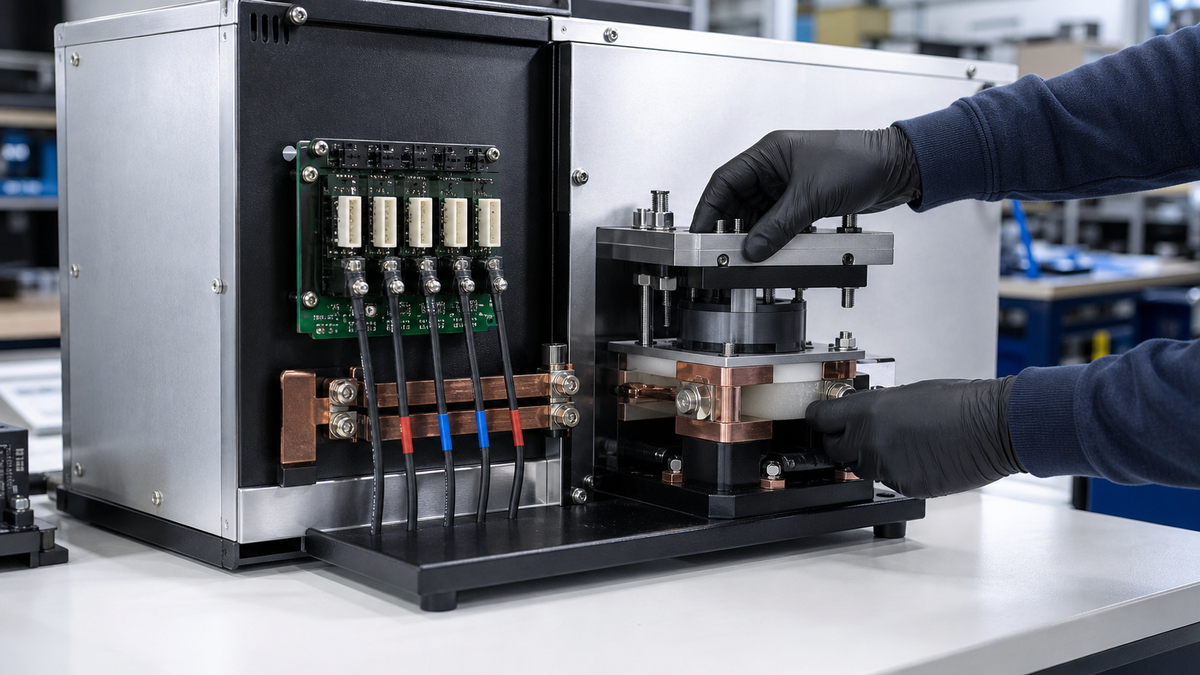
Graphene production is not only a chemistry problem. It is also a machine problem.
Anyone can describe a promising reaction. The harder work is building a machine that repeats that reaction with the same electrical behavior, the same thermal path, the same contact pressure, and the same operator workflow from run to run. That is where many graphene systems fail. They work once, or they work when one person operates them carefully, but the process changes when the electrodes age, the feedstock packing changes, the contact surface shifts, or the power path drifts.
The USA Graphene V2 machine is being developed around a direct engineering goal: make graphene production more measurable, more repeatable, and more reliable. The V2 design improves the machine at three levels. First, it adds advanced resistance measurement so the system can understand the state of the cell before and during a run. Second, it introduces a dedicated power sense board invented for the machine, giving the controller a better view of the real power path instead of relying only on command settings. Third, it uses a new cell design intended to improve consistency, reduce operator variability, and simplify service.
The result is a machine philosophy that is simple but important: if the machine can measure the right signals, control the right variables, and remove unnecessary complexity, graphene production becomes less of a one-off experiment and more of a repeatable process.
Early graphene production machines often prove that a reaction is possible. V2 machines must prove that the reaction can be controlled. That difference matters because the market does not buy a successful single run. Customers need material that behaves predictably across batches, and operators need equipment that does not require constant improvisation.
For USA Graphene, V2 is a step toward a practical production platform. The focus is not adding more complexity for the sake of looking advanced. It is the opposite. The design removes weak points, improves measurement, and organizes the electrical system around the real behavior of the production cell.
In pulsed or high-current graphene production, small details can become large process variables. A slightly loose contact can change resistance. A different cell packing density can change current distribution. A power lead with unexpected voltage drop can make the controller think the cell received one amount of energy while the actual reaction zone received another. If the machine cannot see those differences, the operator is forced to guess.
V2 is designed to reduce guessing.
Resistance is one of the most useful signals in a graphene production machine because it tells a story about the production cell. Before a run, resistance can indicate whether the cell is assembled correctly, whether the feedstock is packed consistently, and whether the electrical contacts are making a clean connection. During a run, changing resistance can reveal how the material is heating, converting, compacting, or opening new current pathways.
Basic machines often treat resistance as a rough number. The operator may check continuity or use a simple meter before starting. That can catch obvious failures, but it is not enough for repeatable production. A serious machine needs resistance measurement that is part of the control system, not an afterthought.
The V2 approach makes resistance a production variable. The system can use resistance checks to confirm that the cell is in a valid starting range. It can help detect poor clamping, contaminated contact surfaces, inconsistent material loading, or a cell that was assembled differently from the previous run. This matters because the same commanded power setting can produce a different result if the starting resistance is different.
Advanced resistance measurement also supports better process records. Instead of recording only "run complete," the machine can preserve the electrical profile of the run. That profile becomes useful for comparing batches, troubleshooting failed runs, and improving the cell design over time.
In practical terms, resistance measurement turns the machine into its own diagnostic tool. If a batch does not meet expectations, the operator can review whether the cell started too high, too low, or unstable. If the resistance curve changes after several runs, the machine may be signaling electrode wear, contact oxidation, feedstock inconsistency, or mechanical alignment drift.
That is the kind of feedback needed for real production.
One of the most important V2 improvements is the power sense board invented for the machine. In a graphene production system, power delivery is the heart of the process. The machine needs to know not only what it asked the power stage to do, but what actually happened at the cell.
That distinction is critical. A controller can command a pulse, a voltage, a current limit, or an energy target. But between the controller and the reaction zone there are real physical components: power electronics, bus bars, cables, connectors, electrode interfaces, and the production cell itself. Every part can introduce loss, delay, heating, or measurement error.
A dedicated power sense board gives the V2 machine a clearer view of the electrical reality. It can support more accurate sensing of voltage, current, timing, and delivered energy. It can help separate command intent from actual delivery. It can also make the system easier to debug because electrical measurements are organized around the machine architecture instead of scattered across temporary test points.
The board is important for consistency. If the controller can measure delivered power more directly, it can compare runs more honestly. Two runs may look identical in software settings, but if one run had a higher contact resistance or different current path, the actual energy delivered to the cell may not be the same. The power sense board helps expose that difference.
It also supports safer engineering. High-current systems should not depend only on operator attention. Better sensing can help identify abnormal conditions such as unexpected resistance, poor contact, excessive voltage drop, or power delivery outside the intended window. That does not replace mechanical safety, insulation, enclosure design, fusing, or operator training, but it strengthens the control layer.
For V2, the power sense board is not just an electronics upgrade. It is a process-control upgrade.
The production cell is where the machine becomes real. It is the place where feedstock, pressure, electrical contact, heating, and reaction geometry meet. If the cell is inconsistent, the rest of the machine has to fight that inconsistency.
The V2 cell design is aimed at repeatability. A better cell should make it easier to load material in a controlled way, clamp the reaction zone consistently, maintain stable electrical contact, and remove the finished material with less disturbance. It should reduce the number of small operator decisions that affect the run.
In graphene production, consistency often comes from boring mechanical discipline. The cell should align the same way every time. The contact surfaces should be easy to inspect and clean. The clamping force should be repeatable. The geometry should not invite accidental misalignment. Consumable parts should be replaceable without rebuilding the entire machine.
The new cell design supports that direction. By simplifying the cell and making its interfaces more predictable, V2 can reduce batch-to-batch variation caused by assembly differences. That is especially important when developing a production recipe. If the cell changes every run, it becomes difficult to know whether a result came from the recipe or from the hardware.
Repeatability does not mean every batch will automatically be perfect. It means the machine gives the operator a stable foundation. Once the mechanical and electrical starting conditions are controlled, process development becomes much more meaningful.
Reliability often improves when unnecessary complexity is removed. This is true for production machines, electronics, plumbing, software, and mechanical assemblies. Every extra connector, wire, bracket, sensor, fastener, and adjustment point is another possible failure point.
The V2 machine uses simplification as an engineering strategy. A simpler machine is easier to assemble, easier to inspect, easier to service, and easier to explain to a new operator. It also makes faults easier to isolate. When a machine has too many improvised parts, troubleshooting becomes slow because every part is a suspect. When the design is clean, organized, and measured, the problem space gets smaller.
Simplification does not mean making the machine less capable. In V2, the goal is to put sophistication where it matters: measurement, power sensing, cell consistency, and control logic. The machine can become more advanced while the physical layout becomes cleaner.
That is the right direction for production equipment. A reliable machine should not look like an experiment that escaped the lab. It should have defined modules, serviceable parts, clear wiring paths, protected electronics, stable fixturing, and a cell that can be operated repeatedly without heroic attention.
When the design is simplified, manufacturing also becomes more realistic. Parts can be standardized. Assembly time can go down. Training gets easier. Maintenance procedures can be written clearly. Spare parts can be stocked. These practical details matter if the machine is going to move beyond prototype status.
The most valuable shift in V2 is the move from experiment to process.
An experiment asks, "Can we make graphene?" A process asks, "Can we make graphene again, under known conditions, with records that explain what happened?"
That second question is harder. It requires control over inputs, cell preparation, measurement, power delivery, timing, cooling, removal, and post-run inspection. It also requires honesty. If a batch is different, the machine should help identify why.
Advanced resistance measurement and the power sense board both support this transition. They allow the machine to collect electrical evidence. The new cell design supports the mechanical side of repeatability. The simplified architecture supports reliability and serviceability. Together, these changes make V2 feel less like a test rig and more like a production tool.
This also creates a better foundation for material development. When runs are repeatable, the team can test feedstocks, packing methods, pulse recipes, cell geometries, and post-processing steps with more confidence. Improvements become traceable. Problems become easier to reproduce. Good results become easier to protect.
For an operator, the best machine improvements are the ones that reduce uncertainty.
With V2, a good workflow should begin before the run starts. The operator loads the cell, clamps it, connects it, and the machine checks whether the starting resistance is in range. If something is wrong, the machine should help catch it before energy is delivered. That prevents wasted material and reduces the chance of a bad run.
During operation, the machine should monitor the power path and record what happened. The operator should not have to rely only on sound, smell, color, or intuition. Those observations can still be useful, but they should be supported by measurements.
After the run, the machine record should help answer practical questions. Was the resistance stable? Did the power delivery match the target? Did the cell behave like previous successful runs? If not, what changed?
That feedback loop is what turns experience into repeatability.
Customers do not see most of the engineering inside a graphene production machine. They care about the material, price, availability, and consistency. But those outcomes depend on the machine.
A more reliable machine can support more dependable production scheduling. A more repeatable cell can reduce batch variation. Better resistance and power sensing can improve quality control. A simplified design can reduce downtime and make future machines easier to build.
This matters because graphene customers often need confidence before they commit to formulation work. Whether the target is concrete, coatings, plastics, batteries, rubber, composites, or thermal materials, customers need samples that are consistent enough to evaluate. If each sample behaves differently for machine-related reasons, application testing becomes frustrating and expensive.
V2 is therefore not only an internal engineering milestone. It is part of making graphene more usable for customers.
The USA Graphene V2 machine is built around a practical principle: repeatable graphene production requires measurement, not guesswork.
Advanced resistance measurement helps the machine understand the cell. The invented power sense board helps the controller understand the real power delivery. The new cell design improves consistency and repeatability. The simplified layout makes the machine more reliable and more realistic as production equipment.
Graphene has always attracted big claims. The real progress now is more grounded: better machines, better diagnostics, cleaner cells, and more repeatable runs. That is how a promising material becomes a usable industrial product.
V2 is a step in that direction.
Serious about B2B integration? Test our premium Pulsed Electrical Resistive Carbon Heating turbostratic graphene in your lab. 100g sample packs available now.
Explore More
Build a flexible graphene battery sensor for real-time temperature and strain monitoring, a crucial step toward preventing thermal runaway in Li-ion cells.

Research on 30° quasi-periodic twisted bilayer graphene reveals a unique, fractal-like energy structure under magnetic fields, paving the way for novel...

Researchers discover naturally formed graphene sheets and carbon ovals in stingless bee hives, creating a novel emergent material with powerful blue light...