
Rippled Graphene Pores for Neuromorphic Fluidic Memristive Devices
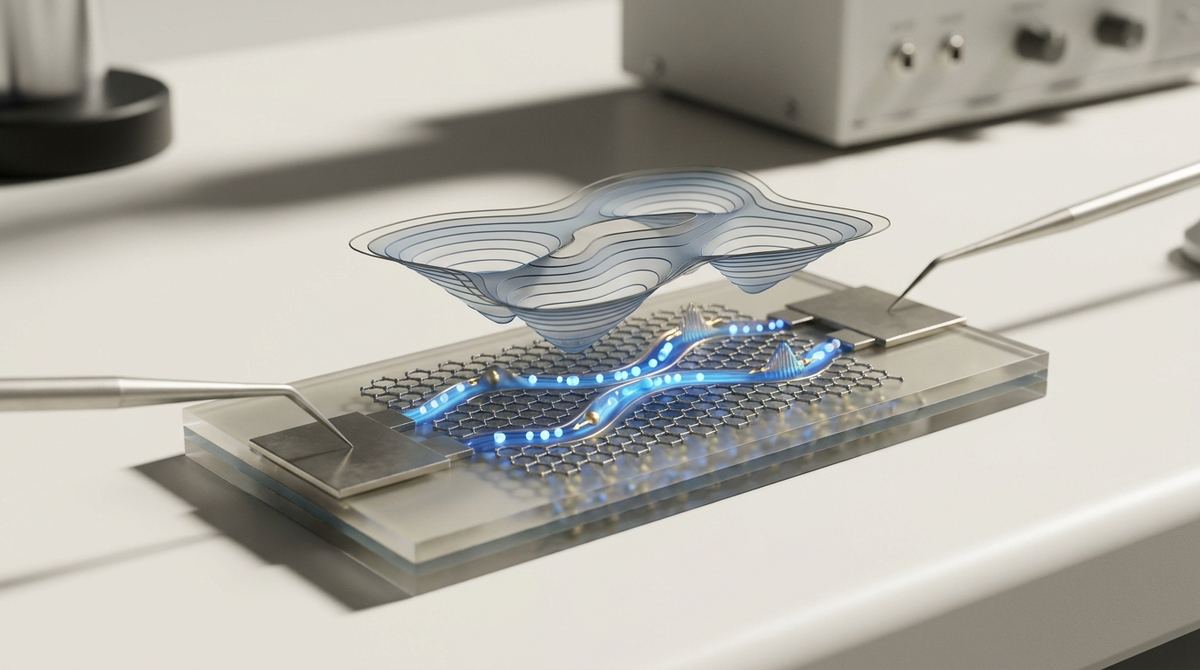
Discover how rippled graphene pores act as fluidic memristors, enabling advanced synaptic functionalities for the next generation of neuromorphic computing.
The future of computing may not rely on the simple movement of electrical charges, but rather on the internal properties of electrons themselves. For decades, engineers have worked to master the spin of an electron to create faster, smaller, and more efficient computers. Now, a breakthrough in the field of two-dimensional materials is opening the door to a new era called valleytronics, where we use the specific location of an electron within a crystal lattice to store and process information. This research represents a major leap forward in our ability to control the quantum properties of matter at the atomic scale.
In the pursuit of high-performance electronics, traditional silicon-based transistors are reaching their physical limits. As components shrink, the heat generated by moving charges becomes unmanageable, and the energy required to switch states becomes inefficient. To solve this, researchers have turned to spintronics, which uses the electron's spin—its intrinsic angular momentum—as the basis for information. However, graphene, one of the most promising materials for spintronics due to its incredible speed and conductivity, has a significant flaw: it lacks spin-orbit coupling.
Spin-orbit coupling is the interaction between an electron's spin and its orbital motion around the nucleus. Without this interaction, it is extremely difficult to manipulate the spin of an electron using external electric fields. In graphene, the lack of this coupling means that while electrons can travel long distances without losing their momentum, we have very little control over their spin direction. To make graphene useful for quantum information, we need to introduce spin-orbit coupling, but doing so is a delicate balancing act. Usually, when we add heavy atoms to graphene to induce this coupling, we introduce a phenomenon called Rashba spin-orbit coupling. This specific type of coupling causes the electron's spin to flip frequently, which leads to the loss of quantum information, a process known as decoherence. Therefore, the fundamental problem is how to introduce enough spin-orbit coupling to control the electron without causing the spin to flip and lose its data.
The researchers have found a way to solve this by using a technique called proximity engineering. Instead of chemically altering the graphene itself, which would create defects and slow down the electrons, they "sandwich" the graphene between layers of another material called tungsten diselenide, or WSe2. WSe2 is a heavy, complex material that naturally possesses very strong spin-orbit coupling.
By placing the graphene in direct contact with the WSe2, the electrons in the graphene begin to "feel" the presence of the heavy tungsten atoms through a phenomenon called the proximity effect. This allows the graphene to inherit some of the properties of the WSe2 without actually becoming WSe2. The genius of this approach lies in the specific type of coupling they target: the valley-Zeeman coupling. Unlike the problematic Rashba coupling, the valley-Zeeman coupling locks the electron's spin to its "valley" index. In graphene, the electrons exist in two distinct energy states called valleys, which we can think of as two different lanes on a highway. By locking the spin to the valley, the researchers have created a way to control the electron's information that is much more stable and resistant to the errors that typically plague quantum systems.
To understand how this system functions, we must look at the atomic architecture of the heterostructure. The researchers, including Yaqing Han, Siqi Jiang, Jingkuan Xiao, Jiawei Jiang, Yulu Liu, Jiabei Huang, Yu Du, Di Zhang, Fuzhuo Lian, Wanting Xu, Siqin Wang, and Kenji Watanabe, utilized van der Waals heterostructures to create this interface. These are essentially stacks of different two-dimensional materials that are held together by weak van der Waals forces rather than strong chemical bonds. This is crucial because it allows for an incredibly clean interface at the atomic level.
When a single layer of graphene is encapsulated by WSe2, the electronic wavefunctions of the carbon atoms in graphene overlap with the orbitals of the tungsten and selenium atoms in the surrounding layers. Because tungsten is a very heavy element, its electrons move at relativistic speeds near the nucleus, creating a strong internal magnetic field that the graphene electrons can sense. This interaction effectively induces a spin-orbit coupling within the graphene layer.
The specific goal achieved here is the tailoring of the valley-Zeeman term. In the mathematical description of these electrons, the valley-Zeen coupling acts like an effective magnetic field that is tied to the crystal's symmetry. This field is perpendicular to the plane of the graphene. Because this field is oriented perpendicular to the plane, it helps stabilize the spin direction, preventing the in-plane fluctuations that cause Rashba-induced spin-flipping. By carefully controlling the thickness of the WSe2 layers and the nature of the contact, the researchers can tune the strength of this coupling, essentially deciding how strongly the spin is tied to the valley.
The study demonstrated that it is possible to achieve a "pure" valley-Zeeman spin-orbit coupling in graphene. This is a significant technical achievement because, in most experimental setups, the desired coupling is mixed with the unwanted Rashba coupling. Through precise material engineering, the team was able to suppress the Rashba component while maximizing the valley-Zeeman component.
The researchers found that this induced coupling was not only present but was highly controllable. By adjusting the environment and the structural parameters of the WSe2-encapsulated graphene, they could manipulate the strength of the interaction. This means the graphene is no longer a passive conductor; it becomes an active medium where the spin and the valley index are intrinsically linked. This locking mechanism ensures that an electron in the K-valley will have a specific spin orientation, and an electron in the K'-valley will have the opposite orientation. This correlation is the fundamental requirement for valleytronics, as it allows the valley index to serve as a robust carrier of quantum information.
The implications of this research are profound for the future of information technology. By successfully tailoring the valley-Zeeman coupling, we move one step closer to practical valleytronics. In a valleytronic device, information is encoded in the valley state of the electron. Because the spin is locked to this valley, the information is protected from the external noise that typically destroys quantum states in other systems.
This research provides a blueprint for creating a new class of devices that are significantly more energy-efficient than current electronics. In a standard transistor, information is moved by pushing large amounts of charge through a channel, which generates heat. In a valleytronic device, we can potentially switch information by shifting the valley state of the electrons, which requires much less energy. Furthermore, the ability to "tailor" the coupling means we can design specific materials for specific tasks, creating a customized quantum landscape at the atomic level. This capability is essential for the development of scalable quantum computers, which require highly stable and controllable individual quantum states to function.
While this research represents a significant scientific milestone, it is important to distinguish these laboratory successes from commercially ready technology. The process of creating these heterostructures is incredibly complex and requires specialized equipment to exfoliate and stack these atomic layers without introducing any defects or trapped gas molecules. Any impurity at the interface between the graphene and the WSe2 could disrupt the proximity effect and destroy the delicate spin-orbit coupling.
Furthermore, the ability to scale this technology to a mass-manufacturing level remains a major hurdle. While we can create small, high-quality samples in a laboratory setting, producing wafer-scale, defect-free graphene-WSe2 sandwiches is a monumental engineering challenge. Additionally, the research focuses on the fundamental physics of the coupling; the actual implementation of a functional valleytronic transistor or qubit requires further testing to see how these systems perform under operational temperatures and in complex circuits. The transition from a single-layer phenomenon to a functional, integrated system is the next major frontier.
The practical applications of this research extend across several high-tech industries. In the field of quantum computing, the ability to create stable, spin-valley locked states could lead to the development of new types of qubits that are more resilient to decoherence, making quantum computers more reliable and easier to scale.
In the semiconductor industry, this research could lead to the development of post-silicon electronics. As traditional transistors reach their physical limits, valleytronic logic gates could provide a path forward for ultra-low-power processors in smartphones, supercomputers, and artificial intelligence hardware. Additionally, these materials could be used in advanced sensors. Because the electronic properties are so sensitive to the local environment, graphene-WSe2 heterostructures could be used to create incredibly precise sensors for detecting magnetic fields, electric fields, or even individual molecules, opening new doors in medical diagnostics and materials science.
If you take away only one concept from this research, let it be this: by sandwiching graphene between layers of a heavy material like WSe2, we can "borrow" its properties to control the spin and valley of electrons, creating a stable and tunable environment for the next generation of quantum electronics.
What is the difference between spintronics and valleytronics?
Spintronics uses the intrinsic spin of an electron to store and process information, much like how traditional electronics use the charge of an electron. Valleytronics goes a step further by also using the valley degree of freedom, which refers to the specific momentum state of an electron within the crystal lattice. Using both spin and valley allows for more complex and efficient information encoding.
Why is graphene important if it lacks spin-orbit coupling?
Graphene is highly prized because its electrons move at extremely high speeds with very little resistance, making it an ideal conductor. However, because it lacks spin-orbit coupling, we cannot easily control the electron's spin. This research solves that problem by using proximity effects to add that control without losing graphene's high-speed advantages.
What is the "proximity effect" in materials science?
The proximity effect occurs when one material influences the electronic properties of another material it is touching, without changing its chemical composition. In this case, the heavy tungsten atoms in the WSe2 layer influence the electrons in the graphene layer through their electromagnetic fields, effectively transferring spin-orbit coupling to the graphene.
Why does "pure" coupling matter?
When researchers talk about "pure" coupling, they are referring to a state where the desired interaction—in this case, the valley-Zeeman coupling—is present without the presence of interfering interactions like the Rashba coupling. The Rashba coupling causes electron spins to flip randomly, which is detrimental to quantum computing because it leads to the loss of information.
Is this technology ready for use in my smartphone?
Not yet. While this is a major breakthrough in fundamental physics and material science, the manufacturing processes required to create these perfectly aligned atomic layers are currently limited to highly controlled laboratory environments. It will likely take years of engineering development to scale these materials for mass production.
The work conducted by Han, Jiang, Xiao, and their colleagues marks a pivotal moment in the study of two-dimensional materials. By mastering the ability to tailor the valley-Zeeman spin-orbit coupling in graphene through WSe2 encapsulation, they have provided a method to bridge the gap between graphene's high mobility and the control requirements of quantum information science. As we move from the study of single layers to the engineering of complex, multi-layered quantum systems, the ability to precisely manipulate the spin and valley of an electron will be the cornerstone of the next technological revolution.
Serious about B2B integration? Test our premium Pulsed Electrical Resistive Carbon Heating turbostratic graphene in your lab. 100g sample packs available now.
Explore More
Discover how rippled graphene pores act as fluidic memristors, enabling advanced synaptic functionalities for the next generation of neuromorphic computing.

Learn how to use electromechanical responses in gapped graphene to measure electronic temperature and band gaps using traveling flexural waves.

Explore how researchers have discovered viscous electron fluid behavior in cadmium, a breakthrough that could revolutionize the future of nanoelectronics.