
Practical Guide: A Practical Guide to Building a Graphene Battery Safety Sensor
Build a flexible graphene battery sensor for real-time temperature and strain monitoring, a crucial step toward preventing thermal runaway in Li-ion cells.
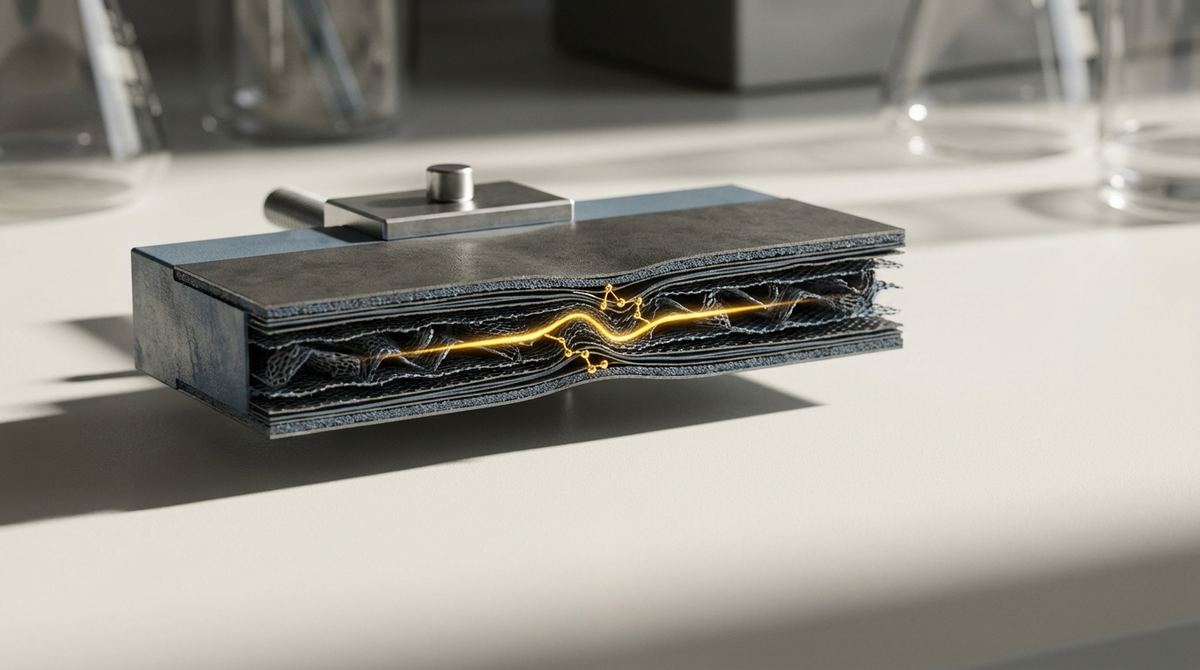
Imagine a material that does not simply bend or stretch when you touch it, but instead snaps suddenly from one shape to another, much like a pop-it toy or a metal spring. This behavior is not just a novelty; it is a way for a material to "remember" its configuration or act as a tiny, physical switch. In the world of nanotechnology, the ability to control these sudden transitions could lead to machines that operate without electricity, using only mechanical force to process information or sense changes in their environment. This research represents a fundamental leap in how we design "smart" materials by combining two of the most powerful substances known to science: graphene and carbon nanotubes.
Most materials we interact with every day are linear and predictable in their mechanical response. If you apply a certain amount of pressure to a rubber band, it stretches a certain amount; when you release the pressure, it returns to its original shape. This is a predictable, single-state behavior. While this is excellent for structural stability, it is quite limited for advanced computation or sensing. In the realm of micro-electronics and nano-machines, we need materials that can act like bits in a computer—having a clear "on" state and a "off" state.
The challenge lies in the fact that most materials do not possess this inherent bistability at a scale that is useful for engineering. Furthermore, as we shrink devices down to the nanoscale, the physical laws change, and the way forces are transmitted through a material becomes incredibly complex. Traditional engineering models that work for steel beams or plastic components fail when we reach the scale of individual molecules. Engineers need a way to bridge the gap between the movement of a single atom and the movement of a macroscale structural component. Without understanding how these tiny, atomic-level interactions translate into large-scale mechanical behavior, we cannot build the next generation of nano-electro-mechanical systems (NEMS).
The core concept explored in this study is the creation of a hybrid material that combines the two-dimensional strength of graphene with the one-dimensional resilience of carbon nanotubes. By mixing these two forms of carbon, the researchers aim to create a system that has a "double-well" energy landscape. To understand this, imagine a ball rolling in a landscape with two valleys separated by a hill. If the ball is in the first valley, it is stable. If you give the ball a push (applying force), it might roll over the hill and fall into the second valley. Once it is in that second valley, it will stay there even if you stop pushing.
This is what we call bistability. The material can exist in two distinct, stable physical states under the same conditions. The "hysteresis" mentioned in the research refers to the fact that the path taken to get from the first state to the second is not the same as the path taken to go back. This "memory" effect is the key to creating mechanical switches and sensors that are both incredibly small and extremely efficient.
To understand the mechanics of this system, we must look at the unique properties of its components. Graphene is a single layer of carbon atoms arranged in a hexagonal lattice, providing immense surface area and strength in a two-dimensional plane. Carbon nanotubes, on the other hand, are essentially sheets of graphene rolled into cylinders, providing one-dimensional structural reinforcement.
The research, led by a collaborative team including Mingda Ding, Nanami Sakurai, Man Shen, Taiki Inoue, Takahisa Matsuzaki, Takuo Mizuno, Kento Suzuki, John Isaac Enriquez, Harry Handoko Halim, Yuji Hamamoto, Yuta Nishina, and Hiroshi Y. Yoshikawa, focuses on how these two geometries interact. When graphene and carbon nanotubes are combined into a hybrid structure, they create a complex landscape of intermolecular forces, specifically van der Waals forces. These forces are the weak, short-range attractions that hold molecules together.
In this hybrid system, the graphene sheets can act as flexible membranes, while the carbon nanotubes act as structural supports or "spacers." As force is applied to the hybrid structure, the interaction between the sheets and the tubes changes. The sheets may bulge or buckle due to the presence of the tubes. This buckling is not a smooth, continuous motion. Instead, because of the specific way the nanotubes support the graphene, the system reaches a critical point where the current configuration becomes unstable, and the material "snaps" into a new, more stable configuration. This transition is driven by the energy stored in the distorted carbon bonds and the changing potential energy of the van der Waals interactions between the layers.
By utilizing advanced atomistic simulations, the researchers were able to trace this phenomenon from the level of individual atoms up to the macroscale structural response. One of the most significant findings is the direct correlation between the local atomic configuration and the global mechanical behavior of the hybrid material. The simulations revealed that the bistability is a direct consequence of the geometry of the hybrid arrangement.
The study demonstrated that by tuning the relationship between the graphene and the carbon nanotubes, one can control the specific force required to trigger the "snap" and the degree of hysteresis present in the system. The research highlights how the presence of nanotubes prevents the graphene from simply collapsing and instead guides it toward a secondary stable state. Furthermore, the simulations provided a way to see how the energy dissipation—the "lag" in the system's response—can be managed. This is critical because if a material takes too much energy to switch states, or if it loses too much energy during the switch, it becomes inefficient for practical use. The researchers successfully mapped how these tiny, atomic-level energy shifts culminate in a macroscale structural response that can be measured and utilized.
The implications of this research for the field of materials science and engineering are profound. First, it provides a blueprint for designing materials with "programmable" mechanical properties. Instead of searching for a material that naturally has certain properties, engineers can now theoretically design a hybrid carbon structure with a specific snapping force or a specific degree of hysteresis.
Second, this work bridges the gap between molecular dynamics and structural engineering. For a long time, these two fields were somewhat siloed. Understanding how to predict macroscale behavior from atomistic simulations allows for more accurate design of nano-scale devices. This reduces the need for expensive and difficult physical prototyping at the nanoscale, as engineers can simulate the mechanical "logic" of a material before ever attempting to build it.
Finally, the existence of bistability in a carbon-based hybrid system opens the door to mechanical computing. If we can create materials that switch between states with minimal energy input and high reliability, we can move toward a type of "mechanical logic" that is far more energy-efficient than current electronic systems, which generate significant heat due to electron resistance.
While the results are groundbreaking, it is important to distinguish between successful atomistic simulations and a commercially ready product. The research presented is primarily based on computational models, which are highly sophisticated but still represent an idealized version of the world. In a simulation, the atoms are often perfectly placed, and the environment is controlled.
In the real world, several challenges remain. Manufacturing these hybrid systems with atomic precision is an immense hurdle. If a single carbon nanotube is out of place, or if the graphene sheets have unintended defects, the bistability might disappear or become unpredictable. Furthermore, the transition from a simulated "atomistic" model to a "macroscale" structural component requires scaling up the material significantly. Scaling up often introduces new variables, such as material impurities, thermal expansion, and environmental degradation, which were not the primary focus of this specific study. Real-world testing in varying temperatures and pressures will be essential to see if the bistability remains stable outside of a controlled computational environment.
The potential applications for graphene-CNT hybrid systems are diverse. In the field of NEMS (Nano-Electro-Mechanical Systems), these materials could serve as ultra-sensitive pressure sensors or tiny mechanical switches that trigger at a precise threshold. This could lead to a new generation of sensors for medical implants, where the material could respond to biological changes through a physical mechanical snap.
In robotics, these materials could be used to create "smart skins." These skins could provide tactile feedback or even allow the robot to change its shape slightly in response to external stimuli, mimicking the way biological tissues respond to pressure. Additionally, in the realm of data storage, the bistable nature of these hybrids suggests a future where information is stored mechanically rather than electronically. A "bit" could be represented by the physical orientation of a microscopic graphene-CNT structure, offering a method of storage that is potentially much more durable and energy-efficient than current magnetic or flash-based memory.
If there is one takeaway from this complex research, it is that the combination of different carbon structures—the 2D sheet and the 1D tube—creates entirely new mechanical behaviors, such as bistability and hysteresis, that neither material possesses on its own. This synergy allows us to design materials that can "remember" their shape and act as mechanical switches at the molecular scale.
What is the fundamental difference between graphene and carbon nanotubes?
Graphene is a two-dimensional material consisting of a single layer of carbon atoms arranged in a flat, hexagonal lattice. In contrast, carbon nanotubes are one-dimensional structures that are formed by rolling a graphene sheet into a cylinder. This difference in dimensionality is crucial because the flat surface of graphene interacts with the cylindrical shape of the nanotubes to create the unique energy landscapes needed for bistability.
Why is bistability considered a desirable property in materials science?
Bistability allows a material to exist in two different, stable physical states under the same external conditions. This is highly desirable because it allows a material to act as a switch or a piece of memory. Once the material is pushed from one state to another, it stays in that new state without needing a constant application of force, which is essential for creating efficient, low-power sensors and mechanical logic gates.
How does hysteresis affect the performance of a smart material?
Hysteresis is the phenomenon where the state of a material depends on its history, meaning it does not follow the same path when being loaded as it does when being unloaded. In the context of smart materials, hysteresis can be used to create a "memory" effect, but too much hysteresis can also mean that energy is lost as heat during each cycle. Controlling the amount of hysteresis is vital for making these materials efficient for high-speed or high-frequency applications.
Can these hybrid materials be used in everyday electronic devices?
While the research is exciting, these materials are currently in the research and simulation phase. Using them in everyday electronics would require new manufacturing techniques that can place carbon nanotubes and graphene sheets with perfect precision at a massive scale. Currently, they are more suited for specialized applications in nanotechnology, such as NEMS or advanced sensors, rather than general-purpose consumer electronics.
How do researchers study things as small as atoms?
Scientists use a method called atomistic simulation, often involving molecular dynamics. This involves using powerful computers to apply the laws of physics to every single atom in a model. By simulating how these atoms move and interact, researchers can predict how a large-scale structure will behave, allowing them to test ideas that would be nearly impossible or too expensive to test in a physical laboratory.
This research points toward a practical lesson: graphene-based materials are most powerful when their nanoscale properties are connected to a clear engineering problem. The result is not a finished commercial product by itself, but it gives researchers and manufacturers a better map for designing lighter, more sensitive, or more durable systems. Future work still needs testing under real operating conditions, but the direction is promising because it joins materials science with application-driven design.
Serious about B2B integration? Test our premium Pulsed Electrical Resistive Carbon Heating turbostratic graphene in your lab. 100g sample packs available now.
Explore More
Build a flexible graphene battery sensor for real-time temperature and strain monitoring, a crucial step toward preventing thermal runaway in Li-ion cells.

Research on 30° quasi-periodic twisted bilayer graphene reveals a unique, fractal-like energy structure under magnetic fields, paving the way for novel...

Researchers discover naturally formed graphene sheets and carbon ovals in stingless bee hives, creating a novel emergent material with powerful blue light...