
Rippled Graphene Pores for Neuromorphic Fluidic Memristive Devices
Discover how rippled graphene pores act as fluidic memristors, enabling advanced synaptic functionalities for the next generation of neuromorphic computing.
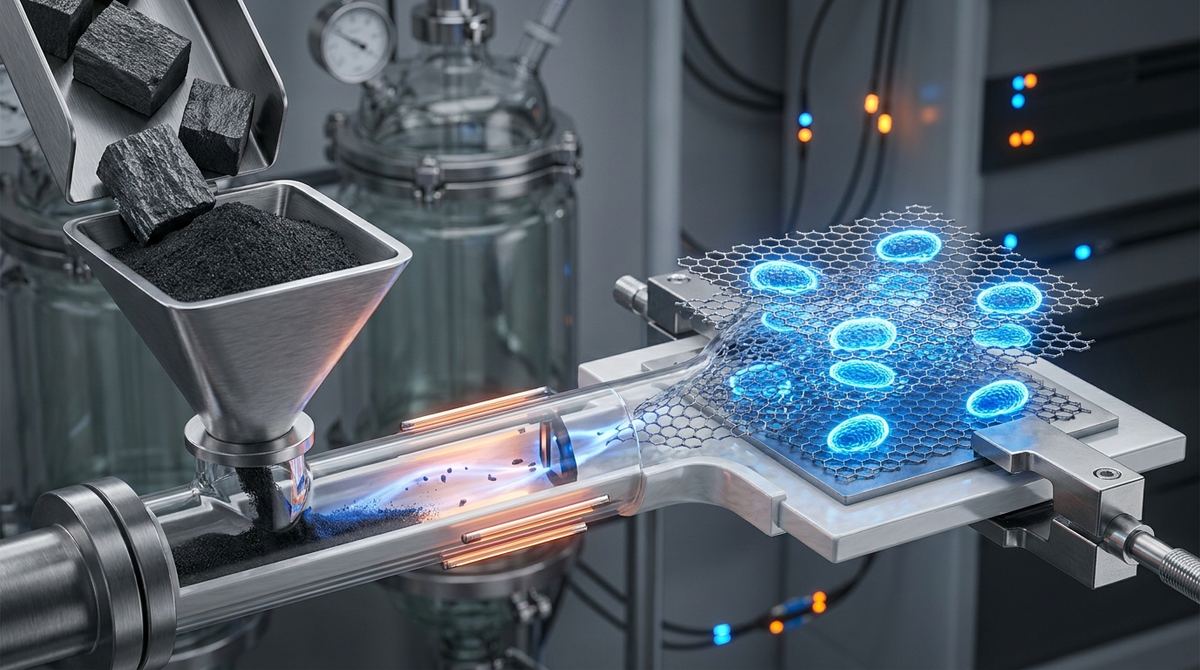
Nature often serves as the ultimate inspiration for scientific advancement, but rarely does it hand us a finished product. We study the intricate structure of a lotus leaf to design water-repellent surfaces or mimic the strength of spider silk for advanced fibers. It is far more unusual to find a cutting-edge nanomaterial, one that scientists have spent decades learning to synthesize in high-tech laboratories, already existing inside a common biological structure. Yet, a recent discovery points to exactly that, finding the building blocks of next-generation electronics hidden within the humble architecture of a stingless bee hive.
The modern materials science landscape is dominated by a dual challenge: performance and sustainability. Creating materials like graphene with exceptional electronic and mechanical properties often requires complex, energy-intensive processes. These methods can involve high temperatures, harsh chemicals, and sophisticated vacuum chambers, all of which contribute to high costs and a significant environmental footprint. There is a global push to develop greener, more scalable methods for producing high-performance materials. Alongside this manufacturing challenge is a specific technological hurdle in the field of optoelectronics: the quest for better blue light emitters. Blue light is a fundamental component of full-color displays and white LED lighting. However, creating materials that emit pure, stable, and efficient blue light is notoriously difficult. Many existing materials are expensive, rely on rare-earth elements, or degrade over time. The search for a low-cost, durable, and ideally biocompatible blue-emitting material is a critical goal for advancing everything from screen technology to medical imaging.
In a fascinating intersection of biology and materials science, researchers Manas Kumar Dalai, Ankita Mahakhuda, and Abinash Prusty turned their attention to an unlikely source: the hive of the stingless bee. They investigated the composition of cerumen, the dark, resinous material these bees use to build their homes. This substance is a complex mixture of beeswax and plant resins collected by the bees. The core idea was that the unique chemical environment within the hive, combined with the bees' metabolic processes, might act as a natural reactor, transforming these raw organic materials into novel carbon structures. Their investigation proved this hypothesis correct in a spectacular fashion. They discovered that the bee hive material contained not only sheets of few-layer graphene but also unique carbon-rich micro-oval structures. Most surprisingly, when this natural composite material was exposed to ultraviolet light, it glowed with a bright, stable blue light, a property not found in the raw materials themselves.
The phenomenon observed by the researchers is an example of an emergent property, where the whole is greater than the sum of its parts. The blue emission does not come from beeswax or plant resin alone, nor is it a typical property of large-sheet graphene. Instead, it arises from the unique nanostructure created within the hive. The process likely begins with the bees collecting plant resins, which are rich in complex organic molecules like terpenes and flavonoids. Inside the hive, these resins are mixed with beeswax and processed. Over time, these organic precursors undergo a slow, low-temperature transformation, a kind of natural pyrolysis or carbonization. This process appears to form two distinct carbon structures: atomically thin sheets of graphene and amorphous, carbon-dense micro-ovals. The blue light emission itself is a process called photoluminescence. When the material absorbs high-energy photons, such as those from a UV lamp, electrons within its unique structure are kicked into a higher energy state. They cannot remain in this excited state for long and quickly fall back to their original level. As they fall, they release the excess energy as a photon of light. The specific color of this emitted light, in this case blue, is determined by the precise energy gap between the excited and ground states. This energy gap is a direct consequence of the material's quantum-scale structure, likely stemming from quantum confinement effects in nanoscale graphene domains or specific defect states within the carbon composite.
The research team employed a suite of advanced characterization techniques to analyze the bee hive cerumen. Using transmission electron microscopy (TEM), they were able to directly visualize the material's nanoscale architecture, identifying the unmistakable lattice structure of few-layer graphene sheets interspersed with the newly discovered carbon micro-ovals. Raman spectroscopy, a powerful technique that uses light scattering to identify molecular vibrations, confirmed the presence of graphene. The resulting spectra showed the characteristic D, G, and 2D bands that serve as a fingerprint for graphitic carbon. The G peak confirmed the presence of sp2-hybridized carbon atoms arranged in a hexagonal lattice, the very definition of graphene, while the 2D peak's shape indicated that the material consisted of only a few atomic layers. The most significant finding, however, came from photoluminescence spectroscopy. When the cerumen sample was irradiated with UV light at a wavelength of 350 nanometers, it exhibited a strong and narrow emission peak centered at 438 nanometers. This wavelength falls squarely in the blue portion of the visible spectrum. This debut of blue emission from a biogenic source represents the core discovery of the paper, demonstrating that a natural process can yield a material with highly desirable optical properties relevant to advanced graphene electronics.
This discovery is profound for several reasons. Firstly, it introduces a new paradigm for materials synthesis known as biogenesis. It proves that complex, functional nanomaterials like graphene can be formed under ambient conditions in a biological system. This opens up an entirely new research avenue for developing environmentally benign and cost-effective graphene manufacturing techniques. Instead of building materials from the atom up in a lab, we may learn to harness and replicate nature's own gentle chemistry. Secondly, the emergence of blue photoluminescence in a carbon-based, biocompatible material is a significant breakthrough. Carbon nanomaterials that glow, often called carbon quantum dots, are a major focus of research, but achieving strong, stable emission in the blue spectrum is a persistent challenge. That a naturally occurring composite exhibits this property so clearly is remarkable. It offers a potential alternative to the heavy-metal-based quantum dots and complex organic dyes currently used in applications like bio-imaging, which often raise concerns about toxicity.
While this discovery is exciting, it is very much the first step on a long road. The paper documents the existence of this material and its properties but leaves many critical questions unanswered. A primary limitation is the lack of understanding of the precise formation mechanism. Is it a specific enzyme from the bees, a unique chemical in the plant resin, or simply a slow aging process in the hive environment? Without this knowledge, replicating the process in a lab for large-scale production is impossible. Furthermore, the material's performance metrics have yet to be quantified. The researchers observed blue light, but they have not yet reported the quantum yield, which measures the efficiency of the light emission. It is crucial to know how this natural material's efficiency compares to synthetic emitters. Consistency is another major unknown. Would the material from a different hive, a different bee species, or a different geographical location with different flora have the same properties? Extensive testing is needed to determine the stability, purity, and reproducibility of this biogenic graphene composite before any practical applications can be seriously considered.
Despite the need for further research, the potential applications for a biocompatible, blue-emitting carbon material are vast and transformative. In the medical field, it could be used to create non-toxic fluorescent probes for cellular imaging and diagnostics, allowing doctors to track biological processes in real-time without harming healthy tissue. The field of biomedical nanomaterials would benefit greatly from such a discovery. In consumer electronics, this material could form the basis for pixels in next-generation OLED displays, potentially leading to screens that are cheaper, more energy-efficient, and made from sustainable resources. Its unique optical properties could also be harnessed for security applications, such as creating anti-counterfeiting inks that are invisible in normal light but glow blue under a UV scanner. Finally, the material's fluorescence could be sensitive to its chemical environment, opening the door to developing highly sensitive and selective graphene sensors for detecting pollutants or specific biological molecules.
If you take away just one insight from this work, let it be this: Scientists have discovered that the resinous material from a stingless bee hive naturally contains a composite of graphene and other carbon nanostructures. This remarkable bio-inspired material has the emergent property of emitting a strong blue light, potentially paving the way for a new generation of sustainable and non-toxic materials for electronics, sensors, and medicine.
What did scientists find in the bee hive?
Scientists analyzed the dark, waxy material, called cerumen, that stingless bees use to build their hives. They discovered that it contained atomically thin sheets of graphene, a highly advanced nanomaterial, along with unique carbon-rich oval structures. This natural composite was found to have surprising and useful electronic properties.
Why is finding graphene in a bee hive so unusual?
Graphene is typically synthesized in highly controlled laboratory environments using methods that require high temperatures, vacuum conditions, or strong chemicals. Finding it formed within a biological system at ambient temperatures is extraordinary. It suggests that nature has developed a gentle, low-energy pathway to create a material we considered purely synthetic.
What is special about a material that emits blue light?
Blue light is one of the three primary colors needed to create full-color digital displays and efficient white light. However, materials that can emit pure and stable blue light are often difficult and expensive to produce. Discovering a new, carbon-based, and potentially sustainable material with this property is a significant step toward better and cheaper optoelectronic technologies.
Is this material ready to be used in my phone screen?
No, not yet. This is a fundamental discovery, not a market-ready product. Researchers have identified the material and its key property, but much more work is needed to understand how to produce it consistently, measure its efficiency and durability, and scale up its production before it could ever be integrated into a commercial device.
How could this discovery lead to more sustainable technology?
Current methods for producing nanomaterials can be energy-intensive and generate chemical waste. By studying how bees create these carbon structures from natural resins, scientists may learn to replicate the process. This could lead to new, bio-inspired manufacturing methods that are far greener, cheaper, and more sustainable than today's industrial techniques.
The discovery of graphene and a blue-emitting carbon composite in the hive of a stingless bee is a powerful testament to the untapped secrets held within the natural world. It blurs the lines between biology and materials science, presenting a compelling case for biogenesis as a future manufacturing platform. While the journey from this initial finding to a real-world application is long and requires significant further investigation, the work of Dalai, Mahakhuda, and Prusty provides an inspiring new direction. It reminds us that nature is the original nanotechnologist, and by studying its subtle processes, we may find the solutions to our most pressing technological and environmental challenges.
Serious about B2B integration? Test our premium Pulsed Electrical Resistive Carbon Heating turbostratic graphene in your lab. 100g sample packs available now.
Explore More
Discover how rippled graphene pores act as fluidic memristors, enabling advanced synaptic functionalities for the next generation of neuromorphic computing.

Learn how to use electromechanical responses in gapped graphene to measure electronic temperature and band gaps using traveling flexural waves.

Explore how researchers have discovered viscous electron fluid behavior in cadmium, a breakthrough that could revolutionize the future of nanoelectronics.