
Practical Guide: Characterizing Gapped Graphene via Electromechanical Anomaly Response
Learn how to use electromechanical responses in gapped graphene to measure electronic temperature and band gaps using traveling flexural waves.
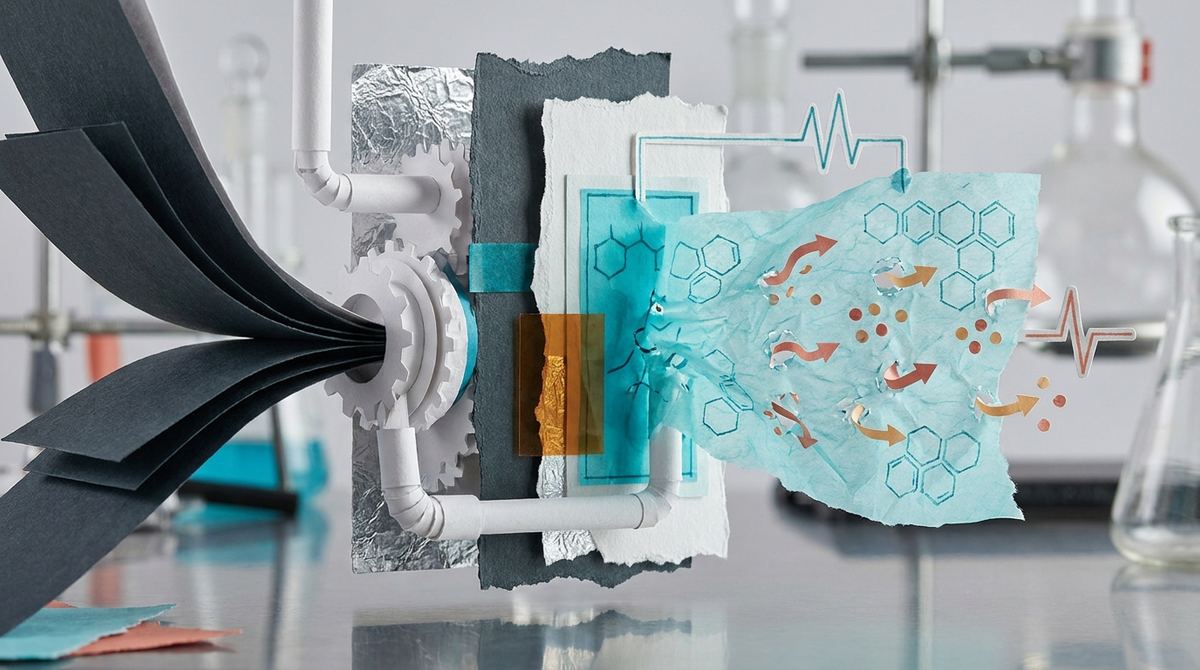
Imagine a computer that does not just calculate numbers like a standard machine, but actually learns and adapts much like a human brain. For decades, engineers have struggled to break away from the traditional way computers process information, which relies on a rigid separation between the memory where data is stored and the processor that acts on it. This separation creates a massive energy drain and a speed bottleneck. In the biological world, our neurons and synapses perform these tasks simultaneously, using chemical and electrical signals that change over time based on experience. This breakthrough research explores a way to bridge the gap between biological intelligence and silicon-based hardware by using the unique physical properties of graphene to create artificial synapses.
The core challenge in modern computing is the von Neumann bottleneck. In a conventional computer architecture, data must constantly travel back and forth between the central processing unit and the memory unit. As we demand more complex artificial intelligence and faster processing, this movement of data consumes the majority of a system's energy and creates a massive delay. To solve this, researchers are looking toward neuromorphic computing, which seeks to design hardware that mimics the structure and function of the human brain.
To achieve true neuromorphic functionality, we need devices called memristors. A memristor is a two-terminal electronic component that acts as a resistor with memory; its electrical resistance changes depending on the history of the current that has passed through it. This ability to "remember" is what allows a network of these components to simulate the plasticity of a biological synapse, where the connection between two neurons strengthens or weakens based on activity. While solid-state memristors exist, they often face issues with stability and the difficulty of mimicking the fluid-based chemical signaling found in biological systems. There is a growing need for devices that can combine the precision of electronics with the fluidic, electrochemical nature of biological life.
The researchers, including Wenzhe Zhou, Dongjiao Ge, Ao Zhang, Jincheng Xu, Yu Ji, Yiran Gong, Wenchang Zhang, Jidong Li, Li Lin, Zhiping Xu, and Pengzhan Sun, have proposed a novel solution using a specific structural configuration of graphene. Instead of using a flat, continuous sheet of graphene, they focus on a membrane that features both nanopores and intentional ripples.
The idea is to use these pores as channels for fluidic movement. As ions move through these pores, the physical structure of the graphene—specifically the ripples around the holes—influences how those ions are distributed and how they behave under an electric field. By controlling the shape of the graphene, the researchers can control the movement of ions, effectively creating a device where the electrical resistance can be tuned by the flow of liquid. This creates a "fluidic memristor" that behaves like a biological synapse, changing its conductance based on the history of the ion flow, which is the fundamental requirement for machine learning in hardware.
To understand why this system works, one must look at the intersection of nanofluidics and the unique mechanics of two-dimensional materials. Graphene is not always a perfectly flat surface; when it is suspended or integrated into a device, it naturally develops ripples due to thermal fluctuations or the tension applied during manufacturing. When these ripples are strategically placed around nanopores, they create a complex energy landscape.
When an electric field is applied across the graphene membrane, ions in the surrounding fluid begin to migrate. In a perfectly flat membrane, the ions might move uniformly. However, in this rippled architecture, the curvature of the graphene alters the local electrostatic environment. The ripples create regions of concentrated electric fields at the edges of the pores. These localized fields act as control mechanisms, guiding the ions through the pores in a way that is not easily reversed.
As the ions move through the pores, they change the local ionic concentration and the electrical double layer at the graphene interface. Because the ripples dictate the pathways and the intensity of the electrical interaction, the device can achieve a state of "memristance." The resistance of the device becomes a function of the amount of ion transport that has occurred in the past. This is a highly sophisticated way of encoding information. Instead of storing a bit as a high or low voltage, the information is stored in the physical distribution and history of ion flow through the nanopores. This mechanism allows for a continuous range of resistance levels, much like the varying strength of a biological synapse.
The study demonstrated that these rippled graphene pores are capable of exhibiting essential synaptic functionalities. One of the most critical findings was the demonstration of synaptic plasticity. In neuroscience, plasticity refers to the ability of a synapse to change its strength in response to increases or decreases in activity. The researchers found that by applying specific voltage pulses, they could simulate the strengthening (potentiation) and weakening (depression) of the device's conductance.
Furthermore, the system showed evidence of spike-timing-dependent plasticity, a specific biological learning rule where the timing of electrical pulses determines whether a connection is strengthened or weakened. This is a cornerstone of how the brain learns patterns and associations. The ability of a hardware device to mimic this specific temporal behavior is a massive step forward for neuromorphic engineering. The researchers were able to show that the device does not just switch between two states, but can transition through many intermediate states of conductance, which is necessary for the complex, multi-layered learning required by advanced neural networks. This makes the device highly suitable for implementing complex algorithms directly into the hardware, rather than simulating them through software.
This research is significant because it offers a path toward highly efficient, bio-inspired computing. Traditional digital computers are inherently inefficient at certain types of tasks, such as pattern recognition, sensory processing, and real-time adaptation, because these tasks are naturally parallel and continuous in the brain. By using fluidic memristors, we move closer to hardware that can process information with the same elegance and energy efficiency as a biological organism.
The integration of fluidics into electronic components also opens new avenues for cross-disciplinary research. For example, the ability to control ion flow with such precision could lead to new types of /applications/ in highly sensitive chemical sensing or even biological interfaces. As we move toward the edge of the network—where AI must live on small, battery-powered devices like drones, wearables, or remote sensors—the energy savings provided by neuromorphic hardware becomes a primary requirement. A device that processes information using ion-flow memristance could potentially operate at a fraction of the power required by current silicon-based AI accelerators.
While the results are promising, several significant engineering hurdles remain before this technology can be integrated into consumer electronics. One primary concern is the stability and longevity of the fluidic environment. In a laboratory setting, controlling the purity and concentration of the liquid is relatively straightforward, but in a commercial device, maintaining a consistent ionic environment over years of operation is a major challenge.
Furthermore, the scalability of manufacturing such precise, rippled graphene structures with consistent pore placement is a daunting task. While /blog/category/graphene-production/ techniques are advancing rapidly, achieving the level of structural perfection required for reliable, mass-produced memristive devices requires extreme precision. There is also the question of integration; combining fluidic components with existing CMOS (complementary metal-oxide-semiconductor) technology, which is the standard for modern electronics, requires complex packaging and new manufacturing paradigms. Finally, the speed of ion-based processing, while efficient, may currently be slower than the electron-based switching used in traditional high-performance computing, meaning the trade-off between energy efficiency and raw speed must be carefully optimized.
The potential applications for rippled graphene memristive devices are vast and span multiple industries. In the field of artificial intelligence, these devices could be used to create "neuromorphic chips" that are capable of on-device learning. This would allow a device to learn from its environment in real-time without needing to send data back to a central cloud server, significantly improving privacy and reducing latency.
In the realm of /blog/category/biomedical/ research, these fluidic memristors could serve as the basis for advanced biosensing platforms. Because they are naturally sensitive to ion concentration and movement, they could be used to detect extremely subtle changes in biological fluids, such as blood or sweat, providing a level of sensitivity that current electronic sensors cannot match. Additionally, the ability to mimic synaptic behavior could lead to the development of brain-machine interfaces that communicate with biological neurons using similar electrochemical principles, creating a more seamless connection between human thought and digital systems. Finally, in /blog/category/water-environment/ monitoring, these devices could be used in highly sophisticated nanofluidic filtration sensors to monitor water quality in real-time at the molecular level.
If you take away only one thing from this research, let it be this: the future of computing may not be found in faster transistors, but in better mimicry of the brain. By using the unique physical structure of rippled graphene to control the movement of ions, scientists are creating a way for hardware to "remember" and "learn" through fluidic changes, paving the way for a revolution in energy-efficient, intelligent machines.
What is a memristor and why is it important for AI?
A memristor is a component that changes its electrical resistance based on the amount of charge that has passed through it in the past. This "memory" allows the device to act like a biological synapse. In artificial intelligence, this is important because it allows us to build hardware that can learn and store information locally, rather than relying on a separate memory unit, which saves a huge amount of energy and increases speed.
Why is graphene the preferred material for this research?
Graphene is a single layer of carbon atoms that is incredibly strong, flexible, and possesses unique electrical properties. Because it is so thin, it is highly sensitive to its environment. Its ability to form ripples and support nanopores makes it an ideal candidate for creating the complex, structured landscapes needed to control the flow of ions for fluidic memristive devices.
What does "neuromorphic computing" actually mean?
Neuromorphic computing refers to a method of designing computer hardware that mimics the architecture and functions of the human nervous system. Instead of using the standard binary logic (0s and 1s) used by traditional computers, neuromorphic systems use components like artificial neurons and synapses to process information in a way that is much more parallel and efficient for tasks like pattern recognition and learning.
How do the "ripples" in the graphene help the device function?
The ripples in the graphene sheet create variations in the local electric field. When ions move through the pores in the membrane, these localized fields influence how the ions are distributed. This influence ensures that the electrical resistance of the device changes in a way that depends on the history of the ion movement, which is the essential mechanism that allows the device to act as a memristor.
Is this technology ready for use in my smartphone or laptop?
Currently, no. This research is in the fundamental scientific stage. While the concept is highly promising, there are many engineering challenges to overcome, such as ensuring the long-term stability of the liquid inside the device, scaling up the manufacturing of these precise graphene structures, and finding ways to integrate these fluidic components with existing electronic manufacturing processes.
This research points toward a practical lesson: graphene-based materials are most powerful when their nanoscale properties are connected to a clear engineering problem. The result is not a finished commercial product by itself, but it gives researchers and manufacturers a better map for designing lighter, more sensitive, or more durable systems. Future work still needs testing under real operating conditions, but the direction is promising because it joins materials science with application-driven design.
For related commercial context, explore graphene drug delivery and water desalination membranes.
Serious about B2B integration? Test our premium Pulsed Electrical Resistive Carbon Heating turbostratic graphene in your lab. 100g sample packs available now.
Explore More
Learn how to use electromechanical responses in gapped graphene to measure electronic temperature and band gaps using traveling flexural waves.

Explore how researchers have discovered viscous electron fluid behavior in cadmium, a breakthrough that could revolutionize the future of nanoelectronics.

Discover how helical multilayer graphene creates supermoiré patterns that allow researchers to control electron valley topology for future nanoelectronics.