
Nature's Nanotech: Graphene and Blue Emission Found in Bee Hives
Researchers discover naturally formed graphene sheets and carbon ovals in stingless bee hives, creating a novel emergent material with powerful blue light...
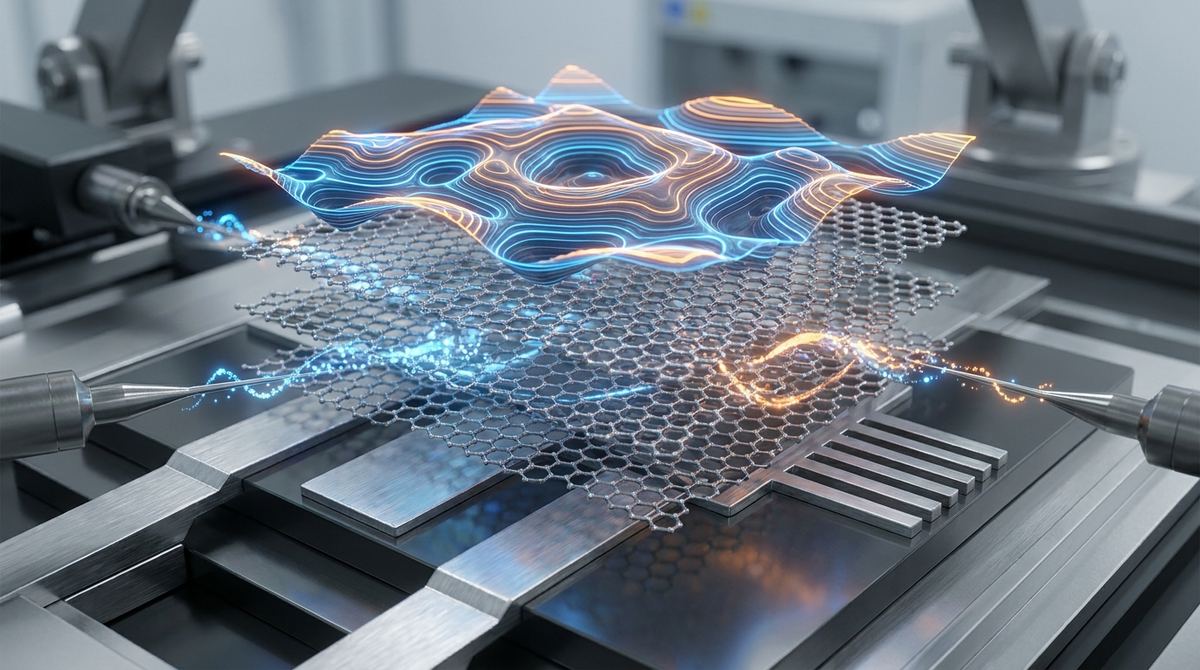
Imagine a material that is not just a conductor of electricity, but a conductor that possesses a sense of direction, much like how a screw turns either clockwise or counter-clockwise. This concept of handedness, or chirality, is a fundamental principle in physics that can dictate how particles behave and interact. While we are accustomed to materials that simply allow current to flow, researchers are now looking toward engineered materials that can host entirely new states of matter. By stacking single layers of carbon atoms in very specific, non-standard patterns, scientists are discovering that they can create electronic environments where the rules of standard physics are rewritten. This research, involving a team of experts including Sandesh S. Kalantre, Ben H. Alexander, Julian May-Mann, Jonah Herzog-Arbeitman, Marisa Hocking, Qingrui Cao, Kenji Watanabe, Takashi Taniguchi, David Goldhaber-Gordon, Andrew J. Mannix, Trithep Devakul, and Yves H. Kwan, explores how these precisely arranged layers of graphene can support a phenomenon known as chiral superconductivity.
In the search for the next generation of quantum technologies, the primary obstacle is decoherence. Quantum information is incredibly fragile; it is easily disrupted by heat, magnetic fields, or even the slight vibration of a nearby atom. To build a truly scalable quantum computer, we need materials that can protect quantum information through their very structure. Standard superconductors, which allow electricity to flow with zero resistance, are useful for many things, but they do not inherently possess the topological properties needed to protect quantum information from noise.
Furthermore, the quest to discover new forms of superconductivity is a race against complexity. For decades, scientists have looked for materials that can superconduct at higher temperatures or exhibit more exotic behaviors. Most known superconductors follow standard pairing mechanisms where electrons pair up in a way that is symmetric and predictable. However, the scientific community is increasingly interested in unconventional superconductors—materials where the electron pairing is more complex and breaks certain fundamental symmetries. Finding and understanding these materials requires a way to manipulate the electronic landscape of a material with extreme precision, a task that is difficult with traditional bulk crystals.
The core idea behind this research is that the way you stack layers of a material can completely change how electrons behave inside it. Graphene is famous for being a single layer of carbon atoms, but when you stack multiple layers on top of one another, the physics changes dramatically depending on the orientation of those layers. This research focuses on a specific arrangement called rhombohedral stacking. In this configuration, the atoms are shifted in a way that creates a very specific electronic environment.
In this environment, scientists have observed evidence of a candidate chiral superconductor. In a normal superconductor, electrons pair up in a way that looks the same if you look at it in a mirror. In a chiral superconductor, the electron pairing has a "handedness." This chirality is not just a curiosity; it is a topological property. This means the state of the material is tied to its geometric shape in a way that makes it much more robust against local errors. If we can master these materials, we could create components for quantum computers that are naturally shielded from the environment, potentially solving the problem of decoherence.
To understand how this system works, we must look at the relationship between the atomic structure and the electronic band structure. In a single layer of graphene, electrons behave like particles that have no mass, moving through the crystal lattice in a very specific way. When we stack four layers of graphene—making it a tetralayer—the interaction between the layers becomes the dominant force.
In rhombohedral stacking, the layers are arranged in an ABC sequence. This specific geometry causes the electronic energy levels to become very "flat." In physics, a flat band means that the electrons have very little kinetic energy, meaning they are not moving rapidly through the material. Because these electrons are moving slowly, they spend more time near each other, which significantly increases the strength of the interactions between them. When the interaction between electrons is strong enough, they overcome their natural repulsion and form Cooper pairs, which is the fundamental requirement for superconductivity.
The researchers use a technique called electrostatic gating to tune the system. By applying a voltage through a gate electrode, they can control the density of the electrons and move the Fermi level—the energy boundary that separates occupied from unoccupied electron states—directly into this flat band. By precisely controlling this voltage, they can switch the material between a normal state and a superconducting state. This ability to tune the material is a direct result of the high surface-to-volume ratio and the extreme sensitivity of the electronic states in thin-film heterostructures.
The researchers focused on the fermiology of this rhombohedral tetralayer graphene. Fermiology is the study of the Fermi surface, which is essentially a map in momentum space that shows which electronic states are occupied. The shape and topology of the Fermi surface are critical because they dictate the electronic and transport properties of the material. If the Fermi surface has a certain shape, it can force the electrons into a specific pairing symmetry, such as the chiral state.
By mapping this fermiology, the team was able to observe how the electronic structure responds to external influences. They found evidence of a candidate chiral superconducting state. This means that the electronic pairing in these tetralayer systems appears to break time-reversal symmetry, which is the hallmark of chirality. The research provides a detailed map of how the electronic density of states is distributed, confirming that the rhombohedral stacking indeed produces the unique electronic conditions necessary for such exotic physics to emerge. This mapping is a vital step in proving that these materials can be used as a platform for topological quantum matter.
This discovery is significant because it moves us closer to the realization of topological quantum computing. In a topological superconductor, the ends of a one-dimensional structure or the edges of a two-dimensional surface can host Majorana fermions. These are unique particles that are their own antiparticles. Because these particles are tied to the topology of the material, they are "protected." If a small piece of dust or a change in temperature hits the material, the quantum information held by a Majorana fermion remains intact because the topology of the entire system hasn't changed.
Furthermore, this research demonstrates the power of "van der Waals heterostructures" as a playground for materials science. We are no longer limited to the materials that occur naturally in the earth's crust. We can now engineer materials layer by layer, atom by atom, to create specific electronic properties. The ability to create a chiral superconductor in a graphene-based system provides a blueprint for designing new quantum-functional materials that do not exist in nature.
While these results are exciting, it is important to maintain a sense of scientific caution. The superconductivity observed is a "candidate" state, meaning that while the evidence points toward chirality, more rigorous testing is required to definitively rule out other types of unconventional superconductivity. The current observations are made under extreme conditions, specifically at temperatures near absolute zero (milli-Kelvin range), which is far from the room-temperature conditions required for commercial technology.
Additionally, the samples used in this research are incredibly small and fragile. Creating perfectly aligned rhombohedral tetralayer graphene requires advanced nanofabrication techniques that are currently only possible in highly specialized laboratories. Scaling this up from a microscopic flake to a macroscopic industrial component is a massive engineering challenge that remains unsolved. We do not yet know how these materials will behave when they are integrated into complex, large-scale electronic circuits.
The long-term engineering relevance of this research lies in the field of quantum information processing. If chiral superconductivity can be harnessed, it could lead to the development of "topological qubits." Unlike current superconducting qubits used by companies like IBM or Google, which are prone to errors, topological qubits would be inherently more stable, potentially allowing for much larger and more complex quantum computers.
Beyond quantum computing, these materials could find applications in ultra-sensitive sensing. Because the electronic states in rhombohedral graphene are so sensitive to external fields, they could be used to create next-generation magnetometers or sensors capable of detecting the smallest possible magnetic fluctuations. This could have implications for medical imaging, where higher sensitivity leads to better resolution, and in geological surveys, where detecting minute magnetic anomalies is key to finding mineral deposits.
If you remember only one thing from this research, let it be this: by precisely controlling the stacking order of graphene layers, we can create entirely new states of matter with "handedness" (chirality) that could provide the stability needed for the future of quantum computing.
Question: What exactly is graphene?
Answer: Graphene is a single layer of carbon atoms arranged in a hexagonal lattice. It is often described as a two-dimensional material because its properties are essentially confined to a plane, making it incredibly thin but remarkably strong and conductive.
Question: Why does the stacking order matter so much?
Answer: The way layers are stacked changes how the electronic wavefunctions overlap. In some arrangements, like rhombohedral stacking, this overlap creates a "flat band" where electrons move slowly and interact more strongly, which is essential for creating exotic states like superconductivity.
Question: What is the difference between a normal superconductor and a chiral one?
Answer: A normal superconductor is symmetric; it doesn't care about left or right. A chiral superconductor has a specific "handedness" in how its electrons pair up, which breaks certain symmetries and can protect quantum information from being lost to environmental noise.
Question: Why do scientists need to study the "Fermi surface"?
Answer: The Fermi surface is like a map of the highest energy levels occupied by electrons. Knowing the shape of this surface tells physicists exactly how the material will conduct electricity and what kind of exotic behaviors, like superconductivity, might emerge.
Question: Is this technology going to be in our devices soon?
Answer: Probably not in the near future. The research is currently in the fundamental science stage, meaning we are still learning how these materials behave in highly controlled laboratory settings at extreme temperatures. It is a long road from a laboratory discovery to a consumer product.
The research conducted by Kalantre, Alexander, May-Mann, and their colleagues represents a significant leap in our understanding of the complex relationship between atomic structure and quantum phenomena. By investigating the fermiology of rhombohedral tetralayer graphene, they have provided a potential pathway toward discovering and utilizing chiral superconductivity. While significant engineering hurdles remain before these materials can be used in practical applications, the ability to engineer the very laws of electron behavior through precise stacking offers a profound new tool for the future of materials science and quantum technology.
Serious about B2B integration? Test our premium Pulsed Electrical Resistive Carbon Heating turbostratic graphene in your lab. 100g sample packs available now.
Explore More
Researchers discover naturally formed graphene sheets and carbon ovals in stingless bee hives, creating a novel emergent material with powerful blue light...

Discover how rippled graphene pores act as fluidic memristors, enabling advanced synaptic functionalities for the next generation of neuromorphic computing.

Learn how to use electromechanical responses in gapped graphene to measure electronic temperature and band gaps using traveling flexural waves.