
Nature's Nanotech: Graphene and Blue Emission Found in Bee Hives
Researchers discover naturally formed graphene sheets and carbon ovals in stingless bee hives, creating a novel emergent material with powerful blue light...
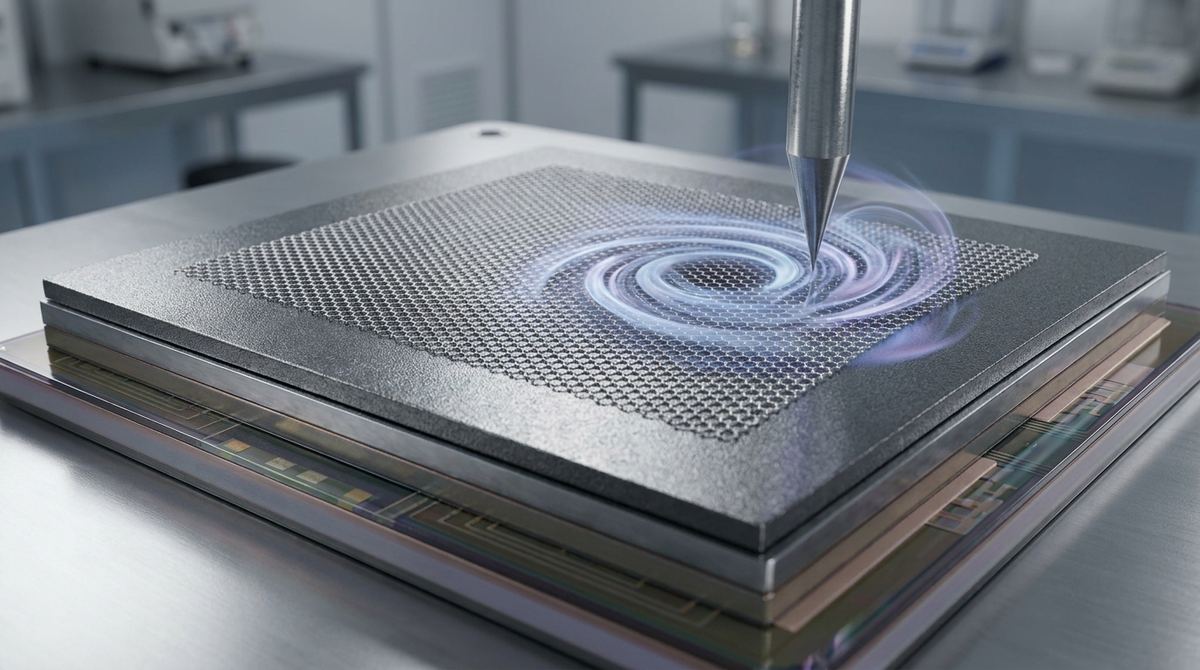
Imagine a computer that never makes a mistake. While that sounds like science fiction, it is the ultimate goal of quantum computing. Currently, quantum computers are incredibly fragile. The slightest vibration, a tiny change in temperature, or a stray bit of electromagnetic noise can cause the quantum information to vanish instantly. This phenomenon is known as decoherence, and it is the single biggest hurdle preventing us from building a practical, large-scale quantum computer. Scientists are searching for a way to "lock" quantum information so that it becomes immune to this environmental noise. The answer may lie in the strange, swirling world of topological physics, where information is not stored in a single particle, but in the shape and structure of the system itself.
The fundamental challenge in modern physics is the instability of quantum states. In a standard quantum computer, information is stored in qubits, which are often represented by the spin of an electron or the polarization of a photon. These states are extremely sensitive. If an electron in a qubit interacts with a single stray photon from the surrounding environment, its quantum state is disrupted, and the information it held is lost. This is a massive engineering problem because as you add more qubits to a system to increase its power, the system becomes exponentially more sensitive to noise.
To solve this, physicists are looking toward topological quantum computing. Instead of relying on individual particles that can be easily nudged out of place, topological computing relies on the global properties of a system. Think of it like a knot in a string. If you shake the string, the knot remains. The information is stored in the "knot" (the topology) rather than the position of a single fiber. However, finding materials that can host these stable, knotted states is incredibly difficult. Most materials are too noisy or lack the necessary electronic properties to support these exotic states at manageable temperatures or under controllable conditions. This is where the unique electronic landscape of graphene enters the conversation.
The research conducted by H. V. Grushevskaya and George Krylov introduces a way to create these stable, "knotted" states using graphene and electromagnetic fields. They are looking for something called Majorana-like fermions. To understand this, you have to understand that in the quantum world, particles have twins called antiparticles. In most cases, a particle and its antiparticle are distinct entities. However, a Majorana fermion is a special kind of quasiparticle that is essentially its own antiparticle.
When these Majorana-like particles exist within a material, they behave very differently from regular electrons. They tend to emerge in "vortical states," which you can think of as tiny quantum whirlpools. Because these whirlpools are tied to the topological structure of the electronic wave function, they are "protected." This means that if there is a small defect in the graphene or a bit of extra noise in the environment, the whirlpool remains intact. The information is encoded in the rotation or the "winding" of the whirlpool. Just as you cannot easily undo a knot by shaking a rope, you cannot easily destroy a topological state by shaking the material. This "topological protection" is the holy grail for creating stable qubits.
Graphene is a single layer of carbon atoms arranged in a perfect hexagonal lattice. This structure gives graphene extraordinary properties, most notably its unique electronic behavior. In graphene, electrons do not behave like the heavy, sluggish particles found in standard semiconductors. Instead, they behave as if they have no mass, moving through the lattice at incredibly high speeds. This behavior is described by the Dirac equation, which is the same mathematics used to describe fundamental particles like neutrinos.
The system described by Grushevskaya and Krylov involves placing this graphene lattice under the influence of an external electromagnetic field. When an electromagnetic field—such as a magnetic field or an electric field—interacts with the electrons in the graphene, it alters their energy levels and their movement. Specifically, the field can create a synthetic "twist" in the electronic wave function.
Because graphene is a two-dimensional material, electrons are confined to a very thin plane. This confinement makes them highly responsive to external fields. The electromagnetic field acts as a tuning knob. By adjusting the strength and orientation of the field, researchers can manipulate the electronic landscape of the graphene. This interaction induces a phase transition where the electrons begin to form these vortical, swirling patterns. These patterns are not just random movements; they are highly organized topological structures that host the Majorana-like fermion states. The effectiveness of this process depends on the interaction between the field's energy and the lattice's symmetry, allowing for the emergence of these protected states.
In their work, Grushevskaya and Krylov demonstrated the emergence of these topologically protected vortical states within the graphene system. Their findings suggest that the interaction between the electromagnetic field and the graphene lattice does more than just move electrons around; it fundamentally reshapes the quantum landscape. They found that the resulting states possess a specific "topological charge," meaning they have a mathematical robustness that protects them from local perturbations.
Specifically, the research identifies that the electromagnetic field can drive the system into a regime where Majorana-like fermions appear as localized excitations within these vortices. These excitations are not just theoretical curiosities; they are emergent properties of the system's collective electronic behavior. The research highlights that the vortices themselves act as the carriers of topological information. By creating these vortices through controlled electromagnetic fields, it becomes possible to manipulate the "knots" in the electronic wave function. This represents a significant theoretical step forward in understanding how to engineer specific quantum states in a 2D material.
The implications of this research are profound for the future of information technology. If we can reliably create and control Majorana-like fermions in graphene, we move one step closer to the realization of a topological quantum computer. Such a computer would be fundamentally different from the ones being developed by current tech giants. While current quantum computers require massive amounts of "error correction" software to deal with noise, a topological quantum computer would be "self-correcting" by its very nature.
The stability offered by topological protection would allow for much larger and more complex quantum processors. In current systems, every additional qubit adds a massive burden of error. In a topological system, adding more qubits would be much more manageable because each qubit is inherently protected from its environment. This could lead to a massive leap in computational power, enabling us to solve problems in drug discovery, material science, and cryptography that are currently impossible for even the most powerful supercomputers. Furthermore, the ability to use graphene—a material that is already being integrated into various electronics—means there is a potential pathway to scale these technologies using existing semiconductor manufacturing philosophies.
While the theoretical results are groundbreaking, it is important to distinguish these findings from a commercially ready product. The research is currently in the realm of advanced theoretical and computational physics. There are several significant hurdles that remain before this can be used in a practical device.
First, there is the issue of material purity. While graphene is an incredible material, real-world graphene often contains defects, such as missing carbon atoms or chemical impurities from the manufacturing process. These defects can disrupt the delicate electromagnetic field configurations required to create the vortical states. Second, the control of electromagnetic fields must be incredibly precise. To maintain the topological protection, the field must be uniform and extremely stable. Any fluctuation in the field could potentially "unwind" the quantum vortices. Finally, the temperature requirements are a major factor. Many of these exotic quantum states currently only exist at temperatures near absolute zero. For this to be practical, researchers will need to find ways to stabilize these states at higher, more manageable temperatures.
The potential applications for graphene-based topological states extend far beyond just making faster computers. One major application is in the field of ultra-sensitive sensors. Because topological states are sensitive to specific environmental changes but resistant to random noise, they could be used to create sensors capable of detecting infinitesimal magnetic or electric fields. This would be revolutionary for medical imaging, deep-space exploration, and geological surveying.
Another application lies in high-precision metrology. Metrology is the science of measurement, and many current standards are limited by the precision of the instruments used. A quantum-stabilized sensor based on Majorana-like states could provide a new standard for timekeeping or voltage measurement. Additionally, the study of these states can lead to the discovery of new types of "quantum materials" that could be used in next-generation electronics, such as ultra-low-power transistors that operate with almost zero heat dissipation.
If you take away only one concept from this research, let it be this: topology provides a way to protect fragile quantum information. By using electromagnetic fields to create stable, swirling "knots" in the electrons of graphene, scientists are finding a path toward quantum computers that are naturally immune to the noise and errors that currently plague the field.
What is graphene and why is it special? Graphene is a single layer of carbon atoms arranged in a honeycomb pattern. It is special because it is the thinnest possible material, yet it is incredibly strong and has extraordinary electrical conductivity. This unique structure allows electrons to move through it in ways that are not possible in traditional materials.
What exactly is a Majorana fermion? A Majorana fermion is a type of quasiparticle that acts as its own antiparticle. In the world of quantum physics, most particles have a corresponding antiparticle that is different from them. Because Majorana fermions are their own antiparticles, they possess unique mathematical properties that make them highly stable and useful for storing information.
Why do we need topological protection? In quantum computing, information is very easy to lose. Even a tiny amount of heat or a stray electromagnetic wave can cause a quantum bit to lose its state, a problem called decoherence. Topological protection uses the overall structure or "shape" of a system to store information, making it much harder for local noise to destroy it.
How does an electromagnetic field help in this research? The electromagnetic field acts as a control mechanism. By applying a specific field to the graphene, researchers can force the electrons to form specific patterns, such as the vortical or swirling states. This allows scientists to "engineer" the quantum environment to create the particles they need.
Is this technology ready for commercial use? No, this research is currently in the theoretical and fundamental research phase. While it provides a roadmap for future technology, there are still significant engineering challenges to overcome, such as maintaining extreme temperatures and ensuring the extreme purity of the graphene material.
The work of H. V. Grushevskaya and George Krylov represents a vital step in our journey toward mastering the quantum realm. By identifying how electromagnetic fields can induce Majorana-like vortical states in graphene, they have provided a blueprint for a new class of quantum matter. While the path from theoretical physics to a commercial quantum processor is long and filled with engineering challenges, the promise of topological protection offers a way to bypass the fundamental limitations of current quantum systems. As we continue to explore the intersection of graphene and topological physics, we move closer to a future where quantum computers are not just experimental curiosities, but stable, powerful tools that transform our world.
Serious about B2B integration? Test our premium Pulsed Electrical Resistive Carbon Heating turbostratic graphene in your lab. 100g sample packs available now.
Explore More
Researchers discover naturally formed graphene sheets and carbon ovals in stingless bee hives, creating a novel emergent material with powerful blue light...

Discover how rippled graphene pores act as fluidic memristors, enabling advanced synaptic functionalities for the next generation of neuromorphic computing.

Learn how to use electromechanical responses in gapped graphene to measure electronic temperature and band gaps using traveling flexural waves.