
Unlocking Quasicrystal Physics in 30-Degree Twisted Bilayer Graphene
Research on 30° quasi-periodic twisted bilayer graphene reveals a unique, fractal-like energy structure under magnetic fields, paving the way for novel...
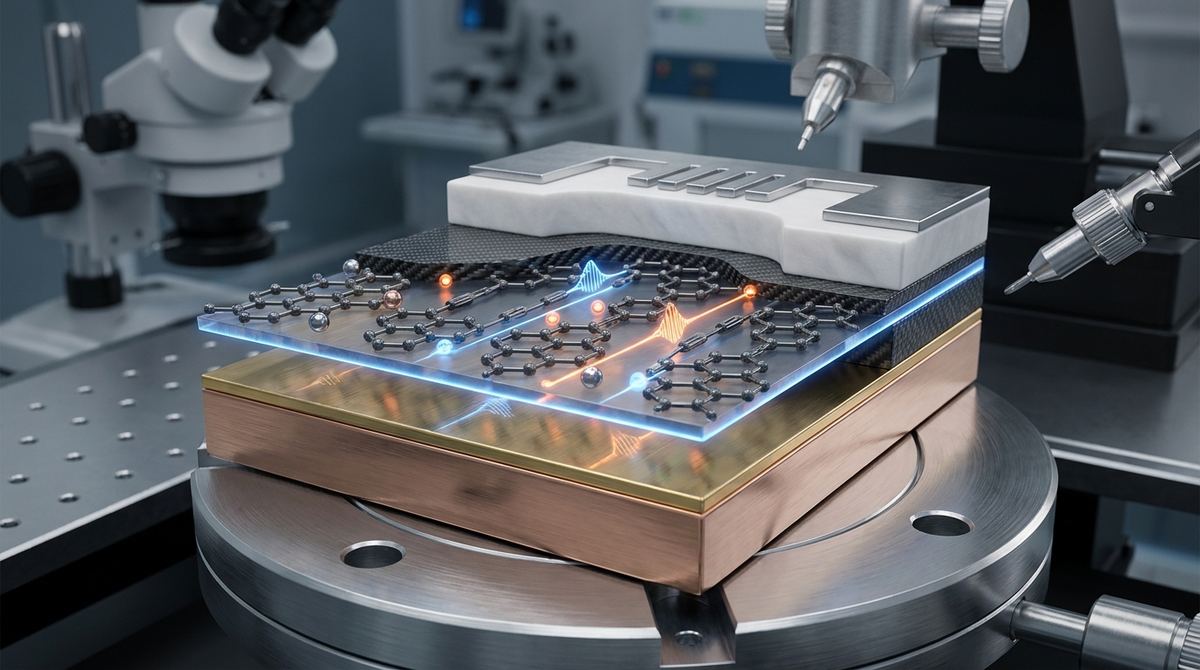
Imagine a high-performance engine that works perfectly on a test stand but loses all its power the moment you try to bolt it into a car because the car's chassis absorbs all its energy. This is the fundamental crisis facing the development of next-generation two-dimensional materials. Scientists are working to build the next generation of ultra-fast, ultra-small electronics using single layers of carbon atoms, but there is a catch: the very surfaces we use to grow these materials often act like sponges, soaking up the unique electrical properties that make them special. This phenomenon, known as substrate coupling, effectively "dampens" the material, turning a high-speed electronic component into a sluggish, non-functional layer.
The primary challenge in the field of two-dimensional (2D) materials is the interaction between a material and the surface it sits on. When a material like graphene or graphdiyne is grown on a metal substrate, the electrons in the metal begin to leak into the 2D layer. This interaction is not just a minor interference; it fundamentally rewrites the electronic identity of the material. For a material to function as a semiconductor in a digital transistor, it must possess a specific electronic bandgap—a "forbidden zone" for electrons that allows us to turn the current on and off.
However, when a 2D material is strongly coupled to a metal substrate, the metal's electrons flood this zone, effectively "closing" the bandgap. This makes the material behave like a metal rather than a semiconductor, rendering it useless for the sophisticated logic gates required in modern computing. Therefore, the holy grail of 2D material science is to find a way to synthesize these materials directly on a surface while ensuring they remain "decoupled"—meaning they maintain their intrinsic, undisturbed electronic structure despite being physically attached to a metal.
To solve this, a team of researchers has developed a specialized method to build graphdiyne, a unique relative of graphene, using iron as a molecular architect. Instead of just letting the carbon atoms clump together randomly, the researchers used iron catalysts to guide the assembly of the material atom by atom on a surface. The goal was to create a monolayer of graphdiyne that is structurally connected to the surface for stability but electronically isolated. This decoupling ensures that the graphdiyne retains its own unique "electrical personality," allowing it to keep the properties that make it so valuable for high-speed technology.
To understand how this works, we must look at the difference between graphene and graphdiyne. Graphene is composed entirely of carbon atoms bonded through sp2 hybridization, forming a simple, seamless hexagonal lattice. Graphdiyne, however, is more complex. It incorporates both sp2 hybridized carbon atoms and sp hybridized carbon atoms. The sp hybridized atoms form acetylenic linkages—chains of triple-bonded carbon atoms—that connect the hexagonal rings. This structure creates a highly porous, two-dimensional framework with a much richer variety of electronic states than graphene.
The synthesis process described by Alice Cartoceti, Simona Achilli, Gianni Conti, Eliecer Pelaez-Sifonte, Alessio Orbelli Biroli, Francesco Sedona, Paolo D'Agosta, Francesco Tumino, Andrea Li Bassi, Jorge Lobo-Checa, and Carlo S. Casari involves using iron to facilitate the formation of these delicate triple bonds. In on-surface synthesis, the precursor molecules are deposited onto a substrate under controlled conditions. The iron catalyst lowers the activation energy required for the carbon atoms to link up in this specific, complex pattern.
The "decoupling" happens at the quantum level. As the graphdiyne forms, the researchers managed to control the interface so that the electronic wavefunctions of the graphdiyne do not overlap significantly with the wavefunctions of the metal substrate's electrons. By preventing this overlap, the carbon-based structure maintains its own distinct electronic band structure. The result is a robust, single-atom-thick layer that sits on a metal surface but refuses to share its electrons with it.
The research successfully demonstrated the iron-catalyzed synthesis of these substrate-decoupled graphdiyne monolayers. The core finding was that the iron-mediated process allows for the creation of highly ordered graphdiyne structures that preserve their intrinsic electronic properties. By using the iron catalyst, the researchers were able to direct the assembly of the sp and sp2 hybridized carbons into the precise lattice required for graphdiyne, without the metal substrate disrupting the resulting electronic bandgap.
This is a significant technical achievement because it proves that we can grow complex 2D materials on metal surfaces—which are much easier to integrate into existing industrial processes—without sacrificing the very characteristics that make those materials useful. The researchers confirmed that the resulting monolayers were indeed decoupled, meaning the electronic signature of the graphdiyne remained intact and was not "smothered" by the underlying metal. This confirms that the iron-catalyzed pathway is a viable method for producing high-quality, functional 2D materials.
This discovery is a major step forward for the field of nano-electronics. Because graphdiyne has a natural bandgap (unlike graphene), it can theoretically be used to create the next generation of field-effect transistors that are significantly smaller and faster than silicon-based ones. Being able to grow these materials on a metal substrate while keeping them decoupled solves the biggest hurdle in making 2D materials practical for real-world hardware.
The ability to maintain the intrinsic properties of a material through substrate decoupling means that we can design electronic components with much higher precision. If we can control exactly how a material interacts with its environment, we can create sensors that are incredibly sensitive to specific molecules or transistors that can operate at much higher frequencies. This research provides a roadmap for moving 2D materials from theoretical models into actual, functional electronic components.
While this research is a breakthrough, it is important to recognize that it is currently in the fundamental science stage. The synthesis occurs under highly controlled, specialized laboratory conditions, often requiring ultra-high vacuum environments and precise thermal management. This is very different from the mass-scale manufacturing processes used to make silicon chips today.
Furthermore, while we can now create these monolayers on a surface, we still need to develop ways to reliably integrate these decoupled layers into complex, multi-layered integrated circuits. There are also questions regarding the long-term stability of these monolayers when exposed to air or moisture outside of a controlled vacuum. The transition from a single, perfect monolayer in a lab to a scalable, industrial production line is a massive engineering challenge that remains to be solved.
The implications for real-world technology are vast, particularly in the following areas:
In nano-electronics, this technology could lead to the creation of "post-silicon" electronics. As silicon reaches its physical limits, decoupled 2D materials like graphdiyne offer a path toward faster, more energy-efficient processors for smartphones, supercomputers, and artificial intelligence hardware.
In gas sensing and chemical detection, the porous nature of graphdiyne makes it an ideal candidate for detecting specific molecules. Because the material is decoupled from the substrate, the electrical signal produced when a target molecule lands on the graphdiyne is much clearer and more distinct, allowing for much higher sensitivity in detecting pollutants or biological markers.
In energy storage, the unique structure of graphdiyne could be utilized in advanced battery anodes or supercapacitors. The high surface area and the specific electronic properties could allow for faster charging times and higher capacities, provided the material can be manufactured at scale.
If you remember only one thing from this research, let it be this: we have found a way to build complex carbon-based materials on metal surfaces without the metal ruining their unique electrical properties, clearing a major path toward the future of ultra-fast electronics.
What exactly is graphdiyne? Graphdiyne is a two-dimensional material made of carbon atoms. Unlike graphene, which is just a flat sheet of hexagonal rings, graphdiyne has extra links made of triple bonds. This makes it look like a mesh or a net rather than just a solid sheet, which gives it very different and useful electrical properties.
Why is it better than graphene for electronics? Graphene is a great conductor, but it lacks a bandgap, which means it cannot be easily turned "off" like a switch. Graphdiyne has a natural bandgap, which allows it to function as a semiconductor, making it much more useful for building the tiny switches that make up computer processors.
What does "substrate-decoupled" mean? In the world of tiny materials, the surface they sit on (the substrate) usually interferes with how they behave. Decoupled means the material is physically there, but its electrons are "shielded" or isolated from the surface, allowing the material to keep its original, intended properties.
Why was iron used in this experiment? Iron acts as a catalyst, which is a substance that speeds up a chemical reaction without being consumed. In this case, the iron helps the carbon atoms find each other and bond in the specific, complex pattern needed to create graphdiyne, acting like a tiny construction foreman.
Is this technology going to change my computer soon? Not immediately. This research is a fundamental scientific breakthrough that proves a difficult concept is possible. Before this reaches your laptop, scientists still need to figure out how to make this process cheaper, faster, and more reliable for large-scale factory manufacturing.
The work performed by Alice Cartoceti and her colleagues represents a significant milestone in the quest for functional 2D materials. By solving the critical issue of substrate coupling through iron-catalyzed synthesis, they have demonstrated that the unique, powerful properties of graphdiyne can be preserved even when the material is placed on a metal surface. This achievement bridges the gap between theoretical material science and practical electronic application, bringing us one step closer to a new era of computing powered by the unique chemistry of carbon.
Serious about B2B integration? Test our premium Pulsed Electrical Resistive Carbon Heating turbostratic graphene in your lab. 100g sample packs available now.
Explore More
Research on 30° quasi-periodic twisted bilayer graphene reveals a unique, fractal-like energy structure under magnetic fields, paving the way for novel...

Researchers discover naturally formed graphene sheets and carbon ovals in stingless bee hives, creating a novel emergent material with powerful blue light...

Discover how rippled graphene pores act as fluidic memristors, enabling advanced synaptic functionalities for the next generation of neuromorphic computing.