
Rippled Graphene Pores for Neuromorphic Fluidic Memristive Devices
Discover how rippled graphene pores act as fluidic memristors, enabling advanced synaptic functionalities for the next generation of neuromorphic computing.
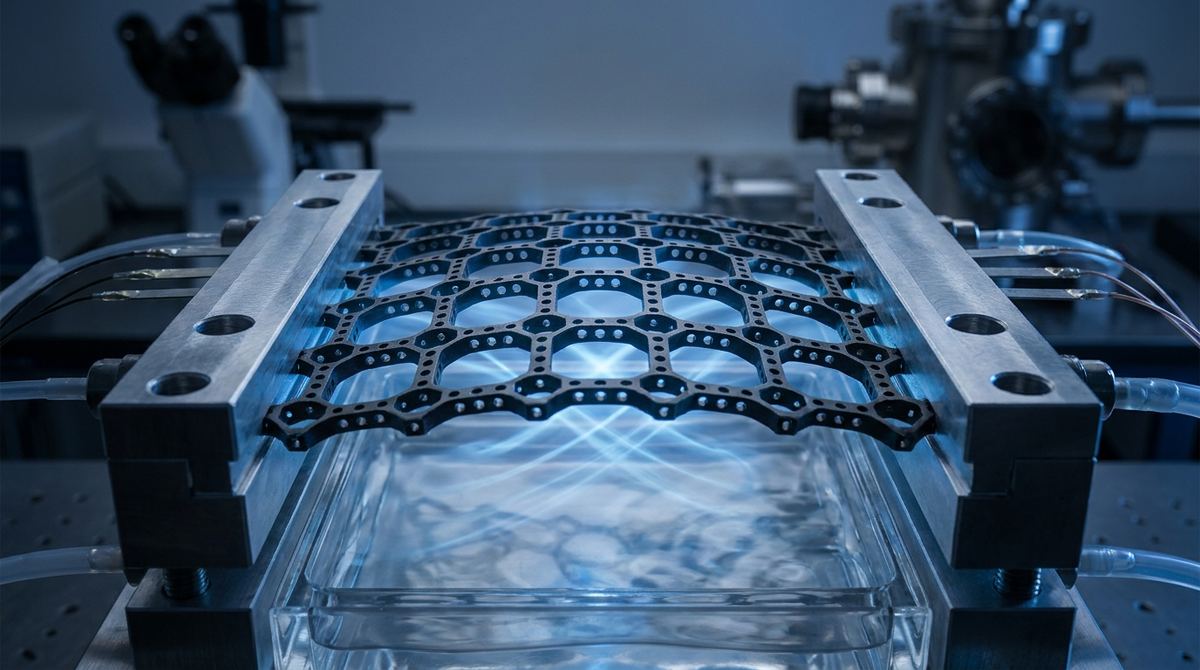
In traditional material science, most materials exhibit a positive Poisson's ratio. This means that when you stretch a material, it becomes thinner in the direction perpendicular to the pull. However, recent research into two-dimensional (2D) materials has opened the door to engineering metamaterials with a negative Poisson's ratio (NPR), also known as auxetic behavior.
When an auxetic material is stretched, it actually becomes thicker or maintains its lateral dimensions because the internal structure expands rather than contracts. For an engineer working in filtration or molecular separation, this is a game-changer. By engineering specific perforation patterns into a sheet of graphene or MXene, you can create a membrane that changes its pore geometry and effective surface area in response to mechanical tension.
The research by Darban (2026) highlights that this behavior is driven by a rotating-junction mechanism. When tension is applied, the ligaments (the solid parts between the holes) rotate. This rotation, combined with the natural tendency of atomically thin materials to bend out-of-plane, allows for highly tunable mechanical responses. For a startup or a lab, this means the ability to create a smart membrane that can "tune" its selectivity by simply applying a controlled amount of strain.
The most practical application for this technology is in adaptive nanofluidic filtration. Current desalination and molecular sieving membranes are often static; once they are manufactured, their pore size is fixed. If the feed concentration of a contaminant changes, the membrane cannot adapt.
By using an auxetic 2D metamaterial, you can build a membrane where the pore shape and size are functions of the applied mechanical strain. By stretching the membrane slightly, you can widen or reshape the pores to increase flux, or compress/relax the structure to tighten the sieving effect for specific ions or molecules. This creates a dynamic, responsive interface for high-precision chemical separation.
To test this concept, you should aim to build a prototype device consisting of a perforated 2D material substrate mounted onto a flexible, transparent support, integrated with a precision mechanical actuator.
The core of the device is the 2D metamaterial—either graphene or a titanium-based MXene (such as Ti3C2Tx). This material will be patterned with a specific geometry of holes (perforations) to induce the desired auxetic response. This patterned sheet is then transferred onto a flexible polymer substrate, such as PDMS (Polydimethylsiloxane), which acts as the structural backbone. Finally, a piezoelectric actuator is used to apply precise, controlled tension to the membrane to observe how the filtration properties change with strain.
Because this involves atomic-scale manipulation, the material requirements are specialized.
1. 2D Material Substrate: High-quality monolayer graphene or Ti3C2Tx MXene. MXene is preferred if you require specific surface terminations for ion interaction, as the research suggests surface chemistry influences the quantitative response.
2. Patterning Equipment: This is the highest barrier to entry. You will require either a Focused Ion Beam (FIB) system or an Electron Beam Lithography (EBL) setup to create the precise rectangular or sinusoidal perforations.
3. Support Substrate: A thin layer of PDMS or a similar flexible, biocompatible polymer.
4. Actuation System: A miniature piezoelectric stage or a micro-mechanical actuator capable of applying sub-micron displacements.
5. Characterization Tools: An Environmental Scanning Electron Microscope (ESEM) or an Atomic Force Microscope (AFM) to observe the structural deformation and out-of-plane bending during tension.
6. Fluidic Testing Rig: A microfluidic chamber to flow solutions through the membrane while under tension.
The following steps assume you have access to a nanofabrication facility.
1. Substrate Preparation: Clean the target 2D material (graphene or MXene) on a sacrificial substrate (like copper foil for graphene or a silicon wafer for MXene).
2. Nanopatterning: Use EBL or FIB to define the perforation pattern. Based on the Darban research, you should test two distinct geometries: rectangular perforations with straight ligaments for predictable rotation, and sinusoidal ligaments to observe more complex, smoothed deformation profiles. Note: The exact dimensions of the pores and ligaments should be in the 1 to 10 nanometer range for molecular sieving, though for a first prototype, larger micro-scale perforations may be easier to observe.
3. Transfer Process: Use a polymer-assisted transfer method to move the perforated 2D sheet onto the flexible PDMS substrate. This step is critical to ensure the 2D material does not tear during the transfer.
4. Actuator Integration: Bond the PDMS-supported membrane to the piezoelectric actuator. Ensure the bond is uniform to prevent localized stress concentrations that could lead to premature fracture.
5. Encapsulation: If using MXenes, ensure the device is protected from excessive oxidation, which can occur when the material is under strain in aqueous environments.
To validate the auxetic effect and its functional utility, follow this three-phase testing protocol.
Phase 1: Mechanical Characterization
Apply incremental uniaxial tension to the membrane. Use an AFM or ESEM to monitor the ligaments. You are looking for the rotating-junction mechanism: the ligaments should tilt rather than just stretching. Measure the lateral expansion of the membrane to calculate the Poisson's ratio. If the ratio is negative, you have successfully created an auxetic metamaterial.
Phase 2: Morphological Analysis
Observe the out-of-plane deflections. The research indicates that 2D materials will undergo complex 3D deformations due to low bending rigidity. Document how the "wrinkling" or "rippling" affects the overall flatness of the membrane, as this will impact fluid flow.
Phase 3: Functional Filtration Testing
Place the membrane in a microfluidic cell. Pass a solution containing a known solute (e.g., a specific salt or organic molecule) through the membrane. Measure the rejection rate and the permeate flux at zero strain, then repeat the measurement at increasing levels of applied tension. A successful prototype will show a predictable, tunable change in both flux and selectivity as the pore geometry shifts.
It is important to distinguish between the research findings and the engineering implementation.
The research by Darban provides the fundamental physics: the geometry of the holes dictates the qualitative auxetic behavior, while the material properties dictate the quantitative magnitude. As an engineer, you must assume that the specific dimensions of your pores will significantly alter the results. While the paper discusses atomistic simulations, a physical prototype will likely operate at a much larger scale.
Risks to Mitigate:
1. Material Fracture: 2D materials are incredibly strong but highly sensitive to defects. Any imperfection in your perforation pattern can act as a stress concentrator, leading to catastrophic failure during tension.
2. Out-of-Plane Instability: The research notes that low bending rigidity causes 3D deformations. In a real-world filtration device, this could lead to uneven flow distribution or "channeling," where the fluid bypasses the membrane through the wrinkles.
3. Oxidation and Degradation: If using MXenes, the increased surface area exposed by the perforations and the mechanical strain may accelerate oxidation, changing the chemical properties of the membrane mid-test.
4. Fabrication Complexity: Achieving the precision required for atomistic-scale perforations is extremely difficult and expensive. For a startup, it may be more practical to first attempt this with micro-scale perforations before moving to the nano-scale.
Serious about B2B integration? Test our premium Pulsed Electrical Resistive Carbon Heating turbostratic graphene in your lab. 100g sample packs available now.
Explore More
Discover how rippled graphene pores act as fluidic memristors, enabling advanced synaptic functionalities for the next generation of neuromorphic computing.

Learn how to use electromechanical responses in gapped graphene to measure electronic temperature and band gaps using traveling flexural waves.

Explore how researchers have discovered viscous electron fluid behavior in cadmium, a breakthrough that could revolutionize the future of nanoelectronics.