
Unlocking Quasicrystal Physics in 30-Degree Twisted Bilayer Graphene
Research on 30° quasi-periodic twisted bilayer graphene reveals a unique, fractal-like energy structure under magnetic fields, paving the way for novel...
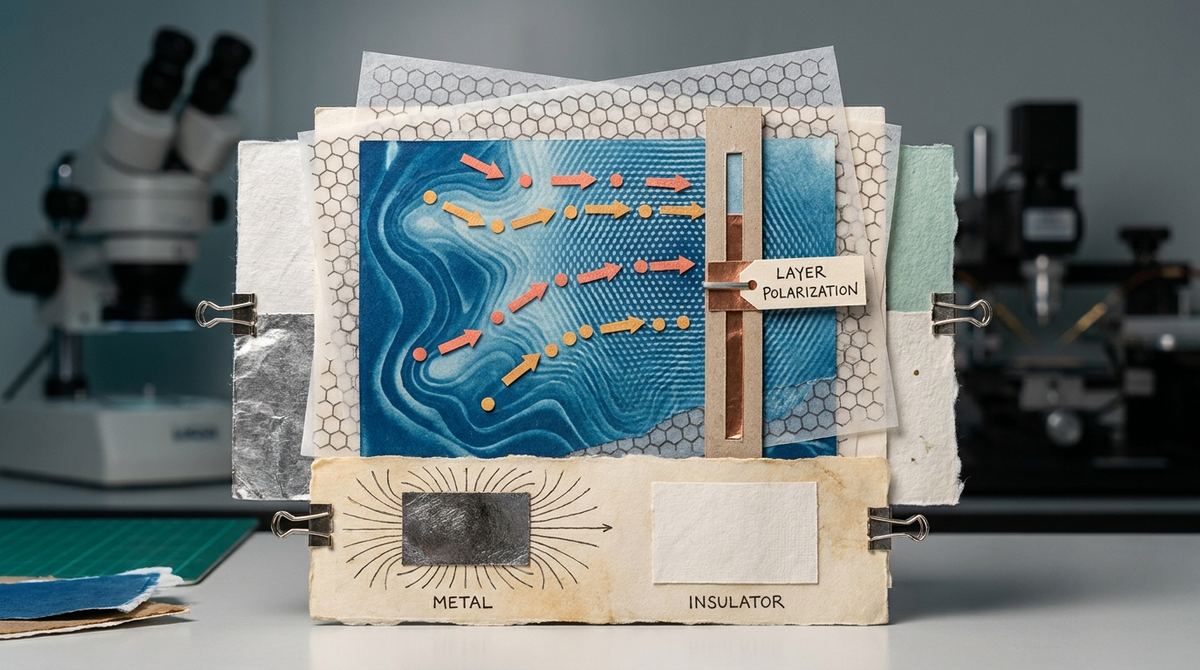
Imagine a material that can switch from being a perfect conductor, like a copper wire, to a complete insulator, like glass, simply by adjusting a tiny electrical charge. This ability to flip a material between these two states is the fundamental mechanism behind every electronic device in your pocket, from smartphones to supercomputers. However, in traditional silicon-based technology, this switching is achieved by physically adding impurities to the crystal structure, a process that is difficult to control with extreme precision. In the emerging realm of two-dimensional materials like graphene, scientists are finding a way to do this through geometry and electrical fields instead. By twisting layers of graphene together, they create a new kind of landscape for electrons to inhabit, allowing for a level of control that was once thought impossible.
The current era of microelectronics is facing a significant bottleneck known as the end of Moore's Law. As we try to make transistors smaller and more efficient, we encounter physical limits where the materials themselves begin to behave unpredictably due to heat and quantum tunneling. Silicon, the backbone of modern computing, is a rigid material; once it is manufactured with a certain level of doping, its electrical properties are largely fixed. We lack the ability to dynamically and continuously tune the fundamental nature of the material itself once it is inside a device.
Furthermore, as we move toward the era of quantum computing, we need materials that can simulate complex quantum states. Traditional materials do not offer the "tunability" required to act as a platform for quantum simulation. We need a system where we can dial in specific electronic properties—such as the density of electrons or the strength of their interactions—to observe how they behave under different conditions. The challenge is to create a material system that is both highly responsive to external inputs and structurally stable enough to maintain these delicate quantum states.
The researchers have turned to a phenomenon called a moiré superlattice to solve this. To understand this, imagine placing one fine-mesh screen over another fine-mesh screen. If they are perfectly aligned, the holes match up. But if you rotate one slightly, a new, much larger pattern emerges from the overlapping mesh. This large-scale pattern is what we call a moiré pattern. In the world of graphene, when two layers are slightly misaligned, they create a "superlattice"—a new, repeating pattern that is much larger than the individual atoms.
This superlattice creates a new environment for electrons. Instead of seeing only the individual carbon atoms, the electrons now see a massive, periodic landscape of energy hills and valleys. This change in the environment allows for the emergence of entirely new electronic states. By applying a vertical electric field to these layers, scientists can induce something called layer polarization. This polarization pushes the electrons toward one layer or the other, effectively changing the height of those energy hills and valleys. This ability to manipulate the energy landscape through polarization allows researchers to trigger a metal-insulator transition, essentially turning the material on and off by shifting the electronic distribution.
The system studied in this research is a highly sophisticated stack of two-dimensional materials. At the heart of the device are layers of graphene, which are only one atom thick. To ensure the electrons can move without being scattered by impurities, these graphene layers are encapsulated within layers of hexagonal boron nitride (hBN). The quality of these materials is paramount; the researchers utilized high-quality crystals provided by Kenji Watanabe and Takashi Taniguchi, which are essential for observing these subtle quantum effects.
When these layers are stacked with a specific twist angle, the resulting moiré superlattice dictates the electronic structure. Unlike standard graphene, which has a simple electronic band structure, these moiré superlattices create "multi-band" systems. This means there are multiple energy levels available for electrons to occupy, and these levels are much more closely spaced. The physics of the system is driven by the interplay between the kinetic energy of the electrons (their desire to move) and the electron-electron interactions (the repulsion they feel from each other).
When a vertical electric field is applied through the stack, it creates layer polarization. This field does not just push electrons; it breaks the symmetry between the top and bottom graphene layers. By shifting the electron density between these layers, the researchers can change the effective strength of the interactions between electrons. This shift alters the electronic bands, effectively making the "hills" in the energy landscape too high for electrons to cross, or the "valleys" too shallow to trap them.
The research conducted by Harsimran Kaur Mann, Simrandeep Kaur, Harsimran Singh, Yashashwani Garg, Amogh Waghmare, Mohit Kumar Jat, Kenji Watanabe, Takashi Taniguchi, Manish Jain, and Aveek Bid reveals how this layer polarization acts as the primary driver for a metal-insulator transition. The team discovered that by carefully tuning the layer polarization, they could move the system through a phase change. In one state, the electrons were mobile and the material conducted electricity like a metal. As the polarization was adjusted, the electrons became "localized," meaning they were trapped in specific positions within the moiré pattern, causing the material to behave as an insulator.
Crucially, the researchers found that this transition is a multi-band phenomenon. This means the transition is not just a simple case of one group of electrons being stopped; rather, it involves a complex dance between electrons in different energy bands. The interplay between these multiple bands and the layer polarization allows for a much more nuanced control over the electronic state than was previously seen in single-band models. This discovery provides a roadmap for how to use electrical fields to navigate the complex energy landscapes of moiré materials, providing a level of precision that is essential for quantum science.
This finding is significant because it demonstrates that we can control the fundamental phase of a material using only an external electric field. In the context of electronics, this suggests a future where "twistronics"—the manipulation of materials through twist angles and electrical fields—could replace traditional doping. This would allow for the creation of transistors that are much more efficient and can be tuned dynamically during operation.
For the field of quantum science, this research provides a new playground for simulating complex quantum phenomena. Because the metal-insulator transition can be controlled via layer polarization, scientists can use these moiré superlattices to mimic the behavior of other, more complex quantum materials that are much harder to study. It opens the door to observing how many-body interactions, where many electrons act together as a single quantum entity, can be controlled and harnessed.
While these findings are a major scientific milestone, it is important to distinguish these fundamental discoveries from commercial technology. The experiments were performed under extreme laboratory conditions, typically requiring temperatures near absolute zero. At these temperatures, thermal energy is minimized so that the delicate quantum effects of the moiré pattern are not washed out by heat. For these materials to be used in consumer electronics, the physics must be able to operate at room temperature, which remains a significant hurdle.
Furthermore, the fabrication of these moiré superlattices requires extreme precision. Even a tiny error in the twist angle can completely change the electronic properties of the material. Scaling this up from a laboratory-scale device to a mass-produced microchip is a massive engineering challenge. The current methods of stacking 2D layers are slow and difficult to replicate at scale, meaning that while the physics is proven, the practical application is still in its infancy.
Despite the current limitations, the potential real-world applications are vast. In the field of quantum computing, these materials could serve as the basis for new types of qubits or quantum simulators, helping to solve problems that are currently impossible for even the most powerful classical computers. The ability to tune the metal-insulator transition could lead to the development of ultra-low-power transistors that require very little energy to switch states, significantly reducing the power consumption of massive data centers.
Another exciting application is in neuromorphic computing. This is a type of computing that mimics the structure of the human brain, using artificial neurons and synapses. The tunable nature of graphene moiré superlattices could allow for the creation of "memristors"—components that can remember how much charge has passed through them—enabling hardware that learns and adapts in real-time, much like biological systems.
If you take away only one concept from this research, let it be this: the twist and the electric field allow us to turn a single material into many different materials by changing its internal energy landscape.
What is a moiré superlattice?
A moiré superlattice is a large-scale periodic structure that emerges when two or more layers of a crystalline material are stacked with a slight rotational misalignment. This creates a new pattern that is much larger than the original atomic lattice, effectively creating a new material with entirely different electronic properties.
Why is graphene so special in this research?
Graphene is a single layer of carbon atoms that is incredibly thin and highly conductive. Because it is so thin, we can manipulate its electronic properties by adding layers or twisting them, a concept known as twistronics, which allows us to create the moiré patterns needed for this research.
What is a metal-insulator transition?
A metal-insulator transition is a fundamental change in how a material conducts electricity. In a metallic state, electrons move through the material relatively freely, allowing current to flow. In an insulating state, the electrons become trapped or localized, preventing the flow of electricity.
How does layer polarization work?
Layer polarization occurs when an external electric field is applied perpendicular to the layers of graphene. This field pushes the electrons toward one layer or the other, changing the electrical environment and the way the electrons interact with each other.
Are these materials ready for use in everyday gadgets?
Not yet. This research is currently taking place in highly specialized laboratories under extreme conditions, such as very low temperatures, to observe these delicate quantum effects clearly. The challenges of temperature and large-scale manufacturing must be solved first.
This research points toward a practical lesson: graphene-based materials are most powerful when their nanoscale properties are connected to a clear engineering problem. The result is not a finished commercial product by itself, but it gives researchers and manufacturers a better map for designing lighter, more sensitive, or more durable systems. Future work still needs testing under real operating conditions, but the direction is promising because it joins materials science with application-driven design.
Serious about B2B integration? Test our premium Pulsed Electrical Resistive Carbon Heating turbostratic graphene in your lab. 100g sample packs available now.
Explore More
Research on 30° quasi-periodic twisted bilayer graphene reveals a unique, fractal-like energy structure under magnetic fields, paving the way for novel...

Researchers discover naturally formed graphene sheets and carbon ovals in stingless bee hives, creating a novel emergent material with powerful blue light...

Discover how rippled graphene pores act as fluidic memristors, enabling advanced synaptic functionalities for the next generation of neuromorphic computing.