
Unlocking Quasicrystal Physics in 30-Degree Twisted Bilayer Graphene
Research on 30° quasi-periodic twisted bilayer graphene reveals a unique, fractal-like energy structure under magnetic fields, paving the way for novel...
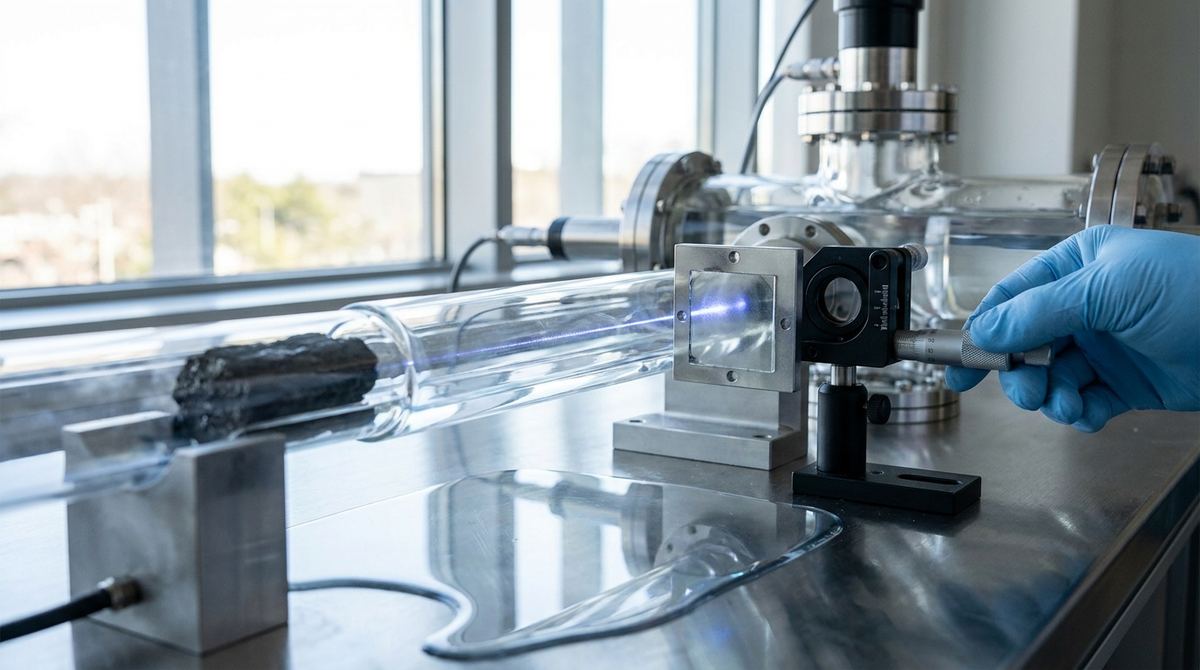
Imagine if you could take a high-speed photograph of a single electron moving through a circuit. Currently, our technology is like a camera with a shutter speed that is far too slow; we see the beginning and the end of a process, but the incredibly fast dance of electrons in between remains a blur. To truly understand the foundations of modern electronics and quantum mechanics, we need a light source that pulses at the scale of attoseconds. An attosecond is one quintillionth of a second, a timeframe so brief that even light, the fastest thing in the universe, can only travel a fraction of a nanometer. This research, spearheaded by Sergio Martín-Domene, Luis Plaja, and Carlos Hernández-García, explores how a single layer of carbon atoms—graphene—might become the engine for these ultra-fast light pulses. By leveraging the unique electronic properties of graphene, these scientists are investigating a way to turn a simple sheet of material into a high-speed optical generator through a complex phenomenon known as high harmonic generation.
To understand why this research is necessary, we must first look at how scientists currently generate attosecond pulses. Most current methods rely on high harmonic generation in gases. In this process, an intense laser is fired into a gas, and the electrons in the gas atoms are kicked out and then slammed back into the nucleus, releasing high-energy photons in the process. While effective, gas-based systems have significant limitations. They are typically bulky, requiring large vacuum chambers and high-pressure gas cells to achieve enough density to produce a usable signal. Furthermore, as we move toward miniaturizing technology, we need light sources that can be integrated directly onto semiconductor chips or into much smaller, more compact optical systems.
The second major problem is the issue of efficiency and coherence. When you use a solid material instead of a gas, you have much more electrons packed into a much smaller space, which sounds ideal for generating light. However, solids introduce a massive headache for physicists: dispersion. In a gas, light travels relatively easily. In a solid, different frequencies of light travel at different speeds. When a laser hits a solid and creates high-frequency harmonics, those harmonics often travel at a different speed than the original laser pulse. As a result, the new light waves fall out of sync with the driving laser, leading to destructive interference where the waves essentially cancel each other out. This makes it incredibly difficult to extract a coherent, usable pulse from a solid material like graphene.
The research addresses these issues by moving the focus from the individual atom to the macroscopic behavior of the material. Instead of just looking at how one electron reacts to a laser, the researchers are looking at how a large-scale sheet of graphene behaves when it is hit by a laser. The core idea is to achieve something called macroscopic phase-matching.
Think of it like a group of runners on a track. If every runner is moving at exactly the same speed and they all start at the same time, they stay in a tight pack, and their collective presence is very easy to see. If they all run at different speeds, they spread out and become a disorganized mess. In this scientific context, the laser is the leader of the pack, and the high-frequency light waves are the runners. If the researchers can find the perfect conditions where the high-frequency light waves "march in step" with the laser pulse, they can prevent the signals from canceling each other out. If they succeed, the graphene will not just emit a chaotic mess of light, but a highly organized, ultra-fast train of light pulses that can be used for precision measurements.
To understand how graphene enables this, we have to look at its unique atomic structure. Graphene is a two-dimensional material where carbon atoms are arranged in a hexagonal lattice. The electrons in graphene are not bound to specific atoms in the same way they are in most materials; instead, they behave like massless particles, often referred to as Dirac fermions. This gives them incredible mobility, meaning they can respond to an external electric field—like that of an intense laser—with extreme speed and efficiency.
When an intense, ultra-fast laser pulse hits the graphene sheet, it creates a massive electric field that pulls the electrons away from their equilibrium positions. Because the electrons in graphene are so mobile and follow such unique paths in momentum space, they are driven very far from their resting state. As the laser field oscillates, these electrons are accelerated and then slammed back toward their original positions. This sudden "re-collision" or deceleration is what generates the high harmonic light.
The macroscopic part of this process involves the propagation of these waves through the medium. As the high-frequency light is generated, it travels through the graphene. For the process to work, the phase velocity of the driving laser must be matched with the phase velocity of the generated harmonics. In graphene, because it is so thin, the interaction is highly controlled. The researchers use the mathematical framework of nonlinear optics to calculate how the geometry of the graphene and the properties of the driving laser can be tuned to ensure that the light waves generated at different points in the material add up constructively. This constructive interference is what creates the powerful, coherent pulse train required for advanced physics.
The research conducted by Martín-Domene, Plaja, and Hernández-García provides a roadmap for how to optimize this process. By modeling the interaction between the intense laser field and the graphene electrons, they identified the specific parameters required to achieve successful macroscopic phase-matching. They found that the generation of these attosecond pulses is not just a matter of hitting the graphene with a stronger laser, but rather a delicate balance of the laser's frequency, its intensity, and the way the light propagates through the material.
One of the critical findings involves the relationship between the material's electronic structure and the phase-matching condition. The researchers demonstrated that the unique, linear energy-momentum relationship of graphene’s electrons—the very thing that makes them so fast—also dictates the specific frequencies at which the light can be effectively synchronized. Their work suggests that by carefully selecting the wavelength of the driving laser, one can control the harmonic spectrum produced, allowing for the creation of specific, tailored attosecond pulses. This moves the field away from "trial and error" and toward a predictive, engineering-based approach to ultrafast light generation.
This research is a significant step forward for the field of ultrafast science. For decades, the ability to resolve events on an attosecond timescale was limited to massive, specialized laboratory setups. If we can successfully utilize graphene for this purpose, we open the door to "on-chip" attosecond science. This means the tools used to study the fundamental nature of matter could eventually be integrated into compact, portable, or even industrial-grade devices.
Furthermore, understanding how to control the phase-matching in a solid material like graphene helps solve one of the long-standing hurdles in nonlinear optics. It proves that solids are not just "messy" versions of gases, but are instead highly tunable platforms that, when understood correctly, can provide much higher signal intensities due to their massive electron density. This could lead to a new generation of light sources that are significantly brighter and more efficient than current gas-based systems.
While the theoretical and modeling work is groundbreaking, it is important to note that this research is not yet a blueprint for a commercial product. Generating attosecond pulses requires extremely high-intensity, ultra-fast lasers that are currently quite large and expensive. Integrating these lasers with a graphene-based system in a way that is stable and repeatable is a major engineering challenge.
Additionally, the production of high-quality, large-scale graphene remains a hurdle. Any defects in the graphene lattice, such as impurities or structural irregularities, can cause scattering, which disrupts the phase-matching and ruins the coherence of the pulse train. Future research will need to focus on how these materials behave in real-world conditions, where imperfections are inevitable, and how to compensate for those defects through advanced material engineering or laser pulse shaping.
The implications of stable, graphene-based attosecond pulse trains are vast. In the realm of semiconductor manufacturing, being able to observe electron movement in real-time could allow engineers to design much faster transistors, pushing the limits of Moore's Law. If we can see exactly how a charge moves through a circuit at the attosecond scale, we can design circuits that are optimized to minimize heat and maximize speed.
In the field of chemistry, attosecond pulses could allow scientists to witness the breaking and forming of chemical bonds. Most chemical reactions happen on timescales that are currently too fast to observe directly; we only see the reactants and the products. Attosecond spectroscopy could provide a "movie" of the reaction, showing the exact moment bonds snap or form. Finally, in quantum computing, these pulses could be used to study and control the incredibly fast quantum states of electrons, which is essential for developing stable, scalable quantum processors.
If you take away only one concept from this research, let it be this: graphene's unique electron movement allows us to generate incredibly fast light pulses, but we must use "phase-matching" to ensure those pulses don't cancel themselves out.
What is an attosecond and why is it important?
An attosecond is a unit of time equal to one quintillionth of a second. It is important because it is the timescale on which electrons move within atoms and molecules. To study the fundamental processes of chemistry and physics, we need light pulses that are fast enough to capture these movements.
Why use graphene instead of a gas?
Graphene is a solid, meaning its electrons are much more densely packed than in a gas. This density allows for much more efficient light generation. Additionally, graphene is a two-dimensional material that can be integrated into much smaller, more compact devices than gas-based systems.
What is the "phase-matching" problem?
When a material generates new light through a laser, that new light often travels at a different speed than the original laser. This difference in speed causes the light waves to fall out of sync, leading them to cancel each other out. Phase-matching is the process of synchronizing these waves so they add together instead of canceling out.
Can we buy a graphene attosecond generator today?
No, this research is currently at the scientific and theoretical stage. While the researchers have mapped out how these systems should work, the technology requires extremely advanced lasers and perfect graphene samples that are currently only available in highly controlled laboratory settings.
What are Dirac fermions?
Dirac fermions are a special type of electron behavior found in materials like graphene. In most materials, an electron's speed is related to its energy in a complex way. In graphene, the relationship is much more direct and linear, making the electrons behave as if they have no mass. This extreme mobility is what makes graphene so good at generating light.
The work by Sergio Martín-Domene, Luis Plaja, and Carlos Hernández-García represents a vital bridge between theoretical physics and practical optical engineering. By tackling the complex problem of macroscopic phase-matching in graphene, they have provided a potential path toward a new era of compact, high-speed light sources. While significant engineering hurdles remain in material quality and laser technology, the ability to generate attosecond pulse trains from a simple sheet of carbon could fundamentally change how we observe, measure, and manipulate the fastest processes in the universe.
Serious about B2B integration? Test our premium Pulsed Electrical Resistive Carbon Heating turbostratic graphene in your lab. 100g sample packs available now.
Explore More
Research on 30° quasi-periodic twisted bilayer graphene reveals a unique, fractal-like energy structure under magnetic fields, paving the way for novel...

Researchers discover naturally formed graphene sheets and carbon ovals in stingless bee hives, creating a novel emergent material with powerful blue light...

Discover how rippled graphene pores act as fluidic memristors, enabling advanced synaptic functionalities for the next generation of neuromorphic computing.