
Rippled Graphene Pores for Neuromorphic Fluidic Memristive Devices
Discover how rippled graphene pores act as fluidic memristors, enabling advanced synaptic functionalities for the next generation of neuromorphic computing.
As the digital world races toward increasingly massive artificial intelligence models, a silent crisis is brewing in the heart of our data centers. Every time a modern AI processes a prompt or recognizes a face, it consumes a staggering amount of energy, much of which is wasted simply moving data back and forth between the processor and the memory. Our current computers are built on a fundamental separation of these two functions, a design choice that works beautifully for traditional software but fails to capture the elegant efficiency of the human brain. Our brains do not have a separate storage unit for memories; instead, the very connections between neurons—the synapses—act as both the processor and the memory simultaneously. This biological integration allows us to learn and adapt with a fraction of the power required by a modern supercomputer. Researchers are now looking toward the quantum world to find a way to replicate this biological magic using advanced materials, specifically through the phenomenon of moiré superlattices.
The primary obstacle facing the next generation of computing is known as the Von Neumann bottleneck. In standard computer architectures, the CPU (Central Processing Unit) and the RAM (Random Access Memory) are distinct entities connected by a bus. When an AI algorithm needs to perform a calculation, it must fetch data from the memory, bring it to the processor, calculate the result, and then send it back to memory. This constant shuttle of data creates a massive latency and a massive energy drain. As we move toward edge computing—where AI needs to run on tiny sensors, drones, or wearable devices—the energy cost of this data movement becomes unsustainable. We need hardware that can perform "in-memory computing," where the memory itself can change its state based on the information it is processing, much like a biological synapse.
Furthermore, current digital memory, such as the flash memory used in your phone, is essentially binary. It stores information as a one or a zero. However, the human brain is not binary; it is analog and plastic. Learning in a brain involves subtle, continuous adjustments to the strength of a connection. To truly replicate intelligence, we need "plastic" hardware—materials that can adjust their electrical properties in a continuous, non-linear way in response to electrical signals. Achieving this level of sophisticated, multi-state memory in a solid-state material has been one of the most difficult challenges in materials science for decades.
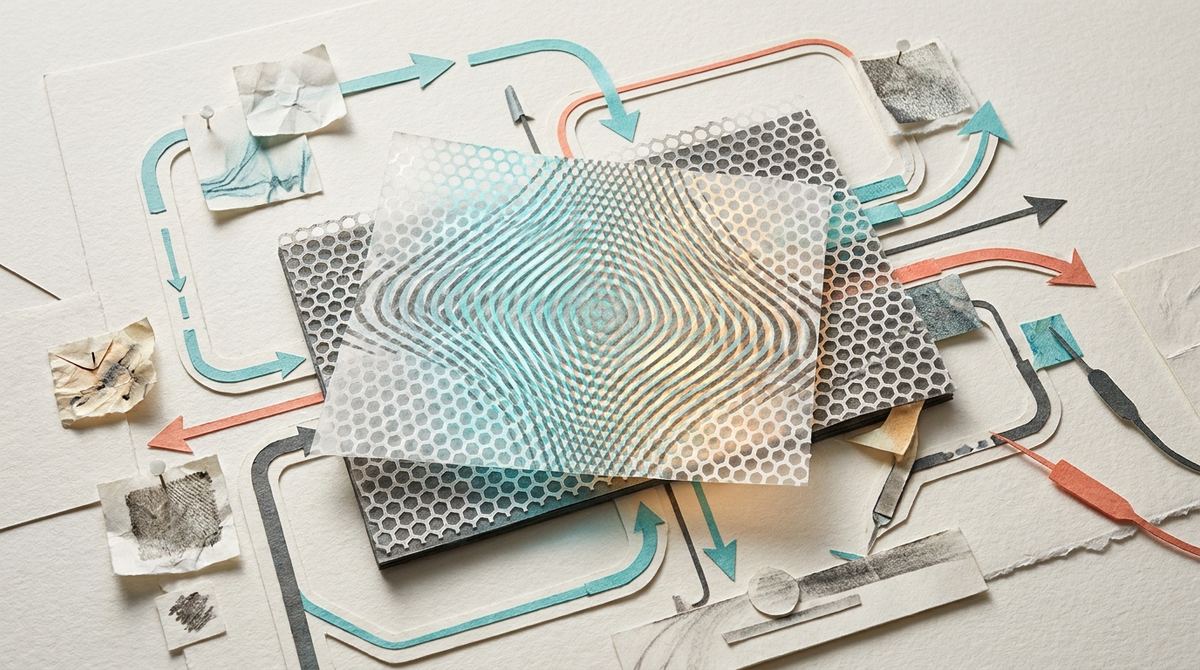
The solution lies in a phenomenon called the moiré effect. You have likely seen this effect in real life: if you take two fine mesh screens and overlap them at a slight angle, a new, much larger pattern emerges from the interference of the two grids. At the atomic scale, the same thing happens when you stack two layers of a two-dimensional material, such as graphene, and twist them slightly. This twist creates a "moiré superlattice," a new periodic pattern that is much larger than the original atomic spacing.
This superlattice acts as a landscape for electrons. Instead of moving freely through the material, the electrons now "see" a complex series of hills and valleys created by the interference pattern. This landscape can be used to trap, guide, or modulate the flow of electrons. Because this pattern is created by the physical orientation of the atoms, the material possesses an inherent ability to store information based on how electrons are distributed across this landscape. This research moves us away from using transistors to represent bits and toward using the physical structure of the material itself to represent the complex, adaptive weights required for artificial intelligence.
To understand how this works, we must look at the specific physics of these 2D materials. The research conducted by Tanweer Ahmed, Kenji Watanabe, Takashi Taniguchi, Fèlix Casanova, and Luis E. Hueso focuses on how these moiré patterns create unique electronic states. The researchers utilized ultra-clean, atomically flat layers of 2D materials, which are essential because even a single misplaced atom can disrupt the delicate moiré pattern.
When these layers are stacked and twisted, the atomic potentials of the two layers overlap. This creates a superlattice potential that is much larger and more influential than the underlying atomic lattice. In these specific configurations, the material can exhibit "flat bands," which are energy states where electrons essentially slow down or become localized. When electrons become localized in these moiré patterns, they can be manipulated by an external voltage.
The concept of "second-order" synaptic memory is the most technical and groundbreaking aspect of this system. In a standard artificial synapse, the memory is typically "first-order," meaning the change in conductivity is directly proportional to the amount of charge applied. However, the researchers found that these moiré superlattices exhibit a more complex relationship. The "plasticity"—the ability of the material to change its resistance—is sensitive to the history and the rate of change of the input signal. This is achieved because the charge carriers do not just move through the material; they interact with the periodic potential of the moiré pattern in a way that creates a memory of the cumulative effect of the applied electrical field. This means the material's conductivity is not just a function of the current voltage, but a function of the pattern of voltages that came before it, mimicking the temporal dynamics of biological neurons.
The study revealed that the inherent plasticity of the moiré superlattice allows for a highly sophisticated form of electronic memory. The researchers observed that the material could undergo "weight updates" similar to those in a neural network. By applying controlled electrical pulses, they could shift the electronic distribution within the moiré pattern, thereby changing the overall resistance of the device.
Crucially, the researchers identified that this is a second-order effect. This means the material's response is not just a simple, linear change. Instead, the memory effect is tied to the complex, non-linear ways electrons interact with the superlattice potential. This non-linearity is a vital requirement for neuromorphic computing. In a neural network, the "weight" of a connection determines how much signal passes through a synapse. To learn, these weights must be able to change in complex ways. The moiré superlattice provides this naturally through its inherent physics, meaning we do not need to rely on complex, power-hungry circuitry to simulate these non-linear behaviors; the material does it automatically.
This research is a significant step toward the realization of true neuromorphic hardware. By using the physical structure of a material to perform the tasks of a synapse, we can drastically reduce the energy requirements of artificial intelligence. If we can build chips where the memory and the computation are one and the same, we eliminate the Von Neumann bottleneck entirely.
The ability to achieve second-order synaptic memory is particularly important for "on-device learning." Currently, most AI models are trained in massive data centers and then "frozen" before being downloaded to your phone. The phone can use the model, but it cannot easily learn from your specific usage patterns without an enormous battery drain. A material-based synapse that mimics the temporal, non-linear learning of a brain would allow a device to learn from its environment in real-time, adapting to a user's voice, habits, or surroundings with minimal power consumption.
While the results are groundbreaking, there are several significant hurdles before this technology can reach your smartphone. First is the issue of fabrication precision. The moiré effect is extremely sensitive to the "twist angle." A deviation of even a fraction of a degree can completely change the electronic properties of the superlattice. Currently, creating these precisely twisted, atomically clean stacks is a painstaking process primarily limited to laboratory settings.
Second is the temperature constraint. Many of the most interesting electronic phenomena in 2D materials, particularly those involving highly localized electron states, have been observed at cryogenic temperatures (extremely cold environments). To be commercially viable, these second-order memory effects must be demonstrated and stabilized at room temperature.
Finally, there is the question of scalability. While it is possible to create these superlattices in a lab using specialized equipment like "dry transfer" methods, scaling this up to produce millions of identical, perfectly twisted devices on a silicon wafer is a massive engineering challenge that has not yet been solved.
Once the challenges of fabrication and temperature are overcome, the applications for moiré-based neuromorphic chips are vast. In the field of autonomous robotics, a robot equipped with these chips could process visual and tactile information locally, allowing it to navigate complex environments and learn from mistakes without needing to communicate with a central server. This reduces latency and increases safety.
In the realm of wearable healthcare technology, these materials could enable continuous, long-term monitoring of biological signals. A tiny, ultra-low-power chip could learn a user's unique heart rate patterns and recognize anomalies locally, alerting a doctor immediately without the need for constant data streaming to the cloud.
Furthermore, edge AI in consumer electronics—such as smart home devices, drones, and even advanced automotive sensors—would benefit from the ability to process complex patterns locally and efficiently, making the technology more responsive and significantly more private, as less data would need to be sent to the cloud for processing.
If you remember only one thing from this research, let it be this: the future of artificial intelligence may not lie in faster traditional processors, but in entirely new classes of materials that mimic the physical architecture of the human brain through the magic of atomic-scale interference patterns.
What exactly is a moiré pattern in this context? A moiré pattern occurs when two identical, finely patterned structures are overlaid at a slight angle, creating a new, much larger pattern. In this research, the "patterns" are the periodic arrangements of atoms in two different layers of 2D materials, and the resulting moiré pattern creates a new electrical landscape for electrons to navigate.
Why is "second-order" memory better than standard digital memory? Standard digital memory is simple and linear, representing only one or zero. Second-order memory is more complex; it allows the material to respond to the history and the rate of change of an input signal. This mimics the "plasticity" of biological synapses, which is essential for the complex, nuanced learning required for true artificial intelligence.
What are 2D materials like graphene? 2D materials are substances that are only a single atom thick. Because they are so thin, they have extraordinary properties, such as incredible electrical conductivity and immense strength. When you stack these ultra-thin layers, you can create entirely new materials with properties that do not exist in nature.
Does this mean we will replace current computer chips soon? Not immediately. The research is currently in the fundamental science stage. Before these moiré-based synapses can replace traditional silicon transistors, scientists must figure out how to manufacture them reliably, at scale, and at room temperature.
What is the benefit of "in-memory computing" for AI? In current computers, moving data between the memory and the processor consumes most of the energy. In-memory computing performs calculations directly within the memory storage itself. This eliminates the need for data movement, which dramatically increases speed and reduces the massive energy consumption associated with modern AI.
The work by Ahmed, Watanabe, Taniguchi, Casanova, and Hueso represents a profound shift in how we approach hardware design. By moving away from the rigid, binary constraints of traditional silicon and toward the fluid, adaptive physics of moiré superlattices, we are opening the door to a new era of neuromorphic computing. This research suggests that the key to creating intelligent machines may not be found in writing better code, but in discovering better materials that naturally behave like the brain itself.
Serious about B2B integration? Test our premium Pulsed Electrical Resistive Carbon Heating turbostratic graphene in your lab. 100g sample packs available now.
Explore More
Discover how rippled graphene pores act as fluidic memristors, enabling advanced synaptic functionalities for the next generation of neuromorphic computing.

Learn how to use electromechanical responses in gapped graphene to measure electronic temperature and band gaps using traveling flexural waves.

Explore how researchers have discovered viscous electron fluid behavior in cadmium, a breakthrough that could revolutionize the future of nanoelectronics.