Graphene's Strange Metal State: How Vibrations Forge Non-Fermi-Liquid Behavior
Explore how specific atomic vibrations in graphene can create a "strange metal" or non-Fermi-liquid state, a breakthrough in controlling quantum materials.
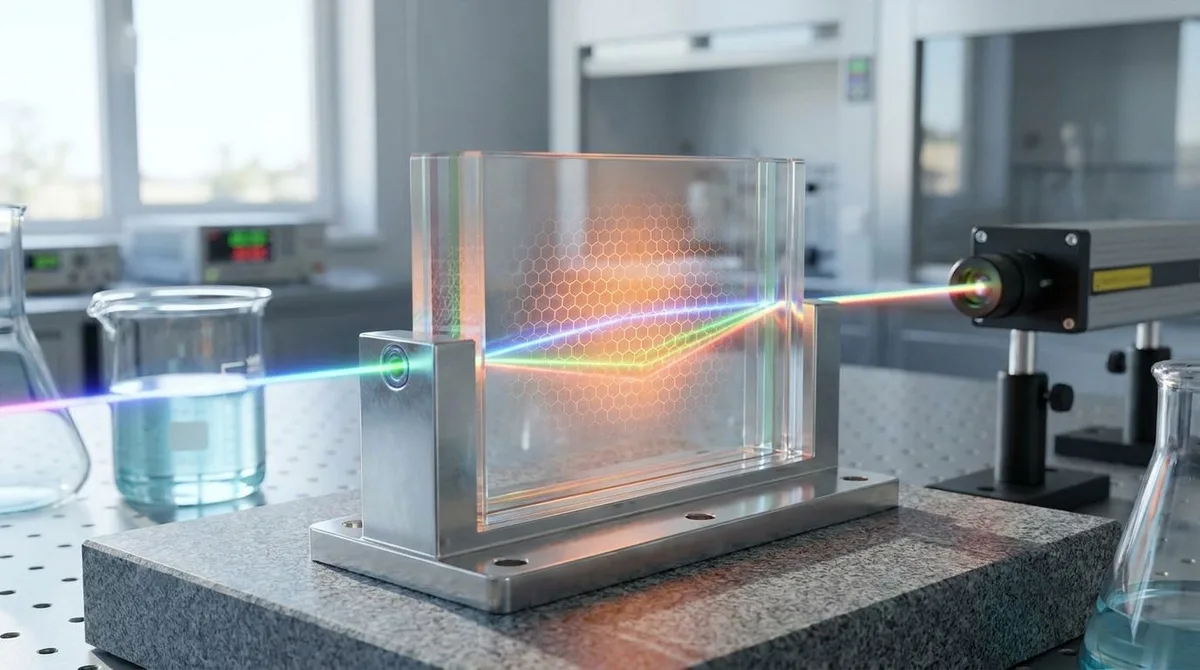
Imagine a window that can instantly change its tint to block the afternoon sun, a camera lens that refocuses without any moving parts, or a holographic display that updates in real time. For decades, these have been concepts largely confined to science fiction. The ability to actively control and manipulate light on demand, known as reconfigurable photonics, represents a monumental leap in optical engineering. While progress has been made for infrared light, creating materials that are both transparent and dynamically tunable for the visible light our eyes can see has remained a formidable challenge. A recent breakthrough in materials science now points toward a viable solution, combining the unique properties of a novel metallic alloy with the exceptional capabilities of graphene.
The world around us is built on static optics. The glass in our windows, the lenses in our glasses, and the filters in our cameras all have fixed properties. They are designed to do one job and do it well, but they cannot adapt to changing conditions. To achieve dynamic control, we typically rely on bulky, slow, and power-hungry mechanical systems like motors, shutters, and gimbal-mounted mirrors. The goal of reconfigurable photonics is to replace these mechanical components with solid-state materials whose optical properties can be changed with an external stimulus, such as an electrical voltage or heat.
The central difficulty lies in finding the right material. For visible light applications, a material must be highly transparent in its default state but also capable of significantly changing how it transmits, reflects, or refracts light when activated. Many materials that exhibit this phase-change behavior, such as germanium-antimony-tellurium (GST), work well in the infrared spectrum but are too opaque for visible light. Conversely, materials that are transparent in the visible spectrum often lack a strong, reversible mechanism for tuning their optical properties. Furthermore, many promising metals like silver, which has excellent properties for manipulating light at the nanoscale, suffer from poor environmental stability; they tarnish and degrade quickly when exposed to air. In a new research paper, a team of scientists including Hongyi Sun, Yi-Siou Huang, Junyeob Song, Francis Vásquez-Aza, Christopher S. Whittington, Nathan Youngblood, Sharon M. Weiss, Georges Pavlidis, Amit Agrawal, and Carlos A Rios Ocampo addresses these challenges head-on with an innovative material platform.
The core innovation presented by the researchers is the development of an ultra-thin film of silver that has been doped with a small amount of aluminum. This new material, aluminum-doped silver (Al-Ag), elegantly solves two problems at once. First, the addition of aluminum atoms into the silver crystal lattice dramatically improves the material's stability, protecting it from the oxidation and sulfidation that causes pure silver to tarnish. This ensures the optical component has a long and reliable operational lifetime.
Second, and more importantly, the Al-Ag film is designed to be "thermally reconfigurable." This means its optical properties can be precisely controlled by changing its temperature. When gently heated, the atomic arrangement within the ultra-thin film shifts subtly. This structural change alters the way the material's free electrons interact with incoming light waves, a phenomenon related to plasmonics. The result is a measurable change in the film's refractive index and absorption coefficient, which in turn modifies the color, intensity, and phase of the light passing through it. Because the film is extremely thin—likely only a few nanometers—it remains highly transparent, allowing most of the light to pass through while still enabling active modulation. The key is that this change is reversible; as the material cools, it returns to its original state, ready to be activated again.
The concept of a thermally reconfigurable material is powerful, but it requires a critical enabling component: a heater that is itself transparent, efficient, and ultra-thin. This is where graphene becomes an indispensable part of the system. Constructing a practical device involves creating a multi-layer stack. A transparent substrate, such as glass or flexible plastic, forms the base. On top of this, the ultra-thin Al-Ag active layer is deposited. The final and crucial layer is a sheet of high-quality graphene.
Graphene's role here is that of a perfect transparent heating element. Due to its unique atomic structure—a single layer of carbon atoms arranged in a honeycomb lattice—graphene possesses an extraordinary combination of properties. It is more transparent than glass across the visible spectrum, meaning it does not block or color the light passing through the device. At the same time, it is an excellent electrical conductor. When a small voltage is applied across the graphene sheet, its electrical resistance causes it to heat up rapidly and uniformly through a process called Joule heating. This heat is then efficiently transferred to the adjacent Al-Ag layer, triggering its optical state change.
The thinness of the graphene layer is also a major advantage. At just one atom thick, it adds negligible bulk or weight to the final device, allowing for the creation of extremely compact and lightweight optical systems. The efficiency of graphene as a heater means that the optical state can be switched with minimal power consumption. The quality of the material, often derived from sources like industrial graphene supply, ensures uniform heating without hot spots, leading to precise and repeatable control over the device's optical properties. This elegant synergy between the Al-Ag active material and the graphene heater is central to creating a functional device for graphene electronics.
The authors of the paper demonstrated the viability of their ultra-thin aluminum-doped silver films as a platform for transmissive, thermally reconfigurable photonics. Their work likely involved fabricating these films and meticulously characterizing their optical properties both before and after heating. They would have measured how key metrics like transmittance (the percentage of light that passes through) and refractive index (a measure of how much the material bends light) change with temperature.
The title "Transmissive Thermally Reconfigurable Visible Photonics" implies several key findings. First, the material is "transmissive," confirming that even with the addition of aluminum, the silver film remains largely transparent in the visible spectrum, a prerequisite for applications like smart windows or see-through displays. Second, it is "thermally reconfigurable," meaning they successfully observed and quantified a reversible change in its optical properties upon heating and cooling. They would have demonstrated that this effect is repeatable over many cycles without significant degradation of the material, which confirms the enhanced stability provided by the aluminum doping. The research likely established a clear relationship between the applied temperature and the resulting optical state, proving that the material’s response is controllable and predictable.
This research provides a crucial building block for the future of optics. By creating a stable, transparent, and tunable material for visible light, it opens the door to replacing static, single-purpose optical components with dynamic, multi-functional ones. This shift from passive to active optics has profound implications. It allows for the development of flat, compact optical systems that can perform tasks currently requiring complex assemblies of lenses and mirrors.
The significance lies in moving beyond the mechanical world. Instead of physically moving a lens to focus, we could change the refractive index of a flat surface to achieve the same effect electronically. Instead of using a colored filter, we could tune a material to absorb a specific wavelength of light. This solid-state approach is faster, more reliable, has no moving parts to wear out, and can be miniaturized to fit on a microchip. This work contributes a new and promising material to the toolkit of engineers and scientists working on next-generation optical devices, from consumer electronics to advanced scientific instruments. The potential graphene applications in this field are expanding rapidly as new complementary materials like Al-Ag are developed.
While this research is highly promising, it represents an early stage in the development process. Several important questions must be addressed before this technology can be commercialized. A primary concern is switching speed. Thermal processes are inherently slower than purely electronic ones. The time it takes for the material to heat up and, more importantly, cool down will determine its suitability for applications like high-speed displays or optical communications. This thermal latency needs to be thoroughly quantified.
Power consumption is another critical factor. While graphene heaters are efficient, the energy required to induce and maintain the desired optical state needs to be low enough for use in battery-powered devices like AR glasses or mobile phones. Long-term durability is also a key unknown. Although the aluminum doping improves stability, the material must be tested over tens of thousands of switching cycles to ensure it does not degrade over the lifetime of a product. Finally, the scalability of the manufacturing process needs to be explored. Fabricating small-scale laboratory samples is one thing; developing cost-effective methods for producing large-area films for windows or displays is a significant engineering challenge that will require advances in scalable graphene production.
If the remaining challenges can be overcome, the potential applications for this technology are vast and transformative. In architecture, it could lead to smart windows that dynamically control the amount of light and heat entering a building, dramatically reducing energy costs for heating and cooling. In consumer electronics, it could enable true augmented reality glasses with compact, lightweight, and electronically focusable lenses.
In the automotive industry, this material could be used for LiDAR systems in autonomous vehicles, allowing for non-mechanical beam steering to scan the environment. This would create more robust and compact sensors than the spinning mechanical units used today. Other potential applications include dynamic holographic displays, tunable color filters for advanced cameras and sensors, and reconfigurable optical interconnects for next-generation data centers, where light is used to transmit data between computer chips.
The key takeaway from this research is that doping an ultra-thin silver film with aluminum creates a new material that is stable, transparent, and whose optical properties in the visible spectrum can be actively controlled with heat. When combined with a graphene transparent heater, this forms a powerful platform for creating a new generation of dynamic, solid-state optical devices.
What is photonics?
Photonics is the science and technology of generating, controlling, and detecting photons, which are particles of light. It encompasses a wide range of applications, from fiber optic communications and laser manufacturing to medical imaging and consumer electronics displays. This field aims to use light in the same way that electronics uses electrons.
Why is it hard to make reconfigurable devices for visible light?
The primary challenge is finding materials that satisfy multiple conflicting requirements. They must be highly transparent so they don't block the light they are meant to control, but they also need to undergo a significant and reversible change in their optical properties when a stimulus is applied. Many materials that work well for infrared light are too opaque in the visible spectrum, while many transparent materials are not easily tunable.
What is special about aluminum-doped silver?
Pure silver has excellent optical properties for manipulating light but tarnishes very easily, making it impractical for most real-world devices. Doping the silver with a small amount of aluminum creates an alloy that retains the desirable optical characteristics of silver while dramatically increasing its chemical stability and resistance to degradation, making it a much more robust material for optical components.
What role does graphene play in this system?
Graphene acts as the perfect heating element to control the aluminum-doped silver. It is electrically conductive, allowing it to generate heat efficiently when a voltage is applied, but it is also optically transparent, so it doesn't interfere with the device's function. Its atomic thinness also means it adds almost no bulk, enabling the creation of ultra-compact optical systems.
Is this technology ready for consumer products?
No, this technology is still in the early research and development phase. While the fundamental science is promising, significant engineering challenges related to switching speed, power consumption, long-term durability, and large-scale manufacturing must be solved before it can be integrated into consumer products. It represents a foundational step, not a finished solution.
The work on ultra-thin aluminum-doped silver represents a significant advancement in the field of materials science for visible photonics. By addressing the long-standing stability issues of silver while creating a thermally reconfigurable platform, these researchers have unlocked a new pathway for developing active optical devices. The integration of graphene as a transparent, efficient heater is not merely an add-on but a critical enabler that makes the entire system concept viable. This convergence of novel alloys and advanced 2D materials highlights a powerful trend in modern engineering. While much work remains to be done, this research provides a clear and promising glimpse into a future where our interaction with light is no longer static, but dynamic, intelligent, and seamlessly integrated into the world around us.
Serious about B2B integration? Test our premium Pulsed Electrical Resistive Carbon Heating turbostratic graphene in your lab. 100g sample packs available now.
Explore More
Explore how specific atomic vibrations in graphene can create a "strange metal" or non-Fermi-liquid state, a breakthrough in controlling quantum materials.
Graphene memory research is advancing, but a fast laboratory device is not a PC RAM upgrade. Here is what the evidence shows.
Researchers develop a new technique using the nonlinear Hall effect in ballistic graphene to create high-resolution maps of Berry curvature, a key quantum...