Graphene Magnonics and Topological Frustration: A New Path for Computing
Research into graphene magnonics explores how topological frustration can create robust, one-way channels for spin waves, paving the way for future...
The world of materials science was forever changed when researchers discovered that stacking two sheets of graphene and twisting them by a tiny "magic" angle could produce superconductivity, a state of zero electrical resistance. This opened the field of "twistronics," where the rotational angle between atomic layers becomes a powerful knob for tuning material properties. But what happens when we go beyond two layers and create more complex, ordered stacks? A new theoretical study provides a fascinating glimpse into this future, exploring a material built from multiple graphene layers with twists that alternate back and forth. This work offers a roadmap for designing materials with exotic quantum behaviors that could one day redefine electronics and computing.
As scientists explore the landscape of twisted 2D materials, the complexity grows. While twisted bilayer graphene is now a well-studied system, the properties of multilayer stacks, especially those with intricate stacking orders, remain largely uncharted territory. A team of researchers, Igor Vasilevskiy, Miguel Sánchez Sánchez, Khadija Challaouy, Dionisios Margetis, Guillermo Gómez-Santos, and Tobias Stauber, sought to address this gap. Their work tackles the fundamental question of how a stack of graphene with alternating twist angles (for example, +1.1 degrees, then -1.1 degrees, then +1.1 degrees, and so on) behaves in the presence of a magnetic field applied parallel to the material's surface, or "in-plane."
This specific configuration is important for two reasons. First, most studies focus on magnetic fields applied perpendicular to the graphene sheets. The in-plane response is a less-explored but critical piece of the puzzle, revealing different aspects of the material's electronic structure and the nature of its quantum states. Second, understanding this response allows for the calculation of a crucial value known as the Maki parameter. This parameter helps physicists classify the type of superconductivity a material might host, providing clues as to whether it is a conventional, well-understood type or a more exotic, "unconventional" form that is of great interest for future technologies like quantum computers. The problem, therefore, is to build a reliable theoretical model that can predict these properties before undertaking the immensely difficult task of fabricating and measuring such a complex material.
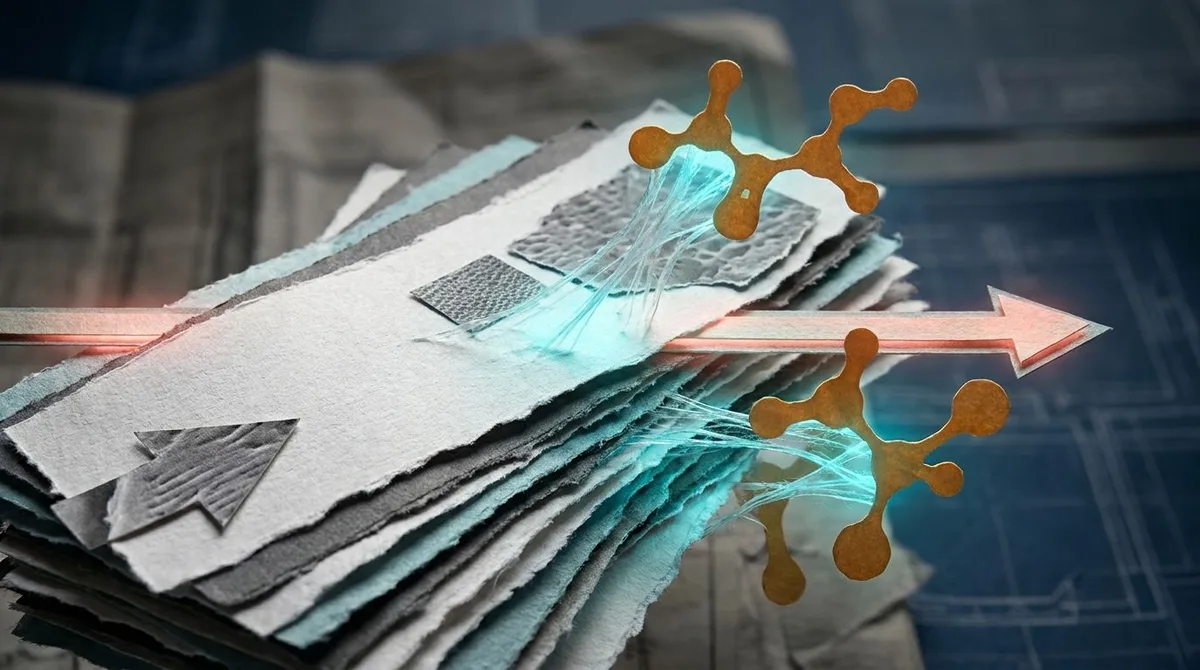
Imagine you have a stack of patterned transparent sheets. When you lay one on top of another and twist it slightly, you see a new, larger pattern emerge—a moiré pattern. In graphene, this moiré pattern creates a "superlattice" that dramatically changes how electrons move. Electrons can get trapped in this new landscape, slowing down and interacting with each other much more strongly than they normally would. This is the source of the magic in magic-angle graphene.
The key idea of this research is to extend this concept to a multilayer stack where the twist angle isn't constant but alternates. The researchers hypothesized that this alternating structure would create an even more complex and potentially more powerful electronic landscape. They developed a mathematical framework to simulate how electrons within this specific structure would react to the subtle but important influence of an in-plane magnetic field. By modeling the electron energy levels and their behavior under this field, they could calculate the material's overall magnetic response and, critically, extract the Maki parameter. In essence, they created a computational microscope to peer into the quantum mechanical heart of a material that does not yet exist on a lab bench, providing the first theoretical predictions for this promising new system.
The system at the center of this study is an alternating-twist multilayer graphene stack. It begins with a single sheet of graphene, which is a one-atom-thick layer of carbon atoms arranged in a honeycomb lattice. A second sheet is placed on top and twisted by a small angle, let's say +θ. A third sheet is then placed on top of the second, but it is twisted in the opposite direction, -θ, relative to the layer below it. This pattern of alternating positive and negative twists continues for multiple layers.
This specific stacking order is far from random. Unlike the disordered arrangements found in materials like turbostratic graphene flakes, this structure has a precise, repeating symmetry. The alternating twists create a highly intricate, three-dimensional moiré superlattice. This superlattice acts as a periodic potential landscape for the electrons, fundamentally altering their allowed energy states. As in simpler twisted systems, this can lead to the formation of "flat bands"—energy levels where the electrons have very low velocity. When electrons occupy these flat bands, their kinetic energy is suppressed, and the effects of their mutual repulsion (electron-electron correlation) become dominant. These strong correlations are the gateway to exotic phases of matter, including unconventional superconductivity and correlated insulating states.
When an in-plane magnetic field is applied, it interacts with the electrons in two main ways. It couples to the electron's intrinsic magnetic moment, known as spin (the Zeeman effect), and it also affects the electron's orbital motion as it moves through the material. In this complex, twisted structure, the magnetic field's effect on the orbital motion becomes particularly important and non-trivial. The theoretical model developed by the researchers captures these intricate interactions, allowing them to predict how the electronic flat bands are modified by the field and how this ultimately shapes the material's macroscopic properties.
Through their detailed theoretical modeling, the researchers were able to make specific predictions about the behavior of alternating-twist multilayer graphene. Their primary finding is a quantitative description of the material's in-plane magnetic response. They calculated how the energy levels of the electrons shift and split as a function of the applied magnetic field strength and the twist angle between the layers. This provides a unique fingerprint of the material's electronic structure.
Crucially, from this magnetic response, they derived the Maki parameter. Their calculations suggest that for certain twist angles where flat bands emerge, the Maki parameter in these alternating-twist systems can become exceptionally large. A large Maki parameter is a strong indicator of unconventional superconductivity. It suggests that if this material were to become a superconductor, its superconducting state would be unusually robust against in-plane magnetic fields. In many conventional superconductors, even a modest magnetic field can destroy the superconducting state. The predicted resilience in this new structure is a significant theoretical result.
Furthermore, the model allows for a systematic exploration of how these properties evolve with the number of layers in the stack. This provides a design tool for tuning the material's characteristics. By adding more layers in an alternating-twist fashion, it may be possible to further enhance the strong-correlation effects and optimize the conditions for hosting exotic quantum states. The research provides a set of theoretical data—graphs and calculations—that experimentalists can now aim to verify.
This theoretical work is significant because it acts as a guidepost for the future of materials science. The experimental fabrication of precisely aligned multilayer graphene structures is incredibly challenging, expensive, and time-consuming. A robust theoretical model like this one allows the scientific community to identify the most promising structures and parameter ranges before committing significant resources to building them. By predicting a large Maki parameter, the study elevates alternating-twist multilayer graphene from a mere curiosity to a prime candidate in the search for new quantum materials.
The findings deepen our fundamental understanding of strongly correlated electron physics. These systems are notoriously difficult to understand, and each new platform that can be modeled and eventually tested adds a vital piece to the overall puzzle. The unique symmetry of the alternating-twist structure provides a new playground for physicists to test and refine their theories of electron interactions.
Moreover, the focus on the in-plane magnetic field response is important for practical device physics. In many potential electronic and spintronic devices, components would be subjected to magnetic fields from various angles, not just perpendicularly. Understanding and eventually engineering the in-plane response is essential for designing functional and reliable next-generation graphene electronics. This research provides the first chapter in the operational manual for this new class of materials.
The most significant limitation of this research is its purely theoretical nature. While the model is built on established principles of quantum mechanics, it has not yet been confirmed by experimental measurement. The predictions of a large Maki parameter and a specific magnetic response are, for now, just predictions. The next critical step is for experimental groups to develop the techniques to fabricate these alternating-twist multilayers with sufficient precision and then measure their properties in a laboratory.
The fabrication process itself presents a monumental challenge. Achieving precise, alternating twist angles layer after layer is at the absolute cutting edge of nanotechnology. Real-world samples will inevitably contain imperfections, such as wrinkles, tears, atomic defects, and variations in the twist angle, which are not fully accounted for in the idealized model. The substrate on which the graphene is placed can also induce strain and alter the electronic properties.
Furthermore, theoretical models often involve approximations. The calculations may simplify the nature of the electron-electron interactions or neglect other environmental factors. Therefore, even when experimental data becomes available, there will likely be differences between the theoretical predictions and the measured results, which will in turn help to refine the theoretical models further.
While this research is fundamental and far from commercial application, its implications point toward several transformative technologies. The potential for robust, unconventional superconductivity is perhaps the most exciting. Such materials could be foundational for building fault-tolerant quantum computers. Topological qubits, a promising approach to quantum computation, could potentially be realized in materials with the type of exotic superconductivity hinted at by this research.
Beyond quantum computing, materials with tunable, strong electronic correlations are of interest for a wide range of advanced electronics. They could lead to ultra-low-power transistors, new types of memory, or highly sensitive magnetic field sensors. The ability to control the electronic state of a material (from insulator to superconductor, for instance) simply by adjusting a twist angle or applying a small field is a powerful concept for creating reconfigurable electronic systems.
In the long term, understanding these complex stacks could inform the design of a broad array of engineered quantum materials. While the initial focus is on graphene, the principles of twist-angle engineering can be applied to other 2D materials, opening up a vast design space for materials with on-demand electronic, optical, and magnetic properties. These designer materials could find their way into a variety of graphene applications, from next-generation communications to advanced energy systems.
If you remember one thing from this research, it should be this: stacking graphene layers with a precisely alternating twist angle (+θ, -θ, +θ...) creates a unique artificial material with a highly tunable electronic structure. This theoretical study predicts that such a material is a prime candidate for hosting exotic quantum states, like unconventional superconductivity, that are remarkably stable in the presence of magnetic fields, paving the way for future experimental exploration.
What is "twistronics"?
Twistronics is a field of condensed matter physics that studies how the properties of stacked two-dimensional materials, like graphene, change when the layers are twisted relative to one another. This twist creates a moiré superlattice that can dramatically alter the material's electronic behavior, leading to emergent phenomena such as superconductivity and correlated insulating states that are not present in the individual layers.
What makes an "in-plane" magnetic field special in this context?
An in-plane magnetic field is one that is applied parallel to the surface of the material. While perpendicular fields primarily cause electrons to move in circular paths, in-plane fields interact more subtly with both the electron's orbital motion and its intrinsic spin. Studying the response to an in-plane field provides complementary information about the material's electronic band structure and the nature of its quantum states, which is particularly revealing in complex, anisotropic structures like twisted multilayers.
What is the Maki parameter and why is it important?
The Maki parameter is a dimensionless quantity in the theory of superconductivity that relates a material's upper critical magnetic field (the field that destroys superconductivity) to its superconducting energy gap. A very large Maki parameter often signifies that the superconductivity is "unconventional," meaning it cannot be explained by standard theories. It also suggests that the superconducting state is very robust against being broken by magnetic fields, a desirable property for many potential applications.
Is this technology ready to be used in products?
No, this research is at a very early, fundamental stage. It is a theoretical study that makes predictions about a material that is extremely difficult to create in a lab, let alone produce at scale. The primary value of this work is to guide future research and experimentation. It will likely take many years of further research and development before the concepts explored here could be translated into commercial products.
How is alternating-twist graphene different from regular twisted bilayer graphene?
Regular twisted bilayer graphene consists of just two layers of graphene twisted by a single angle. This creates a single two-dimensional moiré pattern. Alternating-twist multilayer graphene involves three or more layers, with the twist angle alternating between positive and negative values between successive layers. This creates a more complex, three-dimensional superlattice, offering additional degrees of freedom for tuning the material's properties and potentially stabilizing different or more robust quantum phases.
The theoretical exploration of alternating-twist multilayer graphene by Vasilevskiy and his colleagues represents a significant step forward in the field of twistronics. By moving beyond the well-trodden ground of bilayer systems, they have illuminated a new direction for materials design. Their prediction of a large Maki parameter provides a tantalizing hint that these complex stacks could be a fertile ground for discovering and manipulating robust, unconventional superconducting states. While the path from theoretical prediction to experimental verification and eventual application is long and challenging, this work provides a crucial blueprint. It underscores the incredible richness of physics hidden within simple carbon layers and reinforces the idea that by stacking and twisting, we can engineer the quantum world from the bottom up.
Serious about B2B integration? Test our premium Pulsed Electrical Resistive Carbon Heating turbostratic graphene in your lab. 100g sample packs available now.
Explore More
Research into graphene magnonics explores how topological frustration can create robust, one-way channels for spin waves, paving the way for future...

Discover how longitudinal nonreciprocal charge transport could revolutionize electronics by enabling one-way current flow in graphene without magnetic fields.
Discover how computational modeling shows that creating atomically precise perforations in 2D MXenes can induce a negative Poisson's ratio, or auxetic response.