Engineering Graphene Superlattices with Anisotropic Strain
Discover how anisotropically strained twisted bilayer graphene creates commensurate moiré superlattices, a breakthrough for engineering predictable...
Imagine stretching a rubber band. As it gets longer, it also gets noticeably thinner. This intuitive behavior, where a material narrows in one direction when pulled in another, is characteristic of almost everything around us, from steel beams to clothing fibers. But what if a material did the opposite? What if, when you stretched it, it actually grew thicker? Such materials, known as auxetics, are rare and possess a host of remarkable properties useful for everything from bomb-proof vests to biomedical implants. The challenge has always been how to design and build them, especially at the nanoscale. New computational research points toward a fascinating solution using one of the most promising families of two-dimensional materials.
The world of advanced materials is in a constant search for new properties. While we have materials that are incredibly strong, lightweight, or conductive, controlling their mechanical response in three dimensions remains a significant hurdle. The property that governs how a material deforms laterally when stretched or compressed is known as the Poisson's ratio. For nearly all materials, this value is positive; stretch it, and it thins. A negative Poisson's ratio defines an auxetic material. This counter-intuitive property allows a material to become denser and stronger at a point of impact, making it an exceptional shock absorber. It also allows for unique conformity, where a fastener can be inserted easily and then expand when pulled, creating a super-secure anchor. The problem is that naturally auxetic materials are uncommon, and engineering this property into high-performance materials like those in the 2D family is a complex design challenge. In a recent computational study, researcher Hossein Darban explores a method to overcome this by using atomic-level architecture to imbue a class of 2D materials known as MXenes with a powerful auxetic response.
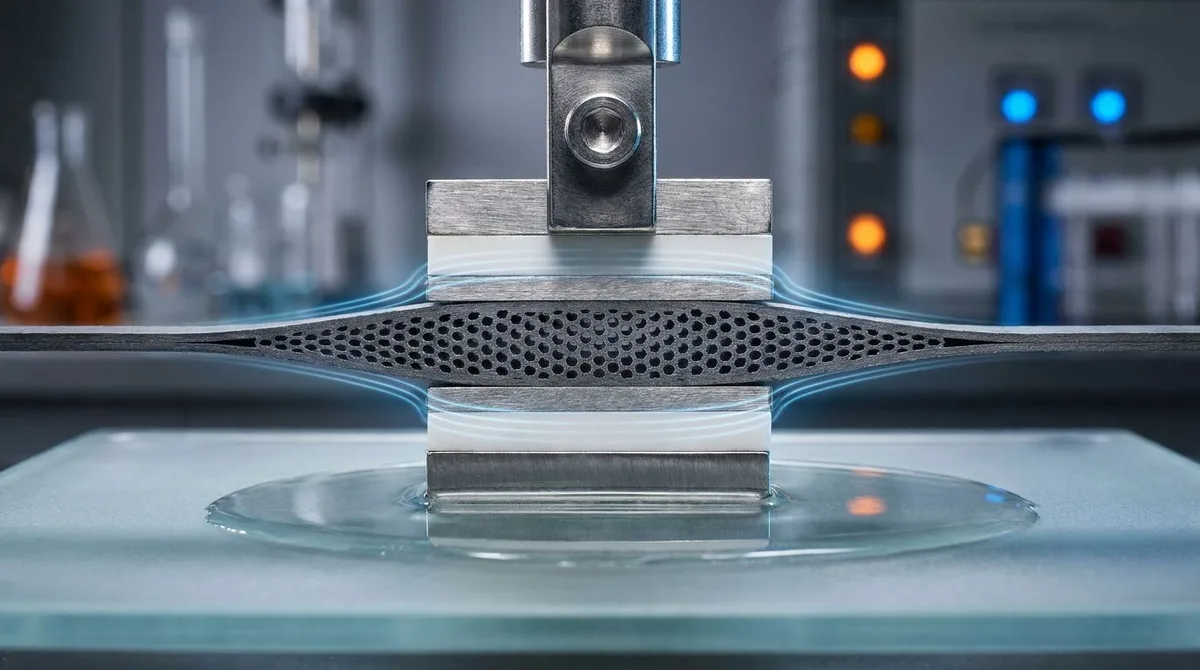
The central idea behind this research is elegantly simple: if a material’s natural structure doesn’t behave in a certain way, you can sometimes force it to by changing its geometry. The study proposes taking an atom-thin sheet of a material called MXene and strategically removing atoms to create a precise pattern of perforations, or tiny holes. These are not random defects; they are meticulously designed voids that act like a network of microscopic hinges and levers. When a force is applied to stretch the perforated sheet, this internal geometry is forced to reconfigure. Instead of the atoms simply pulling farther apart and causing the sheet to thin, the hinges within the structure open up. This unfolding motion pushes the material outward, perpendicular to the direction of the pull. The result is that the entire sheet expands, becoming thicker as it is stretched. By carefully controlling the size, shape, and spacing of these atomic perforations, it becomes possible to not only create an auxetic effect but to tune its intensity for specific needs.
This research operates in the broader universe of two-dimensional materials, a field that exploded into prominence with the isolation of graphene. While this study focuses on MXenes, the principles and modeling techniques are part of the legacy of graphene exploration. MXenes (pronounced "max-eens") are a family of 2D materials composed of transition metal carbides, nitrides, or carbonitrides. A common example is titanium carbide (Ti3C2), which consists of a few-atoms-thick layer of titanium and carbon atoms. Unlike graphene, which is a pristine sheet of carbon, MXenes have a more complex chemistry and often have other molecules, or functional groups, attached to their surfaces, which gives them unique electronic and chemical properties.
The "system" investigated in this work is a computational model, not a physical object. The research, categorized under computational physics, likely used sophisticated simulation techniques like Density Functional Theory (DFT). In this approach, scientists build a virtual, atom-by-atom replica of a MXene sheet inside a computer. They then digitally perform surgery on this sheet, removing specific atoms to create the desired perforation patterns. Once this engineered structure is built in the simulation, a virtual "stress test" is performed. The program applies a tensile force to stretch the digital sheet along one axis. As the sheet deforms, the simulation continuously calculates the positions of all the atoms. By measuring how much the sheet expands or contracts in the perpendicular axis, the researchers can calculate the Poisson's ratio. A negative value confirms an auxetic response. This computational method allows for the rapid testing of countless perforation geometries to find the most effective designs without the immense cost and difficulty of physical experimentation, guiding future efforts in creating advanced reinforced polymer composites.
The primary finding, as suggested by the paper's title, is that introducing atomically defined perforations is a viable and effective strategy for inducing an auxetic response in 2D MXenes. The simulations demonstrated that a standard, non-perforated MXene sheet behaves conventionally, exhibiting a positive Poisson's ratio. However, once specific perforation patterns were introduced, the material's behavior fundamentally changed. The simulations confirmed that when the perforated MXene sheet was subjected to tensile strain, it expanded laterally, yielding a negative Poisson's ratio.
Furthermore, the research likely established a clear relationship between the geometry of the perforations and the strength of the auxetic effect. The size of the holes, their shape (e.g., hexagonal versus rectangular), and their spacing on the MXene lattice were all critical parameters. By tuning these variables, the researchers could control the exact value of the negative Poisson's ratio, effectively making it a programmable material property. This computational proof-of-concept shows that MXenes are not just passive building blocks; their fundamental mechanical character can be actively engineered at the most basic level of their atomic structure. Such design principles are crucial for developing the next wave of graphene applications and other 2D material technologies.
This result is significant because it adds a powerful new dimension to the capabilities of MXenes and, by extension, the entire field of 2D materials. MXenes are already highly regarded for their excellent electrical conductivity, which surpasses many other 2D materials, and their chemically active surfaces, making them prime candidates for energy storage devices like batteries and supercapacitors. This study demonstrates that a third, highly desirable property—a tunable mechanical response—can be added to this list. This transforms MXenes from a material with a fixed set of properties into a multifunctional platform.
The ability to engineer an auxetic response from the atom up is a major step toward the goal of "materials by design." Instead of discovering materials with the properties we need, we are increasingly able to design materials to have the exact properties required for a specific task. This computational blueprint for creating auxetic MXenes provides a direct pathway for experimentalists to follow. It saves countless hours of trial-and-error in the lab by identifying the most promising structures to synthesize. It bridges the gap between pure theory and practical material engineering, suggesting that future industrial-scale synthesis of materials, perhaps using technology similar to today's graphene production machinery, could one day produce these atomically-tailored sheets.
The most significant limitation of this work is inherent in its computational nature. While simulations provide powerful insights and strong predictions, they are an idealized representation of the real world. The models likely assume a perfect, defect-free MXene crystal lattice, whereas real materials always contain imperfections. These defects could disrupt the precise geometry of the perforations and alter or even negate the auxetic effect. Furthermore, the simulations may not fully account for environmental factors like temperature fluctuations or interactions with a substrate, which could influence the material's mechanical behavior.
The critical next step is experimental validation. The biggest hurdle will be fabricating the MXene sheets with the "atomically defined perforations" described in the study. Achieving this level of precision on a large scale is an immense manufacturing challenge. Techniques like focused ion beam milling or advanced electron beam lithography could potentially create such patterns on small flakes, but translating that to a scalable process is far from trivial. Once fabricated, these materials would need to be mechanically tested using tools like atomic force microscopy to stretch the tiny sheets and confirm whether they physically exhibit the auxetic response predicted by the computer models.
If the challenges of manufacturing can be overcome, auxetic MXenes could unlock a range of transformative applications. In aerospace and defense, they could be integrated into composite materials to create lightweight armor that becomes denser and more resistant upon impact from a projectile. For protective gear like helmets or body armor, this property would offer superior shock absorption and energy dissipation. In the biomedical field, an auxetic material could be used for smart bandages that apply constant pressure to a wound or for medical implants like stents that can be easily inserted in a compressed state and then expand to fit perfectly within a blood vessel. Another exciting possibility is in filtration and membrane technology. A membrane made from perforated auxetic MXenes could have tunable pores; by stretching the membrane, the pores could be made to open wider, allowing for dynamic control over what can pass through. In sensing applications, the significant change in shape could be used to create highly sensitive strain gauges that translate minute stretches into a large, easily measurable electrical or optical signal.
By computationally demonstrating that strategically punching atom-sized holes in ultra-thin MXene sheets can make the material get thicker when stretched, this research provides a design guide for creating a new class of smart, tunable nanomaterials.
What is an auxetic material?
An auxetic material is one that exhibits a negative Poisson's ratio. In simple terms, when you stretch it along one direction, it expands or gets thicker in the perpendicular directions, which is the opposite of how common materials like rubber or metal behave.
What is a Poisson's ratio?
The Poisson's ratio is a dimensionless number that describes how a material deforms in the directions perpendicular to the direction of an applied force. A positive ratio means the material thins when stretched, while a negative ratio means it thickens when stretched.
What are MXenes and how are they different from graphene?
MXenes are a class of two-dimensional materials made from transition metal carbides or nitrides, such as titanium carbide. Graphene is a two-dimensional material made purely from carbon atoms arranged in a honeycomb lattice. While both are atomically thin, their different chemical compositions give them distinct properties; MXenes are often more conductive and chemically versatile, while graphene is known for its exceptional strength and unique electronic behavior.
Is this research based on a real experiment?
No, this work is a computational study based on theoretical models and simulations. It serves as a digital proof-of-concept, predicting how the material should behave under ideal conditions. The next crucial step is for experimental scientists to try to create and test these materials in a physical lab.
Why are perforations needed to create this effect?
The perforations are not just random holes; they create a specific internal geometry within the 2D sheet. This engineered structure, often resembling a re-entrant honeycomb or a series of hinges, is what dictates the material's mechanical response. When the material is stretched, this internal structure is forced to unfold or rotate in a way that causes lateral expansion, which is the source of the auxetic behavior.
The theoretical work by Hossein Darban on inducing an auxetic response in MXenes represents a significant step forward in the field of programmable matter. By leveraging the power of computational simulation, this study provides a clear and compelling blueprint for transforming a promising 2D material into a multifunctional platform with a rare and highly desirable mechanical property. It highlights a future where materials are no longer simply discovered but are meticulously designed, atom by atom, to meet the specific demands of an application. While the path from computer model to real-world product is fraught with challenges, particularly in nanoscale manufacturing, this research illuminates a promising direction. It expands the toolbox for materials scientists and engineers, pushing the boundaries of what is possible and bringing us closer to a new generation of smart, responsive, and high-performance materials.
Serious about B2B integration? Test our premium Pulsed Electrical Resistive Carbon Heating turbostratic graphene in your lab. 100g sample packs available now.
Explore More
Discover how anisotropically strained twisted bilayer graphene creates commensurate moiré superlattices, a breakthrough for engineering predictable...
Researchers have demonstrated a novel method for transporting quantum information, using wave-like electron oscillations in graphene to carry flying qubits...
Researchers show how a graphene-MoS2 heterostructure enhances transistor performance through interfacial charge transfer, improving carrier transport and...