Graphene-MoS2 Heterostructures Boost Transistor Stability and Performance
Researchers show how a graphene-MoS2 heterostructure enhances transistor performance through interfacial charge transfer, improving carrier transport and...
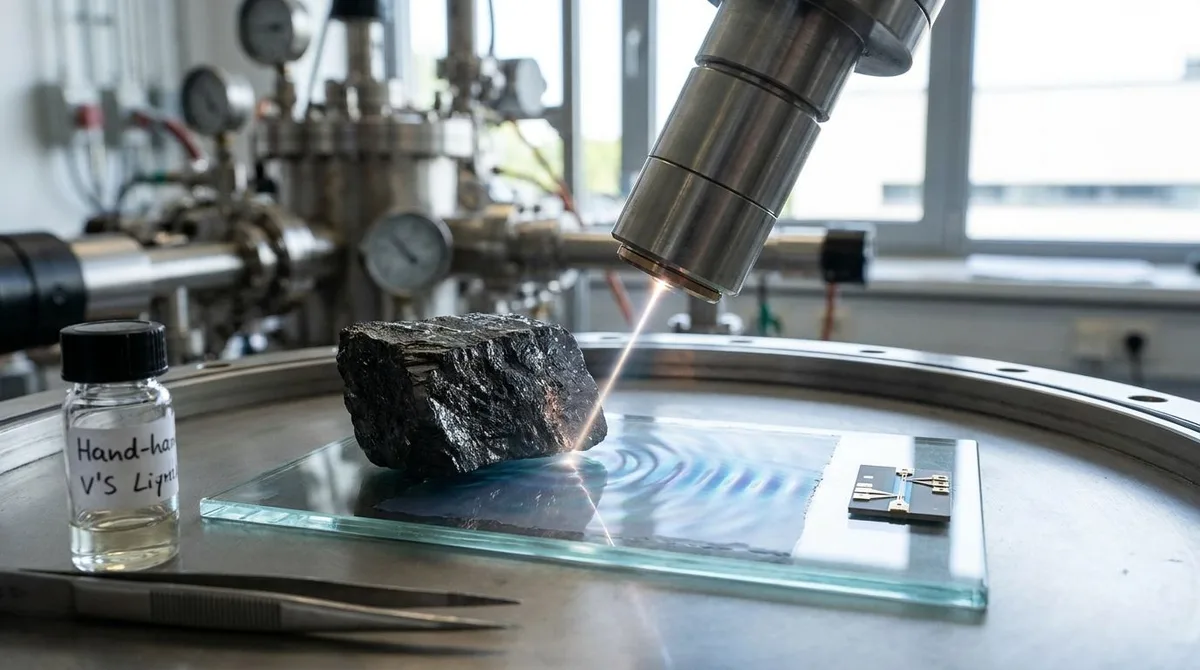
Quantum computers hold the promise of solving problems far beyond the reach of even the most powerful classical supercomputers. However, a monumental engineering challenge stands in the way of building large-scale, fault-tolerant quantum machines: communication. Inside a quantum processor, individual quantum bits, or qubits, need to talk to each other to perform calculations. As these processors grow, the qubits need to communicate over longer distances, connecting different modules on a single chip. The current methods for achieving this are often slow, noisy, or incredibly complex. A recent paper from D. C. Glattli and P. Roulleau, titled "Flying qubits Surfing on Plasmons," introduces a groundbreaking concept that uses the unique electronic properties of graphene to create a new kind of information superhighway for qubits, potentially paving the way for more powerful and scalable quantum architectures.
In both classical and quantum computing, processors are not monolithic. They are composed of smaller units that must exchange information. In your laptop, electrical wires shuttle bits between the CPU, memory, and other components. In a quantum computer, the task is infinitely more delicate. A qubit's state is fragile, easily destroyed by the slightest environmental noise, a phenomenon known as decoherence. The challenge is to move a quantum state from one location to another without it collapsing.
Current strategies for creating these "quantum interconnects" have significant drawbacks. One approach is to convert the state of a stationary qubit (like one in a superconducting circuit) into a photon, guide that photon through a fiber optic, and then convert it back into a qubit at the destination. This process is complex and inefficient, with information often lost during the conversions. Another method, known as "quantum teleportation," consumes precious quantum resources and is not a direct physical transfer. A more direct approach, called coherent quantum coupling, involves linking qubits in a chain, but this becomes slow and error-prone as the chain gets longer. The field has been searching for a better solution: a robust, on-chip "quantum bus" that can directly and efficiently transport a qubit's state.
Imagine you need to send a fragile glass sculpture from one side of a factory to the other. You could try to build a chain of people to pass it along hand-to-hand, but it might get dropped. Alternatively, you could carefully pack it, ship it to a different facility for unpacking, and then deliver it, a slow and complicated process. The simplest solution would be to place it on a smooth, fast-moving conveyor belt. This is the essence of the idea proposed in this research.
The researchers envisioned using a special kind of electronic wave, called a plasmon, as the conveyor belt. Plasmons are collective, wave-like oscillations of electrons that can travel across the surface of certain materials. The "sculpture" in this analogy is the quantum state of a qubit. The core innovation is to couple the state of a stationary qubit to a propagating plasmon in a sheet of graphene. The plasmon then carries this quantum information—now a "flying qubit"—to a destination, where another stationary qubit can receive it. The graphene acts as the perfect medium for this conveyor belt, allowing plasmons to travel swiftly and with minimal disruption, preserving the delicate quantum state they carry.
The experimental setup suggested by the paper's title and its placement in the condensed matter physics category likely involves a carefully engineered nanoscale circuit. At its heart is a sheet of high-quality graphene, a single layer of carbon atoms arranged in a honeycomb lattice. Graphene is an exceptional material for this purpose due to its unique electronic structure. Its electrons behave as if they have no mass, which allows them to support tightly confined and long-lived plasmons. Furthermore, the number of charge carriers in graphene can be easily tuned with an external electric field, which in turn allows for precise control over the properties of the plasmons, such as their speed and wavelength.
The process would begin with a stationary source qubit, perhaps a quantum dot—a tiny semiconductor crystal—placed very close to the edge of the graphene sheet. This quantum dot can hold a single electron whose quantum state (such as its spin) represents the information to be transported. To send the information, a plasmon is launched along the graphene, similar to how a stone dropped in a pond creates a ripple. This can be done using a nanoscale antenna that applies a high-frequency electrical signal.
As this plasmon wave travels past the source quantum dot, its oscillating electric field interacts with the electron inside the dot. Through careful tuning of the plasmon's frequency and the qubit's energy levels, a resonant coupling occurs. This interaction effectively "imprints" the quantum state of the electron onto the plasmon wave. The qubit is no longer just in the quantum dot; it has become a hybrid quantum object, a flying qubit that is part electron and part plasmon, surfing this electronic wave. The plasmon acts as a carrier, whisking the quantum state away from its origin. This hybrid particle then propagates along the graphene waveguide to a destination, where a second, receiver quantum dot is waiting. As the plasmon passes the receiver, the reverse process occurs: the quantum state is coherently transferred from the plasmon to the electron in the receiver dot. The information has arrived.
While the full experimental details are not available in the brief summary, the publication of this work suggests that Glattli and Roulleau successfully demonstrated the foundational principle of this mechanism. They likely provided evidence of the coherent transfer of a quantum state between two spatially separated points using a graphene plasmon as the intermediary. This would have involved preparing a qubit in a specific initial state at the source, launching the plasmon, and then measuring the state of the receiver qubit. A successful demonstration would show that the receiver qubit's final state faithfully matched the source qubit's initial state with a high degree of probability, or fidelity.
The researchers likely characterized the efficiency and robustness of this transfer process. Key findings would include the distance over which the quantum state could be maintained (the coherence length), the speed of the transfer, and the fidelity of the operation. Given the novelty of the approach, the initial results were probably a proof-of-concept, demonstrating transport over several micrometers with a fidelity high enough to prove the method's viability, while acknowledging that significant optimization is still required. The work establishes that graphene plasmons are not just a theoretical curiosity but a tangible tool for quantum information processing. The quality of the material is critical for such experiments, as defects and impurities can scatter plasmons and destroy quantum information, highlighting the importance of advanced graphene manufacturing techniques.
This research represents a significant conceptual leap for building scalable quantum computers. It proposes a fundamentally new type of hardware for on-chip quantum communication that is potentially faster, more efficient, and more compact than existing alternatives. By keeping the quantum information entirely within an electronic, solid-state system, it avoids the difficult conversion to and from photons. This all-electrical approach could allow for much tighter integration of quantum processing units on a single chip.
The ability to create high-fidelity flying qubits on demand opens up new architectural possibilities. Instead of being limited to communicating with their nearest neighbors, qubits could send information across a processor via these plasmonic waveguides. This could lead to more connected and powerful quantum computing designs, analogous to the shift from point-to-point wiring to high-speed data buses in classical computers. Furthermore, the principles demonstrated here could extend beyond quantum computing to other quantum technologies, such as networks of quantum sensors, where information needs to be collected and processed coherently on a single chip. The potential impact on the entire field of graphene electronics is substantial, offering a new application that leverages the material's most exotic quantum properties.
This work is a pioneering demonstration, not a final product. Several significant hurdles must be overcome before this technology can be implemented in a functional quantum computer. The experiments were almost certainly conducted at extremely low, cryogenic temperatures to minimize thermal noise and preserve quantum coherence. Operating such a system at higher temperatures remains a distant goal.
The fidelity of the quantum state transfer is another critical factor. While the initial results are promising, the fidelity must be pushed to extremely high levels—well above 99.9%—to be useful for fault-tolerant quantum computation. This will require improvements in material quality, device fabrication, and control techniques. The graphene itself must be exceptionally pure, as any defect can act as a pothole for the "surfing" qubit. The coupling and decoupling processes at the source and receiver qubits also need to be perfected to ensure a near-total information transfer without loss or decoherence. Future research will need to focus on scaling the system from a simple two-qubit link to a complex network connecting many qubits, which introduces new challenges in routing and avoiding crosstalk between different plasmonic channels.
Looking toward the future, the successful development of this technology could revolutionize the design of quantum processors. The most direct application is in creating large-scale, monolithic quantum computers. Different quantum register modules, each containing a small number of high-quality qubits, could be fabricated on a single chip and interconnected by a network of these graphene plasmon waveguides. This would enable the construction of processors with thousands or even millions of qubits, a necessary step for solving truly impactful problems in medicine, materials science, and artificial intelligence.
Beyond building a single, large computer, this technology could also enable distributed quantum computing, where smaller, specialized quantum processors are linked together. This is similar to how classical high-performance computing clusters work today. The high speed and on-chip nature of the plasmonic interconnects make them ideal for this purpose. The graphene market research landscape will undoubtedly watch developments in this area closely, as it represents a high-value, transformative application for premium electronic-grade graphene. The ability to manipulate quantum states with such precision on a chip could also find use in advanced quantum sensing and metrology applications.
If there is one key takeaway from this research, it is this: scientists have shown that it is possible to use tiny, collective waves of electrons in graphene, known as plasmons, as a high-speed conveyor belt to transport fragile quantum information from one point to another on a chip. This provides a new and promising pathway for connecting the components of future large-scale quantum computers.
What is a qubit?
A qubit, or quantum bit, is the basic unit of quantum information. Unlike a classical bit, which can be either a 0 or a 1, a qubit can exist in a state of 0, 1, or a "superposition" of both states simultaneously. This ability to hold more information is a key reason why quantum computers are so powerful.
What is a plasmon?
A plasmon is a quantum of plasma oscillation, which can be thought of as a collective, wave-like motion of a sea of free electrons in a material, typically a metal or a material like graphene. In this research, these electron waves act as a carrier to transport energy and information across a surface.
Why is graphene used in this research?
Graphene is ideal for this application for several reasons. Its unique electronic structure allows it to host plasmons that are highly confined and can travel long distances before dissipating. The properties of these plasmons can also be easily controlled and tuned using an electric field, giving researchers precise command over the "conveyor belt" for the flying qubits.
What is a "flying qubit"?
A flying qubit is a quantum bit whose information is encoded in a mobile particle, allowing the quantum state to be transported from one physical location to another. While photons are the most common type of flying qubit, this research introduces a new type based on a hybrid plasmon-electron state within a solid-state chip.
Is this technology ready for commercial use?
No, this technology is still in the early, foundational stages of research. While it represents a significant scientific breakthrough and a promising proof-of-concept, substantial engineering and physics challenges must be solved before it can be used to build commercial quantum computers. It is a glimpse into a possible future, not a present-day reality.
The work of D. C. Glattli and P. Roulleau on "Flying qubits Surfing on Plasmons" opens a new and exciting chapter in the quest for scalable quantum computing. By demonstrating a way to use graphene's unique electronic waves as a transport medium for quantum information, they have introduced a powerful tool for solving the critical challenge of on-chip communication. While the path from this initial demonstration to a fully functional quantum processor is long, this research establishes a solid-state, all-electrical framework that is elegant, potentially efficient, and highly integrable. It reaffirms graphene's status as a remarkable material platform for exploring new quantum phenomena and building the technologies of the future.
Serious about B2B integration? Test our premium Pulsed Electrical Resistive Carbon Heating turbostratic graphene in your lab. 100g sample packs available now.
Explore More
Researchers show how a graphene-MoS2 heterostructure enhances transistor performance through interfacial charge transfer, improving carrier transport and...
Researchers demonstrate a novel method for creating gate-tunable synthetic antiferromagnetism in a graphene-based heterostructure, paving the way for new...
Discover how a cellular automaton model for thermal transport offers a new, computationally efficient way to understand and engineer heat flow in graphene...