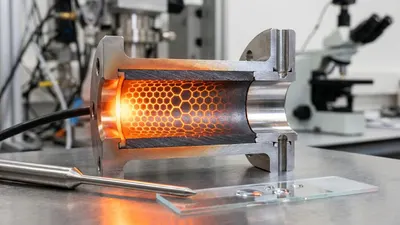
Modeling Heat Flow in Nanomaterials with Cellular Automata
Discover how a cellular automaton model for thermal transport offers a new, computationally efficient way to understand and engineer heat flow in graphene...
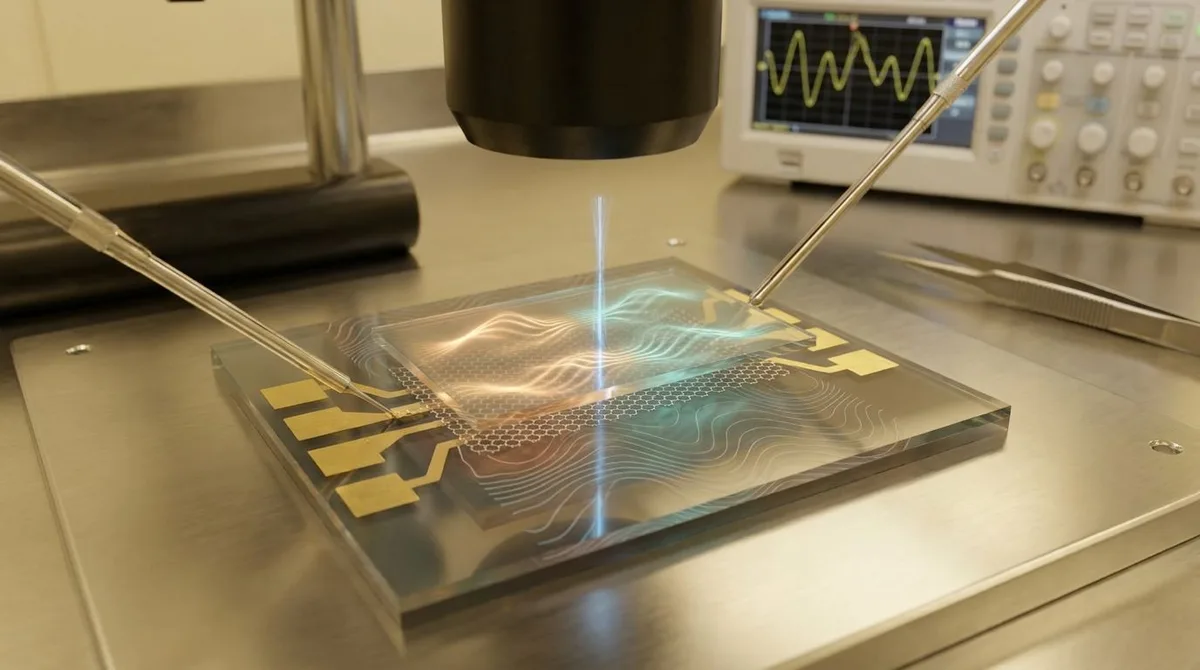
The quest for the next generation of computing hardware is a journey into the quantum world. For decades, progress has been defined by shrinking transistors to pack more processing power into smaller spaces. But as we approach the physical limits of this strategy, scientists are exploring entirely new ways to store and process information. One of the most promising avenues is "spintronics," a field that aims to use an electron's intrinsic quantum property called spin, in addition to its charge. By harnessing spin, we could create devices that are significantly faster, smaller, and more energy-efficient than anything possible today. A major challenge, however, is finding materials where this spin behavior can be precisely and electrically controlled.
To build a spintronic transistor or memory bit, you need a switch. Specifically, you need the ability to flip the magnetic state of a material using a simple electrical voltage, just as a conventional transistor uses a voltage to control the flow of current. Many materials are naturally magnetic, but their magnetic properties are often fixed and difficult to alter without using cumbersome and slow external magnetic fields. The ideal material would be one where magnetism can be turned on, turned off, or flipped on demand with a small electrical signal. In a new theoretical paper, researchers Marko Milivojević and Martin Gmitra propose a clever solution using a custom-designed stack of two-dimensional materials centered around graphene. Their work outlines a method for creating an electrically controllable magnetic state known as synthetic antiferromagnetism in a system that is not naturally magnetic, providing a blueprint for a fundamental component of future spintronic devices.
Imagine making a sandwich with two slices of graphene bread and a single-atom-thick layer of a magnetic material, manganese sulfide (MnS), as the filling. Graphene itself is not magnetic. However, when it is placed in extremely close contact with a magnetic material, the magnet can "imprint" some of its magnetic character onto the graphene through a quantum mechanical phenomenon called the proximity effect. The researchers' key insight was to use this effect in a symmetric, double-sided structure. In their proposed system, the top and bottom graphene layers both feel the influence of the central MnS layer. The MnS is an antiferromagnet, meaning its own internal magnetic atoms are arranged in an alternating up-down-up-down pattern. This underlying pattern causes the top graphene layer to pick up a spin polarization in one direction (say, "up"), while the bottom graphene layer picks up a polarization in the opposite direction ("down"). The result is a synthetic antiferromagnet: two distinct layers whose induced magnetic moments are locked in an antiparallel alignment. The most innovative part of the idea is that the strength of this magnetic locking can be precisely controlled by applying a vertical electric field across the entire sandwich, making it a "gate-tunable" system.
The device architecture proposed by the researchers is a van der Waals heterostructure, a term for layered materials built by stacking individual two-dimensional sheets on top of one another. The specific stack is monolayer graphene/monolayer manganese sulfide (MnS)/monolayer graphene. Each layer is just a single atom thick. The graphene layers serve as the active electronic channels. They are prized for their exceptional electrical conductivity and the unique behavior of their electrons, which move through the lattice as if they have no mass. The central MnS layer is the crucial mediator. It is an antiferromagnetic insulator, which means it does not conduct electricity well, but it possesses a stable, intrinsic magnetic order.
The operation hinges on the interplay between an external electric field and the quantum interactions at the interfaces between the layers. When a gate voltage is applied across the structure, it creates an electric field that pushes or pulls electrons. This can be used to create a charge imbalance, for instance, by adding extra electrons to the top graphene layer while removing them from the bottom one. This electrical imbalance is the control knob. The electrons in the graphene layers interact directly with the magnetic atoms in the MnS layer through a powerful quantum force known as the exchange interaction. This proximity-induced exchange interaction forces the electron spins within the graphene to align with the local magnetic moments in the MnS. Since the MnS layer has an alternating magnetic structure, the top graphene layer, sitting on one magnetic sublattice, inherits one spin polarization, while the bottom layer, adjacent to the opposite sublattice, inherits the opposite spin polarization. This creates the synthetic antiferromagnetic (SAF) state between the two electrically isolated but quantum-mechanically coupled graphene sheets. By increasing the gate voltage, the charge imbalance between the layers grows, which in turn strengthens the exchange interaction and increases the magnitude of the induced magnetism.
Through first-principles calculations, a powerful computational method used to model quantum systems, Milivojević and Gmitra demonstrated the viability of their concept. Their simulations showed that a stable synthetic antiferromagnetic state could indeed be induced in the graphene/MnS/graphene heterostructure. They confirmed that the magnetic coupling between the top and bottom graphene layers was antiparallel, the defining characteristic of an SAF system. Crucially, they found that the strength of this coupling could be linearly tuned by the applied gate voltage, confirming the system's potential as an electrical switch. A key discovery was the emergence of a large "nonrelativistic spin splitting" in the graphene layers. This means that the energy levels for electrons with spin pointing up and electrons with spin pointing down become significantly separated. In many materials, such splitting arises from relativistic effects like spin-orbit coupling, which can be weak and difficult to control. Here, the splitting is nonrelativistic, driven by the much stronger exchange interaction with the MnS layer. This large, electrically tunable spin splitting is a direct signature of the induced magnetism and is the physical property that would be harnessed in a spintronic device.
This theoretical work is significant because it provides a new and potentially superior mechanism for electrical control of magnetism. The concept of a gate-tunable SAF system built from 2D materials is a major step forward for the field of graphene electronics. The ability to switch a magnetic state without an external magnetic field is the holy grail for technologies like Magnetoresistive Random-Access Memory (MRAM). MRAM is a non-volatile memory that stores data in magnetic states and promises higher speed and lower power consumption than conventional RAM. SAF-based memory bits are particularly attractive because their net magnetic moment is zero. This means they do not create stray magnetic fields, allowing memory cells to be packed much more densely without interfering with one another. Furthermore, the nonrelativistic origin of the spin splitting is a key advantage. Exchange interactions are typically much stronger than spin-orbit interactions, suggesting that devices based on this principle could be more robust, exhibit a larger difference between their "on" and "off" states, and potentially operate at higher temperatures. This work provides a concrete theoretical foundation and a promising material candidate for experimentalists to pursue in the development of next-generation spintronic logic and memory.
It is important to recognize that this research is a computational and theoretical study. While such calculations are highly sophisticated and predictive, the concept must be validated through physical experimentation. The primary challenge will be in the fabrication of the heterostructure itself. Creating a perfectly clean and atomically sharp interface between three distinct monolayers is an immense engineering feat. Any defects, impurities, or misalignment between the layers could disrupt the delicate quantum interactions that give rise to the desired effect. The theoretical models also likely assume ideal conditions, such as cryogenic temperatures. For any practical application, the synthetic antiferromagnetism would need to be stable and controllable at or near room temperature. Future experimental work will need to focus on developing fabrication techniques to build these heterostructures and then testing their properties across a range of temperatures and operating conditions to see if the theoretical predictions hold up in the real world.
If the principles demonstrated in this paper can be realized experimentally, they could unlock a range of transformative technologies. The most immediate application lies in high-density, low-power MRAM, where the gate-tunable SAF state could serve as a memory bit that is written electrically rather than magnetically. This could lead to computer memory that is as fast as current RAM but retains its data when the power is turned off. Beyond memory, these structures could be used to build spin-based logic gates, forming the basis of spintronic processors that compute using spin currents, potentially consuming a fraction of the energy of today's silicon chips. The extreme sensitivity of graphene's electronic properties to its magnetic environment also suggests potential use in advanced magnetic field sensors. Such highly localized and sensitive graphene sensors could have applications in everything from medical diagnostics to data storage readout heads. The development of such devices represents a significant expansion of the landscape for graphene applications in advanced computing and sensing.
By layering graphene, a 2D magnet, and another sheet of graphene, researchers have theoretically designed a system where a simple electric voltage can induce and control opposing magnetic states in the two graphene layers. This creates an electrically switchable "synthetic antiferromagnet," a breakthrough concept that could serve as a fundamental building block for future ultra-fast and energy-efficient spintronic computers.
What is spintronics?
Spintronics is an emerging field of electronics that seeks to use the intrinsic spin of electrons, in addition to their electrical charge, to carry and process information. The goal is to create devices that are faster, smaller, and consume less power than conventional electronics by manipulating spin states (often represented as "up" or "down") to represent digital data.
What is antiferromagnetism?
Antiferromagnetism is a type of magnetic ordering where adjacent magnetic ions or atoms align their spins in opposite, or antiparallel, directions. This results in a material having no net external magnetic field, which makes them very different from ferromagnets like iron refrigerator magnets, where all the spins align in the same direction.
Why is "gate-tunable" so important for electronics?
The term "gate-tunable" means that a property of a material can be controlled by applying a voltage via an electrical contact called a gate. This is the fundamental principle behind the transistor, which is the building block of all modern digital electronics. A gate voltage controls the flow of current, creating a switch that can represent a one or a zero. A gate-tunable magnetic material allows for the same electrical switching principle to be applied to magnetic states.
What is a van der Waals heterostructure?
A van der Waals heterostructure is an artificial material created by stacking different two-dimensional materials, like graphene or MnS, on top of one another. These layers are held together by weak van der Waals forces, allowing scientists to combine materials with very different properties to create a new composite material with unique, engineered functionalities that do not exist in nature.
Is this graphene spintronic technology ready for commercial use?
No, this technology is still in the very early stages of fundamental research. The work described is a theoretical proof-of-concept. Significant experimental and engineering challenges, such as perfecting the large-scale manufacturing of these complex atomic-scale structures, must be overcome before this can be translated into commercial products. The path from a theoretical paper to a device in your computer is typically a long one, often taking more than a decade of further research and development.
The theoretical work by Marko Milivojević and Martin Gmitra provides a compelling and elegant pathway toward all-electrical control of magnetism in a graphene-based system. By leveraging the principles of proximity-induced exchange interactions within a carefully designed heterostructure, they have laid out a blueprint for creating a gate-tunable synthetic antiferromagnet. This concept addresses a critical need in the development of spintronics, offering a mechanism that is potentially stronger and more direct than those relying on relativistic spin-orbit effects. While experimental verification remains a crucial next step, this research illuminates a promising direction for creating the fundamental switches and memory elements needed for the next generation of computing. The successful realization of such devices will depend on advances in materials science and the availability of a high-quality industrial graphene supply capable of forming the pristine interfaces required for these quantum phenomena to flourish.
Serious about B2B integration? Test our premium Pulsed Electrical Resistive Carbon Heating turbostratic graphene in your lab. 100g sample packs available now.
Explore More
Discover how a cellular automaton model for thermal transport offers a new, computationally efficient way to understand and engineer heat flow in graphene...
New research on the violation of Onsager reciprocity in graphene presents a thermomechanical proof for non-reciprocal energy flow, suggesting future...
Explore Super-Klein tunneling in graphene, a theoretical breakthrough promising perfectly transparent electronic barriers for next-generation...