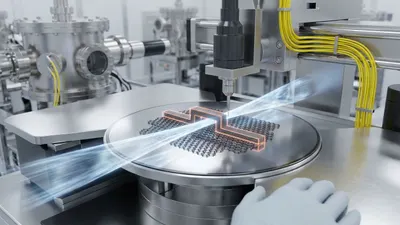
Super-Klein Tunneling: Engineering Perfect Electron Transparency in Graphene
Explore Super-Klein tunneling in graphene, a theoretical breakthrough promising perfectly transparent electronic barriers for next-generation...
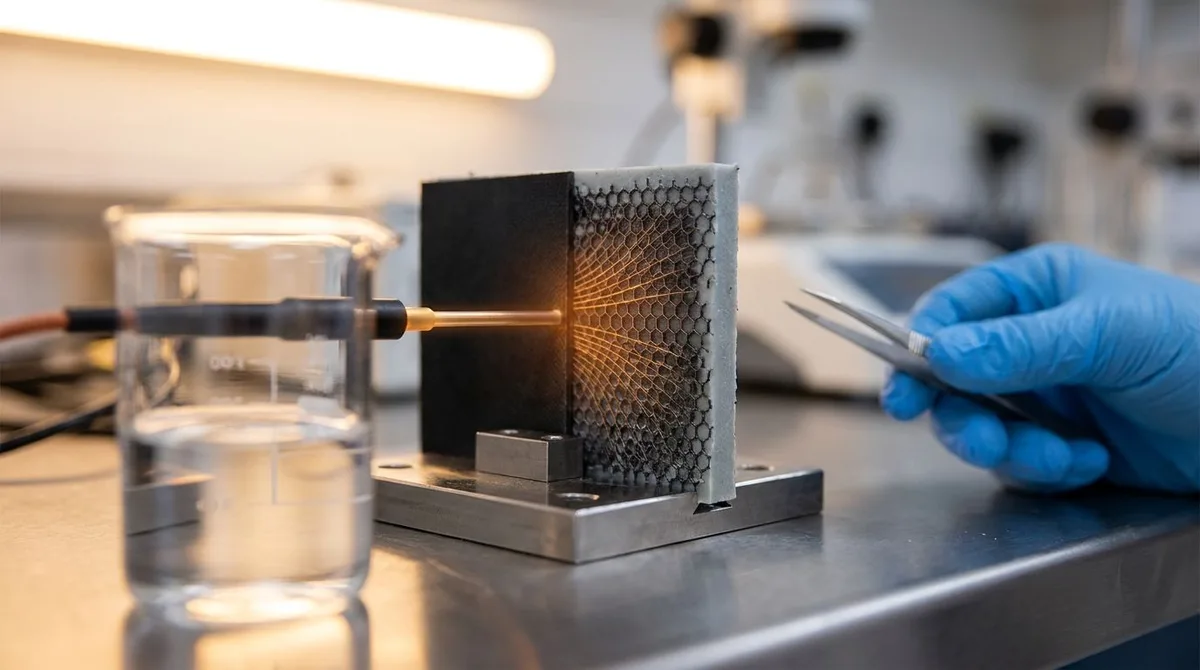
In the world of physics, some rules are held as nearly sacred. They form the bedrock upon which we build our understanding of everything from steam engines to supercomputers. One such rule governs the elegant symmetry of the universe, stating that for many interacting processes, the cause-and-effect relationship works equally in both directions. Imagine pushing on a spring: the force you feel from the spring pushing back is directly related to how much you compress it. This principle of reciprocity seems intuitive. But what if, at the unseen scale of atoms, this dependable two-way street could sometimes become a one-way road? What if heat could be forced to flow more easily in one direction than another? This is the profound implication of new theoretical work that challenges a long-held principle, using the unique properties of graphene to light the way.
At the heart of this work is a concept from thermodynamics known as the Onsager reciprocal relations, formulated by Nobel laureate Lars Onsager in 1931. This principle is a cornerstone of non-equilibrium thermodynamics, the branch of physics that deals with systems in a state of change, like heat flowing from a hot object to a cold one. In simple terms, Onsager reciprocity states that in a system with coupled flows—for example, where a temperature difference creates an electrical current (the thermoelectric effect)—the relationships are symmetric. The effect of temperature on electricity is directly proportional to the effect of electricity on temperature. This symmetry has been a powerful and reliable assumption for physicists and engineers for nearly a century, underpinning the design of countless technologies.
However, the theories of classical thermodynamics were developed for large-scale systems close to a state of equilibrium. The question that has emerged with the rise of nanotechnology is whether these same rules apply without exception at the atomic scale, especially in materials pushed far from equilibrium by intense forces or temperature gradients. A recent paper by Monty Dabas, titled "Multiscale Violation of Onsager Reciprocity: Thermomechanical Proof, Atomic Evidence, and Graphene Predictions," directly confronts this question. The research investigates if this fundamental symmetry can be broken, particularly in the thermomechanical domain, where heat flow and mechanical stress are intertwined. A breakdown of this reciprocity would not be a flaw in Onsager’s original theory but rather the discovery of a new physical regime where different rules apply, opening a new frontier for materials science.
The central idea proposed in the paper is that Onsager reciprocity can indeed be violated under specific conditions. The research suggests that the symmetric, two-way relationship between thermal and mechanical processes can break down, leading to non-reciprocal, or one-way, behavior. Consider the coupling between a temperature gradient and mechanical stress. According to reciprocity, the way a material deforms when you apply a heat gradient should be symmetrically related to the way its temperature changes when you mechanically deform it.
Dabas's work posits that this is not always the case, particularly in highly structured, low-dimensional materials like graphene. The core insight is that by carefully engineering strain and thermal gradients at the nanoscale, you can create a system where the cause-and-effect linkage is no longer a simple, reversible exchange. The material might respond strongly to a thermal input with a mechanical output, but the reverse process—a mechanical input causing a thermal output—could be significantly weaker or different in nature. This asymmetry creates a directional bias. It’s like having a special valve for energy, allowing it to be controlled and directed in ways that were previously thought to be impossible under the classical framework. This research provides the theoretical proof and atomic-level evidence for this phenomenon, predicting how it would manifest in a real-world material.
Graphene serves as the ideal theoretical laboratory for exploring this potential violation. Its nature as a two-dimensional sheet of carbon atoms arranged in a honeycomb lattice gives it extraordinary and unique properties. It is incredibly strong, lightweight, and an excellent conductor of heat and electricity. The "Graphene Predictions" in the paper’s title stem from using this material as a model system to demonstrate the thermomechanical breakdown of reciprocity. The mechanism for this violation lies in the behavior of phonons, which are quantized packets of vibrational energy that carry heat through a material’s atomic lattice.
In an undisturbed sheet of graphene, phonons propagate in a relatively predictable, symmetric manner. However, the research suggests that when the graphene sheet is subjected to specific types of mechanical strain—stretching, twisting, or bending—the landscape through which these phonons travel is fundamentally altered. This engineered strain can create asymmetric pathways for phonon scattering. Imagine a perfectly flat field versus a field with carefully plowed furrows; a ball will roll very differently across each one. Similarly, a strained graphene lattice can guide or impede phonons in a directional manner. When a thermal gradient is also applied across this strained lattice, the interaction between the heat-carrying phonons and the distorted atomic structure can become non-reciprocal. The simulations presented as "atomic evidence" likely show that phonons moving in one direction scatter differently than those moving in the opposite direction, leading to an asymmetric flow of heat. This effect is a direct consequence of the material being held in a state far from thermodynamic equilibrium by the combined mechanical and thermal stresses.
The paper claims to provide a "multiscale" validation of this concept. This means the evidence is presented at different levels of abstraction, from high-level theory down to the behavior of individual atoms. The first part is the "thermomechanical proof," which is likely a rigorous mathematical framework derived from statistical mechanics. This proof would formally define the specific conditions—the types of strain, the magnitude of the thermal gradients, and the material properties—under which the Onsager symmetry is expected to break. It provides the theoretical foundation for the entire claim.
The second part is the "atomic evidence," which almost certainly refers to results from large-scale molecular dynamics simulations. These computer models simulate the motion of every single atom in a virtual sheet of graphene according to the laws of physics. By applying virtual strain and heat sources, the researchers could observe the non-reciprocal behavior directly. They could track the energy carried by phonons and demonstrate quantitatively that heat flows more easily along one direction of the strain field than the other. Finally, the "Graphene Predictions" are the tangible outcomes of this theoretical and computational work. The research likely predicts the magnitude of this asymmetry, forecasting by how much the thermal conductivity could differ in opposite directions. These predictions could serve as a roadmap for experimental physicists looking to verify the effect in a laboratory.
The implications of confirming a violation of Onsager reciprocity are profound, potentially opening an entirely new chapter in materials engineering. For decades, our designs have been implicitly constrained by the assumption of symmetric responses. If that constraint can be lifted, we gain a new degree of freedom in controlling the flow of energy at the nanoscale. One of the most exciting possibilities is the creation of a "thermal diode," a device that allows heat to flow easily in one direction but blocks it in the other. Such a component could revolutionize thermal management in everything from microprocessors to high-power batteries, actively pumping heat away from sensitive components instead of just passively dissipating it.
Furthermore, this discovery could lead to significant advances in energy harvesting. Thermoelectric devices, which convert waste heat into useful electricity, are currently limited in their efficiency by factors tied to reciprocal effects. A non-reciprocal system could potentially bypass some of these limitations, leading to more efficient solid-state generators. The heightened sensitivity of a non-reciprocal system also makes it a powerful candidate for next-generation graphene sensors. A tiny mechanical strain could produce an amplified and directional thermal signal, enabling the detection of forces and vibrations with unprecedented precision.
It is crucial to approach these findings with a clear understanding of their current status. The research, as described by its title and categories, is primarily theoretical and computational. The "proof" and "evidence" are mathematical and simulation-based, not yet demonstrated in a physical laboratory. The most significant limitation, therefore, is the absence of experimental verification. Fabricating a graphene device with the precise strain engineering required to observe this effect and then measuring the subtle, directional heat flows is an immense experimental challenge.
Another open question is scalability. The predicted effects may be strong in a perfect, single layer of graphene under ideal conditions. However, real-world materials are never perfect. It remains to be seen how robust this phenomenon is to defects, grain boundaries, and interactions with a substrate. The behavior in bulk materials, such as an industrial graphene supply used in composites, may be very different from that in a pristine monolayer. Future work must focus on bridging this gap between theoretical prediction and experimental reality, exploring different materials and structures to see if the effect can be amplified and made more practical for real-world engineering.
While still in the realm of prediction, the potential real-world applications of harnessing non-reciprocal thermomechanical effects are transformative. In high-performance computing, the primary bottleneck to faster processors is heat. A thermal diode integrated directly onto a chip could actively channel heat away from hotspots, dramatically improving computing performance and energy efficiency. This would represent a paradigm shift from passive cooling with fans and heatsinks to active, on-chip thermal management.
In the aerospace sector, materials are often subjected to extreme mechanical stresses and thermal gradients simultaneously. Hypersonic vehicles, satellites re-entering the atmosphere, and advanced propulsion systems could benefit from materials with programmable thermomechanical responses. An aircraft wing or engine component could be designed to route thermal energy away from critically stressed areas, enhancing safety and performance. Such a capability would be invaluable for designing lighter and more resilient aerospace composites. Other potential applications include solid-state refrigeration with no moving parts, more sensitive thermal imaging cameras, and novel forms of phononic logic where information is processed using heat vibrations instead of electrons.
If there is one key takeaway from this research, it is this: a fundamental rule in physics that assumes energy processes are a symmetric "two-way street" may not apply at the nanoscale. In materials like graphene, it may be possible to create a "one-way road" for heat and energy, opening the door to a new generation of smart materials and devices with unprecedented control over thermal flow.
What exactly is Onsager reciprocity?
Onsager reciprocity is a principle in thermodynamics that states the relationship between coupled flows and forces in a system is symmetric. For example, it dictates that the way a temperature gradient generates an electric voltage is symmetrically related to the way an electric voltage generates a temperature gradient. It’s a foundational concept that assumes a two-way, balanced interaction.
Why is it such a big deal to violate this principle?
Violating this principle is significant because it breaks a long-held assumption that has constrained material and device design. If the relationship between two processes is not symmetric, it means we can engineer systems that favor one direction over another. This opens up entirely new functionalities, like thermal diodes that pass heat one way or energy harvesters that operate beyond previously assumed efficiency limits.
Why was graphene chosen for this study?
Graphene is an ideal material for studying this effect due to its unique structure and properties. As a one-atom-thick sheet, it is a simple, two-dimensional system where atomic behaviors are pronounced. Its incredible mechanical strength allows it to withstand extreme strain, and its unique lattice structure gives rise to exotic phonon (heat vibration) behaviors that are sensitive to that strain, making it a perfect theoretical platform for engineering non-reciprocal effects.
Does this discovery mean our old physics textbooks are wrong?
No, this does not invalidate classical thermodynamics or Onsager's work. Instead, it refines our understanding by identifying a new regime where the classical assumptions no longer fully apply. The original principles are still perfectly valid for most large-scale systems near equilibrium. This research carves out a new, specialized area of physics relevant to nanotechnology and systems pushed far from equilibrium.
How soon could we see real devices based on this research?
It will likely be a long time before we see commercial devices based on this principle. This paper presents a theoretical and computational breakthrough. The next step is for experimental physicists to try and reproduce and measure these predicted effects in a laboratory, which is a highly challenging task. From there, it would take many more years of engineering and development to create practical, reliable applications.
The theoretical work presented by Monty Dabas offers a tantalizing glimpse into a new domain of material physics. By providing a multiscale proof for the violation of Onsager reciprocity, this research challenges us to rethink the fundamental symmetries that govern energy flow at the nanoscale. The predictions for graphene showcase a clear, albeit theoretical, pathway toward engineering non-reciprocal thermomechanical materials. While the journey from theoretical prediction to experimental validation and technological application is long and arduous, this research provides a critical map. It reshapes our understanding of how force and heat interact, suggesting that we may one day build materials that can control energy with a level of sophistication previously confined to the realm of science fiction.
Serious about B2B integration? Test our premium Pulsed Electrical Resistive Carbon Heating turbostratic graphene in your lab. 100g sample packs available now.
Explore More
Explore Super-Klein tunneling in graphene, a theoretical breakthrough promising perfectly transparent electronic barriers for next-generation...
Explore how researchers are using PT symmetry to overcome energy loss in graphene plasmons, a breakthrough that could enable lossless optical circuits and...
Researchers have developed a closed-loop platform for the automated design and nanoscale imaging of GHz acoustic metamaterials, accelerating the creation of...