
Designing GHz Acoustic Metamaterials with an Automated Discovery Platform
Researchers have developed a closed-loop platform for the automated design and nanoscale imaging of GHz acoustic metamaterials, accelerating the creation of...
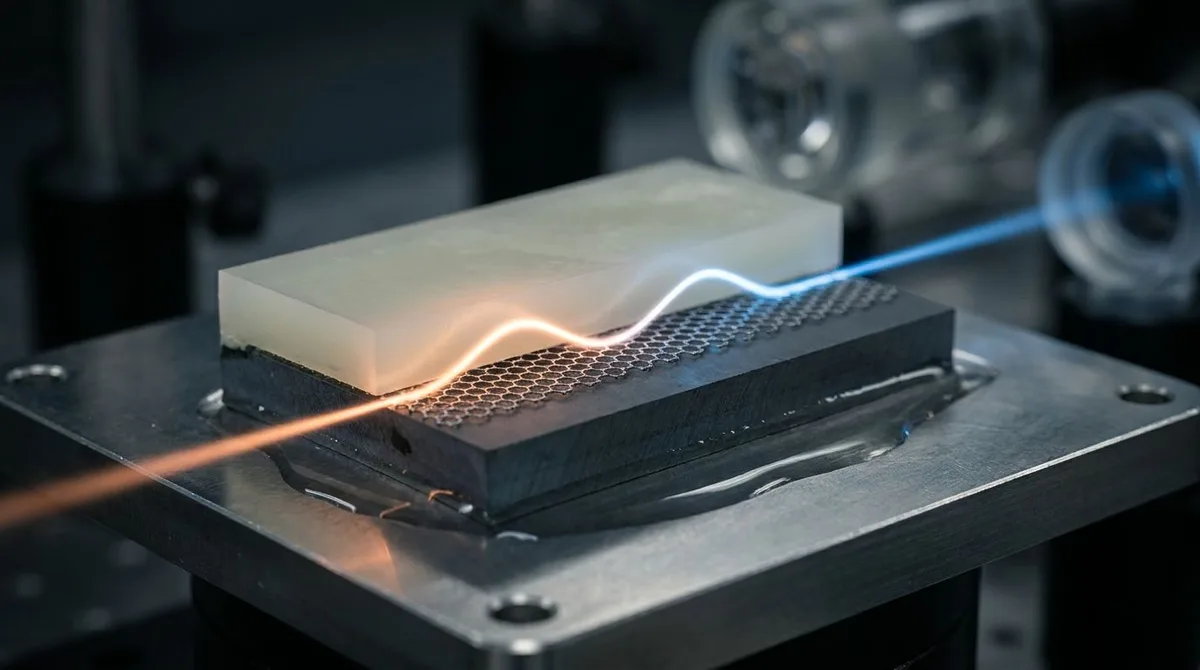
Imagine a world where data moves at the speed of light, not just between cities, but between the tiny components inside a single computer chip. This is the promise of photonics, a field dedicated to replacing electrical signals with light. Using light could make our devices faster, more efficient, and less prone to overheating. However, as we try to shrink light-based components down to the nanoscale, we hit a fundamental wall: light is difficult to confine and control in spaces smaller than its own wavelength. This is where a unique phenomenon called a plasmon comes in, and where graphene, a single layer of carbon atoms, truly shines. But even with graphene, these tiny waves of light and electrons lose energy and fade out far too quickly to be useful. A recent theoretical paper outlines a groundbreaking strategy to solve this problem, proposing a way for these waves to travel without any loss at all.
The central challenge this work addresses is energy loss, or "damping," in plasmonics. Plasmons are collective oscillations of electrons on the surface of a metal or, in this case, a sheet of graphene, that are tightly coupled with light. They act as a hybrid of light and matter, allowing us to squeeze optical energy into volumes far smaller than the wavelength of the light itself. This is the key to building nanoscale photonic circuits. The problem is that as these plasmons travel along the graphene surface, the oscillating electrons inevitably collide with imperfections in the material and with each other, converting their organized energy into useless heat. This causes the plasmon wave to decay rapidly, limiting its travel distance to just a few micrometers. This short "propagation length" is the single biggest obstacle preventing the development of complex, functional plasmonic circuits for computing and communications. It's like trying to build a superhighway where every car runs out of gas after driving a few feet. To make plasmonics practical, we need to find a way to either reduce this inherent loss or actively compensate for it. The work by researchers Andrianos Sygrimis and Giorgos P. Tsironis explores a radical approach to the latter.
The core idea presented by the researchers is to use a concept from quantum physics called Parity-Time (PT) symmetry to create a system where energy loss is perfectly canceled out by energy gain. Imagine a tug-of-war. On one side, you have the natural, unavoidable energy loss that causes the graphene plasmon to fade. On the other side, you have an engineered "gain" medium that actively pumps energy into the plasmon. A PT-symmetric system is designed so that the "pull" of the loss is exactly and perfectly balanced by the "push" of the gain. In this exquisitely balanced state, the plasmon feels neither a net loss nor a net gain. As a result, it can propagate along the material as if it were completely transparent or "lossless," traveling indefinitely without decaying. The researchers propose a theoretical model for how to construct such a system using graphene, laying out the physical principles that could turn this elegant concept into a tangible solution for the loss problem in nanophotonics.
To understand how this PT-symmetric system could be built, we must visualize its components. The system requires two key parts: a lossy medium and a gain medium, arranged in a specific way. Graphene itself serves as the inherently lossy component. Its unique two-dimensional structure and exceptional electron mobility make it an ideal platform for supporting plasmons, but these same properties also contribute to the energy dissipation that we want to overcome. The second part is the gain medium. This would be a separate material placed in close proximity to the graphene sheet. This material must have the ability to amplify light at the specific frequency of the plasmon. This is typically achieved by "pumping" the gain medium with an external energy source, like a laser or an electrical current, which excites its atoms into a higher energy state. When the plasmon passes by, it stimulates these excited atoms to release their energy as light that is perfectly in sync with the plasmon, effectively amplifying it.
The "PT symmetry" part comes from the precise spatial arrangement and properties of these two components. The system is designed so that the rate of energy absorption in the graphene is perfectly matched by the rate of energy emission from the gain medium. This creates a delicate equilibrium. Graphene's role is particularly crucial here because its electrical properties, and therefore its level of loss, can be tuned in real-time by applying a voltage. This tunability offers a powerful way to fine-tune the "loss" side of the equation to perfectly match the "gain" side, which is essential for achieving and maintaining the PT-symmetric condition. This level of control is a unique advantage of graphene-based systems and is central to the viability of the proposed device, opening new avenues for advanced graphene electronics and photonics. The researchers' model mathematically describes this coupled system, defining the precise conditions under which the gain and loss cancel each other out, leading to the desired lossless propagation.
Based on the title of their paper, "Lossless propagation of PT graphene plasmons," Sygrimis and Tsironis have theoretically demonstrated that such a system is, in principle, possible. Their work likely involves complex numerical simulations and analytical modeling to show that when the parameters of the graphene and the gain medium are tuned to a specific "exceptional point," the system's behavior changes dramatically. Below this point, the system is still lossy. Above this point, the gain overwhelms the loss, leading to unstable amplification similar to the feedback squeal from a microphone held too close to a speaker. But precisely at this exceptional point, the physics dictates a state of perfect balance. The model shows that a plasmon wave launched into this perfectly balanced system will propagate without its amplitude diminishing over distance. This finding provides a theoretical blueprint, a set of design rules, for engineers to follow. It proves that the fundamental physics does not forbid lossless plasmon propagation; it just requires an incredibly clever and precisely engineered environment to achieve it.
This theoretical result, if it can be realized experimentally, would represent a paradigm shift for optical computing and data communications. Overcoming plasmon damping would unlock the full potential of plasmonic circuits. Instead of being limited to short-range interactions, we could build complex, chip-scale optical processors where information is carried by plasmons over significant distances. This could lead to interconnects that are orders of magnitude faster and more energy-efficient than the copper wires currently used inside microchips. The heat generated by electrical resistance in modern processors is a major limiting factor for performance; switching to light-based communication would dramatically reduce this thermal load, enabling more powerful and densely packed chips. This breakthrough could accelerate progress in high-performance computing, artificial intelligence, and telecommunications. Furthermore, the principles of PT symmetry are not limited to communications; they could also be applied to a wide range of other graphene applications, including creating ultra-sensitive sensors and novel laser technologies.
It is crucial to emphasize that this research presents a theoretical model. The journey from a mathematical proof of concept to a working device is long and filled with immense practical challenges. The primary limitation is the difficulty of fabrication. Creating a nanostructure where the gain and loss are balanced with the required precision is an extraordinary engineering feat. Any tiny imperfection in the materials or their alignment could disrupt the delicate PT symmetry and destroy the lossless effect. Another significant challenge is the gain medium itself. It requires a constant supply of energy from an external pump source, which adds to the overall power consumption and complexity of the system. The stability of the system at the exceptional point is also a concern; it can be highly sensitive to small fluctuations, potentially making it difficult to maintain the lossless state in a real-world operating environment. Extensive experimental work is now needed to build and test prototypes to see if the lossless propagation predicted by the theory can be observed in a physical device and sustained under practical conditions.
Assuming the engineering hurdles can be overcome, the long-term applications are transformative. The most immediate impact would be on-chip optical interconnects, replacing the electrical wiring inside CPUs and GPUs. This would break the data transfer bottleneck that currently limits computing performance. In telecommunications, this technology could lead to the development of highly integrated and efficient modulators, switches, and routers for fiber-optic networks. Beyond communications, the field of sensing stands to benefit greatly. In a typical plasmonic sensor, the sensitivity is related to how long the plasmon can interact with the target molecules. By enabling lossless propagation, the interaction length could be extended dramatically, leading to graphene sensors with unprecedented sensitivity for detecting trace amounts of chemicals or biological markers. This could have profound implications for medical diagnostics, environmental monitoring, and security screening.
If you take away just one idea from this research, let it be this: by cleverly balancing energy gain against natural energy loss using a principle called PT symmetry, it may be possible to make light-like waves in graphene travel without fading. This theoretical breakthrough provides a potential solution to the biggest problem holding back the development of ultra-fast, nano-sized optical computer chips.
What is a plasmon?
A plasmon is a quantum of plasma oscillation, which can be thought of as a collective, wave-like motion of electrons on the surface of a conductive material. When these electron oscillations couple with photons of light, they form a hybrid quasiparticle called a surface plasmon polariton. These plasmons allow light energy to be confined to and guided along nanoscale pathways, far smaller than the wavelength of the light itself, which is essential for building miniaturized optical circuits.
Why is graphene a good material for plasmonics?
Graphene is an excellent material for plasmonics for several reasons. First, its plasmons are very tightly confined, meaning it can guide optical energy in extremely small spaces. Second, and most importantly, graphene's electronic properties can be dynamically tuned by applying an external voltage. This allows for real-time control over the plasmon's behavior—its frequency, intensity, and loss—which is a unique capability not found in traditional plasmonic materials like gold or silver. This tunability is a key enabler for advanced devices like the one proposed in this research.
What does "loss" mean in this context?
In the context of plasmonics, "loss" or "damping" refers to the unavoidable dissipation of the plasmon's energy as it travels through the material. The energy of the oscillating electrons is converted into heat through scattering events, such as collisions with other electrons or imperfections in the material's atomic lattice. This energy loss causes the plasmon wave's amplitude to decrease exponentially as it propagates, severely limiting how far it can travel before it fades away completely.
What is PT symmetry in simple terms?
PT symmetry is a concept from physics where a system remains unchanged under the combined operations of Parity (P), which is like looking at its mirror image, and Time reversal (T), which is like running a movie of its evolution backward. In optics and photonics, this is achieved by creating a system with a carefully balanced arrangement of a region that absorbs energy (loss) and a region that amplifies energy (gain). When the gain and loss are perfectly matched, the system can exhibit unusual properties, such as the lossless propagation of light waves.
Is this technology ready to be used in our computers?
No, this technology is still in the very early, theoretical stage of research. The paper describes a physical model and mathematical proof of concept, not a working device. There are significant engineering and fabrication challenges that must be solved before this idea can be turned into a practical component. While it offers a very promising direction for the future of optical computing, it will likely be many years before we see PT-symmetric graphene plasmonic circuits in commercial products.
The theoretical work of Andrianos Sygrimis and Giorgos P. Tsironis provides a fascinating and potentially pivotal contribution to the field of nanophotonics. By applying the elegant principles of PT symmetry to the practical challenge of plasmon damping in graphene, they have charted a clear theoretical path toward achieving lossless energy propagation at the nanoscale. While the experimental realization of such a system remains a formidable task, this research acts as both a blueprint and an inspiration. It reaffirms graphene's status as a uniquely versatile material for next-generation electronics and photonics and pushes the scientific community to explore novel physical phenomena in the quest for technologies that will define the future of computing and communication.
Serious about B2B integration? Test our premium Pulsed Electrical Resistive Carbon Heating turbostratic graphene in your lab. 100g sample packs available now.
Explore More
Researchers have developed a closed-loop platform for the automated design and nanoscale imaging of GHz acoustic metamaterials, accelerating the creation of...

Molecular dynamics simulations show water maintains a high slip flow in graphene nanochannels at realistic pressures, a key finding for future...
Researchers have demonstrated electrically controllable valence-conduction band reversals in helical trilayer graphene, a breakthrough for future...