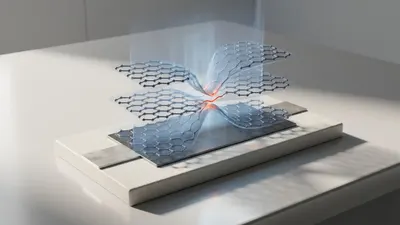
Helical Trilayer Graphene: Reversing Electronic Bands With an Electric Field
Researchers have demonstrated electrically controllable valence-conduction band reversals in helical trilayer graphene, a breakthrough for future...
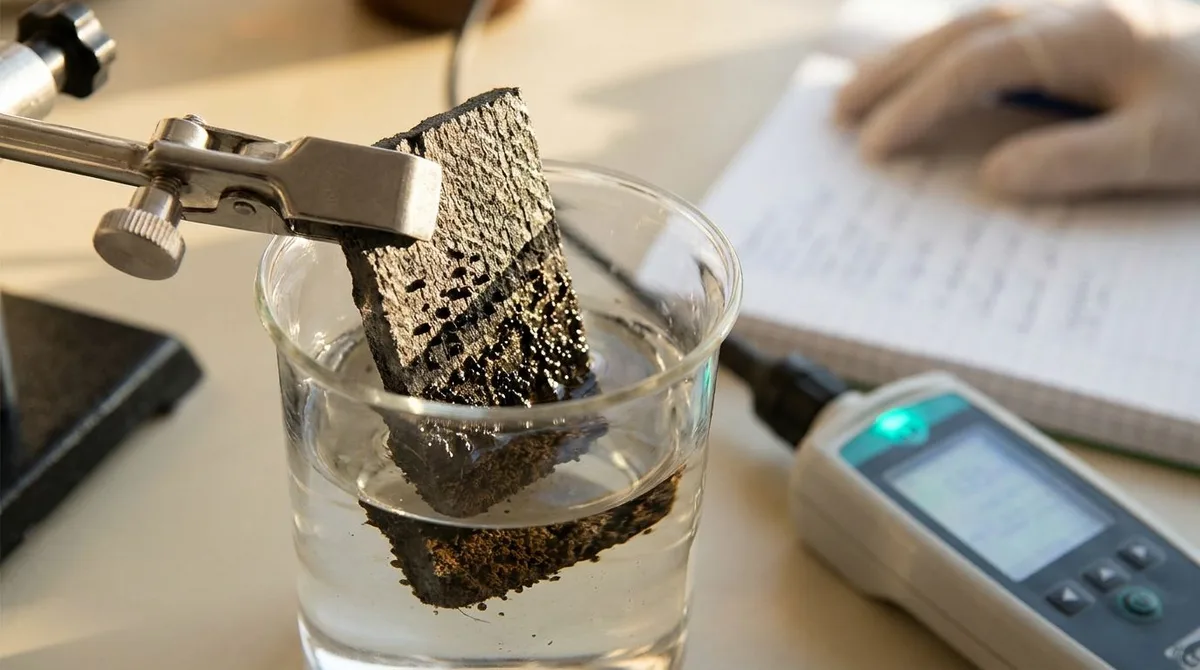
Imagine water flowing through a pipe. On a microscopic level, the water molecules right next to the pipe’s inner wall are slowed down by friction, creating a layer that barely moves. This drag affects the entire flow, demanding more energy to push the water through. Now, what if you could create a pipe so atomically smooth and with such unique properties that the water barely felt the walls at all? The liquid would slip past with almost zero friction, enabling flow rates and energy efficiencies that seem impossible with conventional materials. This is not science fiction; it is the world of nanofluidics, and new research is bringing it one step closer to reality by modeling the behavior of water inside tiny channels made of graphene.
Scientists have known for some time that graphene, a single layer of carbon atoms arranged in a honeycomb lattice, is a remarkable material for guiding fluids. Its surface is incredibly smooth and hydrophobic, or water-repelling, which allows water to flow over it with exceptionally low friction—a phenomenon known as high slip flow. While this has been demonstrated in principle, a critical question has remained for engineers and physicists: does this super-slippery behavior hold up under the high-pressure, high-speed conditions required for practical applications like water desalination or electronics cooling? Most prior simulations focused on relatively slow flows, leaving a knowledge gap about how these systems would perform when pushed to their limits. A team of researchers, Carmelo Civello, Luca Maffioli, Edward Smith, James Ewen, Peter Daivis, Daniele Dini, and Billy Todd, sought to bridge this gap. Their work addresses the need for a robust, predictive model of water flow in graphene nanochannels at strain rates—a measure of flow intensity—that are high enough to be relevant and testable in real-world laboratory experiments.
Instead of building a physical, nanometer-sized plumbing system, which is incredibly difficult and expensive, the researchers built one inside a computer. They used a powerful computational technique called molecular dynamics (MD) simulation. An MD simulation is like creating a virtual universe with its own laws of physics. In this universe, the researchers constructed a nanochannel made from two perfectly parallel sheets of graphene. They then filled this channel with virtual water molecules. Each atom, whether carbon in the graphene or oxygen and hydrogen in the water, was programmed to interact with its neighbors according to the fundamental forces of physics. By applying a simulated pressure to push the water through the channel at very high speeds, the researchers could watch and measure exactly how every single molecule behaved. This allowed them to study the water-graphene interaction with a level of detail impossible to achieve in a physical experiment, specifically to see if the celebrated "high slip" effect would break down under realistic, high-stress conditions.
The system in this study is a computational model, not a physical object. The core of the model is the nanochannel, formed by two flat, pristine sheets of graphene. The distance between these sheets is just a few nanometers, only wide enough for a small number of water molecules to fit across. The choice of graphene is deliberate and central to the entire phenomenon. Firstly, graphene is the ultimate in smoothness. On an atomic level, it is a perfect, repeating lattice with no bumps or ridges that would cause conventional friction. Secondly, graphene is hydrophobic. This doesn't mean it repels water in the way oil does; rather, the interactions between the carbon atoms of graphene and the water molecules are weak. Water molecules are more attracted to each other than they are to the graphene wall. This weak solid-liquid interaction is the fundamental reason water does not "stick" to the surface. Instead of forming a stationary boundary layer, the water molecules can easily slide past the graphene. This effect is quantified by a parameter called the slip length. A slip length of zero means the water sticks to the wall (no-slip), while a large slip length means the fluid behaves as if the wall were shifted far away, creating a nearly frictionless channel. This research investigates how that slip length changes as the flow rate is ramped up to experimentally relevant speeds.
The simulation delivered a crucial and promising result: water’s high slip flow within graphene nanochannels is remarkably robust, persisting even at the high strain rates that mimic practical device conditions. The computer model predicted that even when the water was forced through the channels at extreme velocities, the friction at the graphene-water interface remained exceptionally low. The slip length, while showing some dependence on the strain rate, stayed significantly high across the entire range of simulated conditions. This indicates that the fundamental physics enabling low-friction flow does not catastrophically break down under pressure. The simulation also provided insights into why this happens. It showed that the water molecules near the graphene walls form distinct, ordered layers. This structuring of the water, dictated by the confinement of the nanochannel and the weak interaction with the graphene, helps facilitate the bulk fluid's easy passage through the center. The model essentially confirms that the theoretical promise of graphene for nanofluidics isn't just a low-speed curiosity; it's a durable property that could be harnessed in demanding, high-throughput applications.
This finding is a significant step forward for the field of nanofluidics. It provides strong theoretical validation for engineers and materials scientists who are designing next-generation technologies based on fluid transport at the nanoscale. For years, the potential of graphene membranes for applications like water filtration has been a major topic of discussion. The primary benefit would be energy efficiency. In reverse osmosis desalination, for example, immense pressure is required to force saltwater through a membrane to separate out the salt. If the membrane channels were made of graphene, the required pressure could be drastically reduced thanks to high slip flow, leading to massive energy savings. The results from this simulation give developers more confidence that this principle will hold true in a working device. This research helps de-risk the development of such technologies by showing that the underlying science is sound, not just at a theoretical level, but under the very conditions those technologies will face. This strengthens the case for further investment and experimental work in areas like advanced filtration and separation, as explored in the field of water and environmental applications.
It is essential to remember that this work is a simulation. Molecular dynamics models are powerful, but they are based on approximations and idealizations. The graphene in the simulation was perfectly flat, infinitely strong, and free of any defects, voids, or wrinkles. Real-world graphene materials, such as the turbostratic graphene flakes used in industrial composites, have a more complex structure. These imperfections could potentially disrupt the smooth flow of water by creating sites where friction increases. Furthermore, the water in the model was pure H2O. Contaminants, dissolved salts, or biological matter present in real water sources could interact with the graphene surface, potentially altering its properties and reducing the slip effect over time through a process called fouling. Therefore, the most critical next step is experimental validation. Physical experiments must be designed to measure water flow through real graphene nanochannels at these high strain rates to see if they match the predictions of the simulation. This research provides the map; now, explorers must venture into the physical territory to confirm its accuracy.
If these simulation results are borne out by physical experiments, the potential impact across multiple industries is enormous. The most frequently cited application is in water desalination and purification. Graphene-based membranes could make clean water more accessible and affordable by dramatically cutting the energy costs of filtration. Beyond water, this technology could revolutionize thermal management in high-performance electronics. Microscopic nanofluidic channels integrated directly into a computer chip could carry away heat far more efficiently than current methods, allowing for more powerful and compact processors. In the biomedical field, lab-on-a-chip devices that rely on the precise control of tiny fluid volumes could become faster and more sensitive. There is even potential in energy generation, where technologies that harness the osmotic pressure difference between fresh and saltwater could be made significantly more efficient with low-friction graphene membranes. These diverse possibilities highlight the foundational importance of understanding fluid dynamics at the nanoscale and underscore the wide range of potential graphene applications.
If you take away just one idea from this research, let it be this: powerful computer simulations have predicted that the near-frictionless flow of water through graphene nanochannels is not just a delicate laboratory phenomenon. This "super-slippery" effect remains strong even at the high speeds and pressures required for real-world technologies, boosting confidence that graphene can be used to build a new generation of ultra-efficient devices for everything from producing clean water to cooling computers.
What is a molecular dynamics simulation?
A molecular dynamics simulation is a computer-based method used to study the physical movements of atoms and molecules. Scientists create a virtual model of a system, like water in a graphene channel, and use the laws of physics to calculate how each particle will move and interact over a period of time. It is like a virtual microscope that allows researchers to see and measure processes at a scale that is impossible to observe directly.
What does "high slip flow" mean in this context?
High slip flow describes a condition where a fluid moves across a surface with very little friction. In a conventional pipe, the fluid layer right at the wall surface is stationary, creating drag. In a high-slip scenario, like water on graphene, the fluid at the wall is still moving at a significant velocity, almost as if it's slipping or hydroplaning over the surface, which makes the overall flow much more efficient.
Why is graphene so effective for creating low-friction channels?
Graphene's effectiveness stems from a combination of its physical and chemical properties. Its single-atom thickness and honeycomb lattice structure make it the smoothest possible surface, eliminating physical friction. Additionally, its electronic properties lead to weak van der Waals forces with water molecules, meaning the water is not strongly attracted to the surface and does not "stick" to it, allowing it to glide past easily.
Is this technology available for commercial use today?
No, this research represents a fundamental scientific investigation, not a market-ready product. It is a computer simulation that provides a theoretical framework and predictive data. Before any commercial devices based on these principles can be built, the simulation's findings must be confirmed through extensive physical experimentation, and scalable manufacturing techniques for creating high-quality graphene nanochannels must be perfected.
What are "experimentally accessible strain rates"?
This term refers to the speeds and pressures of fluid flow that can be realistically created and measured in a modern laboratory setting. By focusing their simulation on these rates, the researchers ensure that their theoretical predictions are not just abstract but can be directly tested and verified by other scientists conducting physical experiments, bridging the gap between theory and practice.
The research conducted by Civello, Maffioli, Smith, Ewen, Daivis, Dini, and Todd provides a vital piece of the puzzle for the future of graphene-based nanofluidics. By using meticulous molecular dynamics simulations, they have shown that the remarkable low-friction properties of water in graphene nanochannels are robust enough to withstand the demanding conditions of real-world applications. This work moves the concept from a theoretical curiosity toward an engineering probability. While experimental validation remains a crucial next step, this simulation offers a powerful endorsement for continued development. It illuminates a path toward technologies that could redefine energy efficiency in fluid systems, with profound implications for global challenges like water scarcity and energy consumption, and hints at a future graphene market built on principles of atomic-scale design.
Serious about B2B integration? Test our premium Pulsed Electrical Resistive Carbon Heating turbostratic graphene in your lab. 100g sample packs available now.
Explore More
Researchers have demonstrated electrically controllable valence-conduction band reversals in helical trilayer graphene, a breakthrough for future...
Researchers discover a universal inverse-cube scaling law for projectile penetration energy in ultrathin films, offering a new predictive tool for designing...
Explore how researchers use machine learning to design a high-capacity Janus aminobenzene-graphene anode, a breakthrough for next-generation sodium-ion...