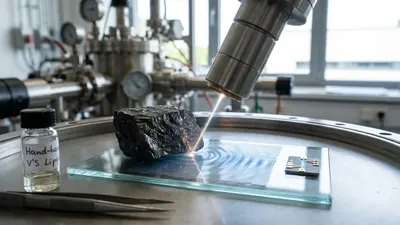
Graphene Plasmons Offer a New Superhighway for Flying Qubits
Researchers have demonstrated a novel method for transporting quantum information, using wave-like electron oscillations in graphene to carry flying qubits...
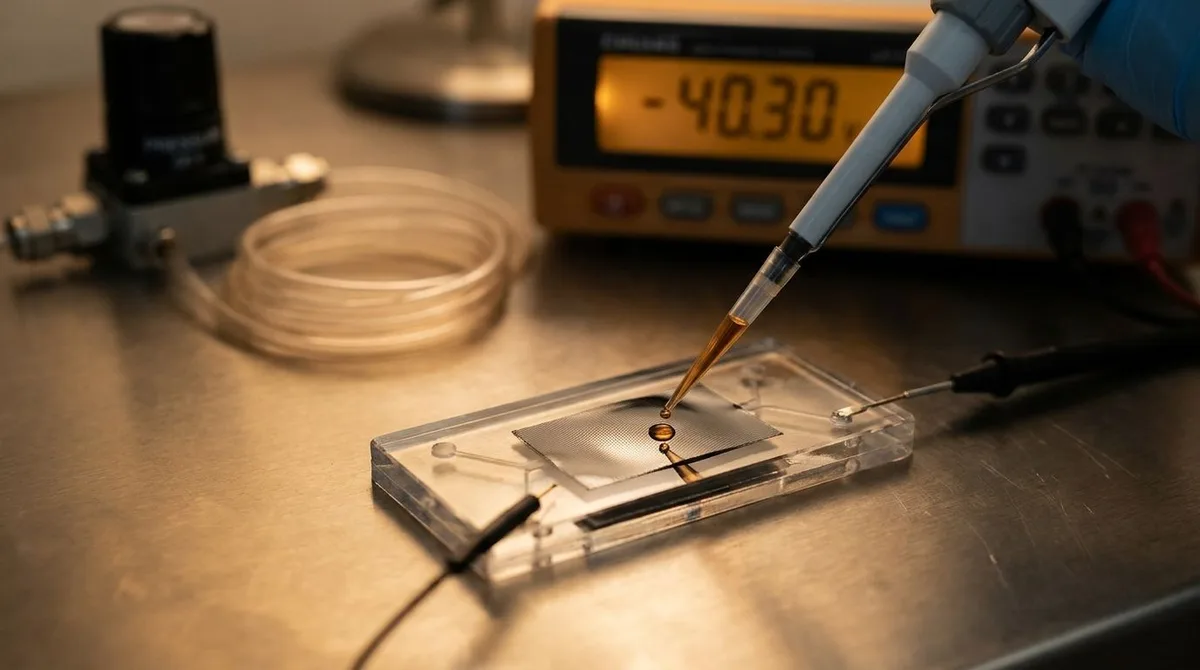
Imagine trying to create a new musical chord not by pressing keys on a piano, but by carefully tuning the tension of each individual string to produce a perfect, stable harmony. In the world of nanomaterials, scientists have been searching for similar ways to precisely tune the electronic properties of graphene. The discovery of "magic-angle" twisted bilayer graphene, where two sheets are stacked at a slight angle to create remarkable phenomena like superconductivity, was like finding a single, incredible chord. But what if we could design a whole new instrument? Recent theoretical work points toward a new method for tuning this "graphene music," not just by twisting it, but by strategically stretching it first.
The promise of twisted bilayer graphene (TBG) is immense, but it comes with a significant challenge: extreme sensitivity. The "magic angle" of approximately 1.1 degrees is a knife's edge. A tiny deviation of even a tenth of a degree can cause the exotic electronic properties to vanish. This fragility makes it incredibly difficult to manufacture reliable, large-scale devices. The scientific community has been grappling with this issue, seeking ways to make these fascinating properties more robust or to find new methods of control beyond a single, fixed twist angle. In a new theoretical paper, researchers Ayan Mondal and Bheema Lingam Chittari investigate a powerful new knob for tuning these systems: anisotropic strain. Their work explores whether applying a controlled, directional stretch to the graphene layers can create highly ordered and electronically stable structures, potentially overcoming the inherent fragility of relying on twist angle alone.
The central idea is to use mechanical strain as a design tool. Instead of just laying one sheet of graphene on another with a simple twist, the researchers modeled what happens if you first stretch one of the sheets unevenly—more in one direction than another. This is called anisotropic strain. Think of it like stretching a rubber band; it gets longer but also thinner. Applying this specific type of deformation to a graphene lattice before stacking it changes the geometry of the resulting moiré pattern. The key insight is that this strain can be precisely calculated to force the overlapping atomic lattices into a state of "commensurability." A commensurate pattern is a perfectly ordered, repeating superstructure, unlike the more common and quasi-random "incommensurate" patterns. By achieving this perfect alignment on a larger scale, it may be possible to create new, stable electronic states that are engineered by design rather than discovered by chance.
To understand the significance of this work, we need to break down a few core concepts. Graphene itself is a single layer of carbon atoms arranged in a honeycomb lattice. When you place two of these layers on top of each other, you get bilayer graphene. If you rotate one layer slightly relative to the other, a beautiful interference pattern emerges, much like the pattern you see when looking through two overlapping window screens. This large-scale pattern is called a moiré superlattice.
This moiré pattern is not just a visual curiosity; it creates a new electronic landscape for the electrons that live in the graphene. The size and shape of this new landscape, or "superlattice," dictate how the electrons behave. For years, the primary way to control this landscape was by changing the twist angle.
The work of Mondal and Chittari introduces anisotropic strain as a second, powerful control parameter. Strain is simply the deformation of a material. Isotropic strain would be like stretching a balloon, where it expands equally in all directions. Anisotropic strain is directional; imagine pulling a sheet of plastic wrap from two opposite ends. It elongates in the direction of the pull but contracts in the perpendicular direction.
The researchers' model applies a precise anisotropic strain to one of the graphene layers. This pre-stretching changes the fundamental spacing and symmetry of its honeycomb lattice. When this strained layer is then twisted and placed on an unstrained layer, the resulting moiré pattern is fundamentally altered. The key is the concept of commensurability. A moiré pattern is commensurate when the atomic pattern of the top layer, the bottom layer, and the superlattice all align perfectly after a certain number of repeating units. It's a state of high order and perfect periodicity. These states are typically rare, occurring only at specific, discrete twist angles. The theoretical model shows that by applying the right amount and direction of anisotropic strain, it's possible to create these highly desirable commensurate states at a much wider range of twist angles, effectively "forcing" the system into a state of perfect order. This contrasts with the disordered stacking found in materials like turbostratic graphene flakes, where the layers are randomly oriented, highlighting the importance of precise structural control.
As this is a theoretical and computational study, the findings are predictions that await experimental confirmation. The researchers essentially created a map that connects strain to structure. They identified the specific mathematical conditions—the precise combinations of twist angle, strain magnitude, and strain direction—that would theoretically produce these commensurate moiré superlattices.
Their calculations likely predict that these strain-engineered superlattices host unique electronic band structures. The electronic band structure of a material is like a blueprint that determines whether it will act as a metal, a semiconductor, or an insulator. In magic-angle graphene, the moiré pattern creates "flat bands" where electrons slow down dramatically and interact strongly, leading to superconductivity. The researchers likely found that anisotropic strain can also be used to generate or modify these flat bands, or even create other features like a tunable band gap. A band gap is an energy range that electrons cannot occupy, and the ability to open and close a band gap is the fundamental principle behind modern transistors and digital electronics. The paper provides a recipe book for creating specific electronic behaviors on demand.
This research is significant because it represents a shift from discovery to design in the field of "twistronics." Instead of hunting for new magic angles, scientists could potentially engineer the properties they need for a specific application. This has several profound implications.
First, it offers a pathway to robustness. If strain can be used to stabilize desirable electronic properties, devices might become less susceptible to the tiny, unavoidable imperfections in twist angle that plague fabrication today. An industrial process could use a more forgiving twist angle and then "fine-tune" the result by applying a controlled strain.
Second, it massively expands the parameter space for materials science. The twist angle is a single knob. Anisotropic strain is a knob with two settings: magnitude (how much stretch) and direction (along which axis). This opens up a vastly larger landscape of possible structures and electronic phenomena to explore. We may find new correlated electron states, new topological phases of matter, or new ways to control the flow of heat and charge at the nanoscale. This level of control is a key goal for many next-generation graphene applications.
Finally, it provides a blueprint for programmable matter. By patterning the strain across a single sheet of bilayer graphene—stretching some areas differently than others—one could theoretically create a single material that behaves as a conductor in one region, a semiconductor in another, and an insulator in a third. This would be a revolutionary platform for creating complex electronic circuits from a single, monolithic material.
The primary limitation is that this is a theoretical work. The elegant mathematics and compelling predictions made in the paper now need to be painstakingly tested and verified in the laboratory. This presents a formidable experimental challenge. Applying a precise, uniform, and anisotropic strain to a material that is only two atoms thick is exceptionally difficult. Scientists will need to develop new techniques for manipulating and securing these delicate flakes while simultaneously measuring their electronic properties.
Furthermore, the models likely describe idealized, perfect graphene sheets. Real-world graphene has defects, ripples, and can interact with the substrate it rests on, all of which could complicate or alter the predicted effects of strain. Researchers will need to determine how robust these commensurate states are in the presence of real-world imperfections. Finally, there is the question of scale. Demonstrating this effect in a microscopic laboratory sample is the first step, but developing methods to apply patterned strain across wafer-scale graphene sheets for industrial manufacturing is a distant, long-term goal.
While commercial products are far off, the long-term vision enabled by this research is exciting. The ability to engineer a material's electronic properties with such precision could revolutionize graphene electronics. One could imagine reconfigurable transistors that can be switched between different performance modes, or ultra-low-power logic circuits where the material properties are locally optimized for each component.
In the realm of sensing, this technology could lead to devices with unprecedented sensitivity. Because the electronic structure of these strained superlattices is so precisely defined, it would also be exquisitely sensitive to external disturbances. This could be harnessed to create highly responsive graphene sensors for detecting minute pressures, specific chemical molecules, or single photons of light.
The potential for creating new quantum materials is also significant. The highly ordered and tunable electronic states predicted in these commensurate superlattices could be ideal platforms for hosting and manipulating quantum information. This might provide a new and more stable foundation for building qubits, the fundamental building blocks of quantum computers.
If you take away just one idea from this research, let it be this: by precisely stretching graphene layers in specific directions before twisting them, we can create perfectly ordered superstructures. This technique provides a powerful new tool to engineer predictable and tunable electronic properties, opening a new path for designing the next generation of advanced nanomaterials by design, not just by discovery.
What is a moiré superlattice in graphene?
A moiré superlattice is a large-scale interference pattern that forms when two sheets of graphene are stacked with a slight misalignment, either in their rotation angle or their lattice spacing. This pattern creates a new, larger repeating unit cell that imposes a periodic potential on the electrons, fundamentally changing the material's electronic properties.
Why is a "commensurate" superlattice special?
A commensurate superlattice is one where the atomic lattices of the two graphene layers and the overarching moiré pattern align in a perfectly repeating, periodic fashion. This high degree of order is important because it leads to well-defined, stable, and predictable electronic properties, which are essential for manufacturing reliable electronic devices. Incommensurate patterns, by contrast, are quasi-periodic and lack this perfect long-range order.
What is anisotropic strain?
Anisotropic strain is a mechanical deformation that is not uniform in all directions. Imagine stretching a sheet of rubber only along its length; it will get longer in that direction but contract in its width. This is different from isotropic strain, which would be like inflating a balloon, where it expands equally in all directions.
Is this technology ready to be used in products?
No, not yet. This research is a theoretical study, meaning it is based on calculations and computer models. It provides a crucial scientific roadmap, but the next step is for experimental physicists to verify these predictions in a laboratory. The engineering challenges to apply such precise strain to an atomically thin material are significant.
How is this different from "magic-angle" graphene?
Magic-angle graphene relies on a single parameter—a twist angle of about 1.1 degrees—to create its interesting properties. This new research introduces anisotropic strain as a second, independent control parameter. It suggests that we are not limited to a single magic angle but can use strain to create interesting and well-ordered electronic states across a much wider range of conditions, offering greater flexibility and design freedom.
The theoretical framework presented by Ayan Mondal and Bheema Lingam Chittari provides a compelling glimpse into the future of materials engineering. By demonstrating how anisotropic strain can be used to sculpt commensurate moiré superlattices in twisted bilayer graphene, they have unlocked a new dimension of control. This work elevates the field from a process of discovery to one of intentional design, allowing scientists to write the recipes for materials with custom-tailored electronic properties. While the experimental path forward is challenging, this research lays the theoretical groundwork for a new class of programmable quantum materials, promising to accelerate progress toward next-generation electronics, sensors, and quantum computing technologies.
Serious about B2B integration? Test our premium Pulsed Electrical Resistive Carbon Heating turbostratic graphene in your lab. 100g sample packs available now.
Explore More
Researchers have demonstrated a novel method for transporting quantum information, using wave-like electron oscillations in graphene to carry flying qubits...
Researchers show how a graphene-MoS2 heterostructure enhances transistor performance through interfacial charge transfer, improving carrier transport and...
Researchers demonstrate a novel method for creating gate-tunable synthetic antiferromagnetism in a graphene-based heterostructure, paving the way for new...